
now that I have access (I think I do now) to it. But here is this to read-enjoy!
Doctor Who is the best show ever made. Here’s why.
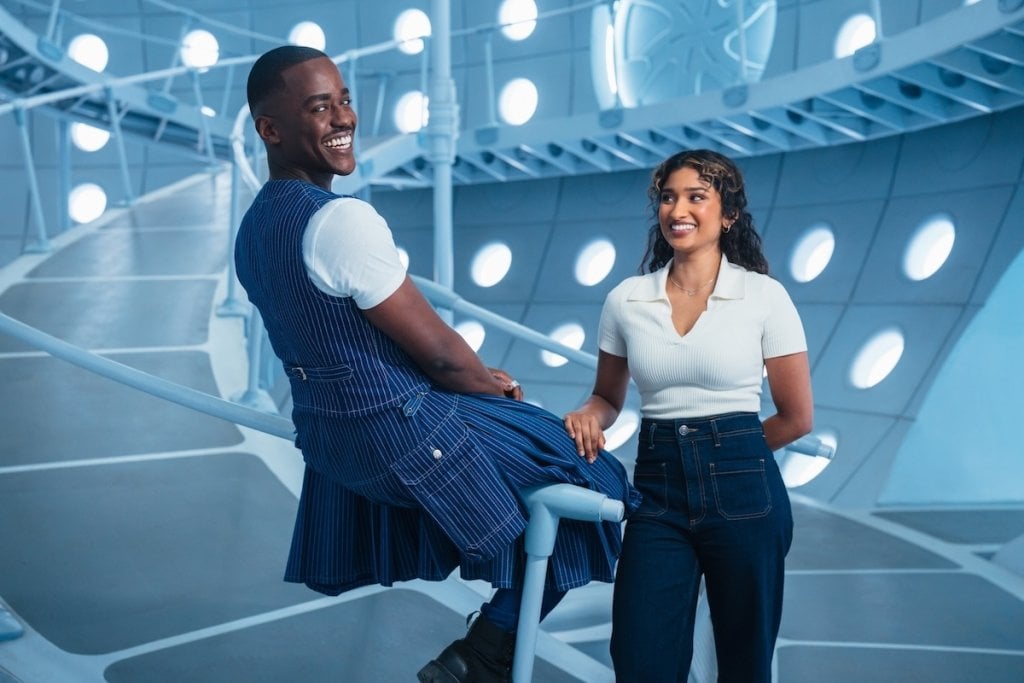
The world is full of darkness. So much is going wrong. Experts agree that America has succumbed to right-wing authoritarianism; call it fascism or something else, these are extraordinarily difficult times.
This post is a break from all of that. At least kind of.
In this piece, I will try and convince you that Doctor Who is the best TV show ever made, explain to you why it matters, and why it’s particularly important in our current context. In a time when cruelty and fear dominate headlines, it’s worth celebrating a show that insists on the power of kindness, intellect, and hope.
Bear with me. Let’s go.
First, a primer: what is Doctor Who?
You’ve probably heard of Doctor Who, but you might not have watched much or any of it. That’s okay.
The core of every story is this: there is a problem, somewhere in time and space. There might be vampires in Venice in 1580; a plot afoot to steal the Mona Lisa in modern-day Paris in order to fund time travel experiments; a society of pacifists on a far-away planet locked in a generations-long war with warlike, genocidal racists. The Doctor, a strange traveler who carries no weapons, helps solve the problem using intelligence and empathy. They bring along friends who are our “in” to the story, but who also remind the Doctor what it means to be human.
There’s a lot of backstory, but unlike other science fiction shows, it doesn’t matter all that much. There’s canon and history, but it’s constantly evolving. And because it’s squarely aimed at a whole-family audience, and is almost but not quite an anthology show, it’s accessible, fun, and very diverse in its approach. One story might be incredibly silly; the next might be a tense thriller. If you don’t like the tone of the one you’re watching, the next one might be a better fit.
There are a few more constants, but not many: The Doctor’s time and space machine, the TARDIS (Time And Relative Dimension In Space), is stuck as a 1963-era British police box on the outside, and is radically bigger on the inside; every time they die they are “regenerated” in a new body; they stole the TARDIS and fled their people.
Oh, and it’s been running since November 23, 1963: 62 years and counting. It’s the longest-running science fiction show in the world — which makes its accessibility and freshness all the more remarkable. In its original run, it launched the career of authors like Douglas Adams. And in its most recent incarnation, it’s been an early career-launcher for actors like Andrew Garfield, Daniel Kaluuya, Carey Mulligan, Felicity Jones, and Karen Gillan.
Okay, fine. So that’s what the show is. Why does it matter?
Subversive from day one
In 1963, the world was only eighteen years out from the end of World War II. The end of the Holocaust and the closing of the camps was as close as the release of Spider-Man 3 is to us now. Enoch Powell, who would later give the notoriously noxious “rivers of blood” anti-immigrant speech, was the Minister for Health. Homosexuality was illegal.
Waris Hussein, a gay, immigrant director, helmed An Unearthly Child, a story about a teenage girl who obviously didn’t fit in and the teachers who were worried about her. (If the subtext to this story isn’t intentional in the writing, it certainly emerges in the direction.) In the end, her grandfather turned out to be a time traveler who lived in a police box that was more than meets the eye, and the rest is history.
The very next story was about a society of pacifists, the Thals, who were locked in a struggle with a race of genocidal maniacs, the Daleks. It’s a more complicated story than you might expect: in the end, the Doctor and companions help the Thals win by teaching them that sometimes you need to use violence to defeat fascism. The morality of it isn’t straightforward, but it’s an approach that was deeply rooted in recent memories of defeating the Nazis, and that had a lot to say about a Britain that was already seeing the resurgence of nationalism. In a show for the whole family!
When the main actor, William Hartnell, fell into ill health, the show could have come to an end. Instead, the writers built in a contrivance, regeneration, that allowed the Doctor to change actors when one left. In turn, the show itself was allowed to evolve. It was created by necessity rather than as some grand plan, but in retrospect laid the groundwork for Doctor Who to remain relevant for generations.
By the 1980s, the show was still going strong — and still slyly subversive. In The Happiness Patrol, the Doctor faces off against a villainous regime obsessed with mandatory cheerfulness, clearly modeled on Margaret Thatcher’s Britain. The episode includes thinly veiled references to the miners’ strike and the inequality many Britons faced under her leadership.
It also didn’t shy away from queerness. One male character leaves the main antagonist for another man, and at one point, the TARDIS is painted pink.
Eventually, it was canceled, in part because the BBC controller at the time, Conservative-leaning Michael Grade, hated it. (The Thatcher thing, and that Colin Baker, one of the last actors to play the Doctor in the classic run, was in a romantic relationship with Grade’s ex-wife, probably didn’t help.)
When it came off the air in 1989, scriptwriters and fans alike began to write novels under a Virgin Books New Adventures banner that took the subtext of the show and made it text. They told complex stories that could never have been televised — they weren’t as family-friendly, and didn’t fit within a 1980s BBC budget. But they collectively expanded the lore and the breadth of the show. (snip-MORE, and it’s good and not too long to read. Author definitely deserves the clicks!)
https://werd.io/2025/doctor-who-is-the-best-show-ever-made-heres-why

 Scottie's Playtime