Winning Elections Against Autocrats

Opinion M. Gessen

This Is the Formula That Defeated Orban. It Would Defeat Trump, Too.

By M. Gessen

Visuals by Máté Bartha

M. Gessen, an Opinion columnist, and Mr. Bartha reported from Budapest.

  • May 29, 2026

Leer en español

Starting early in the morning on the second Saturday of May, first hundreds and then thousands of people gathered in the square in front of Hungary’s majestic Parliament building to celebrate the start of a new political era. This was the square where tens of thousands gathered in 1956 and 1989 to demand an end to the Soviet occupation and in 2006 to protest a discredited government. It was the square on which Prime Minister Viktor Orban’s regime imposed a major redesign more than a decade ago — with traffic rerouted away, a large reflecting pool and raised beds installed, narrow pathways laid down — apparently to ensure that no such mass gathering could take place again. Today it was the square where Peter Magyar, a former Orban loyalist, would be sworn in, promising a rebirth of democracy and liberty after 16 years of autocratic control.

Squeezing into the available spaces and gradually filling up nearby cafes and streets, the crowd absorbed people of all ages: young people who didn’t remember a time before Orban and who had voted in unprecedented numbers; aging intellectuals who didn’t think they’d ever celebrate their country again; multigenerational families who had arrived by bus after seeing Magyar in their hometowns and villages. During his campaign, Magyar had traveled to an estimated 700 locations, turning many of them into “Tisza islands” — outposts of support for his party. By the end, Magyar was holding five or more rallies a day.

It had looked like an impossible quest. Orban and his cronies dominated the media, persecuted and smeared opposition politicians and changed election laws to benefit his party, Fidesz. Orban had seemed to achieve what the Hungarian sociologist and political theorist Balint Magyar (no relation) calls “autocratic breakthrough” — the point after which it’s impossible to unseat an autocrat using elections. Illiberal politicians from other countries made pilgrimages to Hungary to learn from Orban; CPAC, the gathering for American national conservatives, started staging an annual convention there; and Vice President JD Vance visited Budapest in advance of the election, in a show of support for Orban. And yet Hungarians handed Tisza not just a victory but a constitutional majority, enough power to reverse Orban’s changes to Hungarian laws and institutions. The triumph was stunning — unique in our era of democratic backsliding — and it holds clear lessons for the United States.

One obvious lesson of Peter Magyar’s success lies in the scale, reach and relentlessness of his organizing network. “They had 2,000 Tisza islands with between 30,000 and 50,000 volunteers,” Balint Magyar told me, in evident awe. “Just in their call centers, they had 3,000 to 4,000 people in the last week of the campaign.” We talked two days before the swearing-in ceremony, at his office in the spectacular but largely empty building of Central European University. In 2018, Orban’s government forced most of the university’s operations into exile amid an antisemitic scare campaign focused on the Hungarian American philanthropist George Soros, the C.E.U.’s founder and principal funder. Some of Orban’s many other scare campaigns targeted migrants, “the Brussels elites” and L.G.B.T.Q. people. During the latest election campaign, billboards and A.I.-generated social media posts warned Hungarians they were in danger of being overtaken by Ukraine and only Orban could protect them. It should have seemed absurd — it was absurd — but outlandish xenophobic and antisemitic propaganda had served Orban well for years. It didn’t work against Peter Magyar — probably because so many Hungarians got to see him in person, many of them repeatedly. This is another lesson of his success: Old-fashioned in-person politics can be a powerful antidote to media fearmongering.

In his inaugural speech to Parliament, broadcast on giant screens set up around the square, Peter Magyar said that voters had handed him a mandate “not just to change the government, but to change the system. To start over.”

Magyar enumerated the ways in which Orban had damaged Hungary: a stalled economy in which a third of the population lives in poverty, inadequate health care, low-quality schools, child welfare institutions plagued by abuse, an atmosphere of hatred and fear. Orban’s regime had “stolen from the common good of the Hungarian nation — from the pockets of the Hungarian people, and from the tables of Hungarian children and the elderly,” Magyar said, “an estimated 20 trillion Hungarian forints,” or some $65 billion, over the last decade and a half.

Previous opposition politicians had described Orban’s regime as “corrupt,” a relatively mild term suggesting some aberration from the government’s intended function. Peter Magyar made no such accommodation. Borrowing a term coined by Balint Magyar, he has called it a mafia state — a fundamentally criminal enterprise. Third lesson: Don’t mince words.

Instead of shrinking away from direct confrontation, he fortified himself against it. By getting elected to the European Parliament, in 2024, he secured immunity from prosecution in Hungary. When rumors circulated of an intimate video that would be used to blackmail him, he went on the offensive, accusing Orban of using “Russian-style kompromat” (no video was released). Knowing that he would probably be blocked from registering a new political party, he took over one that had become dormant. Even more important, instead of trying to build coalitions among other parties, he focused on conscripting as many actual people as possible, from across the political spectrum, ultimately building a giant organization capable of taking down Orban’s political monopoly.

One could say — and some have — that Magyar won at least in part because he was a former insider of Orban’s Fidesz party. But my interlocutors in Hungary emphasized that Magyar’s credibility lay in the fact that he was not a member of the old opposition, whose policies had led to the discontent that made Orban’s rise possible and whose timidity had helped perpetuate Orban’s power. That’s a lesson, too: The person best positioned to break the power of Donald Trump would not be an anti-Trump Republican but an outsider to the Democratic establishment, someone who can credibly claim that Trump didn’t happen on his watch — a Graham Platner rather than a Thomas Massie.

For all his tireless work over the last two years, Magyar did not create his political machine from scratch. Like Zohran Mamdani, Magyar excelled at converting potential supporters into campaign volunteers. An existing news distribution service provided an initial skeleton of the organizing network. A panoply of grass-roots protest movements joined, too. On the day of Magyar’s inauguration, a parallel, smaller commemoration organized by the city of Budapest celebrated those organizations. One by one, people took the microphone to give a short speech about their cause and their part in the electoral victory: teachers who had organized against a unified state-dictated curriculum; a young man who spoke up against abuses in the child care system; a high school student persecuted for reciting an anti-Orban poem; organizers of Budapest’s L.G.B.T.Q. Pride celebration. The speakers stayed onstage, gradually forming a crowd of the kind — the many kinds — of ordinary Hungarians who had ended the Orban era.

That’s a fifth lesson: Grass-roots organizations that have little or no connection to electoral politics — in the United States, that might be the networks formed by the No Kings rallies, ICE-resistance groups and so on — can matter as much as or more than those already focused on winning votes.

Another lesson lies in the issues that motivated Magyar’s voters. Hungary’s economy is a mess, but post-election polling by Median, an organization that had predicted election results with uncanny accuracy, shows that voters saw corruption as the most important issue by far. Asked why they thought Orban had lost, 49 percent cited corruption, and only 18 percent thought it was the “worsening economic situation, rising cost of living.” The next three reasons cited were “lies” (15 percent); “fearmongering, war rhetoric” (11 percent); and “people got fed up” (10 percent). In other words, Hungarians seemed to see the damage that Orbanism had done to the nation as more important than any harm they felt they had suffered as individuals. They were united by a sense of moral outrage — “value choices,” as one person close to the incoming government described it to me.

Polls have consistently shown that even Fidesz voters generally want Hungary to stay in the European Union. Some surely just want the ease of travel and residency, but others probably have in mind the loftier ideals of the E.U., such as the rule of law, human rights and the essential purpose of the E.U., which is peace.

Hungary is one of the poorer countries in the union, and in the early years of his regime, Orban was able to use E.U. membership to secure funding, and thereby power, even as he railed against the Brussels bureaucracy. But in 2022, the European Union started withholding funding, citing corruption. And in 2024, after Hungary ignored a European Court of Justice ruling that compelled it to process asylum applications, the court ordered Hungary to pay 200 million euros and imposed a daily fine of 1 million euros. (When Orban refused to pay, Brussels deducted the money from E.U. funds earmarked for Hungary.) These actions didn’t just hurt the Hungarian economy — they also allowed Magyar to draw a causal connection between Orban’s policies and the well-being of ordinary voters. One of his major campaign promises was to unlock E.U. funding.

Hungary joined the European Union in 2004. The E.U. flag — 12 gold stars on a blue background — adorned the facade of the Hungarian Parliament building alongside the nation’s red, white and green standard. But Orban’s politics, like the politics of most autocrats, was the politics of grievance. Under his regime, the E.U. flag was removed and replaced with the flag of the Szekelys, a Hungarian minority that found itself living in Romania when World War I’s victors redrew the region’s borders. Orban’s symbolic gesture helped fan resentment against the E.U. and what he claimed were a new generation of attacks on Hungarian sovereignty.

Peter Magyar scheduled his inauguration for Europe Day — the 76th anniversary of the declaration that created the road map for a united continent. Before he was sworn in, the European flag was raised again. But the Szekely flag remained, signaling that Magyar seeks to represent all Hungarian citizens, including those who supported Orban. In some U.S. coverage, Magyar has been labeled centrist or right-of-center. What his politics actually are — and this is another lesson of his victory — is pluralist. (snip-MORE)
A Bit Of An Antidote To Daily News:

Tennessee Officials Find Out About First Amendment The Hard Way

They have to pay retired cop Larry Bushart $835,000 for sharing a post disparaging Donald Trump after Charlie Kirk’s assassination, which it turns out is not illegal.

Robyn Pennacchia

We’re hearing a lot this week about how the DOJ is going to take over a billion dollars of our tax money and give it to those whose feelings were, like, really hurt when they got in trouble just for doing a little insurrection and maybe pooping on Nancy Pelosi’s desk. So you know what we need? We need a palate cleanser. And, thankfully, the state of Tennessee has deigned to provide us with one. Rejoice!

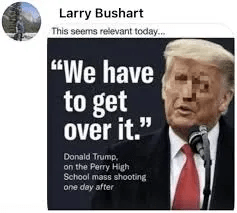
Officials in the state will have to pay 61-year-old retired police officer Larry Bushart $835,000 in restitution after having imprisoned him for 37 days over a meme he shared to Facebook following the death of Charlie Kirk — which caused him to lose his job and miss both his wedding anniversary and the birth of his granddaughter.

Bushart was arrested back in September after he refused to take down a bunch of posts disparaging Kirk after his assassination, specifically over one that actually just criticized Donald Trump. Because, reportedly, people in his community thought it meant he was threatening to shoot up a school, as I guess they are not very good at reading comprehension.

The post he shared in the Perry County, Tennessee, community Facebook page was a meme that existed long before Kirk was assassinated and featured a picture of Donald Trump along the famous words of comfort he shared after the 2024 school shooting in Perry, Iowa: “We have to get over it.”

Yes, just one day after 17-year-old Dylan Butler shot eight people, injuring six and ultimately killing two (a sixth-grader died the day of, the school principal died 10 days later from his injuries), Donald Trump said to Iowans at a campaign event in Sioux Center, “It’s just horrible — so surprising to see it here. But we have to get over it. We have to move forward.”

You know, because godforbid we start thinking that gun control might be a good idea.

Anyway, the aforementioned not-very-good-at-reading-comprehension people saw the meme and thought that this was Larry Bushart threatening a mass shooting at Perry High School in Tennessee. Or at least claimed that they did.

Via The Tennessean:

Perry County Sheriff Nick Weems told The Tennessean in September that participants on the page were planning to host a Charlie Kirk vigil in Linden, Tennessee on Sept. 23.

Bushart posted multiple photos in the comments referencing Charlie Kirk’s death, which Weems called “hate memes,” but stated were “not against the law and would be recognized as free speech.” […]

Weems said Bushart posted the picture “to indicate or make the audience think it was referencing our Perry High School.”

“This led teachers, parents and students to conclude he was talking about a hypothetical shooting at our school,” he said. “Numerous reached out in concern.”

According to the statement, “investigators believe Bushart was fully aware of the fear his post would cause and intentionally sought to create hysteria within the community.”

Yeah, I’m pretty certain that was not at all the point of posting that meme. It seems fairly clear that Bushart had the same reason for sharing it as the millions of other people who shared it that week had — to point out how very callous Trump has been when people who are not his rabid supporters are killed. Nevertheless, Bushart was arrested, held on $2 million bail and imprisoned for over a month.

Weirdly enough, however, the Constitution does not actually have any kind of clauses specifying that the First Amendment can be thrown out the window in cases involving the hurting of Republican feelings, so now the officials involved with his arrest have to pay.

“It’s in times of turmoil and heightened tensions that our national commitment to free speech is tested the most,” said Bushart’s attorney, Cary Davis of the Foundation for Individual Rights and Expression. “When government officials fail that test, the Constitution exists to hold them accountable. Our hope is that Larry’s settlement sends a message to law enforcement across the country: Respect the First Amendment today, or be prepared to pay the price tomorrow.”

Yes, and while many conservatives believe that the First Amendment only exists to keep other people from calling them assholes on social media or kicking them off social media sites for being assholes, it’s actually meant to keep the government from punishing people for speech — which is why these government officials now owe Larry Bushart almost one million dollars. Whoops!

And About “Political” Violence-

A state lawmaker was assassinated last year. Who is keeping others safe?

Grace Panetta

This story was originally reported by Grace Panetta of The 19th. Meet Grace and read more of their reporting on gender, politics and policy.

Political violence is on the rise — making the job more dangerous for state lawmakers and posing new challenges for state law enforcement officials. 

Every high-profile act of violence sets off new waves of threats and fears of more — the assassination of conservative activist Charlie Kirk in September sent chills down the spines of elected officials throughout the country. But Utah, where he was killed, was already ahead of the curve on addressing threats to lawmakers and high-profile public officials.

Nine years earlier, it had set up a new unit to track and prevent violence against public officials.

The unit follows a four-step process, said Taylor Keys, a spokesperson for the state Department of Public Safety: It receives and identifies reports of threats and concerning behaviors, gathers the facts, assesses the individual’s risk of posing a real physical threat, and then manages the risk with intervention and case management. 

In the days after Kirk’s assassination at Utah Valley University, Utah lawmakers reported receiving an uptick in threats. Keys said the agency “regularly reviews” security measures and safety plans for lawmakers and “will continue to leverage new technologies, training, and security features in the coming years to safeguard lawmakers.”

But many states aren’t as proactive and prepared as Utah. Most state legislatures are in session only part-time, and many of the state enforcement agencies charged with protecting them are stretched thin and lack standardized procedures for reporting threats, collecting data and conducting regular training. 

A spate of high-profile violent attacks over the past year threw this reality into stark relief. 

Last April, an arsonist attempted to burn down the Pennsylvania governor’s mansion in an attack targeting Democratic Gov. Josh Shapiro. In June, a gunman assassinated former Minnesota House Speaker Melissa Hortman and her husband, Mark, before wounding state Sen. John Hoffman and his wife, Yvette. Republican Indiana state lawmakers who resisted a White House-led push to redraw congressional lines in the state reported receiving threats. And Kirk’s killing rankled lawmakers on both sides of the aisle.

And for some lawmakers, the environment is becoming untenable: Two recent reports show that harassment, abuse and violence are leading factors driving women and younger legislators, especially, to exit office. 

State legislatures shape consequential policy and serve as a critical pipeline for higher office. But serving in office and entering the pipeline to power poses increasingly high risks to personal safety, especially for groups already underrepresented in the halls of power. While being a state lawmaker is a part-time job with a part-time salary in most states, lawmakers can’t opt out of being a full-time public figure.

“Elected and appointed officials live in a risk environment by nature of their job and their outward, public-facing positions,” said former Lt. Col. Tim Cameron of the Wyoming Highway Patrol, who spoke to The 19th in 2025 before he retired from the agency after more than 46 years in law enforcement. “Within the last year and a half to two years, that’s moved into a threat environment.”  

The 19th spoke with experts and reached out to state-level law enforcement agencies in all 50 states to capture a comprehensive picture of the scope of political violence against state lawmakers and how law enforcement is responding. Officials in a dozen states told The 19th how they identify and respond to threats, what data they collect, and how they’re adapting their responses and procedures to an ever-evolving landscape.

How did states respond? Jump to their answers here.


As political violence is on the rise, many states are scrambling to keep pace. Political violence, Cameron said, was a major topic of discussion at the International Association of Chiefs of Police conference he attended in 2025.

“Anyone charged with executive protection is really looking closely at what they’re doing, how they’re doing it, and looking to utilize technology to leverage that in every way they can,” he said. “So it is going to be a challenge moving forward. And nobody has enough people.”  

A February report from the nonprofit organization Future Caucus, based on interviews and surveys with 89 young lawmakers in 31 states, found that threats of violence “have become a serious deterrent to both candidate recruitment and retention,” especially for women, lawmakers of color and LGBTQ+ lawmakers. 

“This is a four-alarm fire,” said Layla Zaidane, the president and CEO of Future Caucus, which supports young state lawmakers in bridging divides and working on policy across the political aisle. 

“They can stomach the low pay. They can stomach no staff. They can handle even trying to figure out the toxic polarization and transcending that,” Zaidane said of young lawmakers. “But political violence was the thing that, when you add it all together, was the decider of: ‘I don’t know if I’m going to run again, I don’t know if this is worth it.’”


The rise in violent incidents is having an outsized impact on women, who make up half of the United States population but account for only a third of state lawmakers; even fewer women of color are represented in the political arena. 

And when it comes to hyperpolarization and the increasingly toxic and hostile climate in state capitols, “women bear the brunt of this, multi-fold, compared to their male peers,” said Aparna Ghosh, the founder and executive director of the Ghosh Innovation Lab, a nonpartisan organization that conducts research and builds tools to support diverse and representative state legislatures.

A report the Ghosh Innovation Lab published last summer, based on 60 interviews and a nationally representative survey of over 300 women legislators, concluded that the assassination of Hortman “exposed a crisis that has been building for years.” Women lawmakers, the report found, “face systematic harassment, threats, and violence that compromise their safety, well-being, and democratic participation.” 

The report found that 93 percent of women lawmakers said they experienced some form of harm or abuse in office, 59 percent said it disrupted their legislative duties and 32 percent said it impacted their desire to stay in office.   

“It’s not just about an incident, but it’s about the everyday things that add up that push them out of office,” Ghosh said. “This is a huge problem for democracy, because this constant harm that women are facing is eroding the intent to run for office, so it’s eroding democracy in some way.”

Black and white photo of an empty legislative chamber with rows of wooden desks and chairs. A bright red, spray-painted target symbol is scrawled across one desk in the foreground.
(Emily Scherer for The 19th)

In the wake of Hortman’s assassination, several states have weighed legislation that would allow lawmakers to have their home addresses and other identifying information removed from public records. And as federal campaign spending on security expenses has continued to climb into the millions, 25 states now officially or informally authorize state candidates to use campaign funds for personal security, according to an analysis from the nonpartisan Vote Mama Foundation.

The role of law enforcement has also come under scrutiny, with the Ghosh Innovation Lab report concluding that state capitols and law enforcement “systematically fail to protect women legislators.”

The top safety shortcomings identified by women legislators surveyed for the report were a lack of training in handling threats (53 percent), the absence of a panic button for reporting incidents (46 percent) and unclear reporting procedures (42 percent). They also cited inadequate technological solutions, insufficient legal support, buildings feeling overly exposed, too few security officers and poor coordination with law enforcement.  

“Whatever training they’re getting is their own responsibility, and that’s part of where the system breaks down,” said Ghosh. “It’s two things: One is that we’re not a proactive system, we react to incidents, that is one huge thing. And the second is it feels like safety and security is a legislator problem, not an institutional problem.”

At the federal level, the U.S. Capitol Police (USCP) protects members of Congress, often in coordination with local law enforcement, and issues regular public assessments indicating that threats against federal lawmakers are on the rise. 

But far less is known about the risk environment and security landscape for state lawmakers.

States have widely varying levels of security for their state capitol complexes and different open carry rules. A 2024 review from the Wisconsin Legislative Audit Bureau found that 39 states use metal detectors in their capitol buildings, 31 use X-ray machines to scan packages and belongings and 10 require visitors to have photo identification.  

Many states have dedicated capitol police forces, specialized units within state police or highway patrols responsible for protecting lawmakers and executive officials, or both. Local sheriff’s offices and police departments also respond to reports of threats from state lawmakers.

“The big problem is that there’s no standardization in the protocols and processes, and this is the gray zone where the system breaks down,” Ghosh said.   


To get a clearer picture of the protection landscape, The 19th asked these questions to state agencies responsible for protecting state lawmakers in all 50 states: 

  1. What steps should a lawmaker take if they receive a threat?
  2. What are the agency’s processes for identifying and responding to threats?
  3. Does the agency collect data or produce threat assessments on threats to public officials, including state lawmakers? If not, are there plans to start collecting that data and/or to make it public, as the U.S. Capitol Police does?
  4. Has the agency implemented or plans to implement any additional security measures, safety plans or training for state lawmakers/capitol protectees in the wake of the Hortman and Kirk shootings? 

Representatives of law enforcement agencies in 27 states responded to The 19th’s inquiries. Representatives of agencies in four states declined to comment, and 19 did not respond to requests for comment. Of the agencies that responded, many declined to share specific security plans or details but said they were committed to ensuring the security of state elected officials and those working at and visiting state capitol complexes.  

The basics are the same: All agencies said lawmakers should immediately report a threat to a state, capitol or local law enforcement agency. But where lawmakers report threats can vary depending on whether the legislature is in session and the nature of the threat: a lawmaker might report a threat to the state capitol police or the highway patrol if the legislature is in session, or to their local police or sheriff’s department if they’re in their home county. 

All the law enforcement officials emphasized that keeping evidence of threats is important. 

Chris Loftis, a spokesperson for the Washington State Patrol, also said lawmakers should preserve “all evidence, including emails, voicemails, and social media posts” and are “advised not to engage directly with the individual making the threat.”

States use different methods to identify and trace threats. Many said they work with other agencies to monitor, identify and respond to threats. New York State Police spokesman Beau Duffy said the agency has a team of social media analysts who identify threats. Sgt. Ricardo Breceda of the New Mexico State Police said they use a variety of sources, including law enforcement databases. 

“Our response depends on the nature and severity of the threat and can range from routine follow-up investigations to the activation of specialized tactical teams if necessary,” Breceda said. 

Some officials and courts have found that some harassing and abrasive rhetoric directed at public officials falls under the First Amendment’s free speech protections, a finding that has at times frustrated lawmakers. Zaidane pointed to a 2021 case in which a man charged with making a threat to a Michigan state legislator’s office was acquitted after his lawyer said he was “just blowing off steam.” 

“I think, at a minimum, better enforcement of laws and coordination with law enforcement would make lawmakers feel like the system has their back,” Zaidane said. “Like there are still bright lines that we should not cross in America and that we are committed to upholding those.”

Another thing lawmakers want more of, Ghosh said, is data.

For over 20 years, the U.S. Capitol Police has published annual public threat assessments detailing the number of threats they investigate. In new data released in January, the USCP’s Threat Assessment Section reported investigating nearly 15,000 “concerning statements, behaviors, and communications” against lawmakers, their families, staff and the U.S. Capitol complex in 2025, marking the third consecutive year the USCP has investigated more threats. 

But most state law enforcement and state capitol security agencies either don’t collect or don’t publish such statistics. Utah is one of just a few states in the country that collects statewide data on threats to state lawmakers and produces assessments. The lack of comprehensive data from official sources makes it difficult to know the scope and scale of political violence against state lawmakers. 

“They want that kind of tracking and monitoring system,” Ghosh said of women lawmakers. “They want security briefings annually.”

Some state agencies told The 19th they don’t have a full picture of how threats are reported and investigated across their states because jurisdictions respond differently to threat reports. Several others said they do centrally collect that data but don’t release it for security reasons. 

“We collect data, but sometimes we’re not aware of the other complaints that potentially could be made to the sheriff of whatever respective county,” said Cameron of the Wyoming Highway Patrol. 

Some state agencies share data with other law enforcement authorities, including through fusion centers. 

Ghosh said women lawmakers also want more official safety training from law enforcement — many told her that they spend thousands of dollars out of pocket for self-defense and security training. 

“They want systems to back them up and say, ‘We’re going to prepare you for what’s coming,’ even if it doesn’t happen,” Ghosh said. 

Many states are working to expand security as well as training for lawmakers in the wake of the Minnesota shooting, though most declined to share specifics. 

Cameron said that in Wyoming, the conversation about improving protective operations “never stops.” The state Highway Patrol has a trooper focused on protective intelligence who attended a threat intelligence course at the U.S. Marshals Service headquarters in Crystal City, Virginia, and investigates threats against lawmakers, he said. 

“We’re constantly training our people. We recently instituted a special response team, more or less a SWAT unit, but they’re cross-trained to do executive protection,” he added. “Sometimes we’ll activate some of those members, so our [executive protection division] has additional personnel, either for advanced work or on site work or escort work.”

He said he’d like to see more adoption of drones and drone technology, an area where law enforcement in the United States is “behind,” to protect the state capitol and lawmakers. 

Ghosh said the women lawmakers she’s spoken to need three things to carry out their work: to feel prepared, protected and nurtured.  

“It’s simple things, right?” she said. “Their safety needs to feel well supported and ready to do the work that they’re meant to do. They want these three things, and when it breaks down is when they’re unable to do this work.”

Well, This Has Happened

Person in custody after Trump evacuated in shooting incident at White House correspondents’ dinner

Event ended suddenly with loud gunshots and immediate commotion, and will be rescheduled

Donald and Melania Trump were evacuated from the White House correspondents’ dinner on Saturday evening after the event was interrupted by loud gunshots.

A suspect was in custody, the FBI said, after the annual black tie dinner honoring the White House press corps was suddenly interrupted by confusion and chaos. Journalists ducked under tables as authorities rushed the president and members of his cabinet out of the room.

There were reports that the US Secret Service had guns drawn as White House pool reporters were rushed out of the room and Secret Service agents yelled “shots fired”.

In a post on Truth Social, Trump praised the Secret Service and law enforcement and said the shooter had been apprehended.

The FBI confirmed later on Saturday that a suspect was apprehended.

The Secret Service said in a statement that the shooting incident occurred near the main magnetometer screening area at the hotel.

Weijia Jang, president of the White House correspondents’ dinner, told the room that the president is planning a press conference from the White House later Saturday and that he wants to reschedule the dinner in the next 30 days.

“Thank God everyone is safe, and thank you for coming together tonight,” she said. “We will do this again.”

Guardian reporters in the room said there were initially mixed messages about whether press and guests should stay in the room. Many people who stayed in the ballroom said the program was scheduled to resume, although the presidential seal was removed from the podium.

CNN’s Wolf Blitzer reported that he saw someone with a gun at the event.

“I did see the gunman on the ground after he started shooting,” he said. “Police officers threw him to the ground.”

Guests had just started eating dinner when the commotion began. The atmosphere in the room was tense as journalists waited to hear what happened and what to do next.

Jamie Raskin, a Democratic congressman from Maryland, who was attending the dinner said he never saw a shooter, but “I think a Secret Service agent threw me to the ground and on top of some other people and people were screaming and yelling”.

“I heard some loud noises but I don’t know if that was people reacting or if that was something outside, it was hard to know, but people very quickly were saying that was a shot, that was the gunshot,” he added. “People were terrified; people seem to be relieved now.”

Outside the hotel, helicopters circled overhead.

This year’s dinner was already tense given the presence of Trump and top members of his cabinet, including Pete Hegseth, the secretary of defense, and Marco Rubio, the secretary of state. Trump agreed to attend this year’s dinner after refusing to attend last year and during his first term. The correspondents’ dinner tradition began in 1921, though the tradition of a presidential guest started in 1924, when Calvin Coolidge attended.

Every State Has One Of These Candidates Running For Something

Find them, and help them. Then remember to stay on their rear once they’re in office.

Right-wing media hacks use two recent shootings to label trans people as mass shooters.

It is a fact that most mass shooters are males, mostly white males.   But right wing media are so desperate to slander and smear trans people the same way it was tried to before the internet with other media against gay people.  The know what they are creating is false but they don’t care because they know that others will believe it and repeat it everywhere.   It is a sickness and curse to want to create that much hate and chaos against the most vulnerable communities in society.  Hugs

Noem’s disastrous week capped with humiliating new report

The things Noem and Lewandowski do in this report are insane.  And our tax dollars are paying for it.  While the public lost assistance for healthcare and food and had other safety net assistance slashed, she is getting a third 70 million dollar luxury plane.  Lewandowski demanded a badge and a gun along with police authority even though he has no training at all.  They are spoiled children playing with our credit cards.  Hugs

Jen Psaki rounds up a remarkable list of failures and bad news suffered by Donald Trump’s secretary of Homeland Security, Kristi Noem, and shares highlights of eye-popping new reporting from the Wall Street Journal about how Noem has led her department into chaos with tyrannical behavior, wasted money, rumors of infidelity, and bizarre drama over a lost blanket that resulted in the firing and re-hiring of a Coast Guard pilot.

Another Ethical Candidate

from Florida, too! I’m not sure how liberal he’ll be, but there’s a lot of work to get done before worrying about that, and we know this guy can do the work.

Whistleblower Alexander Vindman to seek Florida Democratic nomination for Senate

He is the third major Democrat to enter the contest to challenge GOP incumbent Ashley Moody in November.

By:Mitch Perry-January 27, 20266:00 am

==========================

Yesterdays news I want to share today or …

tRump’s illegal military war crime actions / tRump’s gift to the oil companies that paid him prior / This is a war crime and illegal / tRump trying to get other countries resources for his own profits / tRump grifts and seeking bribes 

Trump: We’re Keeping The Seized Oil And Ships

Trump: We Need Greenland For National Protection, I’m Sure We Were There With Boats 300 Years Ago [VIDEO]

It has nothing to do with US national security and all the minerals / traffic rights to make ships pay / and the “rare earth” metals that tRump wants a piece of.  It is about profit.   Hugs


Fox Host: The Vikings Are Gone, Let’s Seize Greenland


More Donors To President Liberace’s Ballroom Exposed

The paying tribute and bribes to tRump and his slush funds is so anti what the US should and used to stand for.  It is the very thing the founding fathers were most against.  The courts have gutted the holding of tRump to account but the emoluments cause is what this was designed to stop.    Ask yourself if Biden / Obama / Clinton had been so blatant in demanding bribes would you tRump cult supporters be OK with it still?   Hugs


Trump: Watch Kennedy Center Honors And Tell Me If I Should Resign To Be “Full Time Master Of Ceremonies”


$40M Melania Film To Premier At Kennedy Center


More Troops And Special Ops Aircraft Near Venezuela


Latest “Drug Boat” Strike Brings Murder Toll To 105


US Special Forces Expected To Board Oil Tanker


Jeff Landry: We’re Not “Trying To Conquer” Greenland


EU Leader Stands With Greenland Against Trump


FCC Bans Foreign Drones (Junior Sells US Drones)


Pentagon Adds Musk’s Pro-Hitler Grok To “Arsenal”


tRump’s handpicked legal lapdogs /  tRump legal woes / Canon still protecting tRump / ICE

Judge Blocks Jack Smith’s Final Report (For Now)

The appeals court told her to have it completely wrapped up by the first week of January and this is not doing that.  I expect more to happen fast with this.  She ignored the appeals court order to please tRump.


Axed “60 Minutes” Prison Abuse Expose Leaks Online

“There was blood everywhere, screams, people crying, people who couldn’t take it and were urinating and vomiting on themselves,” the college student from Venezuela who sought U.S. asylum, said. “Four guards grabbed me, and they beat me until I bled until the point of agony. They knocked our faces against the wall. That was when they broke one of my teeth.”


Bari Weiss Plans To Overhaul CBS News/60 Minutes

Voldemort: Everybody At “60 Minutes” Should Be Fired


New DHS Clip Turns Santa Claus Into ICE Agent


Voldemort Increasingly Targets Children Of Immigrants

Increasingly, he blames their children as well.

Mr. Miller’s belief that seven decades of immigration has produced millions of people who take more than they give — an assertion that has been refuted by years of economic data — is at the heart of the Trump administration’s campaign to restrict immigration and deport immigrants already in the country.


ICE Plans To Hold Over 80,000 Migrants In Warehouses


DOJ Sues After IL Bans ICE Arrests At Courthouses


Texas Builders Say ICE Has Crippled New Construction


Stupidity beyond belief and why do people believe it / Never challenge the dear leader / Cult of tRump


Trump: I’m Bringing Down Drug Prices By 3000%


Trump Screams That NY Times “Must Be Stopped”


Trump: Stephen Colbert Should Be “Put To Sleep”


Trump Shares Call To Have GOP Georgia Gov Arrested


Trump: Terminate Network Licenses For Criticizing Me


Hate / Bigotry / Racism / White Supremacy / Christian Nationalism / 

Oklahoma Instructor Fired In “The Bible Says So” Idiocy

Fulnecky has been trying to leverage her idiocy into a career as a MAGA influencer.


Erika Kirk Plugs Charlie’s Book In Xmas Message


tRump trying to hold on to power illegally / Jan 6th insurrectionists / trying to change the history everyone seen live / Scamming / Using the US treasury & taxpayer funds to pay off tRump cult members.  

Extremists To March On US Capitol “For Ashli Babbitt”

The U.S. Air Force will provide Jan. 6 rioter Ashli Babbitt with military funeral honors, reversing a Biden-era decision that denied her family’s request, according to a legal group that has represented her family.

 In June 2025, the Pentagon agreed to pay the Babbitt family a $5 million “wrongful death” settlement. Below, see the latest from Proud Boys leader Enrique Tarrio, who is himself reportedly suing the DOJ for $100 million.


19 Blue States Sue HHS Over Trans Youth Healthcare


US health system under tRump / US food safety under tRump / US health systems failing to protect the public under tRump

FDA Issues Yet Another Recall Of Radioactive Shrimp


VA Dept Bans Abortion And Abortion Counseling


Doctors Lament Record Rise In US Tetanus Infections


tRump ruining education / trying to keep students dumb and broke so wealthy have more power

Ed Dept To Garnish Pay Of Student Loan Borrowers


Epstein Files 

DOJ Seeks Holiday Volunteers To Do Epstein Redactions


DOJ: Mentions Of Trump In Epstein Files Are “False”


DOJ: We Just Found Over One Million More Epstein Docs


Some good news / People fighting back / Stopping ICE

Oregon Town Sues To Block Building Of ICE Gulag


Court: Trump Must Restore Disaster Aid For Blue States


DOJ Loses Challenge To New York Driver’s License Law


Some news articles I wanted to get to but did not have time. Now I am caught up to today

So Ron and his sister arrived two days ago.   Lucky for me she is a doer who jumps in to do stuff and doesn’t wait for others to do for her.  She has really helped Ron get a lot of stuff done.  She helps when my back goes out.  She is doing supper right now so I can catch up on the last few days of news.   I really hope she finds a place to her tastes here as she is a good influence for Ron.   Hugs, loves to all, and best wishes to all who wish them.   Scottie

Thanks to Ron’s sister jumping in and doing all the extra stuff I have been trying to do I can rest my back while doing my posting.   I could get used to this.   Hugs


Affordability and costs of things in the US

Scott Bessent Claims Without Evidence That “Rents Are Coming Down Substantially” Due To Mass Deportations


Judge Declines To Halt Liberace’s Ballroom (For Now)


President Liberace Raises Ballroom Cost To $400 Million


tRump’s illegal war for profit to please the corporations he told to give him a billion dollars for his campaign and he would do what ever they asked.  Wow US military young adults sold for tRump’s profit.   Hugs


Trump Announces “Complete Blockade” Of Venezuela


Trump: I’m Getting Our Stolen Oil Back From Venezuela


Trump Asks Big Oil If They Want To Return To Venezuela


WaPo: Voldemort Secretly Behind “Drug Boat” Strikes


Politico: Trump Lied About “Warrior Bonus” For Troops

The $1,776 per person bonuses, unveiled by Trump in his nationwide address Wednesday night, will be covered with funding approved in the Big Beautiful Bill that passed in July, according to the congressional officials and later confirmed by the Pentagon. The payouts — which will cost roughly $2.6 billion — will be a “one-time basic allowance for housing supplement to all eligible service members,” said the official.


Trump Says He Will Not Rule Out War With Venezuela


Two “Drug Boat” Strikes Bring Murder Count To 104


DEI / Hate / Bigotry / Racism / White Supremacy.  

Coast Guard Enacts Downgraded Policy On Swastikas


Christian Nationalist/J6 Flag Posted In Education Dept


DHS Funneled $1 Billion Contract To Trump Donor


ICE Leader Jailed With ICE Detainees After Federal Charge For Strangling Decades-Younger Girlfriend


Trump Judge Threatens Contempt Over ICE Conditions: “Putrid, Cramped, Filthy, Unheated, Lights Blaring 24/7”


Hegseth: “I’m Making Military Chaplains Great Again”


White House To Ramp Up Stripping Of Citizenships


EEOC Solicits Lawsuits For “Anti-White Male” Bias


Trump Endorses Maine Racist Paul LePage For US House


Ryan Walters Melts Down: “The Left-Wing OK Supreme Court Has Attacked Christianity, The Bible, And Trump”


Tennessee High Schools To Get Turning Point Clubs


CBS News To Air Town Halls About God And Feminism


Franklin Graham At Pentagon Xmas Worship Service: “God Hates And God Is Also A God Of War” [VIDEO]


House Passes Bill Criminalizing Trans Youth Healthcare


Mehmet Oz: “The Creation Of A Penis Costs $150,000 Per Child, If You Add Testicles, That’s Extra” [VIDEO]

The Trump administration announced several moves Thursday that will have the effect of essentially banning gender-affirming care for transgender young people, even in states where it is still legal.   

The second would block all Medicaid and Medicare funding for any services at hospitals that provide pediatric gender-affirming care.


Really stupid things say and blame democrats for just because they think it sounds good not realizing how dumb it seems.   


Beetleboob Blames Dems For Colorado Power Outage

Wiles: Trump Lied About Clinton Visiting Epstein’s Island

DAMAGE CONTROL: White House Has Entire Cabinet Post Defenses Of WH Chief Of Staff Susie Wiles On X


Trump Installs WH Plaques Ridiculing Former Presidents


DOJ Launches Crackdown On Left Wing Activism


DOJ Offers States Secret Deal For Role In Elections

As Democracy Docket previously reported, in his previous role as a prosecutor in the Los Angeles district attorney’s office, Neff was put on leave after bringing charges against an election software executive based on information from conspiracy-driven election denier group True the Vote. The saga ultimately cost taxpayers $5 million to settle a lawsuit over the flawed prosecution.

Neff is also affiliated with True The Vote, the far-right QAnon group featured in Dinesh D’Souza’s debunked “2000 Mules” film.


tRump’s many crimes

Jack Smith: I Have Proof Beyond Any Reasonable Doubt Trump Criminally Conspired To Overturn 2020 Election


Boosting the fascist state and the dear leader.


Vance: Those Who Privately Trash Trump Are “Traitors”


Trump Again Dozes Off During White House Meeting

Slumped over in his chair at the Resolute desk, Trump’s face slackened—eyes drooping, the corners of his mouth sagging—as he fought off sleep. The elderly president has now been caught appearing to doze off at four official events in six weeks.


Dem Rep: I Was Muted During Kennedy Renaming Vote


Dear Leader’s Name Added To Kennedy Center Signage


DOJ Is Racing To Redact Thousands Of Epstein Pages


Blanche: DOJ Won’t Release Full Epstein Files Today


Trump Administration Now Targeting Wildlife Refuges


Positive news / Good things / Pro-LGBTQ+ Stuff


Palm Springs Neighbor City Of Palm Desert Rejects Anti-Pride Resolution After Impassioned Speeches By Locals


Study: COVID Vax Lowered Death Risk For All Causes


Australia To Buy Back Guns After Bondi Mass Shooting


Romney Calls For Higher Taxes On Wealthy “Like Me”