
Mourning Dove, Teller of Native American Stories
The gifted storyteller and tribal advocate published one of the first novels written by a Native American woman.
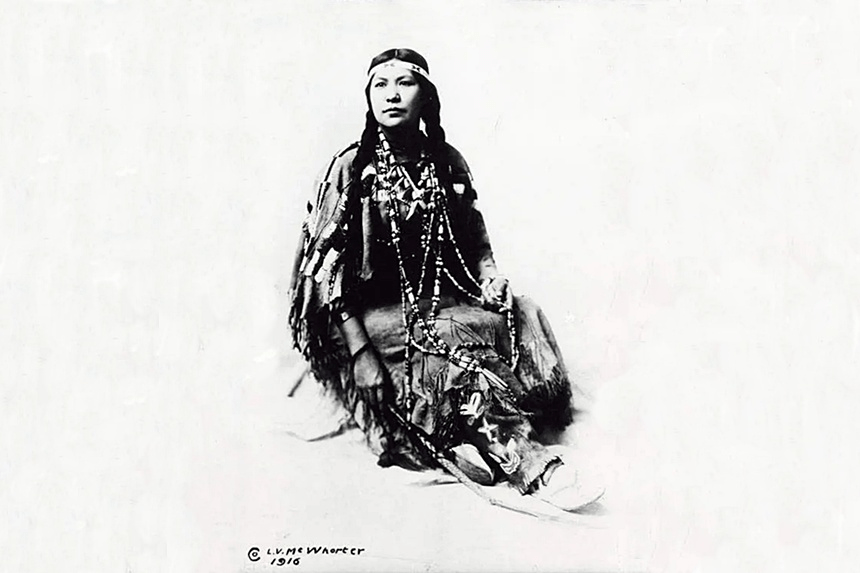
Mourning Dove, 1916 (L.V. McWhorter Collection, Washington State University Libraries Digital Collections)
“I am most grateful that…I was born long enough ago to have known people who lived in the ancient way before everything started to change.”
–Mourning Dove
Maybe it was because she was born in a canoe on Idaho’s Kootenai River. Or because she was multiracial. Or because she went to a convent school to learn English as a ten-year-old. Whatever the reason, Christine Quintasket, whose Salish language name was Hum-ishu-ma (Mourning Dove in English, which she adopted as her literary name as an adult), wrote stories about the hostility white people had toward Native Americans and the confusion they suffered when educated in white schools.
Born around 1884 to Sinixt/Colville Lucy Stukin of the upper Columbia River and Okanagan/Irish Joseph Quintasket of British Columbia, the future writer grew up speaking the Salishan dialect in her mother’s home near Kettle Falls, Washington, according to her autobiography. Mourning Dove’s grandmother taught her the traditional customs of Columbia Plateau natives. Teequalt, an older woman who lived with the family, introduced her to tribal spirituality, and Jimmy Ryan, an adopted white orphan, taught her to read English through dime novels.
As a young girl, Mourning Dove remembered sitting by a campfire and listening to the animated voice of a tribal storyteller imitating an animal. “We thought of this as all fun and play, barely aware that tale-telling and impersonations were part of our primitive education,” she recalled decades later.
Mourning Dove’s indigenous education ended in 1894 when she went to the Sacred Heart School at the Goodwin Catholic Mission near Kettle Falls. When her mother died in 1902, the writer returned home to care for her younger siblings. After her father remarried in 1904, she moved to Great Falls, Montana to attend the Fort Shaw Industrial Indian School. In 1908 Mourning Dove sorrowfully watched the last roundup of America’s wild bison herd as the Old West faded. “One magnificent fellow fought like a lion as they tried to crowd his wonderful shaggy head into a box car,” she told an interviewer. She later incorporated the roundup in her writing. (snip-MORE, not too long to read, and it’s really interesting!)

 Scottie's Playtime