
Tag: US news
Why are ‘fact checks’ vouching for Trump’s lies?
https://www.theframelab.org/why-are-fact-checks-vouching-trumps-lies/
Let’s hope 2024 will be the year that “both sides” fact-checking as a journalistic genre grows up.
The comically bad “fact-checking” that came out of the Democratic National Convention should be a wake-up call for anyone who cares about the truth.
Example: Kamala Harris received a “Mostly False” when she said that, through Project 2025, Donald Trump “plans to create a national anti-abortion coordinator and force states to report on women’s miscarriages and abortions.” Politifact explained that “Project 2025 doesn’t mention a ‘national anti-abortion coordinator.’ The document calls for a ‘pro-life politically appointed Senior Coordinator of the Office of Women, Children, and Families.’”
That’s like saying it’s untrue to suggest a diner serves ketchup when it merely offers catsup.
Trump’s Firehose of Falsehoods
These attempts to parse “tomato” from “tomah-to” might make some sense in a reality that didn’t include Donald Trump, whose complete rejection of the truth thrives when the press falls into the trap of suggesting “both sides” as equally flawed. The perennial GOP nominee lies about everything from hurricane warnings to his historically bad jobs record.
His lies – including his flood of falsehoods about the 2020 election that led to the end of America’s tradition of a peaceful transfer of power – define him.
Even the idea that Trump can be fact-checked helps Trump. It falsely suggests there are times when he might be constrained by the truth when he, like all authoritarians, is “cognitively irresponsible,” says rhetoric scholar Jennifer Mercieca. He uses his words almost solely to reject the idea that he’s accountable to anyone or democracy itself.
The combination of Trump’s firehose of falsehoods and the media’s agenda to appear even-handed has always yielded toxic slop. But “fact checkers’” do accidentally reveal two truths:
- As Dr. George Lakoff has explained for years, accepting someone else’s framing spreads that framing, even if you’re debunking it.
The whole fact-check genre could be called “Don’t Think of this Thing I Think is Wrong.” Whether it’s Richard Nixon saying, “I am not a crook,” or the AP telling us that JD Vance didn’t technically mate with furniture, the idea you’re trying to dispel is spread far more than it can ever be debunked. A fact check tends to be the opposite of a truth sandwich, which Dr. Lakoff proposed to minimize the spread of blatant lies.
- The press still has no idea how to treat Trump, one of the worst liars in American history.
Many of the worst fact checks – like the suggestion Trump doesn’t want to repeal Obamacare – rely on Trump’s constant contradictions of himself, often in the same sentence. This loads in the presumption that Trump uses language the way typical politicians do instead of as a super salesman/demagogue.
Lakoff categorized Trump’s tweets to make it easier to analyze Trump’s linguistic vandalism:
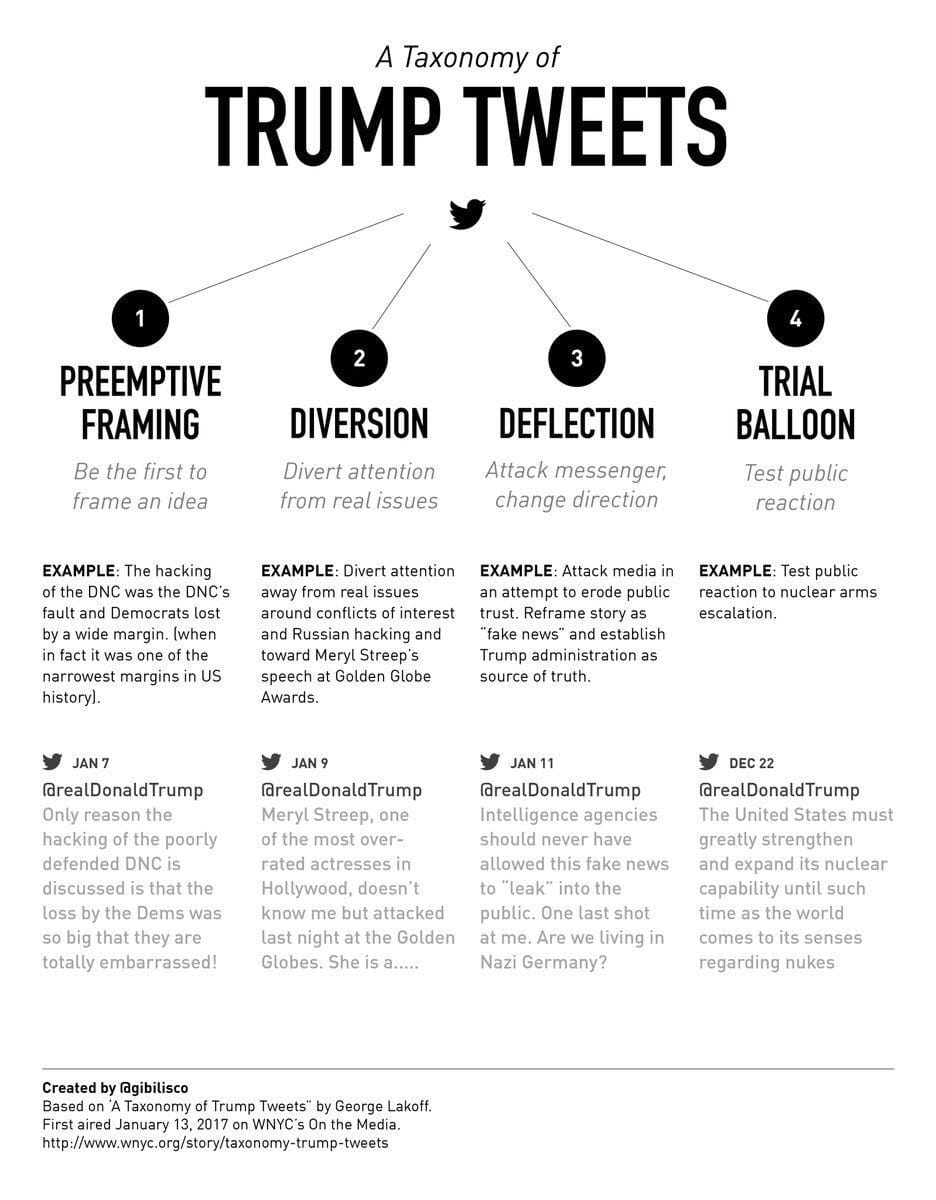
Trump is also an expert in paralipsis, which Mercieca describes as his way of asserting something without taking responsibility for saying it himself. It’s his game of “I’m not saying/I’m just saying.” He does this by retweeting particular noxious notions or images he’s trying to spread or framing his assertions with “many people are saying.” It’s a repulsive hack that renders fact-checks useless.
Fact checks in the Trump era have begun to operate a bit like the “Community Notes” scam on Elon Musk’s version of Twitter. Sure, you occasionally get a gem that exposes an obvious scam – like a faked Trump rally photo or a Republican bragging about an infrastructure program he opposed. But think about where those notes don’t appear. They’re never on Elon’s tweets, which are saturated with right-wing propaganda, AI-generated disinformation, and neo-Nazi conspiracy theorizing. So, in essence, they’re vouching for every lie he spreads.
Can Fact Checks be fixed?
Donald Trump depends on journalism’s failed conventions to continue to normalize his unprecedented attack on American freedoms. That’s why editors must pursue multiple strategies to ensure they don’t mislead anyone into thinking Trump’s dishonesty is comparable to his opponent’s or any relevant American political figure.
We need information to debunk lies, yet there should be a greater sense of responsibility when dealing with blatant untruths. That starts with recognizing that lies change brains, even when debunked. They are like toxic spilloff or nuclear waste that must be tracked, contained and cleaned up as much as possible. The best way to do that is to lead with the truth whenever possible, the exact thing Trump is trying to bury with his lies.
Readers also need a sense of Trump’s lies’ unprecedented scope, recurrence and purpose. One strategy is to annotate a typical rally speech with facts and reality checks. Then, compare it to a typical Harris speech. Another is to track his most-repeated lies. And, as Dr. Lakoff has suggested for decades, journalists should also analyze the rhetoric’s frames to give voters a sense of the information war being waged for their brains.
The problem with all of these strategies is that the press would be required to do something that they seem to do their best to avoid: Call out Trump’s lies directly. The best we can hope for is a “falsely claims” in a headline or two, which is better than nothing.
Fact checkers should stop pretending they are the be-all and end-all of determining a fact’s value. Since their jobs do not seem to depend on their reputations or track records, they should bring in experts whose careers depend on accuracy to take on Trump’s most repeated lies.
Publications that care about the truth need to show they understand the seriousness of this moment. Democracy and journalism face an unprecedented attack from Trump and MAGA that threatens the future of these two pillars of a free society.
Cowering to Trump will, at best, buy you more opportunities to cower to Trump, who will never be satisfied – not until he can imprison anyone who displeases him by suggesting he alone isn’t in charge of deciding what is true.
Trump charged in superseding indictment in election interference case following SCOTUS ruling
The new indictment adjusts the charges to the Supreme Court’s immunity ruling.
ByAlexander Mallin, Katherine Faulders, and Peter Charalambous
Special counsel Jack Smith has charged former President Donald Trump in a superseding indictment in his federal election interference case that charges him with the same offenses in the original indictment, but is adjusted to the Supreme Court’s recent presidential immunity ruling.
“The superseding indictment, which was presented to a new grand jury that had not previously heard evidence in this case, reflects the Government’s efforts to respect and implement the Supreme Court’s holdings and remand instructions,” a Justice Department spokesperson said Tuesday.
Trump last August pleaded not guilty to federal charges of undertaking a “criminal scheme” to overturn the results of the 2020 election to remain in power. Last month, in a blockbuster decision, the U.S. Supreme Court ruled that Trump is entitled to immunity from criminal prosecution for official acts undertaken while in office, and sent the case back to the trial court to sort out which charges against him can stand.
In a separate filing Tuesday, the special counsel said he does not oppose waiving Trump’s appearance for an arraignment on the superseding indictment.
While the original indictment laid out five ways Trump allegedly obstructed the function of the federal government — having state election officials change electoral votes, arranging fraudulent slates of electors, using the Department of Justice to conduct “sham” investigations, enlisting the Vice President to obstruct the certification of the election, and exploiting the chaos of the Jan. 6 riot — the new indictment removes mention of his use of the Department of Justice, which was explicitly mentioned in the Supreme Court’s ruling as falling within his official duties.
While the original indictment mentions the Justice Department on over 30 occasions, the new indictment makes no mention of the DOJ.
It also reframes the portion of the original indictment outlining that Trump allegedly knew his claims of election fraud were false. (snip)
In multiple places, Smith’s new indictment adds clarifying language to state when he believes Trump was clearly acting outside of his official duties, saying, for instance, that Trump “had no official responsibilities related to any state’s certification of the election results” and highlighting when Trump was allegedly acting “not as President but in his capacity as a candidate for office.”
The superseding indictment also removes key allegations about Trump’s refusal to act as rioters stormed the Capitol.
The new indictment no longer includes allegations that Trump refused advisers’ requests to send a message calling off rioters and that Trump later refused to withdraw his objections to the certification despite the plea of his White House counsel.
The new indictment is 36 pages, while the original indictment was 45.
It comes just days after Smith, in a filing, urged the Eleventh Circuit Court of Appeals to reverse a federal judge’s surprise dismissal of Trump’s classified documents case, which Smith is also overseeing.
Vance’s Trumped-Up Economics
Robert Reich Aug 25, 2024 (Posting Monday AM)
Friends,
Sorry to interrupt your Sunday but I think it useful in these final weeks before the election to give you the truth on important matters of public policy.
Today, Republican vice-presidential nominee JD Vance told NBC News that the tariffs Trump imposed during his term in office had not raised prices for Americans but had brought a significant number of jobs back to the United States.
Wrong on both counts.
In a careful analysis, researchers found the cost of Trump’s tariffs were “almost entirely borne by U.S. firms and consumers.”
That’s not surprising; tariffs function like taxes by raising the costs of imported goods. Trump’s proposal to raise tariffs on all imports as a means of raising revenue to offset a tax cut is obviously absurd.
Vance is also wrong about employment. Research clearly shows that the Trump tariffs did not bring jobs back to the United States.
Tariffs may be necessary for national security to protect critical industries such as semiconductors. But no one should be fooled into thinking they’re costless for consumers, or good for workers. The 1930 Smoot-Hawley tariff made the Great Depression far worse than it already was.
That Vance would make these claims — which have been so convincingly debunked — should cause all of us some concern. He seems as unreliable as the person who named him his running-mate.
https://robertreich.substack.com/p/vances-trumped-up-economics
“This Has Been Going On And On”: CNN Cuts Away From Donald Trump Press Conference As Former President Makes Marathon Opening Statement — Update
It’s a start! The reporting is not as honest and full as Heather Cox Richardson’s and the Pod Saves guys that Tengrain posts, but still, it’s a start.
By Ted Johnson, August 15, 2024 3:01pm
UPDATE: Donald Trump defended his personal attacks on Kamala Harris, despite some suggestions from allies that he focus on issues of the economy and the border.
“I think I am entitled to personal attacks,” Trump told reporters at a press conference at his golf club in Bedminster, NJ. “I don’t have a lot of respect for her.”
Trump noted that Harris and her running mate, Tim Walz, have been engaged in their own personal attacks, calling him and JD Vance “weird.”
The press conference appeared to be a Trump campaign effort to get the candidate to do a bit of a reset. For the first 50 minutes or so, Trump read from notes, hammering Harris on the economy as well as the border and crime. Behind him were props of household goods, designed to emphasize the rise in prices during the Biden administration.
But Trump often meandered into different subjects. A reporter asked him about reports that Harris will propose new restrictions on price gouging, something that conservative critics already have decried as price controls. Trump briefly chided Harris for the proposal, before then quickly moving to her position on fracking.
At another moment, Trump got in a swipe at CNN‘s Chris Wallace. “Not the father. There’s no resemblance between him and Mike Wallace, that I can tell you.”
Nikki Haley, Trump’s GOP primary rival who has since endorsed him, said earlier this week on Fox News that he should focus on issues. Trump said that he appreciated her advice, but “I have to do it my way.”
Fox News stayed with the remarks and the press conference. CNN carried the initial 30 minutes of remarks, cut away and then returned when Trump started to take reporters’ questions. The network cut away again about a half hour later. MSNBC skipped the press conference altogether.
PREVIOUSLY: Donald Trump opened his latest press conference by delivering an opening statement that went on … and on.
After 30 minutes, CNN cut away.
CNN’s Wolf Blitzer told viewers, “We’re continuing to monitor the former president of the United States. He’s still with his so called opening statement that’s been going on well more than a half an hour, close to 40 minutes already…This has been going on and on.”
(snip-More)
A new one-
I’ve heard of and even seen camel toe, but …
Heh. I wonder whatever happened to rehearsal, and making sure one knows a word before one uses it?
(I remember Scottie likes to post from JMG, and mentioned it just the other day, so I’m looking at the page now. Others are probably wishing to see it, too.)
 Scottie's Playtime