
Unsealed: Abrego Garcia
Joyce Vance Dec 30, 2025
The sealed order in the Abrego Garcia case that I wrote about in Sunday night’s “The Week Ahead” column was unsealed today. This is in the government’s hastily manufactured criminal case against him, which seemed, at the time, to be some sort of face-saving gesture after they were forced to return him to the U.S. from El Salvador, where he was incarcerated in CECOT prison.
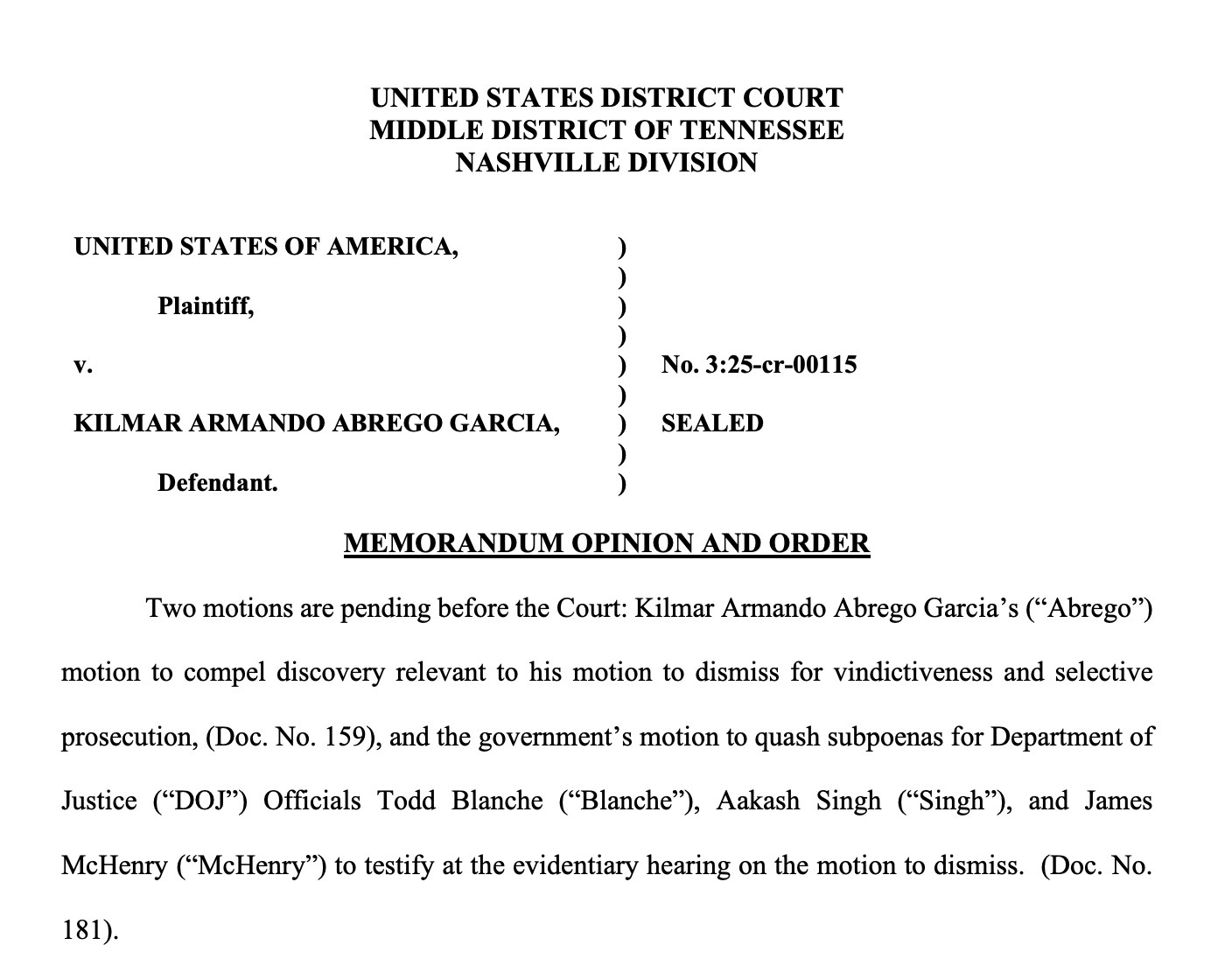
The case is before Federal District Judge Waverly D. Crenshaw, Jr. in the Middle District of Tennessee. It turned out that my conjecture that the sealed motion might have something to do with Abrego Garcia’s motions to dismiss the prosecution because it’s vindictive was on target. As we know from our discussion of this type of motion in the context of the Virginia prosecution of Jim Comey, it’s difficult for a defendant to prove, and cases are only rarely dismissed on this basis. But the timeline here has always seemed to suggest it could be a serious possibility in this one.
In the newly unsealed motion, the Judge goes straight to the heart of the government’s contention that the local U.S. Attorney made the decision to indict, so it was not influenced by any alleged vindictiveness on the part of higher-ups in Washington, writing, “The central question after Abrego established a prima facie case of vindictiveness is what information in the government’s control sheds light on its new decision to prosecute Abrego, after removing him from the United States without criminal charges. These documents show that McGuire [the local U.S. Attorney] did not act alone and to the extent McGuire had input on the decision to prosecute, he shared it with Singh [a Lawyer in Deputy Attorney General Todd Blanche’s office] and others. … Specifically, the government’s documents may contradict its prior representations that the decision to prosecute was made locally and that there were no outside influences.”
This, needless to say, is not good news for the government. To understand just how bad it is, let’s review a bit of the case’s history:
In October, Judge Crenshaw found that Abrego Garcia had come forward with evidence to suggest that a reasonable person might believe the indictment was motivated by vindictiveness on the part of the government. When that happens, the government has to offer evidence that the prosecution was undertaken for legitimate reasons, for instance, that newly discovered evidence made a case previously rejected as weak strong enough to be indicted.
Judge Crenshaw granted Abrego Garcia’s request to conduct discovery on the issue and have an evidentiary hearing. But he noted that it was entirely possible that “no fire will be discovered under all the smoke.”
The indictment stems from a 2022 traffic stop that did not result in Abrego Garcia’s arrest, or even a traffic ticket. The case file at Homeland Security Investigations remained open, but no action was ever taken on it, and the case was closed shortly after he was deported.
The timeline of the criminal prosecution gave rise to the presumption of vindictiveness in the Judge’s view:
- Abrego Garcia was deported on March 15, 2025 (despite the existence of an order that prohibited it).
- Abrego Garcia’s lawyers sued on March 24, 2025, and in less than two weeks, a district judge ordered his return to the U.S.
- Both the Fourth Circuit and the U.S. Supreme Court sided with Abrego Garcia, holding the government responsible for “facilitating” his return. The Supreme Court ruled on April 10.
- Just days after the Supreme Court’s decision, the investigation into the traffic stop was reopened by Homeland Security Investigations (HSI) under DHS Secretary Kristi Noem’s direction.
- Ten days after that, an HSI agent reached out to the acting U.S. Attorney in Nashville.
- The case was indicted on May 21, 2025, only 58 days after Abrego Garcia filed suit in Maryland seeking his return to the U.S.
As Judge Crenshaw noted back in October, “All of this stands in stark contrast to the 832 days the HSI investigation into Abrego remained pending, without referral to the U.S. Attorney’s Office in the Middle District of Tennessee for prosecution.” In other words, the case wasn’t even deemed significant enough to ask a prosecutor to take a look at it. It was only after Abrego Garcia’s lawsuit challenging the legality of his deportation—and the Supreme Court confirmation that he should be returned—that HSI seemed to take the case seriously. In the absence of any explanation from the government, the Judge correctly found these facts gave rise to a presumption of vindictiveness.
Sometimes, though, where there’s smoke, there is, in fact, fire.
The newly unsealed order relates to two motions filed by Abrego Garcia’s lawyers in the course of trying to obtain the discovery the court had ordered they were entitled to: one to compel the government to comply with some of the requests and one to obtain testimony from Deputy Attorney General Todd Blanche and some of the key people in his office. The government had submitted “over 3,000 documents” to the Judge for him to review privately, because the government maintained it wasn’t obligated to turn them over.
Judge Crenshaw has now ordered the government to “disclose to Abrego a sub-set of the over 3,000 documents that are relevant to the narrow issue of whether the government’s new decision to prosecute Abrego, after deciding not to do so, ‘was tainted by improper motivation’ arising from Abrego’s success in the Maryland civil case.” The government doesn’t have to turn over the remainder of the 3,000+ documents. The Judge asked for additional briefing on the government’s motion to prevent Blanche and his subordinates from testifying.
At the time the motion was filed, the government argued that the decision to prosecute was made by Acting U.S. Attorney Robert McGuire in Nashville, so it could not have been vindictiveness of the part of higher-ups in Washington. But as the Judge points out at length in this order, “at the time of Abrego’s arrest, Blanche linked Abrego’s criminal charges to his successful civil lawsuit in Maryland.” Blanche had “volunteered” in a television appearance that the government’s criminal investigation had started up after the judge in the civil case in Maryland accused the government of misconduct when it deported Abrego Garcia. So, Judge Crenshaw orders the government to provide the defendant with documents that “support Abrego’s argument. Specifically, some of the documents suggest not only that McGuire was not a solitary decision-maker, but he in fact reported to others in DOJ and the decision to prosecute Abrego may have been a joint decision, with others who may or may not have acted with an improper motivation.” If Abrego Garcia can use the discovery to successfully wipe out the government’s contention that the decision to indict wasn’t made in D.C., he may be on the road to getting his case dismissed.
Some of the documents the government must now turn over for the defense to use include:
- An email from one of Blanche’s subordinates to the local U.S. Attorney that “made clear that Abrego’s criminal prosecution was a ‘top priority’ for the Deputy Attorney General’s office (Blanche).”
- An email from the U.S. Attorney to his staff, advising them that “DAG (Blanche) and PDAG would like Garcia charged sooner rather than later.”
- There is also an email from the Blanche subordinate to the local U.S. Attorney advising him that they should “‘close[ly] hold’ the draft indictment until the group ‘g[o]t clearance,’ to file.” The Judge comments that “The implication is that ‘clearance’ would come from the Office of the Deputy Attorney General, not just McGuire.”
These developments are all phrased in the polite language used in courts by judges and lawyers, but they are jaw dropping. The government represented to the court that the decision to prosecute Abrego Garcia was made locally, disconnected from his effort to enforce his constitutional rights and challenge his deportation. Their own emails appear to contradict that assertion. The government will still have the opportunity to come forward and explain away the presumption of vindictiveness. I’ve seen a number of cases during my 25 years at DOJ where a defendant argued vindictiveness. In every case, the government explained why the prosecution was legitimate, and in every case, it prevailed. I’ve never seen a case where the government made representations to a judge that were refuted by its own internal communications. It’s exceptionally unusual for prosecutors to have to take the witness stand to defend their own conduct. But Abrego Garcia’s case, which has been highly irregular from the start, may well be the one where that happens.
This is all about due process. Back in April, as Abrego Garcia’s situation was coming to light, Press Secretary Karoline Leavitt claimed that there was “a lot of evidence” Abrego Garcia was a convicted member of the gang MS-13, saying that “I saw it this morning.” We were supposed to take her word for it and leave Abrego Garcia to his fate of torture in a Salvadoran prison. That’s why the rule of law and due process matter. If it’s up to Trump, anyone can be swept up and swept away and have no recourse. Our ability to go to court to protect ourselves when the government gets it wrong is more and more important.
During his monumental filibuster earlier this year, New Jersey Senator Cory Booker said that this was our moral moment and that inaction was not enough. He asked: “Where does the Constitution live? On paper, or in our hearts?” Here at Civil Discourse, it lives in our hearts and stays on our minds.
Thank you for being here with me. I know you have lots of choices about where to get your news and analysis. I appreciate that you’re spending some of it with me. Your paid subscriptions make it possible for me to devote the time and resources it takes to write the newsletter. I’m proud that we’ve built a community together that’s dedicated to keeping the Republic.
We’re in this together,
Joyce
 Scottie's Playtime