Trump Steamrolls His Way Past Accountability. The Mar-a-Lago Search Might Be Different.
Donald Trump’s signature strategy for getting ahead of scandals, ignoring inconvenient facts and hammering his own version of events has served him well, but it might not save him this time.
On top of everything else early voting in Florida started on Saturday Aug 13th. I got my sample ballot on that same day. And it included a couple races I checked and don’t seem to be on the ballot I downloaded Monday from the county web site. Since DeathSantis took over and started his republican maga cult kingdom the election system has taken an awfully bad hit. I used to get my sample ballot with plenty of time to research each candidate and then Ron and I would talk about them and decide which ones we would support. This time with Ron having doctors appointments more often than I do, and with all the things going on, getting the ballot late while the state cut the early voting to only one week from Aug 13 to Aug 20 along with my being ill, I have been scrambling to research the primary candidates while Ron and I have limited time to talk it over. We have to go vote tomorrow morning, it is the only time we have, because James and Ron are leaving to go up to Ron’s brother’s 50th anniversary and Ron doesn’t want me to go to vote on voting day with the huge lines alone. As it is last time, I did not take my walker and had a very hard time standing in line and voting even though it was a short time in line compared to other places in Florida and they really helped me getting me a sit-down voting spot. I will say that the difference in treatment from voting in a majority white district is huge compared to voting in an oppressed minority district.
With everything going on I worked to post some stuff and then researched the candidates. WOW what a revelation for the local races, especially for school boards where most of the candidates were off the wall bizarre maga parents with the goal of first stopping the woke takeover of the teachers who are grooming the students which is making them trans / gay. This is the primaries, not the general. These lower races are not partisan, so the primaries are open to both parties to vote. Looking these candidates up scared me their views and realizing they were likely to win.
I also noted that the highest state offices had democrats that were to the right of center or center candidates. Yes we have a few who are normal democratic liberal candidates which in Florida is about as progressive as we can get. I like some of those. I like the ones that were former public defenders, worked for equality issues, and other things that helped the lower income people / workers. I will be voting for them. But too many of them were republican lite in the democratic primary. Again for those that keep saying the democrats must go to the center or even to the right to get that right leaning vote, the republicans don’t want to vote for republican lite when they can have the full republican candidate. It is the losing position.
Now to address my comments. I was sick for a week. I also get very tired after eating and so have to go to bed for a nap. The doctor explained what was happening. Because I am unable to move much, lowering my calorie intake is a good thing. For me that means eating only twice a day with small portions. But because my blood sugar is low before I eat, I take my insulin and eat, my blood sugar goes down further for a while causing me to get very tired before it bounces back up. He said if I have the time and it is not interfering with my life just go sleep, it helps my pain levels also. If I want it fixed, he will draw up a program for me next visit. So for now, this means after eating lunch (which is my first meal) I go to take a nap and rest my back. I get up and work, then after eating supper I go to bed for the night. Remember If you took my life in a 24 hour period, I will spend more of it in bed than up most day. That is not true all the time, sometimes I get up in the middle of the night and go to the computers because my pain won’t let me sleep.
The point of my telling you the above is I have not answered comments or been to other blogs since I got sick last Thursday. I thought throwing up on the car door and all over the parking lot was because I drank a lot of water and had stop and roll then stop again traffic for 30 minutes. Seems I had a bug, and I really hope I did not give it to anyone else. I will start on the comments next beginning with the oldest I can get to. Tomorrow we are going to vote, then I will be going with Ron to help him do the shopping because remember he just had a large metal wire sliver that got into his heal removed first at home then the rest taken out in the walk-in convenient care, plus he had the three-day heavy metal tests on his back he just got removed this afternoon. I just think he would love to have company in the great fight for food. The point of all this is it is going to take a few days for me to catch up. If I miss your comment because it disappeared before I could get to it or I somehow overlooked it in my rush to get caught up, comment again. Thanks for understanding things are a bit rushed and overwhelming right now. Hugs and lots of loves. Scottie
“Anne Frank’s Diary: The Graphic Adaptation” (Courtesy Anne Frank Fonds)
(JTA) – A school district in suburban Fort Worth, Texas, has ordered its librarians to remove an illustrated adaptation of “The Diary of Anne Frank” from their shelves and digital libraries, along with the Bible and dozens of other books that were challenged by parents last year.
The book purge at the Keller Independent School District in Keller, Texas, was requested Tuesday by a district executive in an email, a copy of which was obtained by the Jewish Telegraphic Agency. A copy of the email also circulated on social media.
“By the end of today, I need all books pulled from the library and classrooms,” wrote Jennifer Price, Keller ISD’s executive director of curriculum and instruction.
It was the latest in a string of book removals being implemented at schools at the behest of conservative activist parents and school board members who are challenging a slew of texts on grounds ranging from their LGBT-friendly content to their supposed connections to “critical race theory.” Some of these challenges have ensnared books with Jewish themes in the past.
“It’s disgusting. It’s devastating. It’s legitimate book banning, there’s no way around it,” Laney Hawes, a parent of four children in the Keller district, told JTA about the order. “I feel bad for the teachers and the librarians.”
“Anne Frank’s Diary: The Graphic Adaptation,” by Israeli filmmaker Ari Folman and illustrator David Polonsky, is a 2019 illustrated adaptation of the bestselling diary by the teenage Holocaust victim. The New York Times called the book “so engaging and effective that it’s easy to imagine it replacing the [original] ‘Diary’ in classrooms and among younger readers.”
The parental challenge against the book came in February, and the district initially dismissed it, Hawes said. Hawes, who is not Jewish, is on a list of parents who can be called in to serve on a committee to review book challenges.
“When we got ‘The Diary of Anne Frank,’ we thought, ‘This is a joke.’ But it wasn’t,” Hawes said, adding that the complaint was that “the book shouldn’t be read without parent supervision.” She suspected that the parent may have objected to the unabridged diary’s references to female genitalia, same-sex attraction and other sexual matters, which have been deemed “pornographic” by parental challenges in the past. But she couldn’t be sure because the parent who challenged the book didn’t show up to the meeting.
Hawes’ committee reinstated the book and thought that would be the end of the saga. But following school board elections in May, right-wing activists backed by campaign funds from a PAC affiliated with conservative cell phone company Patriot Mobile gained a majority on the board. They are now rewriting the guidelines for responding to parental book challenges and have ordered all challenged books from last year to be removed from school libraries in the meantime.
“Right now, Keller ISD’s administration is asking our campus staff and librarians to review books that were challenged last year to determine if they meet the requirements of the new policy,” the district said in a statement to JTA when reached for comment. “Books that meet the new guidelines will be returned to the libraries as soon as it is confirmed they comply with the new policy.”
The district’s statement made no mention of Anne Frank, nor of the Bible, which was one of last year’s other challenged books in the district and thus will presumably also be removed from school shelves. Other books which will presumably now be removed include Toni Morrison’s “The Bluest Eye,” Alison Bechdel’s “Fun Home” and Jon Ronson’s “So You’ve Been Publicly Shamed.”
The district has not shared any timeline for when the new review policy will be implemented. Under the current policy, any district parent, employee or “District resident” may challenge any book in the district “on the basis of appropriateness.”
The Keller district was the subject of a 2021 investigation by the Texas Education Agency, during which Republican Gov. Greg Abbott alleged the district was making “sexually explicit” books available to children.
“This group of people elected to our board, and the crazy parents behind them, decided that the committees must be rigged,” Hawes said, describing parents who would attend school board meetings alleging “conspiracies to take over our public schools,” wearing shirts reading “Alex Jones Was Right.”
Hawes, who said she had become an unofficial activist for district teachers and librarians who felt unsafe speaking out about such policies, said she had been contacted by more than a dozen educators the morning the email went out.
One teacher called her in tears. “She said it: ‘I can’t even let them read ‘The Diary of Anne Frank.’”
Note the paragraph that states because the school spying on the kids, those same kids / parents have been visited by law enforcement. One district used the software to learn the student’s sexual orientation and outed the student their parents.
As the post-Roe era underscores the risks of digital surveillance, a new survey shows that teens face increased monitoring from teachers—and police.
PHOTOGRAPH: MASKOT/GETTY IMAGES
THIS IS WHAT high school teachers see when they open GoGuardian, a popular software application used to monitor student activity: The interface is familiar, like the gallery view of a large Zoom call. But instead of seeing teenaged faces in each frame, the teacher sees thumbnail images showing the screens of each student’s laptop. They watch as students’ cursors skim across the lines of a sonnet or the word “chlorofluorocarbon” appears, painstakingly typed into a search bar. If a student is enticed by a distraction—an online game, a stunt video—the teacher can see that too and can remind the student to stay on task via a private message sent through GoGuardian. If this student has veered away from the assignment a few too many times, the teacher can take remote control of the device and zap the tab themselves.
Student-monitoring software has come under renewed scrutiny over the course of the Covid-19 pandemic. When students in the US were forced to continue their schooling virtually, many brought home school-issued devices. Baked into these machines was software that can allow teachers to view and control students’ screens, use AI to scan text from student emails and cloud-based documents, and, in severe cases, send alerts of potential violent threats or mental health harms to educators and local law enforcement after school hours.
Now that the majority of American students are finally going back to school in-person, the surveillance software that proliferated during the pandemic will stay on their school-issued devices, where it will continue to watch them. According to a report published today from the Center for Democracy and Technology, 89 percent of teachers have said that their schools will continue using student-monitoring software, up 5 percentage points from last year. At the same time, the overturning of Roe v. Wade has led to new concerns about digital surveillance in states that have made abortion care illegal. Proposals targeting LGBTQ youth, such as the Texas governor’s calls to investigate the families of kids seeking gender-affirming care, raise additional worries about how data collected through school-issued devices might be weaponized in September.
The CDT report also reveals how monitoring software can shrink the distance between classrooms and carceral systems. Forty-four percent of teachers reported that at least one student at their school has been contacted by law enforcement as a result of behaviors flagged by the monitoring software. And 37 percent of teachers who say their school uses activity monitoring outside of regular hours report that such alerts are directed to “a third party focused on public safety” (e.g., local police department, immigration enforcement). “Schools have institutionalized and routinized law enforcement’s access to students’ information,” says Elizabeth Laird, the director of equity in civic technology at the CDT.
US senators Elizabeth Warren and Ed Markey have recently raised concerns about the software’s facilitation of contact with law enforcement, suggesting that the products may also be used to criminalize students who seek reproductive health resources on school-issued devices. The senators have sought responses from four major monitoring companies: GoGuardian, Gaggle, Securly, and Bark for Schools, which together reach thousands of school districts and millions of American students.
Widespread concerns about teen mental health and school violence lend a grim backdrop to the back-to-school season. After the mass shooting at an elementary school in Uvalde, Texas, Congress passed a law that directs $300 million for schools to strengthen security infrastructure. Monitoring companies speak to educators’ fears, often touting their products’ ability to zero in on would-be student attackers. Securly’s website offers educators “AI-powered insight into student activity for email, Google Drive, and Microsoft OneDrive files.” It invites them to “approach student safety from every angle, across every platform, and identify students who may be at risk of harming themselves or others.”
See Me After Class
Before the Roe decision brought more attention to the risks of digital surveillance, lawmakers and privacy advocates were already concerned about student-monitoring software. In March 2022, an investigation led by senators Warren and Markey found that the four aforementioned companies—which sell digital student-monitoring services to K-12 schools—raised “significant privacy and equity concerns.” The investigation pointed out that low-income students (who tend to be disproportionately Black and Hispanic) rely more heavily on school devices and are exposed to more surveillance than affluent students; it also uncovered that schools and companies were often not required to disclose the use and extent of their monitoring to students and parents. In some cases, districts can opt to have a company send alerts directly to law enforcement instead of a school contact.
Students are often aware that their AI hall monitors are imperfect and can be misused. An investigation by The 74 Million found that Gaggle would send students warning emails for harmless content, like profanity in a fiction submission to the school literary magazine. One high school newspaper reported that the district used monitoring software to reveal a student’s sexuality and out the student to their parents. (Today’s CDT report revealed that 13 percent of students knew someone who had been outed as a result of student-monitoring software.) A Texas student newspaper’s editorial board argued that their school’s use of the software might prevent students from seeking mental health support.
Also disquieting are the accounts of monitoring software breaching students’ after-school lives. One associate principal I spoke to for this story says his district would receive “Questionable Content” email alerts from Gaggle about pornographic photos and profanities from students’ text messages. But the students weren’t texting on their school-issued Chromebooks. When administrators investigated, they learned that while teens were home, they would charge their phones by connecting them to their laptops via USB cables. The teens would then proceed to have what they believed to be private conversations via text, in some cases exchanging nude photos with significant others—which the Gaggle software running on the Chromebook could detect.
After this was first reported by Wired, Gaggle said in a statement that it does not scan private texts on charging phones, but that a phone’s photos do get uploaded to a school’s account (and scanned) when the student plugs their phone into a school-issued laptop. The associate principal I spoke to says he advises students not to plug their personal devices into their school-issued laptops.
This pervasive surveillance has always been disconcerting to privacy advocates, but the criminalization of reproductive health care in some states makes those problems more acute. It’s not difficult to envision a student who lives in a state where ending a pregnancy is illegal using a search engine to find out-of-state abortion clinics, or chatting online with a friend about an unplanned pregnancy. From there, teachers and administrators could take it upon themselves to inform the student’s parent or local law enforcement.
So could the monitoring algorithm scan directly for students who type “abortion clinic near me” or “gender-affirming care” and trigger an alert to educators or the police? Paget Hetherington, the vice president of marketing at Gaggle, says that Gaggle’s dictionary of keywords does not scan for words and phrases related to abortion, reproductive health care, or gender-affirming health care. Districts can, to an extent, ask Gaggle to customize and localize which keywords are flagged by the algorithm. When WIRED asked whether a district could request that Gaggle specifically track words related to reproductive or gender-affirming health care, Hetherington replied, “It’s possible that a school district in one of these states could potentially ask us to track some of these words and phrases, and we will say no.”
When reached for comment, GoGuardian directed us to the following statement: “As a company committed to creating safer learning environments for all students, GoGuardian continually evaluates our product frameworks and their implications for student data privacy. We are currently reviewing the letter we received from Senators Warren and Markey and will be providing a response.”
When reached for comment, Bark for Schools initially agreed to speak to us, then went silent. After this story was first published, the company released a statement saying, in part, that its policy is to “immediately and permanently delete data which comes into its possession that contains a student’s reproductive health data or searches for reproductive health information.” Therefore, the company says, it cannot be compelled to turn over such data to law enforcement because “it is not in our possession and therefore not produceable.”
Securly did not respond to requests for comment.
All Monitor
Even if student-monitoring algorithms don’t actively scan for content related to abortion or gender-affirming care, the sensitive student information they’re privy to can still get kids in trouble with police. “It is hardly a stretch to believe that school districts would be compelled to use the information that they collect to ensure enforcement of state law,” says Doug Levin, national director of the K12 Security Information Exchange, a nonprofit focused on protecting schools from emerging cybersecurity risks.
Schools can and do share student data with law enforcement. In 2020, The Boston Globereported that information about Boston Public School students was shared on over 100 occasions with an intelligence group based in the city’s police department, exposing the records of the district’s undocumented students and putting those students at greater risk of deportation.
When it comes to safeguarding the privacy of students’ web searches and communications, Levin says current federal protections are insufficient. The primary federal law governing the type and amount of student data that companies can slurp up is the Family Education Rights and Privacy Act. While FERPA has been updated a handful of times since it passed in 1974, Levin says it hasn’t kept pace with the technology that shapes reality for schools and students in 2022. The current national privacy bill in Congress (which might, in other respects, actually be good) won’t do anything for most students either, as it excludes public institutions such as public schools and vendors that handle student data.
For teachers, the value of remote monitoring can be significant. Stacy Recker, a high school social studies teacher in the Cincinnati area, says GoGuardian was “invaluable” during the pandemic. She used the software to provide remote support for students who struggled with the technical demands of remote learning. Now that her students have returned to the classroom, she continues to use GoGuardian to help her kids stay off YouTube and focus on a lesson on W.E.B. DuBois. At the time of WIRED’s interview, she was not aware of the alerting system that claims to detect a student’s risk of self-harm or harm to others, a service GoGuardian offers as a separate product.
Educators are shouldering the unprecedented responsibility of helping students recover from two extremely disruptive years while providing mental health support in the wake of campus tragedies. The monitoring companies’ websites share stories of their products flagging students’ expressions of suicidal ideation, with testimonies from teachers who credit the software with helping them intervene in the nick of time.
Especially after school shootings, educators are understandably fearful. But the evidence that monitoring software actually helps prevent violence is scant. Privacy advocates would also argue that forcing schools to weigh surveillance against safety perpetuates a false choice. “Surveillance always comes with inherent forms of abuse,” says Evan Greer, the director of the nonprofit Fight for the Future. “There are other ways to support and protect kids that don’t.”
Some educators would agree. When the Columbine shooting shook American schools in 1999, Lee Ann Wentzel was an assistant principal at Ridley Public Schools in Pennsylvania. She remembers how her school scrambled to come up with new safety protocols, like issuing ID badges. When she became superintendent in 2010, Wentzel helped design a rigorous student privacy rubric against which her district could measure all software they would be using with students. The rubric included items like whether the student’s data was disposed of and whether it was shared with other parties. Her district does not use GoGuardian, Gaggle, Securly, or Bark for Schools.
She’s wary of the promises student-monitoring companies make. “Those systems provide A) a false sense of security, and B) it kills the curiosity that you want to inspire in learning,” she says. “If you’re going to rely on a technology system to tell you a kid’s unhappy, that’s concerning to me because you’re not developing relationships with kids who are in front of you.”
As to the companies’ claims about bolstering safety and anticipating school violence, she says, “There’s no single answer to these issues. Anyone that promises, ‘We’re gonna be able to predict that sort of thing’—No. You’re not.”
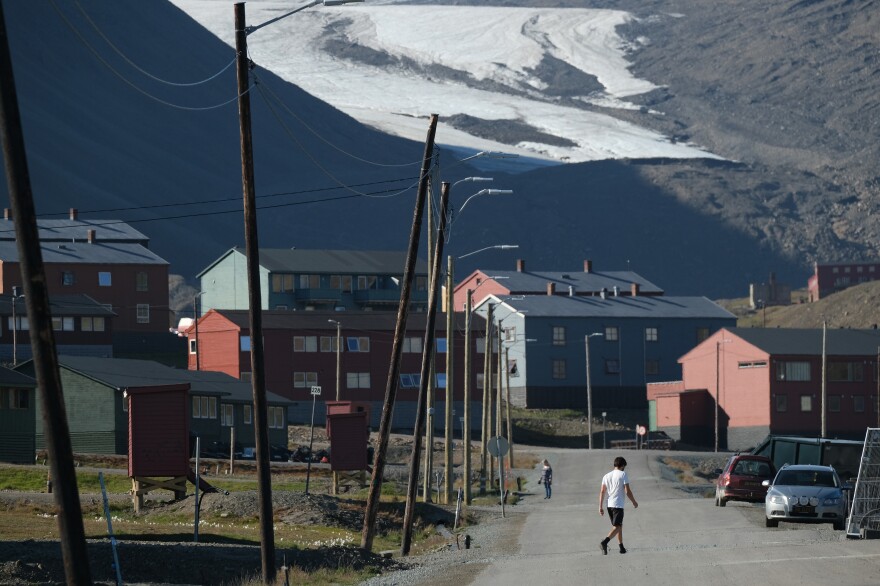
Temperatures in Longyearbyen, Norway above the Arctic Circle hit a new record above 70 degrees Fahrenheit in July 2020. The Arctic has warmed nearly four times faster than the planet as a whole since 1979, a new study finds.
The Arctic is heating up nearly four times faster than the Earth as a whole, according to new research. The findings are a reminder that the people, plants and animals in polar regions are experiencing rapid, and disastrous, climate change.
Scientists previously estimated that the Arctic is heating up about twice as fast as the globe overall. The new study finds that is a significant underestimate of recent warming. In the last 43 years, the region has warmed 3.8 times faster than the planet as a whole, the authors find.
The study focuses on the period between 1979, when reliable satellite measurements of global temperatures began, and 2021.
“The Arctic is more sensitive to global warming than previously thought,” says Mika Rantanen of the Finnish Meteorological Institute, who is one of the authors of the study published in the journal Communications Earth & Environment.
There have been hints in recent years that the Arctic is heating up even more quickly than computer models predicted. Heat waves in the far North have driven wildfires and jaw-dropping ice melt in the circumpolar region that includes Alaska, Arctic Canada, Greenland, Scandinavia and Siberia.
“This will probably be a bit of a surprise, but also kind of extra motivation perhaps,” says Richard Davy, a climate scientist at Nansen Environmental and Remote Sensing Center in Norway, who was not involved in the new study. “Things are moving faster than we could have expected from the model projections.”
There are many reasons why the Arctic is heating up more quickly than other parts of the Earth. Changes in the amount of air pollution coming from Europe and natural multi-decade climate variations likely play a role. But human-caused global warming is the underlying reason that the Arctic, and the planet as a whole, are heating up.
Loss of sea ice is one of the clearest drivers of Arctic warming. The Arctic Circle is mostly ocean, which used to be frozen for most or all of the year. But permanent sea ice is steadily shrinking, and seasonal ice is melting earlier in the year and re-forming later.
That means more open water. But while ice is bright and reflects heat from the sun, water is darker and absorbs it. That heat helps melt more ice, which means more water to trap more heat – the loop feeds on itself, accelerating warming in the Arctic.
“That’s why the temperature trends are the highest [in] those areas where the sea ice has declined most,” explains Rantanen. There are hotspots in the Bering Sea over Northern Europe and Siberia, which are heating up about seven times faster than the global average, the study estimates.
Rapid Arctic warming affects people living far from the Arctic circle. For example, there is evidence that weather patterns are shifting across the U.S. and Europe as sea ice melts, and many marine species migrate between the tropics and the Arctic each year. “What happens in the Arctic doesn’t just stay in the Arctic,” says Davy.
The new research also finds that the advanced computer models that scientists use to understand how the global climate is changing now, and will change in the future, struggle to capture the relative speed of Arctic warming. That suggests that future models may need to be adjusted to better capture the realities of global warming in polar regions, although this study did not tease apart what exactly is missing from current models.
“The paper’s finding that climate models tend to underestimate the warming ratio [between the Arctic and the Earth as a whole] is really interesting,” says Kyle Armour, a climate scientist at the University of Washington who was not involved in the new study.
Previous studies have found that computer models actually do a good job estimating how much the Arctic has heated up, but that they tend to overestimate how much hotter the whole planet is, Armour explains. That means the models’ comparison between Arctic warming and overall warming ends up being incorrect.
“We have more work to do to figure out the source of this model bias,” says Armour. And that work is increasingly important, because world leaders use climate models to understand what the future holds and how to avoid even more catastrophic warming.
The ‘QAnon Queen’ Told Her Followers to Arrest Cops. It Didn’t Go Well.
The attempted citizen’s arrests of police officers in Peterborough, Ontario, was a clear escalation for “QAnon Queen” Romana Didulo and her followers.
Crops, power plants, barge traffic, industry and fish populations devastated by parched waterways
00:37
Drone footage reveals impact of climate crisis on Europe’s rivers – video
In places, the Loire can now be crossed on foot; France’s longest river has never flowed so slowly. The Rhine is fast becoming impassable to barge traffic. In Italy, the Po is 2 metres lower than normal, crippling crops. Serbia is dredging the Danube.
Across Europe, drought is reducing once-mighty rivers to trickles, with potentially dramatic consequences for industry, freight, energy and food production – just as supply shortages and price rises due to Russia’s invasion of Ukraine bite.
Driven by climate breakdown, an unusually dry winter and spring followed by record-breaking summer temperatures and repeated heatwaves have left Europe’s essential waterways under-replenished and, increasingly, overheated.
With no significant rainfall recorded for almost two months across western, central and southern Europe and none forecast in the near future, meteorologists say the drought could become the continent’s worst in more than 500 years.
“We haven’t analysed fully this year’s event because it is still ongoing,” said Andrea Toreti of the European Commission’s Joint Research Centre. “There were no other events in the past 500 [years] similar to the drought of 2018. But this year, I think, is worse.”
He said there was “a very high risk of dry conditions” continuing over the next three months, adding that without effective mitigation drought intensity and frequency would “increase dramatically over Europe, both in the north and in the south”.
Germany’s Federal Institute of Hydrology (BfG) said the level of the Rhine, whose waters are used for freight transport, irrigation, manufacturing, power generation and drinking, will continue dropping until at least the beginning of next week.
On Friday the water at the critical Kaub marker 50km downstream from Mainz – which measures navigability, rather than the water depth – fell below 40cm, the level at which many shipping firms consider it is no longer economical for barges to operate. It could fall to nearer 30cm over the next few days, the BfG has said.
Many barges, which carry coal for power plants and vital raw materials for industrial giants such as steelmaker Thyssen and chemical giant BASF, are already operating at about 25% capacity to reduce their draft, raising shipping costs up to fivefold.
A vital part of northwest Europe’s economy for centuries, the 760 miles (1,233km) of the Rhine flow from Switzerland through Germany’s industrial heartland before reaching the North Sea at the megaport of Rotterdam.
A total halt in Rhine barge traffic would hit Germany’s – and Europe’s – economy hard: experts have calculated that a six-month suspension in 2018 cost around €5bn (£4.2bn), with low water levels forecast to cost Germany 0.2 points of economic growth this year.
While the EU has said boosting waterborne freight by 25% is one of the bloc’s green transition priorities, Germany is now working to divert it to rail and road – although between 40 and 100 trucks are needed to replace a standard barge load.
France’s rivers might not be such key freight arteries, but they do serve to cool the nuclear plants that produce 70% of the country’s electricity. As prices hit all-time highs, power giant EDF has been forced to reduce output because of the drought.
Strict rules regulate how far nuclear plants can raise river temperatures when they discharge cooling water – and if record low water levels and high air temperatures mean the river is already overheated, they have no option but to cut output. With Europe’s looming energy crisis mounting and the Garonne, Rhône and Loire rivers already too warm to allow cooling water to be discharged, the French nuclear regulator last week allowed five plants to temporarily break the rules.
Quiet flows the Po: the life and slow death of Italy’s longest river
Read more
In Italy, the flow of the parched Po, Italy’s longest river, has fallen to one-tenth of its usual rate, and water levels are 2 metres below normal. With no sustained rainfall in the region since November, corn and risotto rice production have been hard hit.
The Po valley accounts for between 30% and 40% of Italy’s agricultural production, but rice growers in particular have warned that up to 60% of their crop may be lost as paddy fields dry out and are spoiled by seawater sucked in by the low river level.
In the protected wetlands of the river’s delta, near Venice, its high temperature and sluggish flow have reduced the water’s oxygen content to the extent that an estimated 30% of clams growing in the lagoon have already been killed off.
Low river levels and high water temperatures can prove fatal to many species. In Bavaria, the Danube reached 25C last week and could hit 26.5C by mid-month, meaning its oxygen content would fall below six parts per million – fatal for trout.
Freight on the 2,850km of the Danube has also been heavily disrupted, prompting authorities in Serbia, Romania and Bulgaria to start dredging deeper channels while barges carrying mainly fuel for the power generators wait to advance.
Even Norway, which relies on hydropower for about 90% of its electricity generation, has said the unusually low levels of its reservoirs may ultimately oblige it to limit power exports.
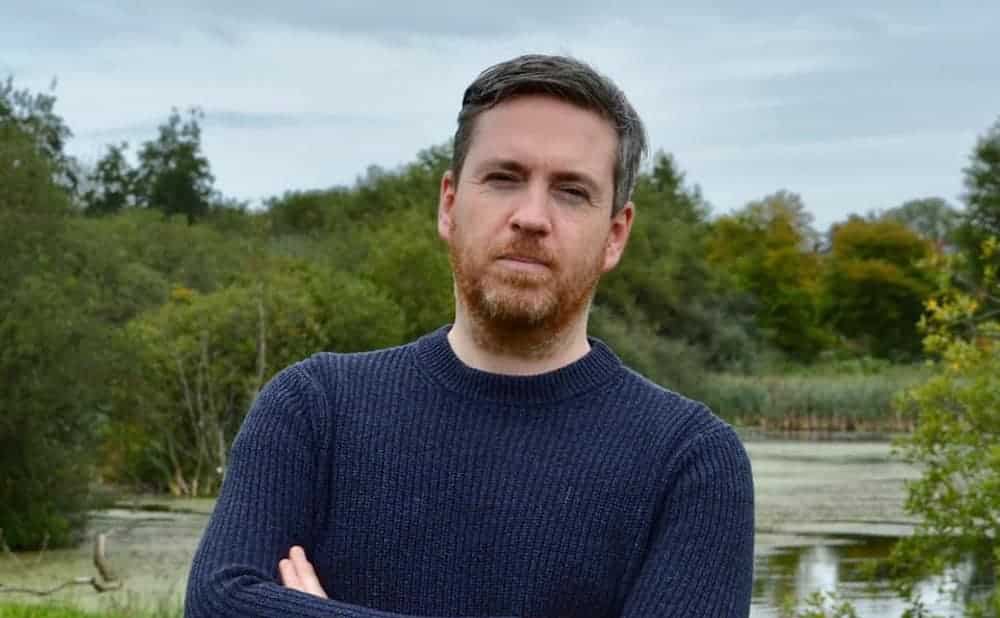
The new leader of the Green Party in Northern Ireland, Mal O’Hara. (Facebook/ Malachai O’Hara)
Belfast councillor Mal O’Hara has become the first openly gay political leader in Northern Ireland after being named as the new leader of the Green Party.
O’Hara will replace Clare Bailey as leader of the Green Party in Northern Ireland, after she lost her seat in May’s Stormont assembly election.
Before embarking on his career in politics, O’Hara was an active LGBTQ+ rights campaigner, having worked for the Rainbow Project and acted as vice-chairman of Northern Ireland’s equal marriage campaign.
He joined the Green Party in 2014, and was elected to Belfast City Council in 2019. That same year, he became deputy leader of the party.
On Monday (15 August), O’Hara became leader of the party after he was elected unopposed.
In a statement posted to social media, he said: “I am beyond delighted to have been elected as the new leader of the Green Party in Northern Ireland.
“I’ve big shoes to fill. Clare Bailey has been my mentor, boss, friend and confidant. As leader she led us to record council elections, [she] and Rachel Woods passed two pieces of law that will change lives and they forced the NI Executive to bring forward climate legislation for Northern Ireland.
“It’s time for a new generation of activists. We were right on marriage and abortion and we were always right on the environment. It is welcome that others are following our lead.
“Northern Ireland faces many challenges; cost of living, housing, mental health, reconciliation and of course the climate and biodiversity crises.
“I believe that Greens uniquely have the solutions to these challenges. We can create a fairer world and a fairer Northern Ireland. Come and be part of that.”
Mal O’Hara is determined to tackle homophobia in Northern Ireland
Speaking to the Belfast Telegraph, Mal O’Hara said he came out while at university in 1998, and that he was “lucky” his family and social circle were affirming.
“I know that is not the experience of everybody,” he said.
“I’ve had death threats, I’ve had harassment, I’ve had homophobic abuse, I’ve experienced all of that and that is what led me into LGBT activism.
“The fundamental failure is the executive promised a sexual orientation strategy in 2007; it is 2022 and that has still not been delivered and that is a key mechanism for addressing inequality.
“While I am very lucky, I am conscious that is not the experience of very many people across Northern Ireland.
“There has never been a better time to be LGBT, but there is still a lot of work to do to make sure it is better for coming generations.”
Over 1/3 were worried about repercussions, others didnt think the police could do anything or they wouldn't be believed. This is why @TRPNI works with our partners within @HCASNI@PoliceServiceNI@Justice_NI to take action to tackle Hate Crime wherever and whenever it appears.
In an interview with The Irish Times, he added he hopes his new position will encourage the younger queer generation, and that it will be a step towards diversifying politics.
O’Hara said: “I hope that says to the next generation of LGBT activists that you can be what you can see. That means you can be the leader of a party, that means you can be an elected representative, and that broadens the political representation in the North.
“I think we have an over-representation of heterosexual older men of a certain class, and politics needs to change and be more diverse and representative of those wider communities and I think that brings us better politics.”
Now for some good trans news. I hope more countries follow along with these steps. Being trans gender is not a crime nor a mental illness. It is an inborn difference between the assigned gender at birth based on genital inspection and gender identity of the individual. Hugs
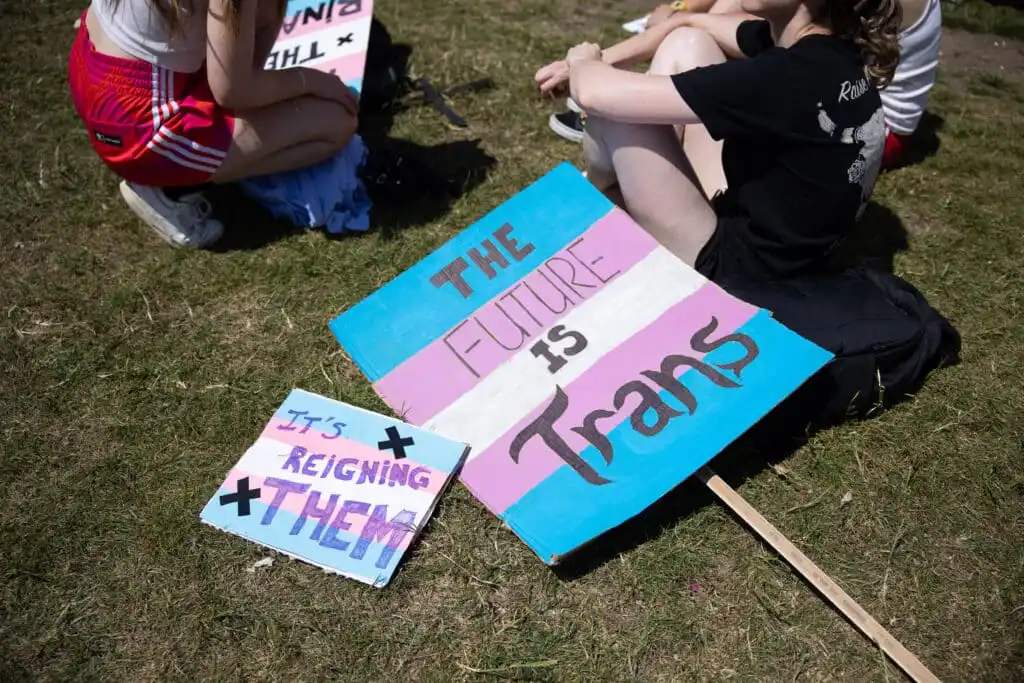
A trans right protest. (Hesther Ng/SOPA Images/LightRocket via Getty Images)
Germany is expected to introduce a bill allowing trans people to request a legal name and gender change without having to undergo surgery, hormone therapy or a psychological consultation.
The Self-Determination Act, which was first presented on 30 June, would allow trans adults – and minors aged 14 and older with permission from their parents or guardians – to change their gender and first name once a year, every year.
Trans and non-binary people could change their name and gender at a registry office, without any medical reports or a court order.
The bill states a fine can be given if a person’s gender or name change is disclosed without their permission.
Family minister Lisa Paus said: “The Self-Determination Act will improve the lives of transgender people and recognise gender diversity.
“In many areas, society is further ahead of legislation. As a government, we have decided to create a legal framework for an open, diverse and modern society.”
🇩🇪 BREAKING NEWS: In Germany, new Chancellor @OlafScholz has reached a coalition deal.
The upcoming bill is part of sweeping reforms of LGBTQ+ rights in Germany, with other proposals including recording the levels of related hate crimes and scrapping restrictions on blood donation for men who have sex with men.
The Chancellor of Germany, Olaf Scholz of the centre-left Social Democratic Party, and his coalition with the Green Party and Free Democrats, revealed reforms in November 2021.
According to Der Tagesspiegel, other reforms for health insurance covering transition-related medical care in full are all being discussed.
Perhaps most ground-breaking of all is the proposal to compensate trans and intersex people physically harmed by previous legislation. For example, through forced sterilisation or unnecessary surgeries.
Before 2011, trans people in Germany were forced to undergo mandatory sterilisation in order to receive legal gender recognition.
Sweden became the first country in the world to compensate trans people for forced sterilisation, in 2018.
Julia Monro, of the German Society for Transidentity and Intersexuality, told Der Tagesspiegel: “There has never been such progressive projects for the rights of queer people in a coalition agreement.
“This is a milestone and the queer community is cheering.”




 Scottie's Playtime