
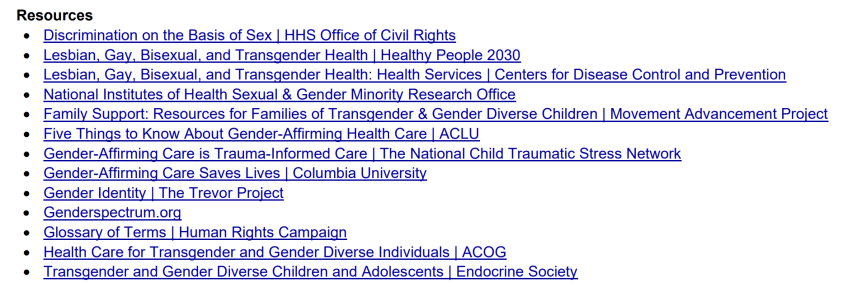
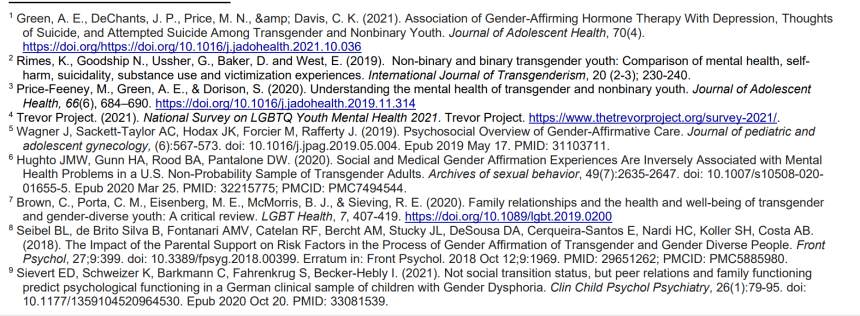
This is from the Office of the Assistant Secretary for Health (OASH). OASH oversees the Department’s key public health offices and programs, a number of Presidential and Secretarial advisory committees, 10 regional health offices across the nation, and the Office of the Surgeon General and the U.S. Public Health Service Commissioned Corps. In order to add the resource links and the footnotes to display properly (and to save my self a lot of work) I did screen captures. To click on the links, use the PDF link to the government site, where they are clickable. This is from the US government, it is facts! The sources, links, and footnotes are all on the webpage. The US government doesn’t promote conspiracy fringe group made up bullshit. For you anti-trans people, modern medical science says gender-affirming care is the best practice for treating people and children with gender identification issues. Please take your anti-trans made up crap else where, because I rate it right up there with anti-vaccine / Covid conspiracy nonsense. Thanks
Click to access gender-affirming-care-young-people-march-2022.pdf
What is gender-affirming care?
Gender-affirming care is a supportive form of healthcare. It consists of an array of services that may include medical, surgical, mental health, and non-medical services for transgender and nonbinary people. For transgender and nonbinary children and adolescents, early gender affirming care is crucial to overall health and well-being as it allows the child or adolescent to focus on social transitions and can increase their confidence while navigating the healthcare system.
Why does it matter?
Research demonstrates that gender-affirming care improves the mental health and overall well-being of gender diverse children and adolescents.(1) Because gender-affirming care encompasses many facets of healthcare needs and support, it has been shown to increase positive outcomes for transgender and nonbinary children and adolescents. Gender-affirming care is patient-centered and treats individuals holistically, aligning their outward, physical traits with their gender identity.
Gender diverse adolescents, in particular, face significant health
disparities compared to their cisgender peers. Transgender and gender nonbinary adolescents are at increased risk for mental health issues, substance use, and suicide.(2, 3) The Trevor Project’s 2021 National Survey on LGBTQ Youth Mental Health found that 52 percent of LGBTQ youth seriously considered attempting suicide in the past year.(4)A safe and affirming healthcare environment is critical in fostering better outcomes for transgender, nonbinary, and other gender expansive children and adolescents. Medical and psychosocial gender affirming healthcare practices have been demonstrated to yield lower rates of adverse mental health outcomes, build self-esteem, and improve overall quality of life for transgender and gender diverse youth.(5,6) Familial and peer support is also crucial in fostering similarly positive outcomes for these populations. Presence of affirming support networks is critical for facilitating and arranging gender affirming care for children and adolescents. Lack of such support can result in rejection, depression and
suicide, homelessness, and other negative outcomes.(7,8,9)
Additional Information
• Endocrine Treatment of Gender-Dysphoric/Gender-Incongruent Persons: An Endocrine Society Clinical
Practice Guideline
• Ensuring Comprehensive Care and Support for Transgender and Gender-Diverse Children and
Adolescents | American Academy of Pediatrics
• Standards of Care (SOC) for the Health of Transsexual, Transgender, and Gender Nonconforming People
| World Professional Association for Transgender Health

Pg 2 of the PDF
Gender-Affirming Care and Young People


 Scottie's Playtime