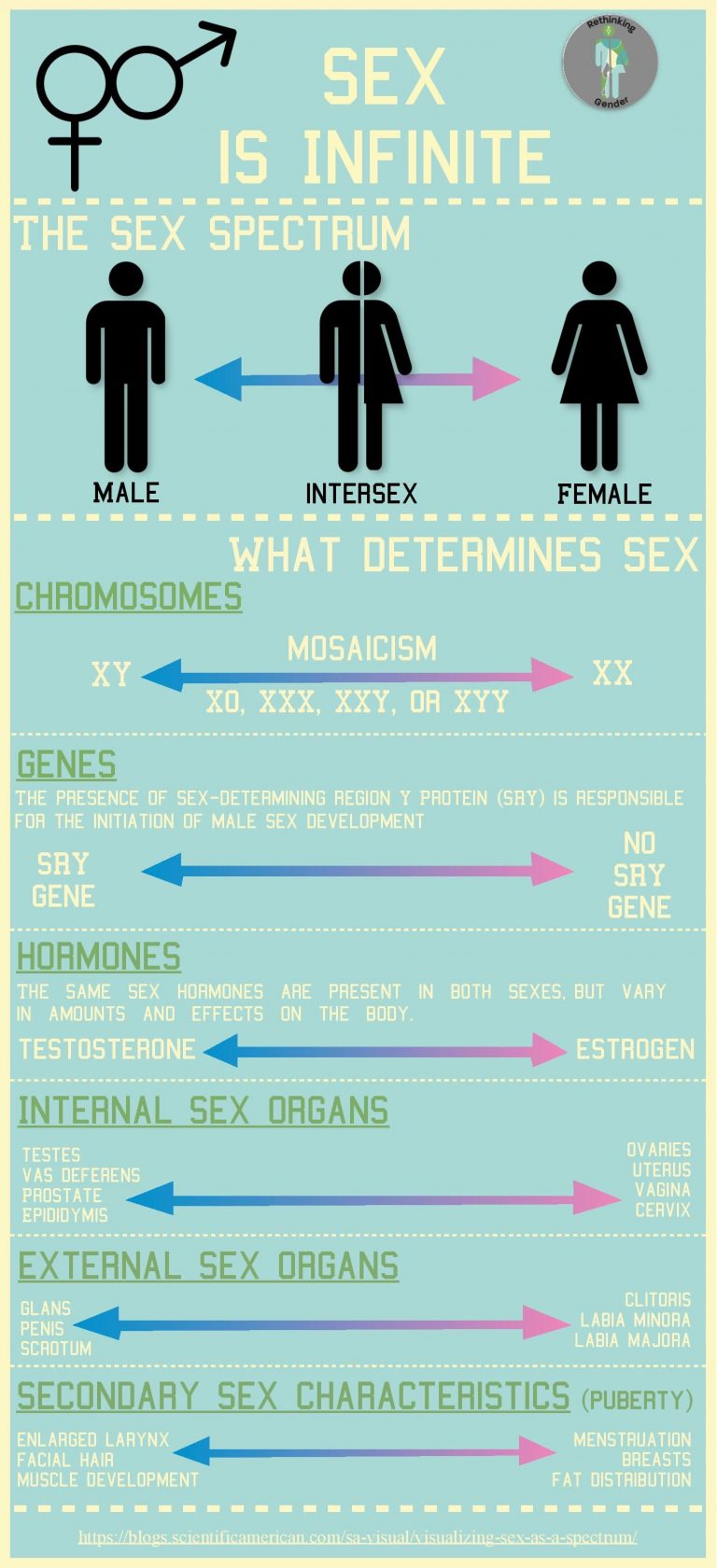
Thanks to Ali for the link. As I have pointed out, science has proven that sex is a spectrum / sliding scale from mostly male to mostly female chemical make up of a being. There is not one simple fixed point at which a person is male or female because biological sex is not binary. Yes it is hard for some people to grasp because for centuries the idea was if it dangles it is male and if not it is female, and if it dangles only a little because it is too short then cut it off so you can raise it as female. Again proven not to work. So what do we mean by male or female is a spectrum? Well because it is a spectrum or sliding scale a person can have a little or a lot of the chemical mix of DNA, chromosomes, enzymes, switches, and other things only scientist can understand or pronounce to look like one side of the slider but inside be all over the slider to the other side of it. The article is about birds, but the article makes it clear this same thing has been found in a lot of other animal species. And guess what? Humans are just another animal species. Hugs. Scottie
The bilaterally gynandromorphic green honeycreeper. Credit: John Murillo
A zoologist from New Zealand has spotted an extremely rare half female, half male bird while on holiday in Colombia.
The wild green honeycreeper (Chlorophanes spiza) has distinct green female plumage on its left and blue male plumage on its right.
This rare specimen is an example of bilateral gynandromorphy – a condition in which one side of an organism has male characteristics, and the other female.
“Many birdwatchers could go their whole lives and not see a bilateral gynandromorph in any species of bird. The phenomenon is extremely rare in birds, I know of no examples from New Zealand ever,” says Professor Hamish Spencer of the University of Otago, New Zealand.
***Video at link above, I am unable to post it here on WordPress***
Play Video
Short video of a bilaterally gynandromorphic Green Honeycreeper near Manizales, Colombia, 20 May 2022. Credit: John Murillo
Spencer was holidaying in Colombia when amateur ornithologist, John Murillo, pointed out the uncommon colouration.
“It is very striking; I was very privileged to see it,” Spencer says.
The finding, which is documented in a report in the Journal of Field Ornithology, is the 2nd example of gynandromorphism in this species in more than 100 years, and the 1st of a living bird.
The bilaterally gynandromorphic green honeycreeper. Credit: John Murillo
According to Spencer, the photographs of the bird are “arguably the best of a wild bilateral gynandromorphic bird of any species ever”.
Gynandromorphism occurs in a large number of groups of animals but is most often reported in species which display strong sexual dimorphism, including insects (especially butterflies), crustaceans, spiders, lizards, snakes and rodents.
Sexes of the same sexually dimorphic species display different physical characteristics. This makes it easier to distinguish gynandromorphism, where one side of the animal looks very distinct from the other.
The bilaterally gynandromorphic green honeycreeper. Credit: John Murillo
“This particular example of bilateral gynandromorphy – male one side and female the other – shows that, as in several other species, either side of the bird can be male or female,” says Spencer.
“The phenomenon arises from an error during female cell division to produce an egg, followed by double-fertilisation by two sperm.”
This error causes the egg cell to have two nucleuses: one with a Z chromosome and the other with a W chromosome. These are the sex chromosomes in birds, whereas in humans they are X and Y.
The bilaterally gynandromorphic green honeycreeper. Credit: John Murillo
Then, each of the two nucleuses are fertilised by a separate sperm. As a result, one side of the bird has female cells (ZW chromosomes) and the other has male cells (ZZ chromosomes).
The researchers observed the bird between October 2021 and June 2023. Its behaviour largely matched those of other green honeycreepers – except for one major difference.
“In general, it avoided others of its species, and the others also avoided it; it seems unlikely, therefore, that this individual would have had any opportunity to reproduce,” they concluded.
I am an older gay guy in a long-term wonderful relationship. My spouse and I are in our 36th year together. I love politics and news. I enjoy civil discussions and have no taboo subjects. My pronouns are he / him / his and my email is Scottiestoybox@gmail.com
View all posts by Scotties Playtime



 Scottie's Playtime