Idaho’s recently enacted bill encourages parents and children to bring legal action against schools and libraries that refuse to move certain material into “adult only” sections.
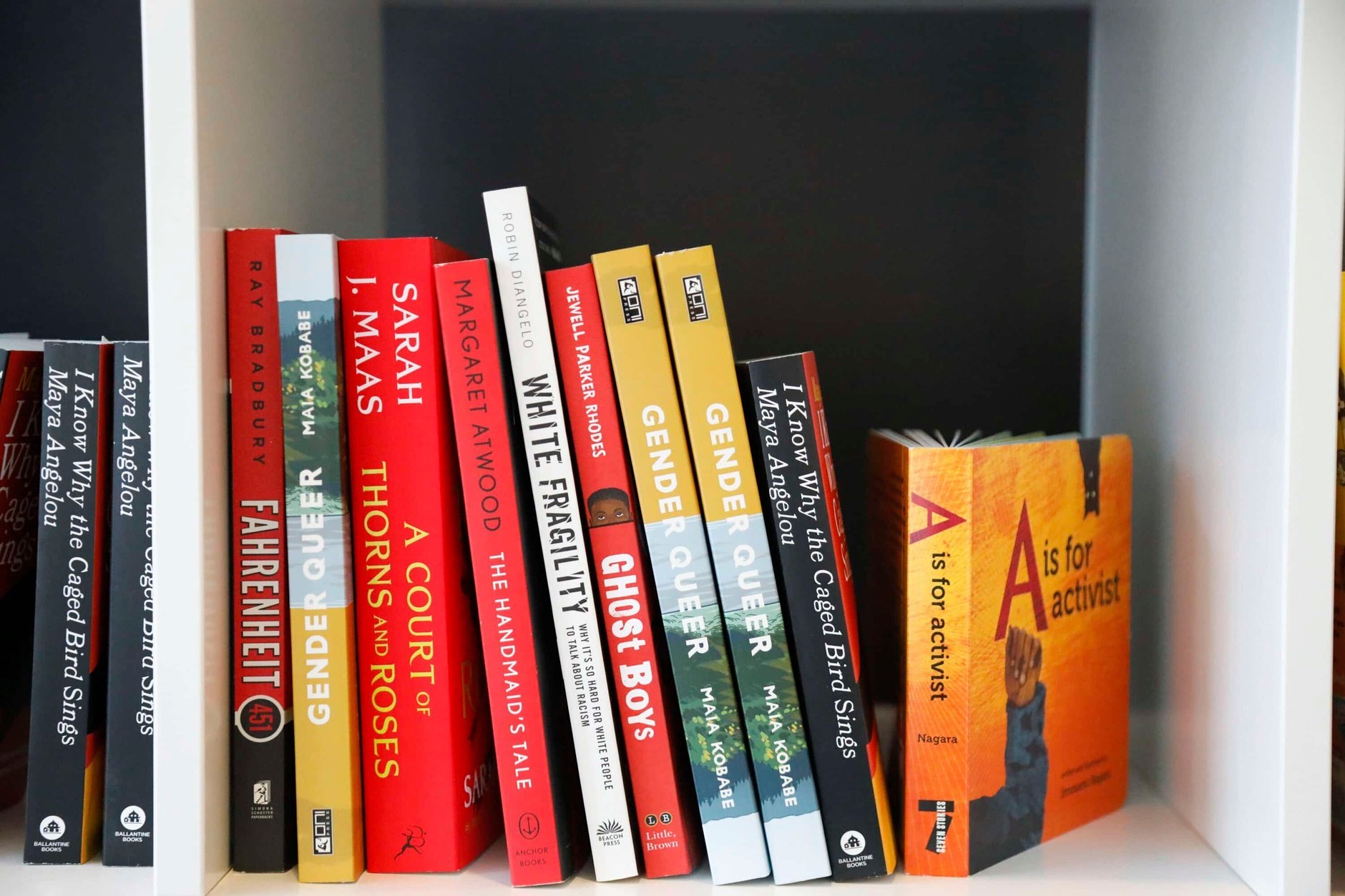
Books are displayed at the Banned Book Library at American Stage in St. Petersburg, Fla., on Feb. 18, 2023. (Jefferee Woo/Tampa Bay Times via AP)
A recently enacted law requiring Idaho schools and libraries to remove materials that are “harmful” to minors infringes on the First Amendment rights of private entities, a group of private schools, privately-funded libraries, parents and schoolchildren say in a Thursday lawsuit.
House Bill 710 — which took effect July 1 after Governor Brad Little signed it into law in April — allows citizens and the government to file a lawsuit against any school or library that doesn’t move certain material into designated “adult only” sections within 60 days of a complaint.
“H.B. 710 is the product of a social climate in Idaho (and elsewhere) in which schools and libraries have been inaccurately and unfairly castigated and villainized for using and making available constitutionally protected materials with content that the state and some Idahoans disapprove of,” the plaintiffs say in the 57-page complaint.
The suit was brought by private schools Sun Valley Community School and Foothills School of Arts and Sciences, along with the Community Library Association, a privately funded public library, and Collister United Methodist Church, which operates a lending library.
The groups are also joined by a set of parents and two high school-age students, who say that they want access to these reportedly “harmful” books and other materials to further their education.
The plaintiffs say the law violates their First Amendment free speech rights and their Fourteenth Amendment rights to due process. They ask the court to block enforcement of the law and to declare HB 710 unconstitutional.
“The act’s vague and overbroad definition of ‘harmful to minors’ conflicts with decades of settled constitutional law and extends well beyond the state’s limited authority to restrict the materials that private parties, like the private entity plaintiffs, may provide to minors,” they write.
Under the act’s definitions, the plaintiffs say, materials like health and sex education textbooks, literary works like Maya Angelou’s “I Know Why the Caged Bird Sings” and artworks like Michelangelo’s David would all be subject to removal, possibly based on arbitrary and subjective reasons.
“Even the Bible, if a defendant or citizen complainant subjectively believes members of their community would find them offensive,” could be targeted, the plaintiffs note.
The plaintiffs also take specific aim with a clause of the act that restricts materials that depict or represent “sexual conduct” — a definition that includes “any act of … homosexuality.”
Beyond the “vague and overbroad” definition of what constitutes “harmful for minors,” the plaintiffs also take issue with what they called the “incoherent” enforcement provisions outlined in HB 710. The act “fails to provide constitutionally meaningful guardrails on enforcement,” plaintiffs say.
“If a private entity plaintiff disagrees with the content-based assessment of the parent or minor and declines to segregate the challenged material, the parent or minor is authorized to file a civil suit against the private entity plaintiff and incentivized to do so by a cash reward and the availability of ‘actual damages,’” the plaintiffs write, referring to a provision in HB 710 that allows for a possible recovery of $250 and statutory and actual damages, if the complainant prevails in the case.
The government itself is also permitted under HB 710 to seek an injunction against any of the plaintiffs, who say this could lead to financial and reputational harm.
The plaintiffs name Idaho Attorney General Raúl Labrador as a defendant, alongside Jan Bennetts, prosecuting attorney for Ada County, and Matt Fredrick, prosecuting attorney for Blaine County.
HB 710 is not the first attempt Idaho legislators have made to restrict library access in the state. A version of the measure made it through the 2023 session but was rejected by Little.
In a letter after he signed HB 710, the governor commended the 2024 bill for having tighter definitions for restricted material and for lowering the recovery from $2,500.
“I share the co-sponsors’ desire to keep truly inappropriate materials out of the hands of minors,” Little wrote in April.
Libraries initially pushed back on the bill, citing free speech concerns and the financial burden it could levy, particularly on smaller libraries, but legislators stood by the measure.
“I can assure you that there is no book banning and there’s no book burning and there’s no book removal anywhere in this legislation. What we have to look at when you look at these libraries is that you have differing viewpoints and different opinions from taxpayers,” Representative Jaron Crane, a Nampa Republican and bill co-sponsor, said in committee, the Idaho Capital Sun reported in March.
I am an older gay guy in a long-term wonderful relationship. My spouse and I are in our 36th year together. I love politics and news. I enjoy civil discussions and have no taboo subjects. My pronouns are he / him / his and my email is Scottiestoybox@gmail.com
View all posts by Scotties Playtime


 Scottie's Playtime