
It reminds me of how “Cosmopolitan” was one of the early ‘mainstream’ magazines honestly discussing the AIDS virus, where to find care, and knowledge to avoid contracting it. They knew and reported early on that any- and everyone can catch what we now know as HIV. This piece is about early cancer info dissemination.
How Midcentury Women’s Magazines Fought Cancer
At a time when people wouldn’t even say the word, journalists at Good Housekeeping, Redbook, and other women’s magazines were informing readers how to recognize, protect against, and talk about cancer.
Maxine Davis wrote about plenty of tough topics during her long career in journalism, but none of them frightened her as much as the assignment she received in the spring of 1940. Her editors at Good Housekeeping wanted her to cover cancer, a disease so cloaked in stigma that Davis, like many other Americans, was afraid to say its name out loud.
The sweeping series of articles she produced that year changed her thinking. “My research has dispelled that terror,” she wrote in an article that appeared in Good Housekeeping’s April 1940 issue, declaring that cancer could be cured especially if it was caught early through education and hypervigilance. Cancer, she explained, was “sneaking, insidious. Only you and you alone can guard yourself against it.”
At the time Davis wrote these words, cancer was a taboo topic. The term itself wouldn’t be spoken on the radio until 1945. Rumors about its causes were rampant. (Many Americans at the time believed it to be contagious or a sign of poor character.) Physicians routinely withheld cancer diagnoses from patients to spare them shame. Although it wasn’t always a death sentence, the treatments we rely on today were nascent or nonexistent. And yet, the editors at Good Housekeeping still decided to devote pages and pages to in-depth coverage of the disease.
This is one example of how, during the 1940s and 1950s, women’s magazines played a vital and largely forgotten role in educating average Americans about burgeoning efforts to prevent and treat cancer. It was a pivotal era for modern medicine thanks to scientific advancements and increased attention to public health. Cancer was among the leading causes of death, and rates were increasing in part because people were living longer. Print media in all its forms played a major role in normalizing public conversations about cancer, but women’s magazines took a unique approach. They made disease prevention personal, calling upon women to become cancer watchdogs for themselves and their families.
Davis was among the best-known of the women’s magazine journalists covering cancer. By the early 1940s, she had reported on the League of Nations, driven all over the United States to research a book about American youth, and founded a wire service aimed at explaining politics to women. Her cancer stories for Good Housekeeping launched her to a new level of prominence, one akin to modern day health influencers. Her editors promoted her work heavily, framing her as a lay expert with carefully cultivated sources. “Doctors like to work with her,” they wrote in an introduction to her spring 1940 cancer series, “and they give her all the help they can.”
Writing in May of 1940, Davis introduced readers to the basics of cancer treatment, explaining in plain language how surgery, X-rays, and radium were being used to help patients.
Sometimes X-ray, radium, and surgery are all used to treat a malignant condition. Take the case of Ada Johnson. Ada put off going to hospital longer than she should have after she felt a lump in her breast; but the doctor didn’t think the situation was hopeless. This is what he did:
First, there was a surgical operation. When that had been successfully accomplished, the specialist in cancer of the breast applied radium to the chest wall. That wasn’t all. The doctor then used deep X-ray therapy on Ada’s breast and armpit….This was repeated for thirty-five treatments. Ada is perfectly well today.
Davis was not, however, the only women’s magazine reporter working the cancer beat at midcentury. Seventeen magazine’s beauty editor Jean Campbell urged her young readers to get involved in efforts to bring specialized cancer to more communities. “Demand them,” she wrote in the April 1948 issue, “and raise funds for them.” That same year Miriam Zeller Gross deftly described the history of stomach cancer treatment in a gripping feature story that appeared in Better Homes and Gardens. In the early 1950s, Redbook’s Collie Small encouraged women to overcome “false modesty” and allow physicians to screen them for breast cancer. Women’s magazines were publishing hundreds of articles on cancer by dozens of writers. Women also wrote about cancer for general magazines including The Saturday Evening Post, which featured a handful of stories in the 1950s by female cancer survivors.
Stories about cancer were far less common before World War II, but they did sometimes appear in women’s magazines. Ladies Home Journal has been credited by medical historians with publishing the very first general interest article about cancer detection in 1913. Others, including Good Housekeeping, featured occasional educational columns by physicians during the 1920s.

In addition to becoming quick experts on complex medical topics, these journalists managed often-fraught relationships with health professionals who tended to distrust journalists. It became common practice during this time for physicians to review stories before they were published. Sometimes, one of those physicians would write a sidebar: In 1955, American Cancer Society vice president Dr. Charles S. Cameron had reviewed a draft of an April 1955 article on cervical cancer by health journalist Gladys Denny Shultz for Ladies Home Journal, and wrote a public note of thanks, proclaiming that the magazine was “offering its readers a great service by publishing this excellent article. It should be a means of saving thousands of lives.”
While most of the bylines atop women’s magazine stories about cancer belonged to female journalists, editors did occasionally invite physicians, almost always men, to contribute. Cosmopolitan published a 14-page essay by Walter Alvarez, who had just retired from clinical practice to pursue a second career in medical writing. The piece, which appeared in January of 1953, sprawled across 14 pages under the headline “Danger Signals in Your Life” and includes tips to spot illnesses like cancer in children, teens, and adults. Alvarez assured readers he wasn’t out to scare them. Instead, he hoped to save “wise persons from avoidable illness or death.”
Much of this coverage was driven by coordinated public relations campaigns initiated by the American Cancer Society and similar organizations. In addition to connecting journalists with expert sources and organizing junkets to prominent research centers, such campaigns included advertising blitzes promoting new treatments, championing medical breakthroughs, and reminding Americans of the importance of cancer screenings. Women’s magazines were a popular venue for such ads, so it wasn’t uncommon for some issues to feature a reference to cancer on nearly every page.
While groundbreaking, the cancer coverage provided by midcentury women’s magazines was imperfect. Race and class were seldom addressed because these publications — like much of the news media — assumed their audience was white and financially stable. Some coverage also illustrates the era’s rudimentary and fast-evolving scientific knowledge. One example is a story that appeared in Parents magazine in 1943. Written by journalist Constance J. Foster and prominently endorsed by the New York City Cancer Committee, the article proclaimed that “cancer is not hereditary.” A piece that appeared in Redbook a decade later explained new research showing that some forms of cancer do run in families.
The role of women’s magazines in the fight against cancer is a fascinating chapter in media history, one laced with a type of gender politics that feels familiar today. The cancer beat gave women journalists like Davis access to male-dominated sectors like medicine, public policy, and journalism, but it also kept them firmly tethered to domestic matters and subservient to male physicians. Their work, while educational, put undue pressure on individual women to spot the signs of cancer. But it also brought hope to families facing a terrifying diagnosis. As Davis wrote in the October 1948 issue of Good Housekeeping, “Cancer is not necessarily fatal. Cures do exist.”
Northeastern University student Elsa O’Donnell contributed archival research for this article.

 Scottie's Playtime
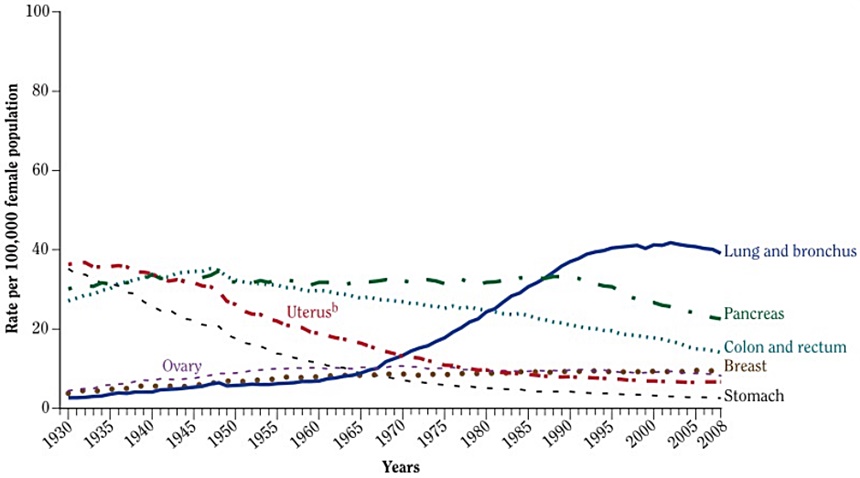
First, the advent of the modern refrigerator in the 20’s and 30’s was one of the greatest public health successes in modern history. Being able to keep food fresh enormously reduced the consumption of salted and pickled foods, which were predominantly preserved with nitrates, which is a carcinogen in high quantities. The refrigerator (and industrial refrigeration throughout the food processing process) dropped stomach cancer from #1 or #2 most common cancer in adults to dramatically lower, to the point where it’s almost nonexistent today.
Also, not telling women about their cancer diagnosis was a practice that continued well into the 60’s. Lurleen Wallace, wife of Alabama Governor George Wallace, was diagnosed with uterine cancer in 1961; her doctor told him, but they did not tell her. The consequence was that she didn’t find out she had cancer until 1965, by which time it was widespread and untreatable, she died months later.
Misogyny kills.
LikeLiked by 1 person
Yep, look at heart disease. For so long, there were only the symptoms that men almost always exhibit, but women not so much though they can and sometimes do. But lots of needless deaths of women from MIs take place because “nothing was wrong” except some nausea, and maybe some discomfort like heartburn or muscle ache. Plus when these symptoms were found, they saved men and others as well as women, because everyone doesn’t always get the chest pain/left-jaw-through-arm-and-chest symptoms that many men exhibit.
I hope people don’t forget what we’ve learned, even if they have to stop learning more. It’s all just so stupidly wasteful.
LikeLike
And now they’re poised to roll all that back.
The list is alphabetic spread across a bunch of posts (I refuse to call them ‘skeets’ ) so you’ll have to go there and look at ’em all, but
But basically nothing that isnt centered on straight white males (exuse me ‘the default human’) is gonna get kicked.
Of course since Elno thinks ANY money spent on squichy biology research is ‘waste and fraud’ they’ll just zero out the agenies.
Between quitting the WHO, killing the CDC, and having Bobby Brainworm in charge of the tattered remants of our national Health systems we are so fucked seventy ways from Sunday the next pandemic comes along…
LikeLiked by 1 person
Cheers.
I don’t know what else to say. I only recall that when the guy at the beginning of “Hitchiker’s Guide” bought everyone a drink before the world ended, it struck me as something I’d like to do myself (not today, but you know what I mean.)
LikeLike