
I don’t know if I care if it looks like a drone, though. However, some people might, so here is this:
Admit It: You’ve Always Wanted a Robot Vac Built Like a Drone
DJI is now getting robot vacuums, and it’s making a splash with a transparent design.
By Kyle Barr
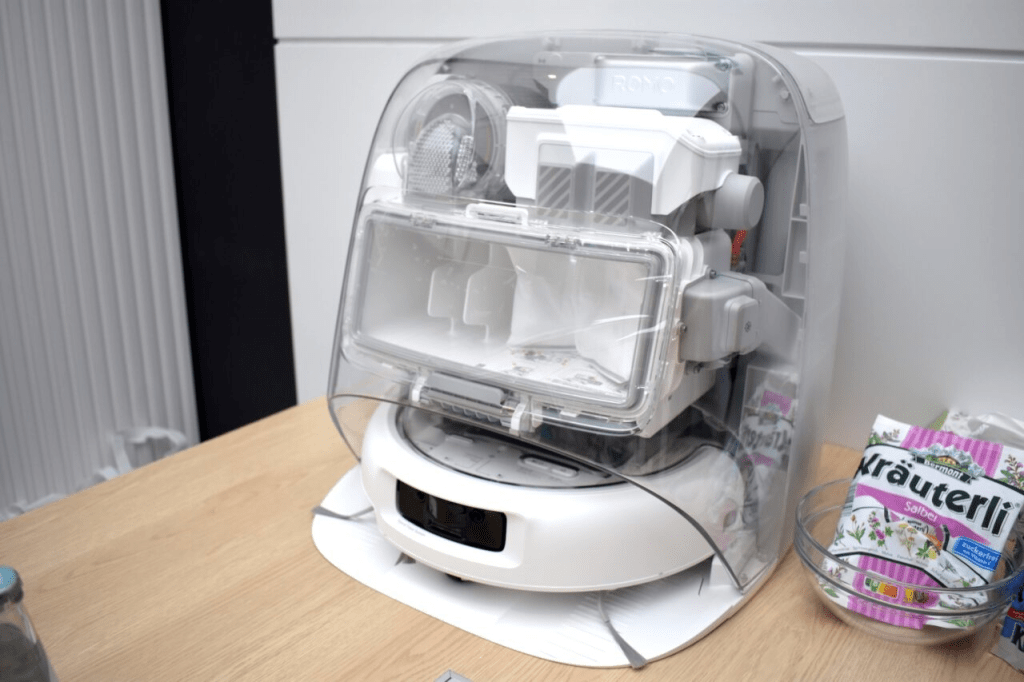
Did you ever want to watch the grubby guts of your robovac as it cleans? © Kyle Barr / Gizmodo
If you thought that it already sucked that you still can’t buy a new DJI drone in the U.S., get ready to learn about the company’s new robovac. The largest drone maker in the world now has its first smart home appliance in the form of the DJI Romo. The easiest way to describe it is as if a modern UAV removed its propellers and replaced them with wheels, fins, and mops but kept the obstacle detection technology. It’s a compelling idea that will inevitably have the U.S. government afraid that foreign actors will start spying on our messy, unwashed floors.

Back during IFA 2025, DJI took me into its back room to see a load of its upcoming tech. I went hands-on with the DJI Mini 5 Pro and DJI Osmo Nano. Then a company rep tore the sheet off the massive base station for a robovac. The first thing that came to mind looking at DJI’s Romo was, “Is this the Game Boy of Roombas?” Sure, I’ve been fully gamer pilled since I first held a controller, but the odd transparent plastic shell that DJI slapped onto its new product told me the company was offering a robovac that would appeal more to the tech-literate than many other automated suckers and mops.
DJI is known for its drones, though it has its feet in a plethora of product categories—from action cameras to microphones. The company’s first smart home tech product could make use of the company’s expertise in flying robotics—even though this device can’t fly (as much as we may wish it could).

DJI’s drones contain some truly impressive obstacle avoidance technology using multiple LiDAR sensors. These sensors combine with binocular fisheye vision sensors for its object detection. DJI claims its robot vacuum can spot objects as thin as 2mm, so it can maybe avoid swacking at any socks, dangling charging cables, or potentially even playing cards. The Romo may even be able to operate with better accuracy in low-light environments, thanks mostly to how LiDAR uses pulsing lasers to measure distances between itself and objects.
DJI says it developed novel algorithms for navigating a home. It’s supposed to recognize the areas of your home with carpets. The two side brooms are supposed to slow down when getting near your cat’s litter box. However, those cameras can also be used by owners to check on their homes. You have to use two-factor authentication to see those feeds. DJI also promises its video data is encrypted. (snip-embedded tweet on the page)
The Romo vacuum comes in three flavors: an S, A, and P version. The cheapest S tier starts at 1,300 euros (or $1,516) and goes up to 1,900 euros (around $2,216) at the P tier. You can expect most of the same features between each model, though the costliest P version includes a “floor deodorizer” solution the vacuum sprays in its wake and UV for disinfecting the drying bag. Either way, the unit will have 25,000Pa of suction power and contain a 164ml tank for mopping with its dual-spinning mop pads.
The Romo is currently only available in European markets. There’s no word when—or if—it’s ever coming to the U.S. Just like all DJI products, the U.S. government has effectively soft-banned any of its shipments to the States, and not just its drones. The U.S. government has until Dec. 23 to stop a full DJI ban from going into effect. The dronemaker needs a U.S. security agency to vouch for it, and DJI confirmed with The Verge that none have stepped up to bat for the China-based tech company.
Sure, there are plenty of other high-end robovacs like last year’s Roborock Qrevo Curv or more recent devices like the Roborock Saros 10 and the Dreame X50 vac/mop combo with suction power just below DJI’s. Some of those vacuums, like the Saros 10, have additional features that let them clear small hurdles as well. But one thing is for sure: none of those have a clear plastic shell.

 Scottie's Playtime
Seriously kiddo, you think one of those things would vacuum you house? No way it could vacuum mine; the neighbors’, my kid’s apt, my g’kids’ apt, literally any house stick-built or manufactured I ever remodeled etc ad nauseum. The only place I ever saw one of those work effectively was in a remodel of about a 7,000 sq ft McMansion with no clutter (funny story: they had a couple of those funny little wrinkly Chinese dogs that would ride around on the roomba:))
I get it, like my electric car it’s cool, but ahhhhhh …
LikeLiked by 1 person
Well, ya know. I don’t have one, but sometimes they’re very tempting. A few years back, we bought this broom from Fuller Brush: it had the same type of sweeping action. It had the two spinning brushes and a roller brush, but a person has to use it. sigh
It was great for, say, crumbs, or anything bigger than the dust that drifts in. But for sweeping in general, especially for dog hair, it really didn’t do the trick. I gave it away to a daycare, who likes it for when cereal flies off highchair trays. I keep talking myself out of a robovac based on that experience. Corky crossed the bridge, but Ollie sheds at least as much as Corky did! 😀
But, yeah, robovacs seem like they’d be cool and time-saving … 🙂
LikeLike
We bought our first robotic vacuum cleaner several years ago. It lacked mapping capability. It did a reasonable job of keeping the ground floor of our multilevel home clean, but had no idea when it had completed cleaning the entire level and would keep going until the battery was low before going in search of the charging station. It did this by locating a wall then following it until it literally ran into the charging station. Sometime the battery went flat before the station was found. About a year later we bought a smart robotic vacuum cleaner that could map and I could assign it to clean specific rooms. The most traversed rooms are vacuumed daily. Our home is not one that can be described as tidy. Lived in is a better description. But the robot can navigate around, under and over most obstacles. Items like stray socks or shoelaces do tend to bring it to a halt but otherwise it’s served us well for two years. Both those robots were cheap brands costing around NZ$250 (about US$150)
Last week we bought a new robotic vacuum cleaner, about twice the price of our previous ones but much smarter. It uses LiDAR to map and find its way around. Once you’ve had one of these devices for a while, you wonder how you managed without one. When you have a long hair cat like our Frankie, they are a godsend. And speaking of Frankie, while he always kept a respectable distance from the other vacuums, he has started to doing mock attacks on the new one, hiding behind a door or furniture and jumping out at it as it passes. He’s figured out that the cleaner will try to avoid him if at all possible. Perhaps it will develop into a battle of wits with Frankie doing his best to disrupt Robbie from doing it job (yes we’ve named the robot) while it does it’s best at cleaning while avoiding the cat. At the moment Robbie has the upper hand, but for how long?
LikeLiked by 1 person
Now that’s a bonus: a cat toy that cleans! Also it sounds as if it does a better job than the broom I had. I guess the vacuum part would have to do with that. I have a little house-984 sq. feet, mostly wood floors. As I said, it’s tempting! I appreciate your input, Barry. It’s good to know.
LikeLike