
or just wish to know a little more! See history and more on this home page; beneath are some snippets.

What Is Day of the Dead
Here in the USA, we mourn our loved ones when they pass with funeral services and wearing dark solemn clothing. It’s usually a sad time in our families when we have to say goodbye to grandpa forever. Different cultures grieve and treat death differently with traditions that have been around for centuries.
One culture that has created a unique and interesting way to face death and the deceased is Mexico. Mexico is colorful, noisy, and lots of fun. The people, the food, and the celebrations are bright, loud, and unequaled. So when it comes to death, in true Mexican style, Mexicans celebrate with color, food, and music.
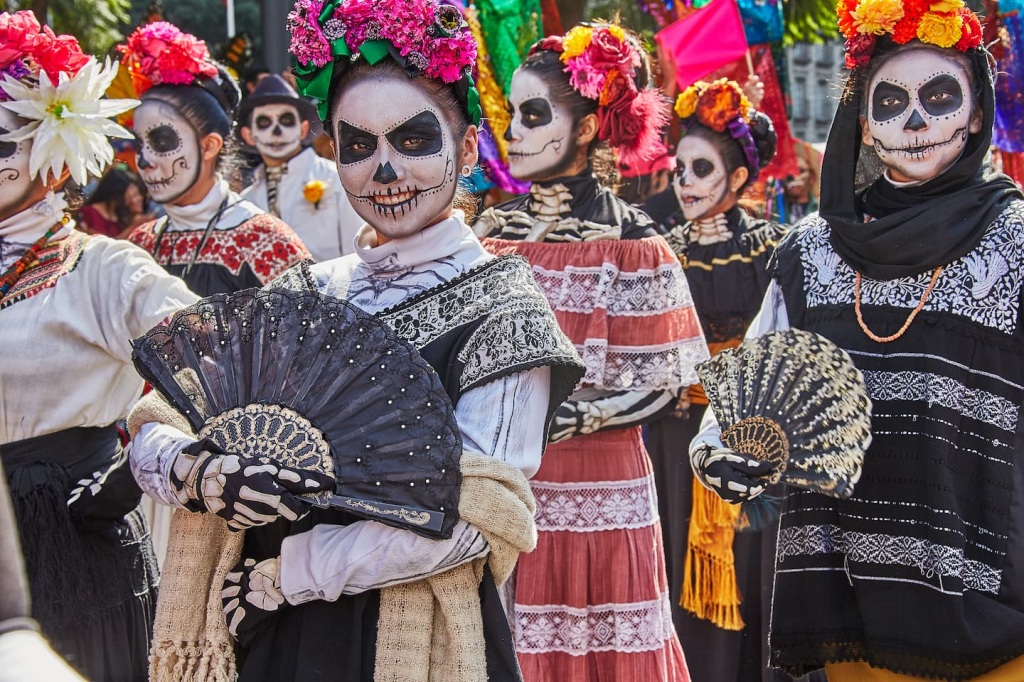
Day of the Dead is a 2-day celebration where it is believed that the passageway between the real world and the spirit world is open so our deceased loved ones can come back to visit us. What do we do when grandpa comes back from the land of the dead? We make his favorite meal and we offer him his favorite drink. We sing, dance, and rejoice before he heads back to the underworld for another year.
When Is Day of the Dead
Day of the Dead is celebrated on November 1st and 2nd. It is sometimes confused with Halloween because of the symbolic skulls but is not related at all.
It is said that on November 1st the children who have passed come back to visit and celebrate as angelitos and on the following day, November 2nd, it’s the adults (Difuntos) turn to show up for the festivities.
Family members prepare for several weeks in advance for the tradition by creating altars, decorating burial sites, and cooking specific Day of the Dead food. (snip-MORE)
=====
Day of the Dead Traditions
Ofrendas
In the weeks leading up to the holiday, Mexican families will begin to decorate their homes for the holiday. The centerpiece will be the Ofrenda, or Altar de Muertos, a display meant to commemorate the lives of loved ones. This tradition can be traced back to the Aztecs, who would place offerings for the dead, including food and flowers, on tree stumps on their days of remembrance.
The traditional Ofrenda is divided into various levels to represent the various stages of life and death. There can be two levels, representing heaven and Earth, three levels, representing heaven, Earth, and the underworld, or seven levels, representing the seven stages souls have to cross to reach eternal rest. It is decorated with purple and orange, the traditional colors of the holiday, and often adorned with papel picado, a popular Mexican paper craft that is made up of ornate cut-outs. The papel picado used for the holiday will feature specific images and motifs associated with Day of the Dead, such as sugar skulls and dancing skeletons. Traditional Mexican oilcloths are commonly used to drape the surface of the Ofrenda. (snip-MORE)
Calavera: Sugar Skull
Skull Imagery in Mexico and its History
Skull imagery has a long history dating back to the traditions of pre-Columbian civilizations. The Aztecs had several festivals of remembrance where they would worship the Goddess Mictecacihuatl, ruler of the afterlife and keeper of the dead. Mictecacihuatl was often represented as a skeleton, adorned with a crown of flowers and skulls. For many pre-Columbian cultures, human skulls or skull motifs were used as decoration on walls as a sacrificial offering to the gods. These are commonly referred to by the Nahuatl term Tzompantli. Some of these, such as the Mayan Chichen Itzá Tzompantli in Yucatán, and the Aztec Huey Tzompantli in Mexico City, remain to this day and can be viewed by visitors.
Another motif that may have influenced calavera imagery as we know it today is likely a type of European art known as Danse Macabre. These paintings and engravings, often featuring dancing skeletons, were meant to represent the inevitability of death and were used as decorations in churches across Europe. It is probable that the Danse Macabre motifs were brought over by Spanish missionaries and later fused with Indigenous skull imagery. (snip-MORE)

 Scottie's Playtime
What I know about the Day of the Dead I learned from Coco, and now here.
I made deviled eggs last night. I guess it will be pizza and Pepsi tonight! Gotta feed the spirit!
LikeLiked by 1 person
Yum! Pizza keeps nudging me, too. Enjoy, MDavis!
LikeLiked by 1 person
Dia de los Meurtos is one of my favorites holidays. Every year I did Day of the Dead lessons in my grade six humanities classes, leading up to the 1 November when we’d have some kind of celebration. I justified it because the Cambodian harvest festival (Pchum Ben) is also a remembrance for your ancestors, but most of my students couldn’t tell me about any of the traditions. It was sad, but it got us talking and researching and writing and presenting and eating calaveras (or as close as we could come to them).
Such a great tradition. I missed it this year, so I’m glad to read about it here. Thanks, Ali!
Blog On, Sibling!
Jack
LikeLiked by 1 person
You’re welcome, Jack! I hadn’t seen anything about it here before, so thought it could be of interest, or maybe make someone feel a little more at home.
LikeLike
You know, you reminded me. I didn’t teach this, per se, but a couple of the kiddoes in my afterschool observed with their families and neighbors, and were willing to share with us, a couple of years. I learned quite a bit. They did a good job, and the other kiddoes did a fine job listening and participating.
LikeLike
It was always a great moment when you had kids teaching each other. Those are the lessons that stick.
LikeLiked by 2 people
Oh, I hope so!
LikeLike