
Linked in a Wonkette newsletter.
Why Democrats are suddenly winning back the left — and the “double-haters”
Plus, the share of Americans calling themselves Republicans just hit a decade low. Your weekly political data roundup for April 5, 2026.
Leading off: Very liberal Americans, who have rated the Democratic Party poorly relative to other partisans since 2024, have swung sharply back toward congressional Democrats over the last few months. A new poll also finds voters who dislike both parties now prefer Democrats by 31 points. These gains should reassure a party that has faced internal strife since Trump’s second term began, but look less due to renewed faith in the Democrats and more like anti-Trump consolidation. That might not matter for the midterms — a vote won is a vote won — but it will matter for 2028 and beyond.
On deck this week: Tuesday’s Deep Dive will cover some new research on the level of ideological thinking in the electorate and the value (or not) of ideological moderation by the Democrats, and Friday’s Chart of the Week will respond to whatever’s in the news. I’m also finalizing questions for our April Strength In Numbers/Verasight poll this week — so subscribers, send in your question recommendations if you haven’t already! (Email or comments are fine.)
On with the data.
1. Anti-Trump sentiment, not pro-Democratic enthusiasm, is uniting Democrats again
A new YouGov/The Economist poll, fielded from March 27 – 30, finds that Democratic voters have grown significantly warmer toward their members of Congress over the last few months. Earlier in 2026, Democrats said their party’s MOCs were favorable at a rate just 30 points higher than the rate they said their party was unfavorable. That gap has now grown to +55 — rivaling the favorability of Republican MOCs among Republican voters.
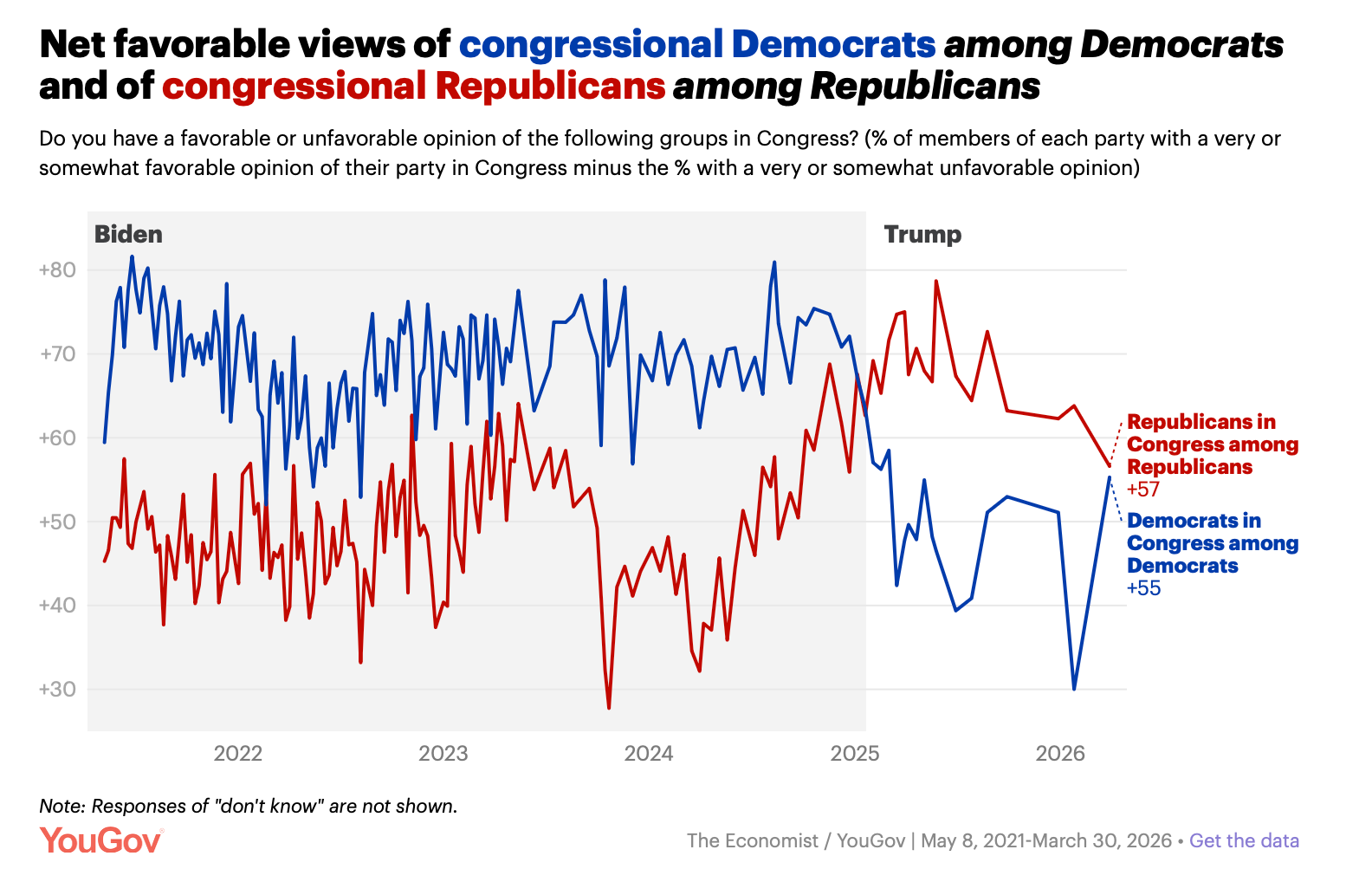
Aggregate Democratic views have increased because very liberal Americans have become sharply more favorable toward congressional Democrats since January. This group evaluated the party’s members of Congress favorably by a net +28 points margin — up from a -13 deficit in January. That’s a 41-point shift in two months:
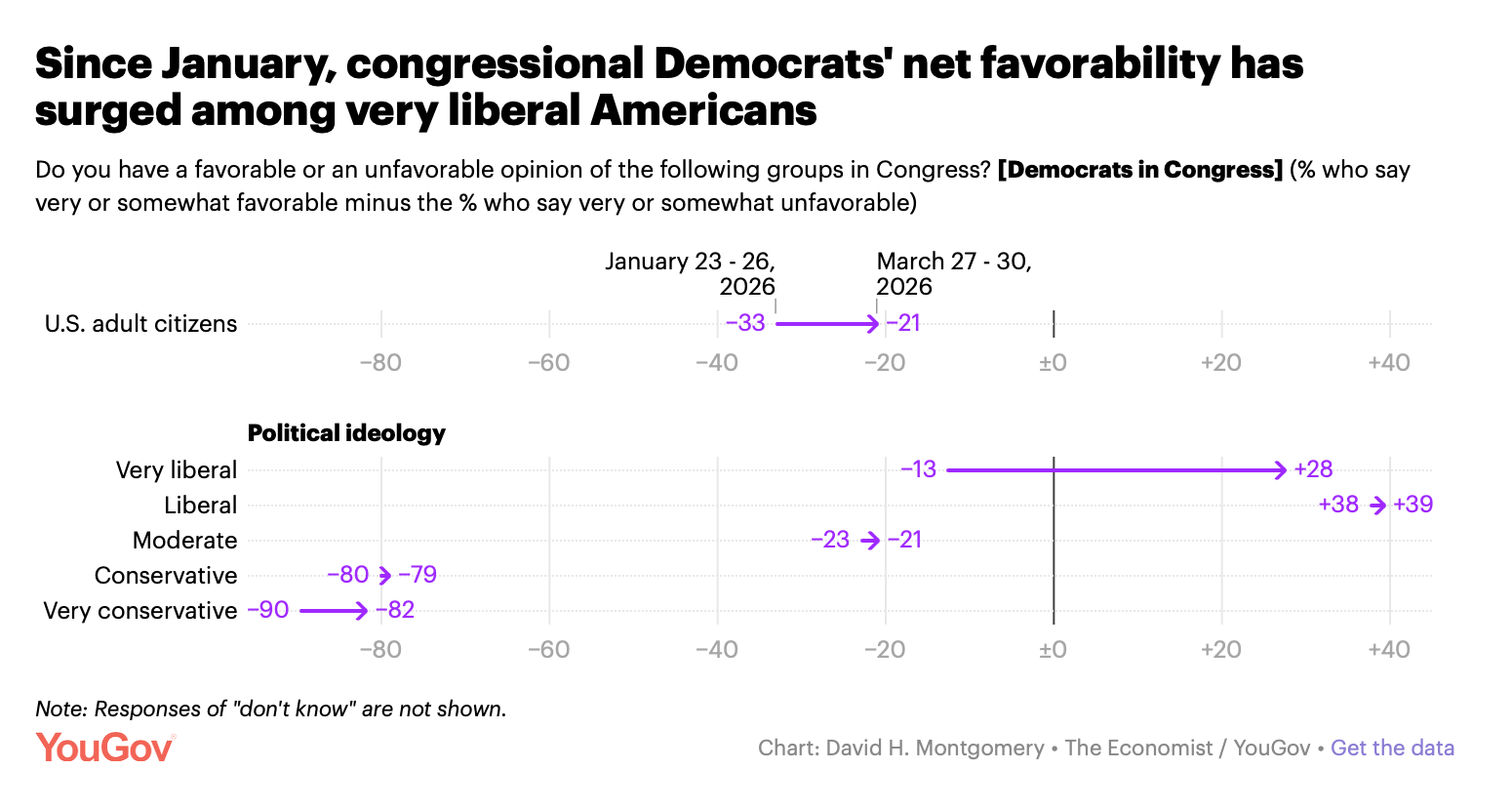
Among Americans who are liberal but not very liberal, moderate, or conservative (basically everyone else), views of congressional Democrats barely budged.
Overall, U.S. adults give the Democrats a favorability rating of -21, 5 points higher than the rating they currently give Republicans.
That is a meaningful change. Last summer, Strength In Numbers documented that Democratic party favorability was unusually weak even as the party remained competitive on the generic ballot. We dug into the survey microdata and found out that this was because many left-leaning Americans were frustrated with their own side after the 2024 loss. Charles Franklin, who conducts the Marquette University Law School Poll, has been tracking the same dynamic in both national and Wisconsin polling. Among Democratic identifiers in Wisconsin, his data shows a net +56 favorability rating for their party, compared to +74 among Republican identifiers for the GOP.
Franklin finds that while Democrats still disagree about what they’re for, they are virtually unanimous in what they’re against: Donald Trump.
The simplest explanation for Democrats’ gains is that politically active party members on the left — who have had a lot of complaints about how the party is handling Trump 2.0 — are now responding to the same thing many other Americans are right now. That is, the president has moved public policy on many issue domains far to the right and up on the authoritarian axis (certainly far past the policy temperature “set point,” to use the language of the thermostatic model), and progressives are setting their differences with the Democrats aside for the moment as they focus on defeating an increasingly unpopular Republican president. This looks more like anti-Trump unity than pro-Democratic enthusiasm.
But it’s not just the base
The Democrats’ consolidation of left-wing liberalism is one piece of a broader backlash to Trumpism that shows up in the polling data right now. Another notable finding this week is from a new CNN/SSRS survey that found that about one-quarter of the public holds an unfavorable view of both parties. These are the so-called “double haters.” This group prefers Democrats on the 2025 generic ballot by 31 points.
This is a big deal for two reasons. First, that’s a massive shift; Double haters broke for Trump in 2016 and again in 2024. Now they’re swinging hard the other way.
Like Franklin’s polling, the CNN report also finds that Democrats’ gains are driven largely by opposition to the GOP, not enthusiasm for Democrats themselves. When asked what they dislike about Democrats, 22% of double haters called the party “do-nothing” and 11% said they aren’t standing up enough to Trump and the GOP, while 10% said they’re too liberal.
Will 2026 be a Democratic fake out?
So we’ve got two layers of anti-Trump consolidation happening at once. YouGov’s data shows the Democratic left is coming home, and the CNN poll shows voters who dislike both parties — a swing group that has been decisive in recent elections — are breaking heavily toward Democrats for the first time in years. Neither group is necessarily enthusiastic about Democrats. But both are currently heavily voting against Republicans. According to the CNN poll, 79% of voters who plan to support Democrats say their vote is a message of opposition to Trump. (Only 46% of Republican voters say they’ll vote to show support for the president.)
This could make for a big electoral win for Democrats in November, despite the division in the party and its overall nominally unpopular rating. According to CNN, Democratic-aligned voters are 17 points more likely than Republicans to call themselves “extremely motivated” to vote in 2026 — even though they’re 14 points less likely to view their own party favorably. Meanwhile, the Democrats have opened up a large lead in the U.S. House generic congressional ballot for 2026. They are up +6 in both the CNN and YouGov surveys, and closer to +5 on average.
This is the pattern I’d expect in a midterm environment that favors the out-party. But with many Americans (including the vaunted “double-haters”) still viewing the Democrats as weak and ineffectual, a big electoral victory will not completely solve their deeper problems of identity and division.
The trend in this data is good for the Democrats, in other words — but don’t misread a positive trend for a positive level.
2. What Strength In Numbers published last week
Readers of Strength In Numbers got three articles last week — a lighter load, since I was out sick Monday and Tuesday.
This week’s Deep Dive asked a question I’ve been getting a lot lately: if Trump is 20+ points underwater, why aren’t Democrats leading the generic ballot by 20?
Trump is 20+ points underwater. So why aren’t Democrats up 20 for the midterms?
G. Elliott Morris Apr 1
On Thursday, David and I recorded our weekly podcast about Trump’s record-low polling numbers on Iran and the economy:
(snip-a bit More, go see it)

 Scottie's Playtime
we may lose the battle but by golly we just might win the war this time. Open eyes, close mouths, vote your gut this time.
LikeLike