
also sigh
Here’s Why We’ve Been Keeping An Eye On Alabama
A really bad decision from SCOTUS
When we last discussed Alabama, we talked about the fact that it took the state about a nanosecond after Callais to run to the Supreme Court for permission to redraw its maps—to get the “benefit” of Callais—ahead of the midterm elections.
Today, the Supreme Court ruled. There had been speculation that they might delay until after the midterm primary, which is scheduled for Tuesday, May 19, one week from tomorrow. But the Court jumped right into the fray, despite its constant protests that it does not interfere in elections or make political decisions.
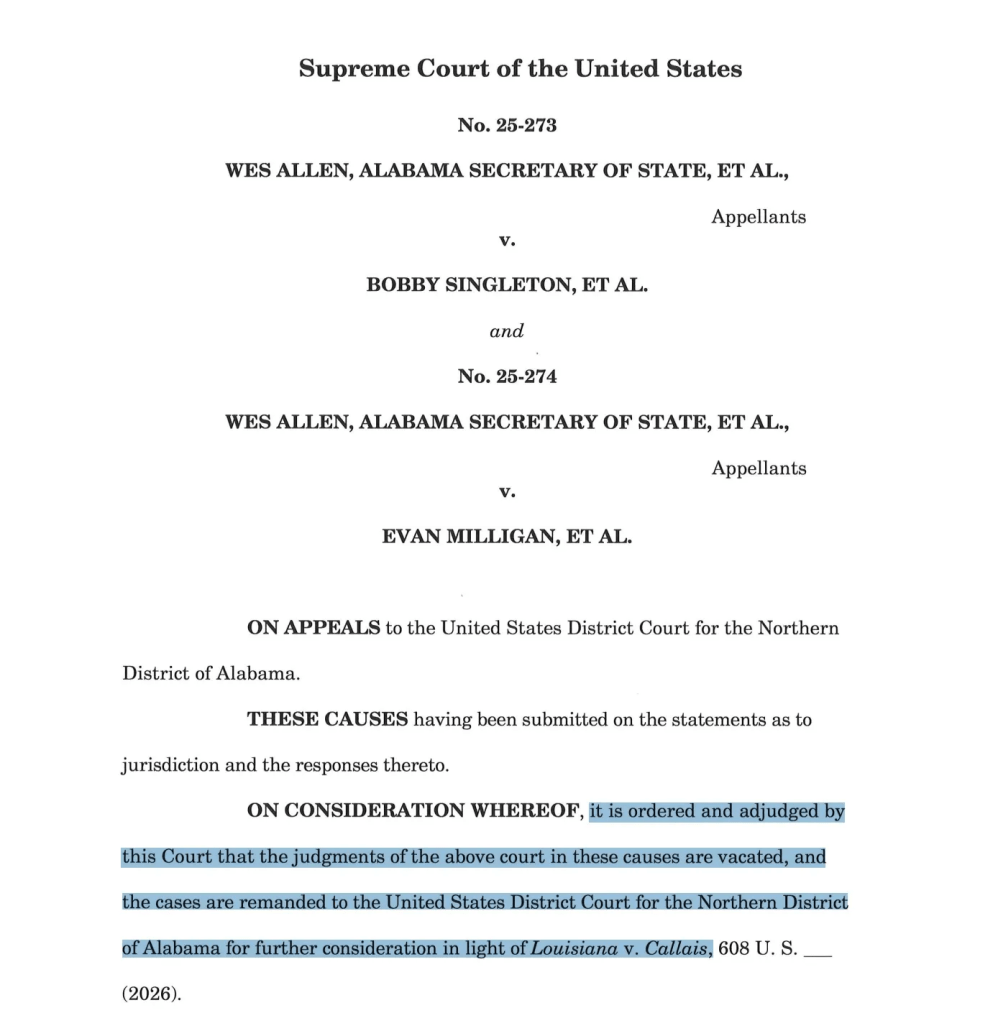
The Court has sent the case back to the panel that considered it previously for a decision “consistent with Callais.” Essentially, that’s a direction to permit Alabama to abandon the court-ordered map that created a second Black opportunity district and leave the state free to revert to the older map that the Court had previously ruled discriminated against Black voters in violation of the Voting Rights Act. That’s the map we looked at the other night, that sends long spines out of Alabama’s Black Belt into Birmingham, Montgomery, and north of Mobile to pack Black voters into a single district.
Justices Sotomayor, Kagan, and Jackson dissented. I haven’t seen the dissent yet, but it’s noted on the docket. I’d expect it to be pretty vigorous and to focus on the panel’s finding that the Alabama Legislature engaged in intentional discrimination against Black voters. The Court split along pure party lines. Justices Roberts and Kavanaugh, who three years ago ruled in favor of Black voters, abandoned that principled position.

Oh, and the kicker? Despite Alabama’s win, which meant the Court found that the maps the state legislature had drawn illegally discriminated against Black voters, the state went through an additional election cycle using those maps. Alabama had argued that any changes, sought in February ahead of a June primary, came too close to the election and violated the Purcell principle.
Purcell is the recently created Supreme Court doctrine that says federal courts can’t make changes to state election laws or procedures “too close” to an election, whatever too close means. Meanwhile, the Supreme Court just made the mother of all changes in Alabama one week before the primary.
The rationale for the principle is that it prevents voter confusion and avoids logistical chaos for election officials. Since the Court dropped its decision, I’ve spoken with candidates, election officials, and voters in Alabama. To say Alabama is in disarray is not an overstatement.
It’s not even clear whether the primary will be held on schedule next week at this point. Jerome Dees, at the Southern Poverty Law Center, told me that, “HB1 didn’t give a clear cutoff date for when it would be ‘too close’ to the election, which means whether Alabama will hold a primary on schedule next week is up in the air.” There has been some suggestion that Governor Kay Ivey and Secretary of State Wes Allen are canvassing local election officials to see if they can make the turnaround happen within a week, but new districts throw everything from candidate qualifying to physical ballots into question. Alabama could invalidate votes cast next week and hold a special election later this year in the affected districts.
Earlier today, the Court scheduled for conference later this week three cases involving whether individual voters can sue to enforce the Voting Rights Act. One was Milligan.

The other cases involve Native voters in Turtle Mountain Band of Chippewa Indians v. Howe and a case out of Mississippi brought by the NAACP.
The Brennan Center explained the significance last year: “For decades, Congress, the courts, the DOJ, and private litigants have agreed that Section 2 of the VRA can be enforced by individual voters and groups. Historically, a majority of Section 2 cases have been brought by private parties, and DOJ attorneys have explained that the department relies on private lawsuits because it does not have the resources to bring all of these types of cases even if it wanted to.”
If the Court rules that private parties cannot sue to enforce the Voting Rights Act, that leaves only the Justice Department—in other words, this Justice Department—which is not inclined to protect historically disenfranchised voters by filing lawsuits. That would truly eviscerate the last shreds of the Voting Rights Act, while DOJ continues to pursue fantastical theories of voter fraud instead of protecting voting rights. It can still get worse.
It is a sad, difficult day for democracy, with the Court as a willing participant.
(snip-subscription stuff)
We’re in this together,
Joyce


I will be so glad when the Civil War finally ends and we can all abandon the prejudices that go with it…
LikeLiked by 2 people
I sometimes wonder if that will ever happen! sigh
LikeLike