Rather than requiring the mom to fill out a form to initiate the district’s formal library review process, Chase, the recently retired Carroll librarian, said an administrator shared the email with her and another librarian, and in order to avoid conflict, they agreed to remove the book from high school shelves.
“I hate that we did this, because we didn’t go through the formal review ourselves,” Chase said. “I think a lot of librarians are making decisions out of fear, and that puts us in a position of self-censorship.”
Book fight spreads from Virginia to Texas
Mary Ellen Cuzela, a mother of three in Katy, a sprawling and booming suburb outside Houston, had never thought much about what library books her kids might have access to at school. But in September, she heard then-candidate Youngkin mention a Virginia school district’s fight over “sexually explicit material in the library” during his campaign for governor against Democrat Terry McAuliffe.
Curious, Cuzela searched the Katy Independent School District’s catalog and was surprised to find that one of the books at the center of the Virginia fight, “Lawn Boy,” by Jonathan Evison, was available at her children’s high school.
Cuzela picked up a copy from the public library and “was absolutely amazed” by what she read, she said. The book, which traces the story of a Mexican American character’s journey to understanding his own sexuality and ethnic identity, was “filled with vulgarity,” Cuzela said, including dozens of four-letter words, explicit sexual references and a description of oral sex between fourth-grade boys during a church youth group meeting.
“I don’t care whether you’re straight, gay, transgender, gender fluid, any race,” she said. “That book had it all and was degrading for all kinds of people.”
She soon discovered that several other young adult books that had been targeted in Virginia and other Texas districts were available at Katy ISD. Cuzela shared her findings with some “like-minded parents,” and together they set out to get administrators to do something.
The school system, a diverse district of nearly 85,000 students, had already made national headlines that fall when administrators temporarily removed copies of “New Kid” and “Class Act” by Jerry Craft from school libraries after parents complained that the graphic novels, about Black seventh graders at a mostly white school, would indoctrinate students of color with a “victim mentality” and make some kids feel guilty for being white.
But Cuzela said she and her friends were having a hard time getting Katy administrators to take their concerns about sexually explicit books seriously. So they hatched a plan, and on Nov. 15, she and five other moms showed up at a Katy school board meeting with a stack of books.
One by one, they took turns at the lectern during public comments. Cuzela implored the board to audit all of the district’s library books and get rid of those that are too obscene to be read aloud in public.
“If you are filtering a student’s internet access,” she said, “why are we not filtering the library?”
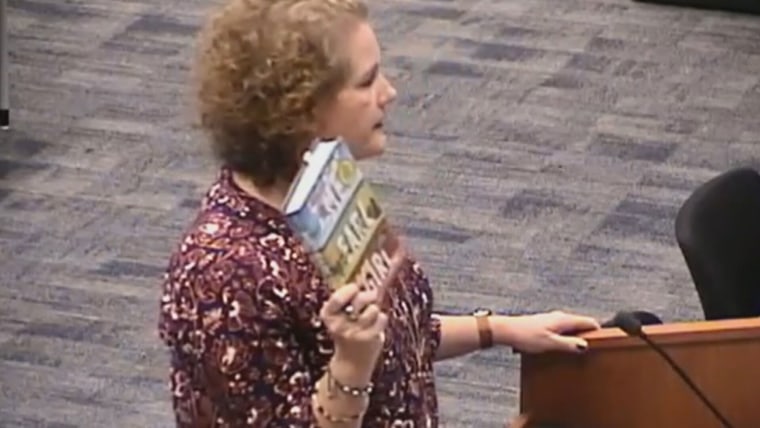
Minutes later, Jennifer Adler, a mother of five, held up a copy of “Jack of Hearts (and Other Parts),” by L.C. Rosen, for the board to see. Adler explained that the book is about a character named Jack, who writes a teen sex advice column for an online site. Then she began reading.
“‘I wonder how he does it … how he gets all that D?’” Adler said, reading the first in a series of explicit excerpts referring to anal and oral sex.
After ending with a passage that included a detailed description of male genitalia and advice on how to give oral sex, she looked up at the board members, her voice shaking as she spoke.
“I cannot even imagine how I would feel if my child came home with this type of book,” said Adler, whose oldest child is in middle school. “We cannot unread this type of content, and I would like to protect my kids’ hearts and minds from this.”
The audience, packed with parents and community members who shared her concerns, erupted in applause.
‘Taking the matter seriously’
Rosen, the author of “Jack of Hearts,” wasn’t surprised when he heard about the demands to ban his book in Katy. Like other authors whose books have been targeted in recent months, Rosen said parents have been reading passages out of context.
At the time of the book’s release in 2015, the School Library Journal, a magazine that districts rely on to select library books, wrote that the dearth of “sex positive queer literature” made “Jack of Hearts” an “essential addition to library collections that serve teens.”
The sex advice columns written by the book’s protagonist are part of a bigger narrative that’s meant to empower queer teens and help them feel safe talking about their sexuality, Rosen said.
All of the questions answered in Jack’s advice column were submitted by real students, Rosen said. And the author consulted with sex education experts to write Jack’s responses, with the goal of providing LGBTQ teens with practical information that’s often omitted from sex ed classes.
“I think it’s troubling when they can’t distinguish between porn — which is not meant for education — and a book like mine that’s trying to educate teenagers and tell them, ‘It’s OK to have these desires; here’s how to act on them consensually and safely,’” Rosen said.
Cuzela and her allies, who denied that they were specifically targeting LGBTQ content, saw things differently. And so did Katy ISD leaders, according to internal messages obtained by NBC News.
Rather than asking the parents to file formal challenges or forming a committee to review the books they’d read aloud, Darlene Rankin, the district’s director of instructional technology, sent an email the day after the school board meeting directing school staff to immediately remove two titles from all libraries: “Jack of Hearts” and “Forever for a Year,” by B.T. Gottfred.
“If these books are currently checked out to students, you must contact the student in order to have the book returned,” wrote Rankin, who declined an interview request.
In the weeks that followed, Katy parents continued applying pressure, calling on the district not only to audit libraries for vulgar content, but to overhaul the selection process to de-emphasize recommendations from prominent book review journals, arguing that those groups are pushing a liberal agenda.
In early December, Superintendent Ken Gregorski responded to those demands, announcing in a letter to all parents that the district was launching a broad review of its library books to remove any that might be considered “pervasively vulgar.” Gregorski, who declined to be interviewed, invited parents to report other books they want removed and assured them that he would “ensure the district is taking the matter seriously and putting into action the plans that resolve the issues for which we are all concerned.”
In total this school year, according to internal messages, the district has launched reviews into at least 30 library books and so far has deemed nine to be inappropriate for students at any grade level, including five that prominently feature LGBTQ characters. Several other books, including “This Is Your Time,” by the civil rights era icon Ruby Bridges, were deemed inappropriate or too mature for young children and removed from either elementary or middle school libraries.
Most of these reviews were opened without a formal book challenge, records show, even though one is required under Katy ISD’s local policy.
In at least two instances, according to three district employees with knowledge of the review process, senior district administrators have ordered books to be removed from libraries even after review committees examined them and voted to keep them in schools. The district employees spoke to a reporter on the condition of anonymity, worried that they might be disciplined for sharing their concerns publicly.
In response to detailed written questions, Katy ISD spokesperson Maria DiPetta wrote that “the district will have to kindly pass on your request.” (After this story’s publication, DiPetta followed up to say that the district declined a parent’s request to remove the children’s book about Michelle Obama.)
Cuzela said she’s pleased that the district is now taking her concerns seriously and hopes administrators go further. Although she doesn’t believe most librarians are knowingly stocking shelves with “pornographic material,” she agrees with Abbott’s call for criminal charges against any who do, including in Katy.
“We have laws in Texas against providing sexually explicit material to children,” she said. “It’s a law on the books, and if they knowingly are providing this, they need to be advised and investigated.”
Foote, the retired school librarian who’s leading a statewide campaign against book bans, said Katy’s approach is flawed, not only because it lacks transparency and opens the door for additional censorship attempts, but because of the signal it sends.
“You can’t overstate the impact these decisions can have on LGBTQ students and even teachers,” Foote said. “Intentional or not, these bans are sending a message to them about their place in the community.”
On the phone at her high school library, the queer Katy student who worries her parents won’t accept her for who she is said she was outraged when she found out librarians had started removing books — especially “Jack of Hearts.”
“For me, a lot of these books offer hope,” the student said. “I’m going to be going to college soon, and I’m really looking forward to that and the freedom that it offers. Until then, my greatest adventure is going to be through reading.”
Like other library books she’d read that centered on LGBTQ characters, the student said “Jack of Hearts” gave her a sense of validation. The main character, a 17-year-old who isn’t shy about his love for partying, makeup and boys, was a sharp contrast to her own high school experience, constantly on guard against saying or doing anything that might lead to her being outed.
The book, she said, made her feel less alone.
Rosen, the author, has heard similar things from other teenagers. When he gets those messages, he said he usually replies to say that he hopes things will get better.
But then he adds: “I can’t promise that it will.”





























































































 Scottie's Playtime
Whoopi Goldberg made a foolish comment about the Holocaust. She apologized. Mike Lester nevertheless piled on.
Less than a year ago, Marjorie Taylor Greene, an actual member of the U S Congress, made vile comments trivializing the Holocaust in the context of criticizing mask mandates as tyrannous. Even Kevin McCarthy condemned them. Mike Lester bravely and forthrightly responded by . . . publishing cartoons condemning mask mandates as tyrannous.
This is, of course, the same Mike Lester who in October 2018, following the Tree of Life synagogue shooting, published cartoons attacking the criticism of Halloween costumes as cultural appropriation and depicting Stacy Abrams as a common thief. It’s pretty clear what bothers Mr. Lester and what doesn’t.