Corals bred in a zoo have joined Europe’s largest reef. This is offering scientists hope

https://apnews.com/article/saving-corals-netherlands-lab-climate-ebe8ee0089c4df5070c13e6309b49171?user_email=e5f9416990dba6bdcdbf1036a2e8d82ce309a199b70a7337a2af721131170076

This is my second attempt to post this, as after I started to post it I realized I might be able to use WordPress’s system of block editor against them. I did not mean for the first one to post but in trying to save it for this one it posted.   Sorry.   Hugs.  Scottie

For those that don’t follow or subscribe to the comments on the blog here, you miss out on the grand comments but the wonderful links a few people like Ali leave knowing they help lift my spirits when I am feeling down or when things crash over me.  This was one Ali left a few days ago that because I took one of the few very rare days that I stayed in bed rather than be dragged out by pain or nightmares to stay in bed until 8 am this morning.  Even was Ron was shocked when he opened his eyes and seen me there.  His first response was “Was I OK” as I rarely if ever stay in bed past 5 am.  I honestly can not remember the last time I did.  He got really worried until I assured him I was fine, but after not sleeping more than a few hours for the last few nights I managed to do so, and even had good dreams.  I know most folks don’t remember their dreams, I wish a lot of times I did not, but most of the time I remember mine, sadly the abusive ones are the most vivid and stay with me long after waking up.  Anyway here is the wonderful environmental news that Ali sent me.  Hugs.  Scottie

1 of 6 | 

Divers with gloved hands gently nestled the first self-bred corals from the World Coral Conservatory project amongst their cousins in Europe’s largest coral reef at the Burgers’ Zoo in Arnhem, eastern Netherlands, Monday, April 22, 2024. (AP Photo/Peter Dejong)Read More

Divers with gloved hands gently nestled the first self-bred corals from the World Coral Conservatory project amongst their cousins in Europe's largest coral reef at the Burgers' Zoo in Arnhem, eastern Netherlands, Monday, April 22, 2024. (AP Photo/Peter Dejong)
A fish swims in a coral reef as divers with gloved hands gently nestled the first self-bred corals from the World Coral Conservatory project amongst their cousins in Europe's largest coral reef at the Burgers' Zoo in Arnhem, eastern Netherlands, Monday, April 22, 2024. (AP Photo/Peter Dejong)

2 of 6 | 

A fish swims in a coral reef as divers with gloved hands gently nestled the first self-bred corals from the World Coral Conservatory project amongst their cousins in Europe’s largest coral reef at the Burgers’ Zoo in Arnhem, eastern Netherlands, Monday, April 22, 2024. (AP Photo/Peter Dejong)Read More

Divers with gloved hands gently nestled the first self-bred corals from the World Coral Conservatory project amongst their cousins in Europe's largest coral reef at the Burgers' Zoo in Arnhem, eastern Netherlands, Monday, April 22, 2024. (AP Photo/Peter Dejong)

3 of 6 | 

Divers with gloved hands gently nestled the first self-bred corals from the World Coral Conservatory project amongst their cousins in Europe’s largest coral reef at the Burgers’ Zoo in Arnhem, eastern Netherlands, Monday, April 22, 2024. (AP Photo/Peter Dejong)Read More

Divers with gloved hands gently nestled the first self-bred corals from the World Coral Conservatory project amongst their cousins in Europe's largest coral reef at the Burgers' Zoo in Arnhem, eastern Netherlands, Monday, April 22, 2024. (AP Photo/Peter Dejong)

4 of 6 | 

Divers with gloved hands gently nestled the first self-bred corals from the World Coral Conservatory project amongst their cousins in Europe’s largest coral reef at the Burgers’ Zoo in Arnhem, eastern Netherlands, Monday, April 22, 2024. (AP Photo/Peter Dejong)Read More

Divers with gloved hands gently nestled the first self-bred corals from the World Coral Conservatory project amongst their cousins in Europe's largest coral reef at the Burgers' Zoo in Arnhem, eastern Netherlands, Monday, April 22, 2024. (AP Photo/Peter Dejong)

5 of 6 | 

Divers with gloved hands gently nestled the first self-bred corals from the World Coral Conservatory project amongst their cousins in Europe’s largest coral reef at the Burgers’ Zoo in Arnhem, eastern Netherlands, Monday, April 22, 2024. (AP Photo/Peter Dejong)Read More

Divers with gloved hands gently nestled the first self-bred corals from the World Coral Conservatory project amongst their cousins in Europe's largest coral reef at the Burgers' Zoo in Arnhem, eastern Netherlands, Monday, April 22, 2024. (AP Photo/Peter Dejong)

6 of 6 | 

Divers with gloved hands gently nestled the first self-bred corals from the World Coral Conservatory project amongst their cousins in Europe’s largest coral reef at the Burgers’ Zoo in Arnhem, eastern Netherlands, Monday, April 22, 2024. (AP Photo/Peter Dejong)Read More

BY MOLLY QUELL
Updated 3:53 AM EDT, April 26, 2024
 

ARNHEM, Netherlands (AP) — Just like the animals on Noah’s Ark, the corals arrived in a pair.

On Monday, divers with gloved hands gently nestled the self-bred corals from the World Coral Conservatory project among their cousins in Europe’s largest coral reef at the Burgers’ Zoo in the Netherlands.

“This is the first project where we started to keep these corals with a known origin. As we know exactly where they’re coming from, they have the potential to be placed back into the wild. … So it is very important to keep these corals, as it’s going not very well in the wild,” Nienke Klerks, a biologist at the Royal Burgers’ Zoo in Arnhem, told The Associated Press.

It’s among several projects worldwide seeking to address the decline of coral reef populations, which are suffering from bleaching caused by rising sea temperatures. Corals are central to marine ecosystems, and while these projects won’t stem the tide of damage from human-caused climate change, they are seen as part of broader solutions.

The World Coral Conservatory hopes to create a bank of corals in aquariums across Europe that could be used to repopulate wild coral reefs if they succumb to the stress of climate change or pollution.

Along with two zoos in France and the originator of the project — the Monaco Scientific Center — the zoo in the east of the Netherlands took in more than a dozen coral fragments from off the coast of Seychelles in east Africa.

The Dutch zoo has been propagating the corals since 2022, allowing them to grow in a highly regulated environment before they were large enough to join the rest of the reef.

“We test it behind the scenes … what works for these corals. In that way, we know where to place them and how to keep them,” zookeeper Pascal Kik said.

Each diver held up a coral — one that resembled a large mushroom, the other a decorative cookie — to be photographed by reporters before placing them on a ledge near the center of the 8-million-liter (2.1-million-gallon) tank.

Few of the other corals at the zoo come from the wild. They are either shared by other zoos or turned over by Dutch customs officers after being confiscated. Coral poaching is a major threat to coral reefs in parts of Asia.

That would make it difficult to return the corals to the wild. But the team knows exactly where their 14 corals came from, making it more likely they could be successfully reintroduced if needed.

Corals area keystone marine species, according to Mark Eakin, executive secretary for the International Coral Reef Society. Eakin, retired coral monitoring chief at the U.S. National Oceanic and Atmospheric Administration, says that around 25% of marine animals spend some part of their lives dependent on coral reefs.

That makes projects such as the one in Arnhem all the more important to pursue, he said.

“We are in a situation where we really need to be taking any possible action we can,” Eakin told AP.

Earlier in April, scientists from the NOAA and International Coral Reef Initiative said that coral reefs around the world are experiencing global bleaching for the fourth time.

Bleaching occurs when coral under stress expels the algae that gives them their vibrant colors. The algae is also a coral’s food source, and if the bleaching lasts for too long or is too severe, the coral could die.

In the world’s largest coral reef ecosystem, Australia’s Great Barrier Reef, bleaching affected 90% of the coral assessed in 2022. The Florida Coral Reef, the third-largest, experienced significant bleaching last year.

Terry Hughes of Australia’s James Cook University, an expert on the Great Barrier Reef, argues that the world needs faster, bolder efforts to stop the damage from climate change, instead of small-scale restoration projects like this one.

“You can’t replace a magnificent ecosystem with an aquarium,” he said.

Others say every little bit helps.

“Coral reefs would be one of the first systems to totally collapse due to climate change,’’ said Ronald Osinga, a marine biologist who specializes in corals at Wageningen University in the Netherlands.

“It’s sad that it has to be like this,” said Osinga, who is not involved in the Dutch zoo initiative. But projects like this are a “good backup plan.”

Follow AP climate coverage at: https://apnews.com/hub/climate-change

Nobody Asked …

Where I lived as a kid in Vermont, the same issue was going on.   The hydro dam was important and had been there a long time but, … it was blocking all the spawning fish.  So they built this huge large grand viewing gallery alongside the dam so the fish could swim up past the dam and also it was built in stages for all to see.  But then … in the late 1970s or so.   Hugs.  Scottie  

These Solar-Powered Carnivorous Flatworms Divide and Conquer | Deep Look

Tiny marine flatworms called acoels hunt for prey in coral reefs. They’re referred to as “plant-animals” because they’ve got a partnership with photosynthetic algae that live inside of them. But this acoel’s real superpower is its ability to regenerate any part of its body!

Researchers are studying a species of tiny marine flatworm called an acoel that has some surprisingly amazing abilities, despite being smaller than a grain of rice.

“They have two very obvious superpowers,” says Dania Nanes Sarfati, a researcher at Stanford University who studies acoels.

“They are able to regenerate any part of their body. And they also have a very intimate relationship with algae that they keep inside their bodies that they exchange energy and other nutrients with.

When you look at them, they just look like a little worm, but if you look inside you can see there’s this green photosynthetic algae that are living between the acoel cells.”

In addition to catching prey to eat, acoels will flatten themselves out in sunny spots so that their photosynthetic internal algae can absorb sunshine.

“It’s like they’re on vacation every day,” says Nanes Sarfati. — What are acoels? Acoels are a group of small, simple, soft-bodied flatworms that mostly live in marine environments.

Acoels lack a permanent but they do have a mouth that they use to eat prey. — What do acoels eat? Acoels eat tiny prey like planktonic plants and animals that float in the water. An acoel will expand its head like a net to engulf its prey and then jam its meal into its mouth. —

How do you pronounce acoel? Acoel is pronounced “a seal.”

So yesterday was a bad costly day

Some background for those new here.   We take care of three cats, two also mooch / are fed by the neighbors also.   One is our house cat Odie, then there is Tupac who is an inside / outside cat, and then there is Smokey an outside feral female who hangs out with Tupac and she will come into the family room to eat but won’t stay.  Even though Tupac eats most of his food at our home, spends most of his day inside with us, if it is a nice night a lot of nights he likes to spend outside some or all of the night.  If it is cold or raining he stays inside.   Even though others feed them, it always seems to fall to Ron and me who takes Tupac to the vet and pay the bills, even though it seems the others have a lot more money.  Maybe that is why.  When Ron told the neighbor woman today who we see feeding them the costs, well she did not offer to help.

We have been noticing Tupac was getting thinner and thinner and thinner.  Last year when we took him in for his shots and deworming he was also thin, but then once dewormed started to gain weight.  But like I said, we noticed that he was losing weight fast.   The last week or longer, he has spent more and more time inside.  Then last Wednesday morning he threw up a lot of green bile looking liquid.  Well sometimes he catches local rabbits or squirrels, other small game and eats it.   So we worry he will get something.  Or he will eat something that will make him sick that someone left out or an anti-cat person who wanted to poison the cats.  His stomach made sounds all the night before and that day.  But Thursday morning I found clear liquid throw up in the kitchen.  Friday morning I found the same thing in the hallway.  He had been staying in all week, which was not normal, as I already said.  Again he was not eating or even drinking.  Ron talked to one of the other people feeding them and she said Tupac quit eating last week also.  I got him to drink a little water.

When Ron got up Friday morning I told him we should call the vet’s office.   We had been talking about it, and knowing it was Friday I did not want to pay the costs of an emergency weekend visit, and Tupac was getting more thin and not eating or drinking.   But as we had no appointment the vet’s office said we could bring him in, drop him off and they would see him when they could.   That cost us $110.00 alone.  But the worst was to come.  Turned out our worst fears were not the problem, which meant Tupac was not going to die of feline leukemia or need surgery we couldn’t afford.  But … it turns out he had an infection in his ear, maybe from a fight where he got scratched.  The vet cleaned all that and gave him something for it.   But … It seems his thyroid is seriously jacked up, running really too high.  The test reads normal at 4 and Tupac was 12.  He will need daily medication.  The vet gave us two weeks of pills and we need to contact an online animal pharmacy for a medicated cream to rub on his ear which takes the place of the pills.  We have never been able to get a cat to take a pill.  This morning Ron tried to get Tupac to eat and take the pill.   He refused both.  

But then the hammer dropped.  The total vet bill came to $530.00 and that was before we order the cream she gave us a prescription for.  That is going to be more expensive than the pills the vet warned us.  We had only $270.00 in both bank accounts until Ron gets his monthly Social Security late in the month.  I transferred money from savings.  So with Ron’s medication in January needing to be fully paid, something in February that needed to be paid, and the cat’s vet bill I had taken out of savings so far this year a total of $1,140.00 with no clue how to put it back if medicine and medical bills don’t slow down.  I guess my new glasses will have to wait until fall, if not until next year.   

What had made the day even worse for me and upset me was that I had spent all week catching up with comments and others blogs.  Seriously when I went to bed Thursday evening I had everything caught up.   Friday morning due to Ron having made a large roast, potatoes, corn, and gravy supper meal there were a lot of dishes and kitchen mess.  So while we waited to hear from the vet, I helped Ron clean up and do dishes.  Then in the morning while doing dishes Ron asked me to make a tomato red sauce.   I had to use tomato puree instead of sauce as Ron got the wrong stuff.   It made a nice sweet basil sauce.   Ron made his wonderful meatballs.   But by the time I got the sauce done, the bread ready to bake, the plates, strainers, and serving things set up I was wiped out.  I had the water ready for the spaghetti but I couldn’t stay standing up even with all the break through medications.  I was done, so Ron took over.  

What this did blog wise was make me basically miss an entire day and by the time I opened up the bell notifications just before going to bed, I had lost some of the older comments and posts.   Well there is another day.   As always if you leave a comment and I have not responded to it in a few days send me another.  I am not sure how much I can do today because I am already suffering badly sitting in my chair.  I suffered through making eggs for breakfast because Ron loves how I make eggs over medium, cooked whites, runny yellow yoke.   So now you’re caught up.  Hugs.  Scottie

Can cannabis help clean up the earth? – BBC REEL

Thank you to Ten Bears for the link to the video.  https://homelessonthehighdesert.com/2024/03/01/five-oclock-shadow-2/  Yes another great reason to support the legalization of cannabis without the crap laws republicans are trying to impose due to religion.   Hugs.   Scottie

Sharpshooter Insects are Real Wizzes at Whizzing | Deep Look

Sharpshooters survive by guzzling a lot of plant sap. But drinking all of that liquid nutrition presents a problem for these tiny insects: How do they move it all out? Easy. They’ve perfected a super-propulsive urination technique using a special catapult in their butt.

The sharpshooter gets all its nutrition from the thin, watery liquid inside a plant, called xylem sap, which it sucks out with this tube-shaped stylet. That sap has so little nutrition that sharpshooters need to guzzle nonstop. Taking all that liquid in presents a problem – how to move it out. The sharpshooter has evolved the perfect tool for the job: an anal stylus — or butt flicker. Here’s something incredible: Each drop of pee actually travels faster than the speed at which the butt flicker launched it. Learn about this incredible creature’s super-propulsive pee in this video!

Spy Octopus Helps Friend Hide From Shark


Coconut octopuses are vulnerable to blacktip sharks, who use smell to find prey. With the help of an unlikely ally, this octopus is able to hide from hungry sharks.

My day, cat food cans, Ron sick

So we are taking care of three cats.   One full inside fat diabetic cat Named Odie, one inside / outside cat who is sort of gray with white paws also a white tiny mustache, who is named Tupac.  Then there is the totally feral untrusting outside cat we all call Smokey.  

We feed the inside cat three times a day as he wants with wet food.  At night we leave him with what ever wet food he did not eat to finish.

Tupac we feed as many times as he wants when he is in the house, he is very tiny and slim, we give him drops but if we miss them for a few days he starts to spot on stuff.   Often Tupac will come in and go straight to the bedroom rather than eat.  But he tends to spend most days inside with us, and nights unless it is really cold, outside with smokey.

Smokey seems to be a nearly feral female who distrusts most people or close quarters.   She has gotten to trust Ron and I enough to come with in a foot or so of our legs.  She will respond to our voice and come very close to us as long as we make no sudden movement.  She startles very easily.  So she eats her food, both dry and wet, on in the family room Ron built out of the carport.  The dance all these cats play is amazing to watch if you care for them.  

So while Ron and I pay for the vet bills for Tupac and Odie we have not gotten Smokey into a carrier to do so.  But to feed these three every time they demand food takes 90 cans of wet food plus a bunch of dry food.  

While Ron was getting Meow Mix for the family room dish, inside we have been giving Odie Fancy feast and mixing both for Tupac.  But today Ron came home and said he got two bags of food made by the companies that make the treaties we give the cats.  Temptations.  

I looked at the ingredients and stuff and it seems OK to me, but both / two bags were about the same amount we paid for one of the bags of Fancy Feast.   Hey if they eat it I am OK with that.  

So here is the real point of the post.  We go through about 3 cans a day which means is 90 a month.  Depending on how many days in the month or when we order, we sometimes order two of the 90 cans a month.  Each order costs us $78.74.  We get Fancy Feast Poultry and Beef Feast Classic Pate - (30) 3 oz. CansPurina Fancy Feast Seafood Classic Pate - (30) 3 oz. CansFancy Feast Poultry and Beef Feast Classic Pate Collection Grain Free Wet Cat Food Variety Pack - (30) 3 oz. Cans

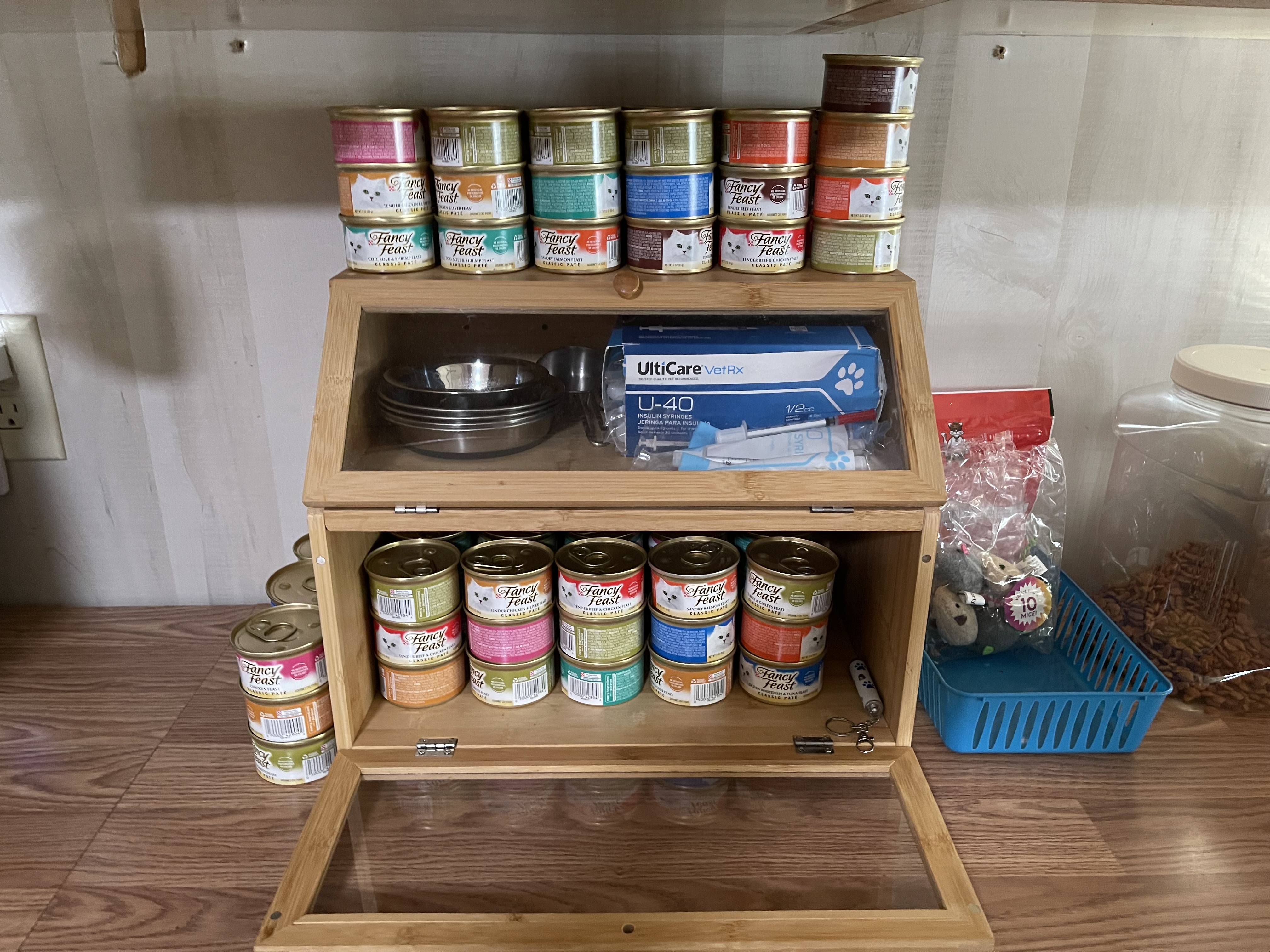
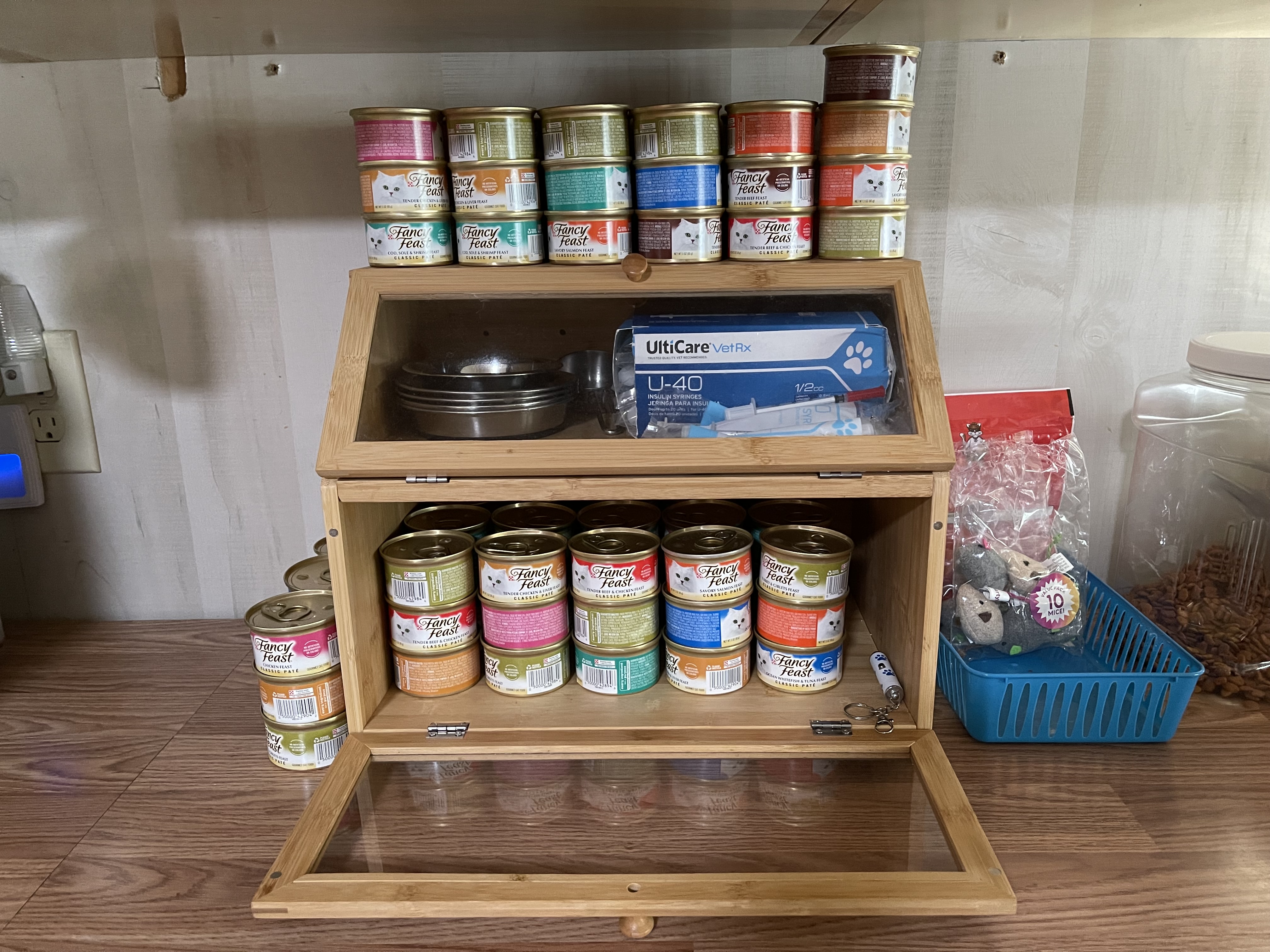
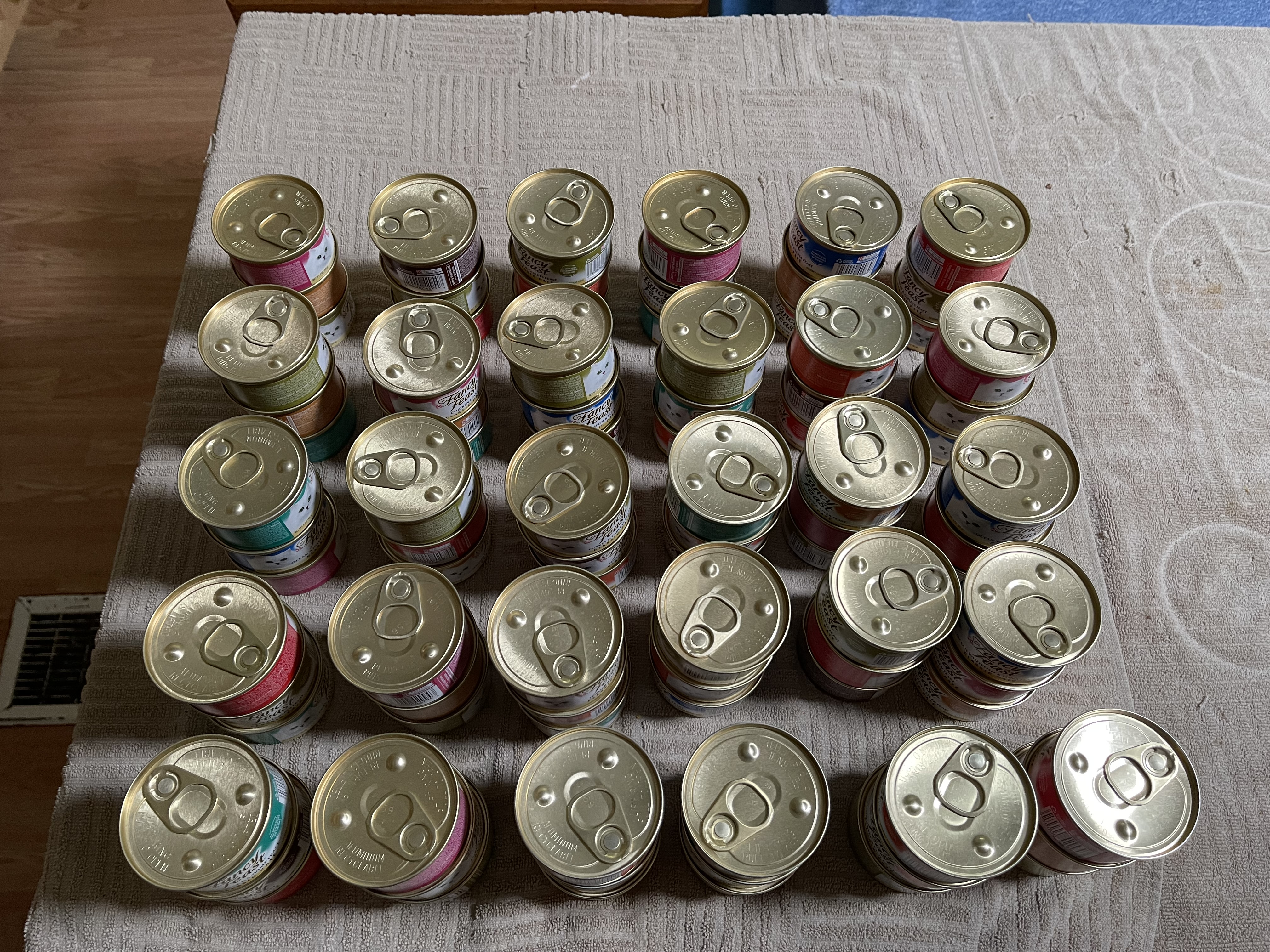
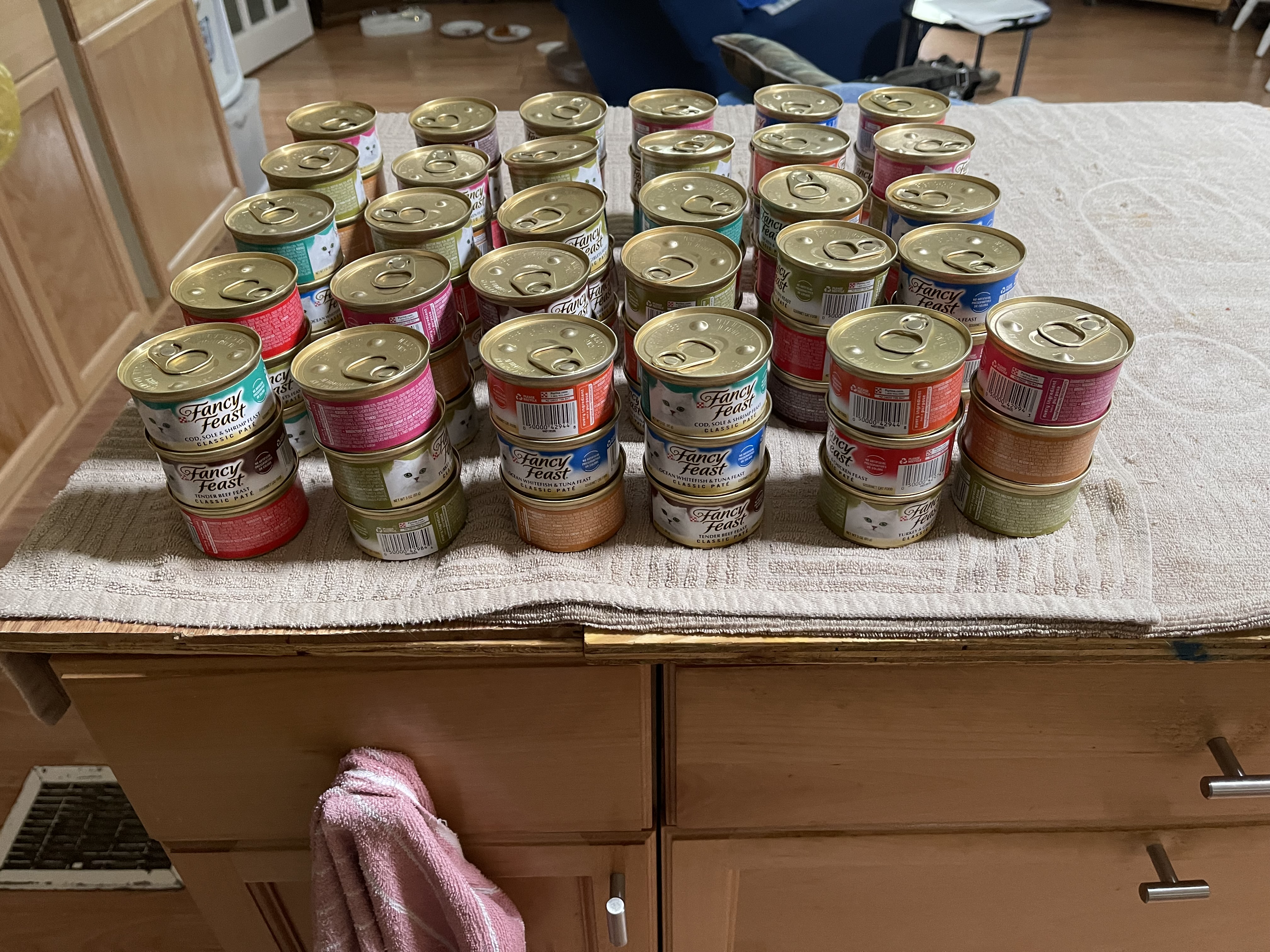
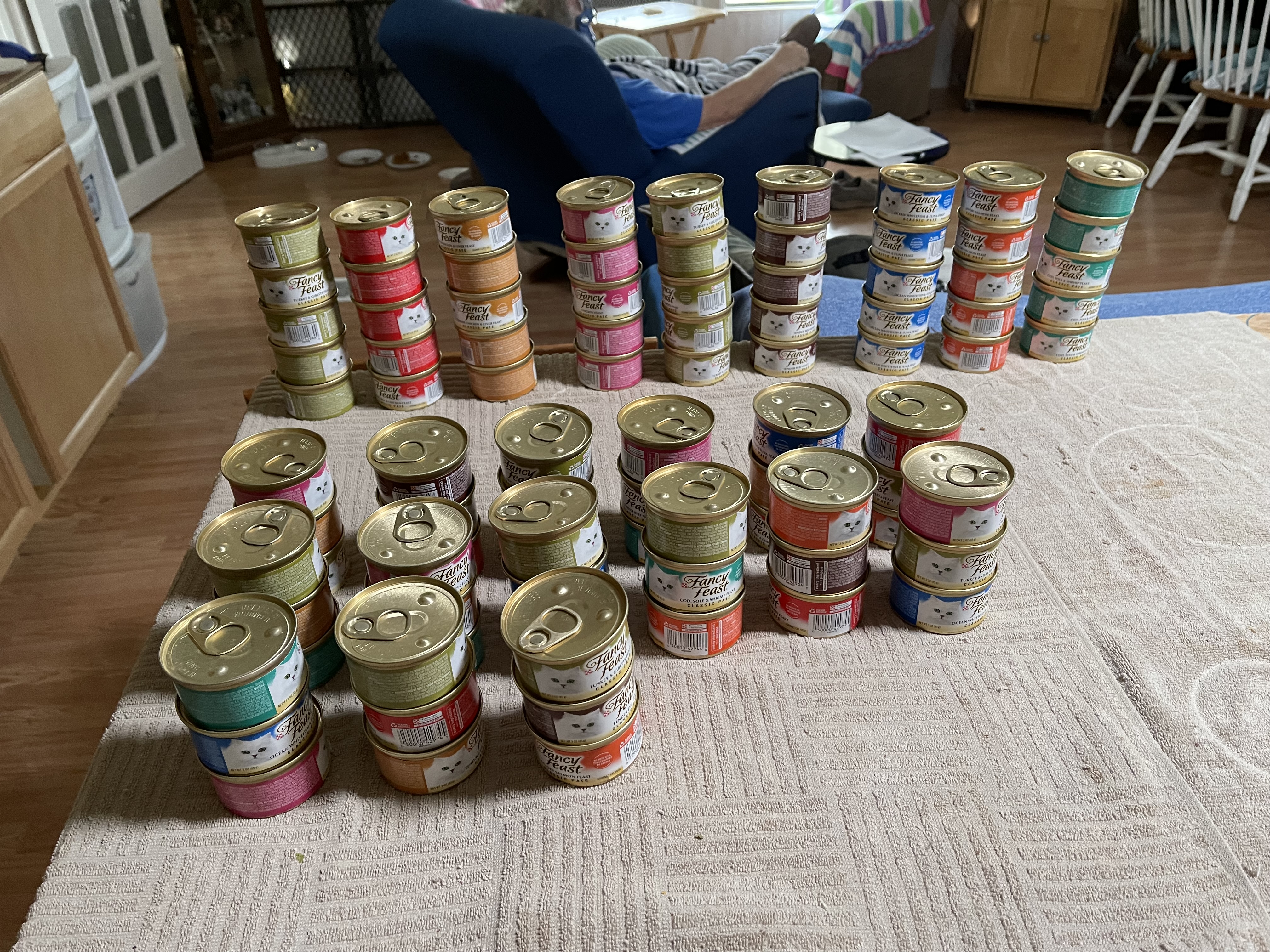
So, to the point of the post.  Are you not glad I am finally getting to it?  When the cases come in we have to wait until the old cans are gone and then do the “CAT FOOD CAN SHUFFLE”   Ron prefers to put it off until I do it.  Below is the pictures of the cat food can shuffle.   Hugs.   Scottie

This is the place we store the cans and where after the shuffle they go.

IMG_0669IMG_0670

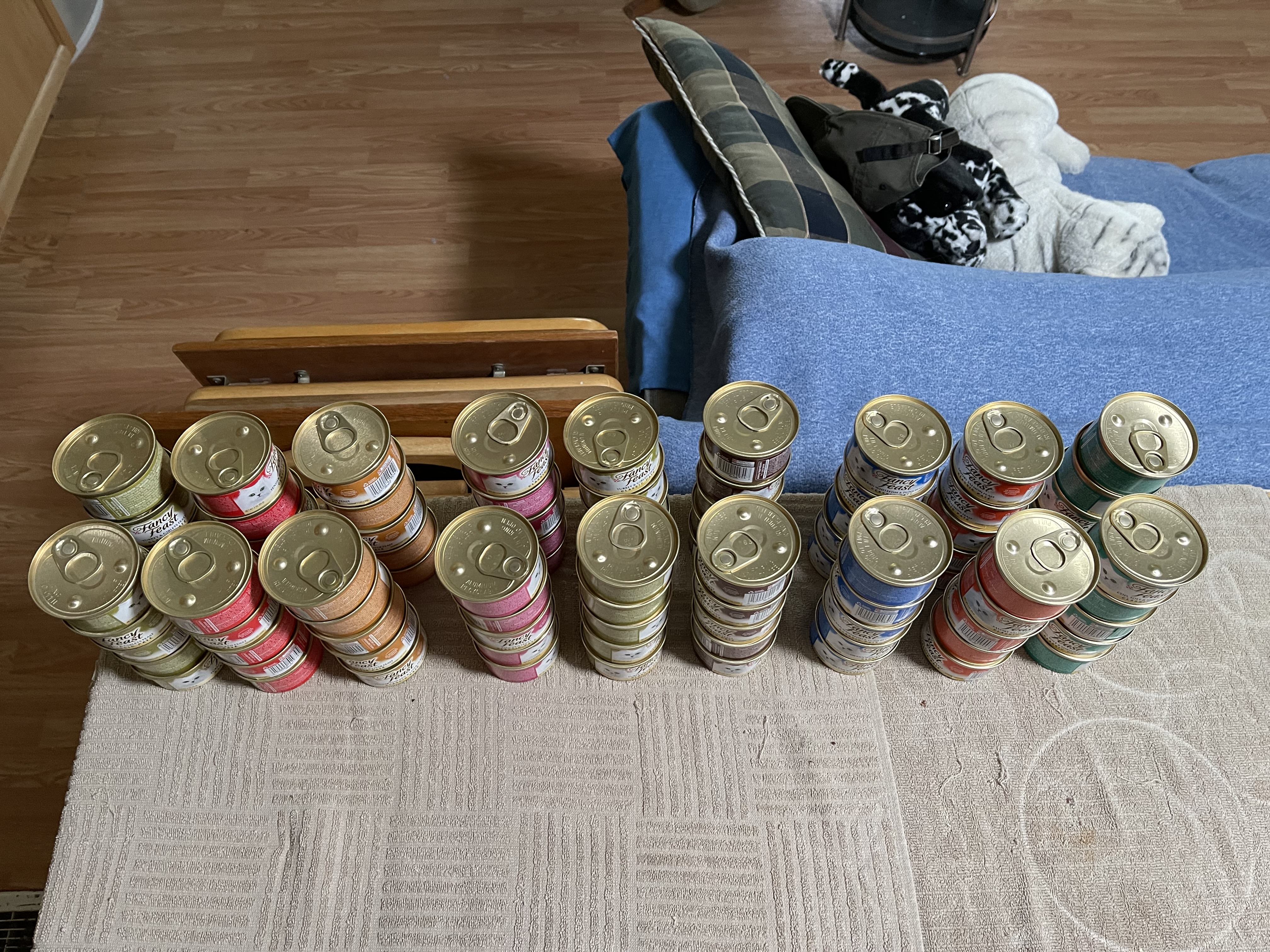
First I have to open each of the three boxes of 30 cans each and put them on the counter.

IMG_0665IMG_0664

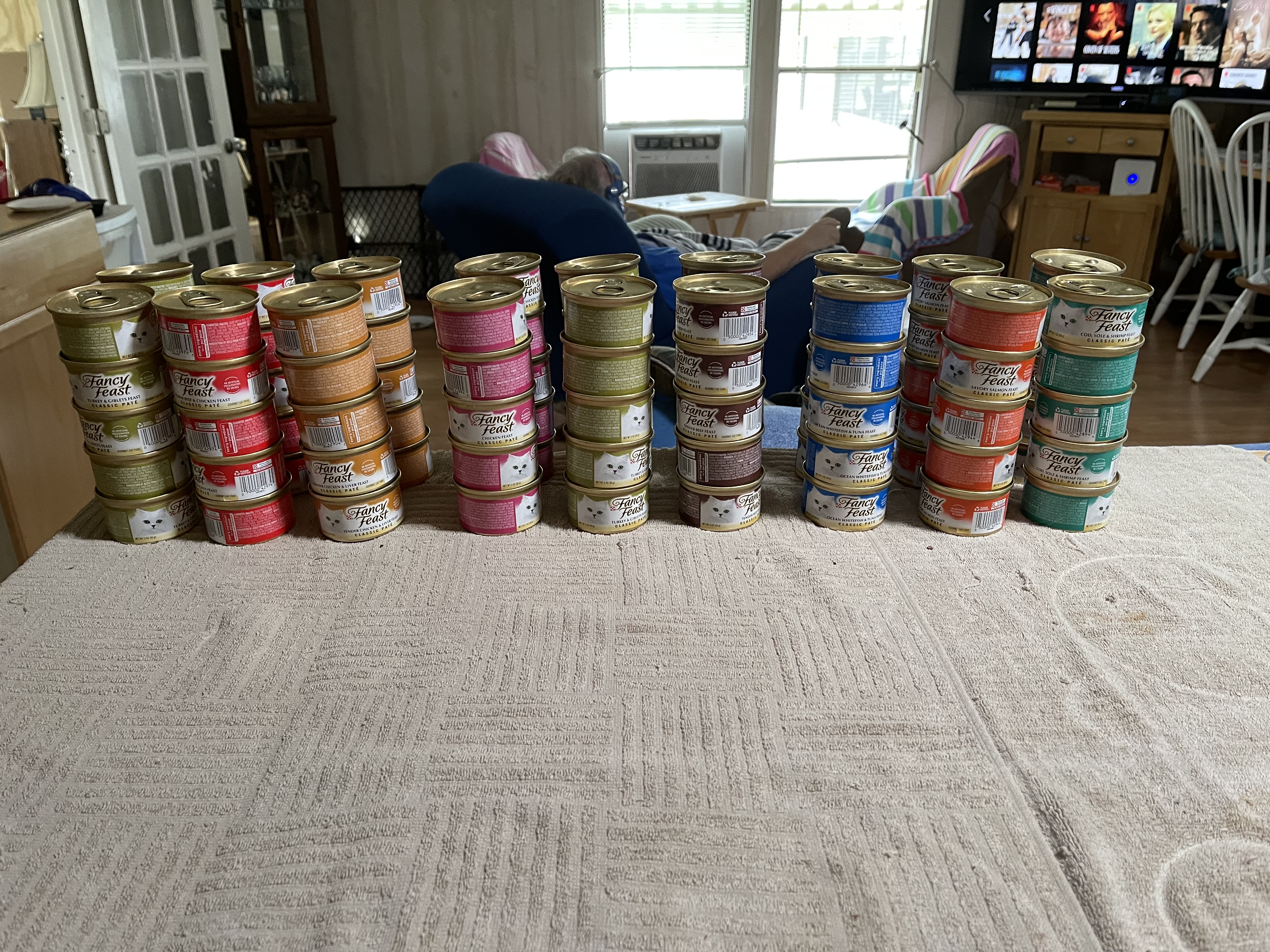
Then I start shuffling them.  This is the part Ron hates and why he leaves it to me.  If you look at the first pictures you will see the cans well mixed, so the cats don’t get the same can of food at any two feedings.  I would get bored if every meal was the same as the last.  Ron will keep opening cans until he finds something the cats like and will eat. So below is the rest of the photos.   Hugs.  Scottie

IMG_0668IMG_0667IMG_0666

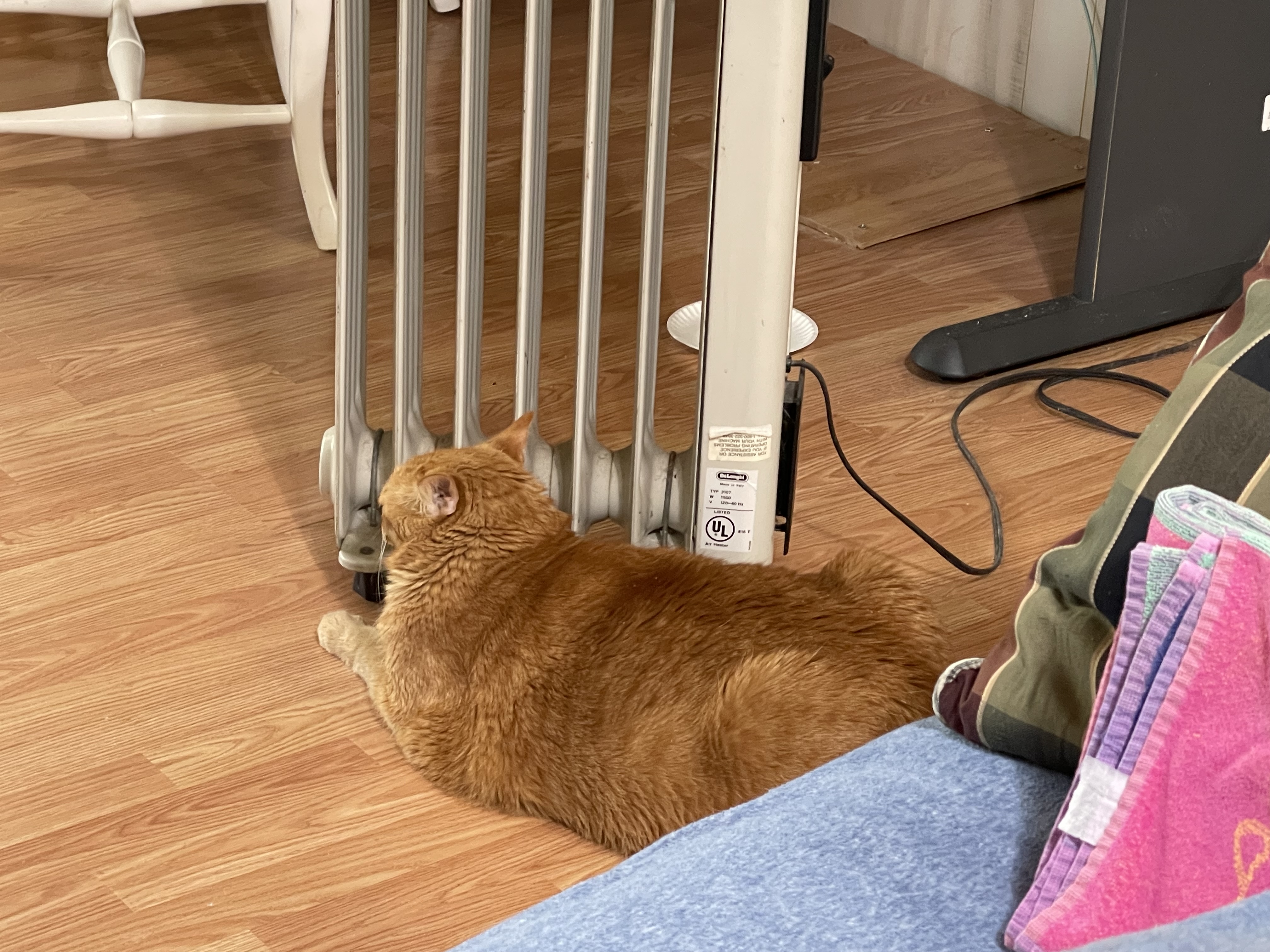
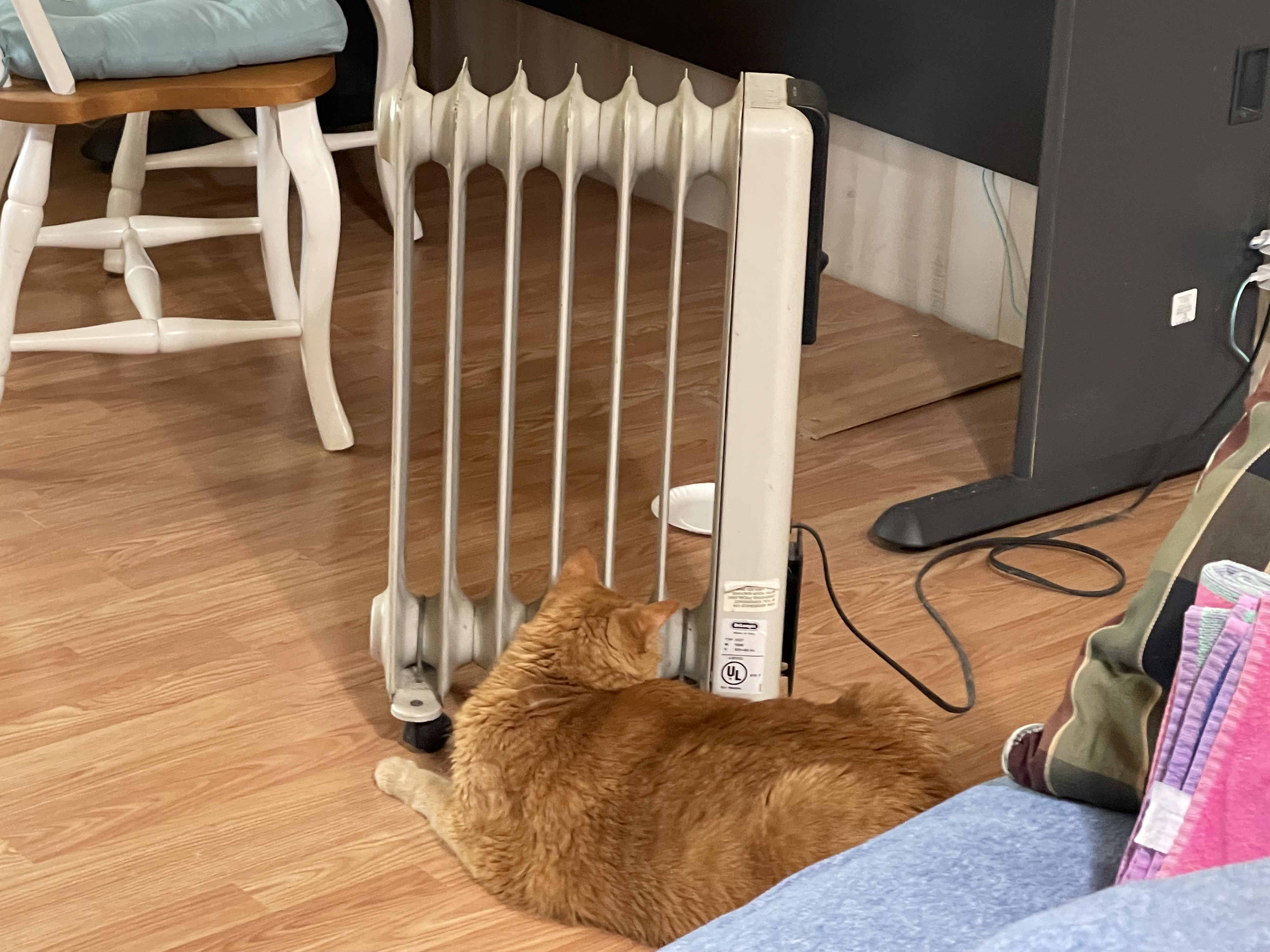
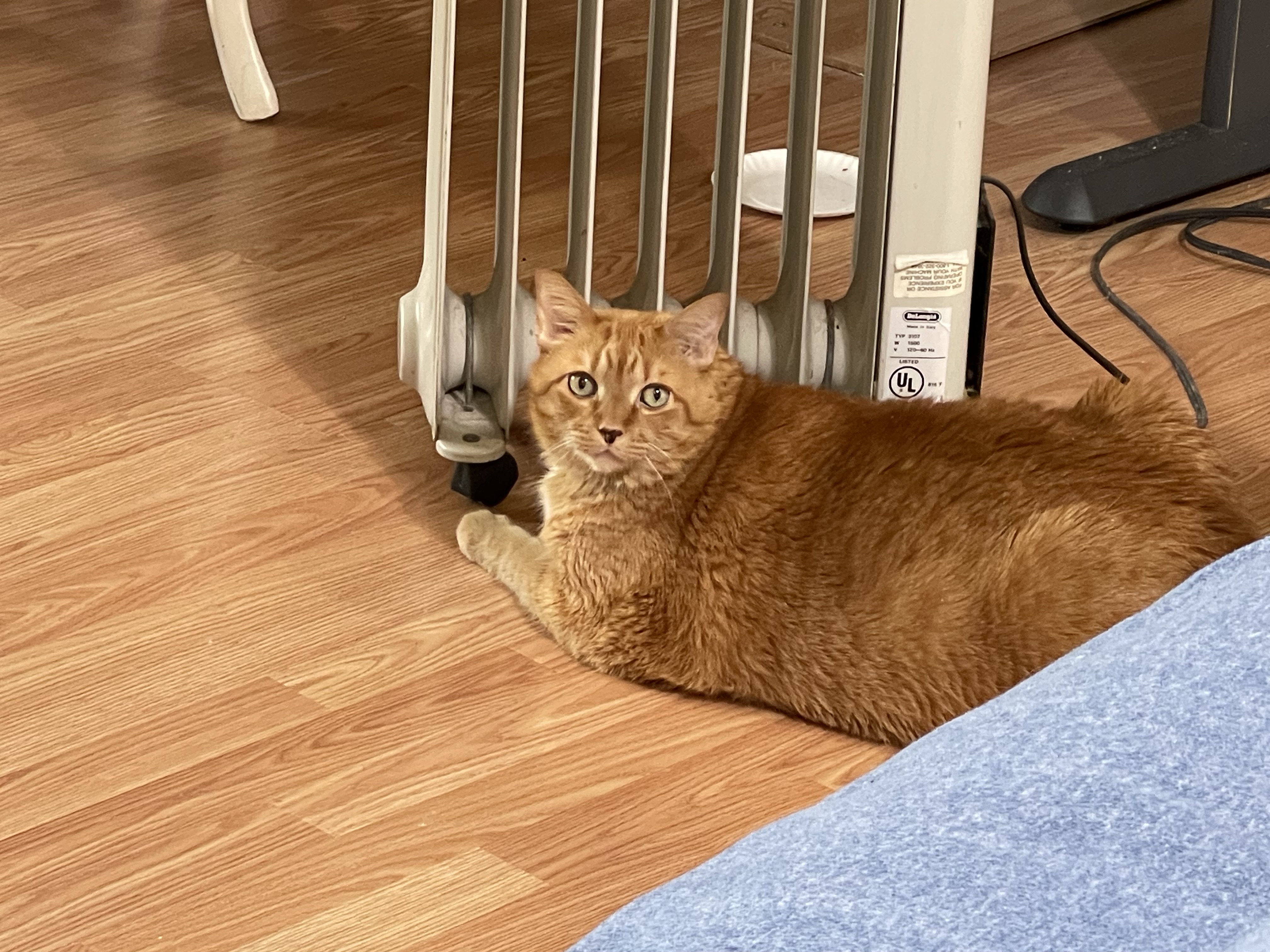
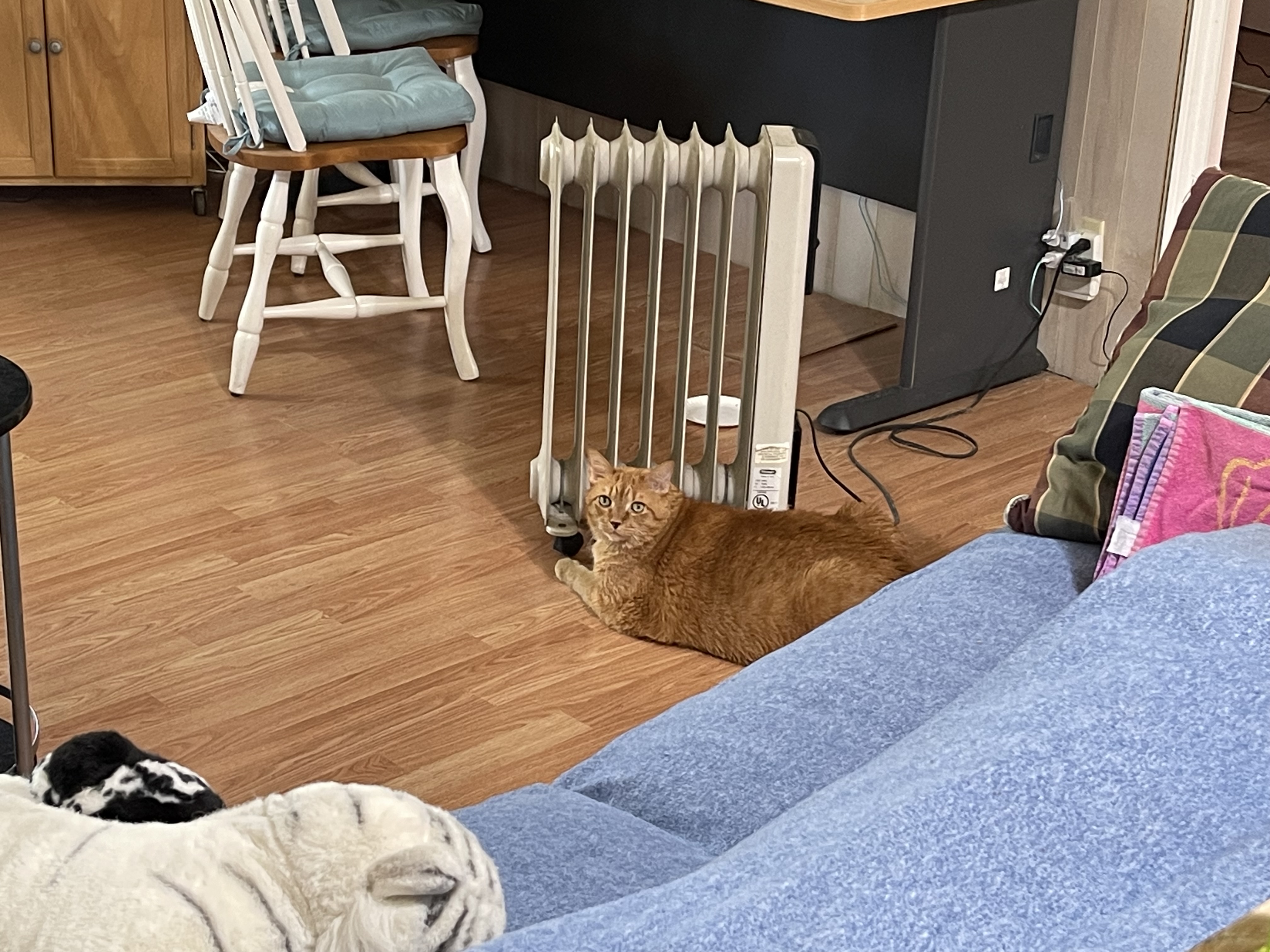
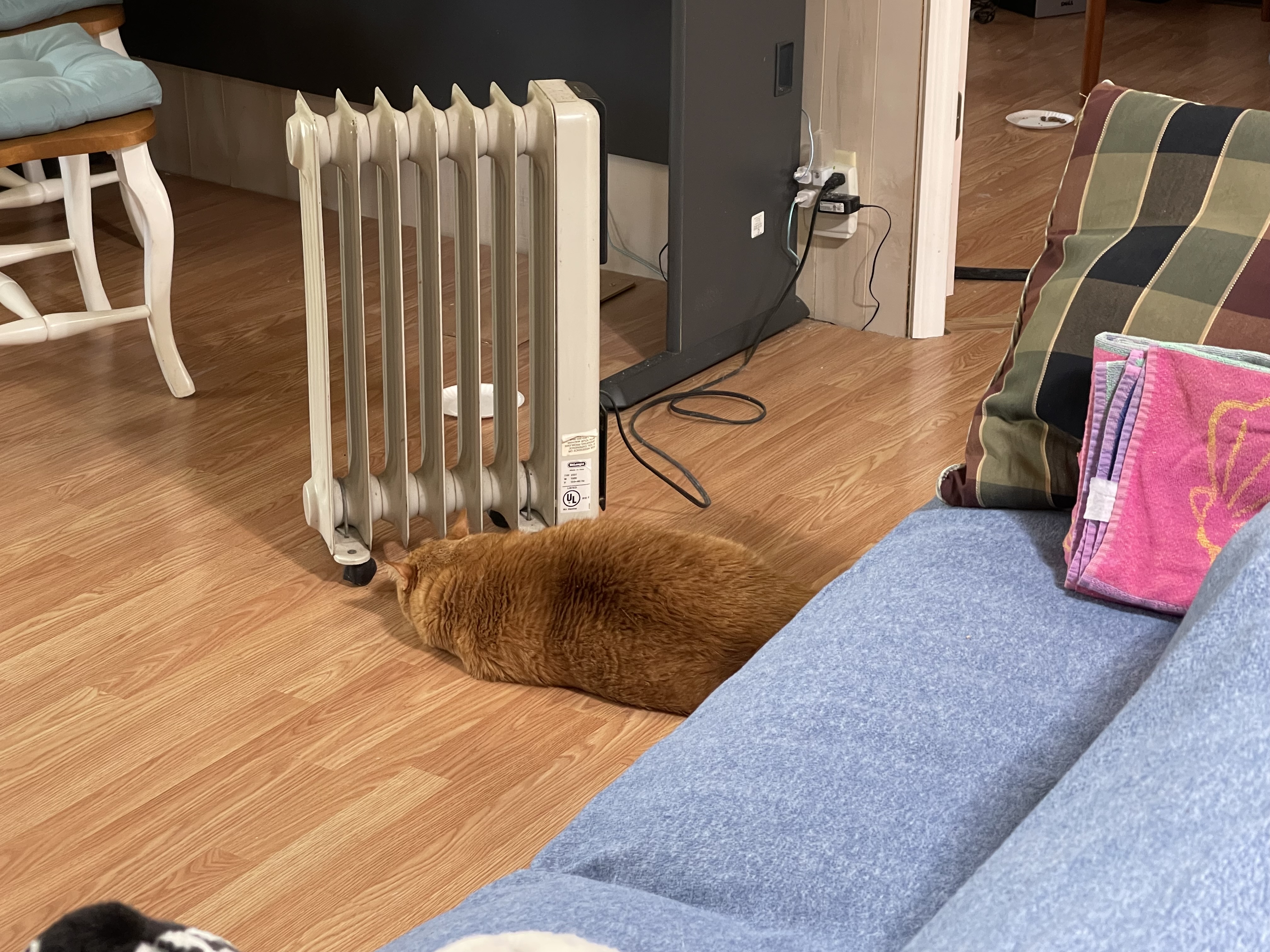
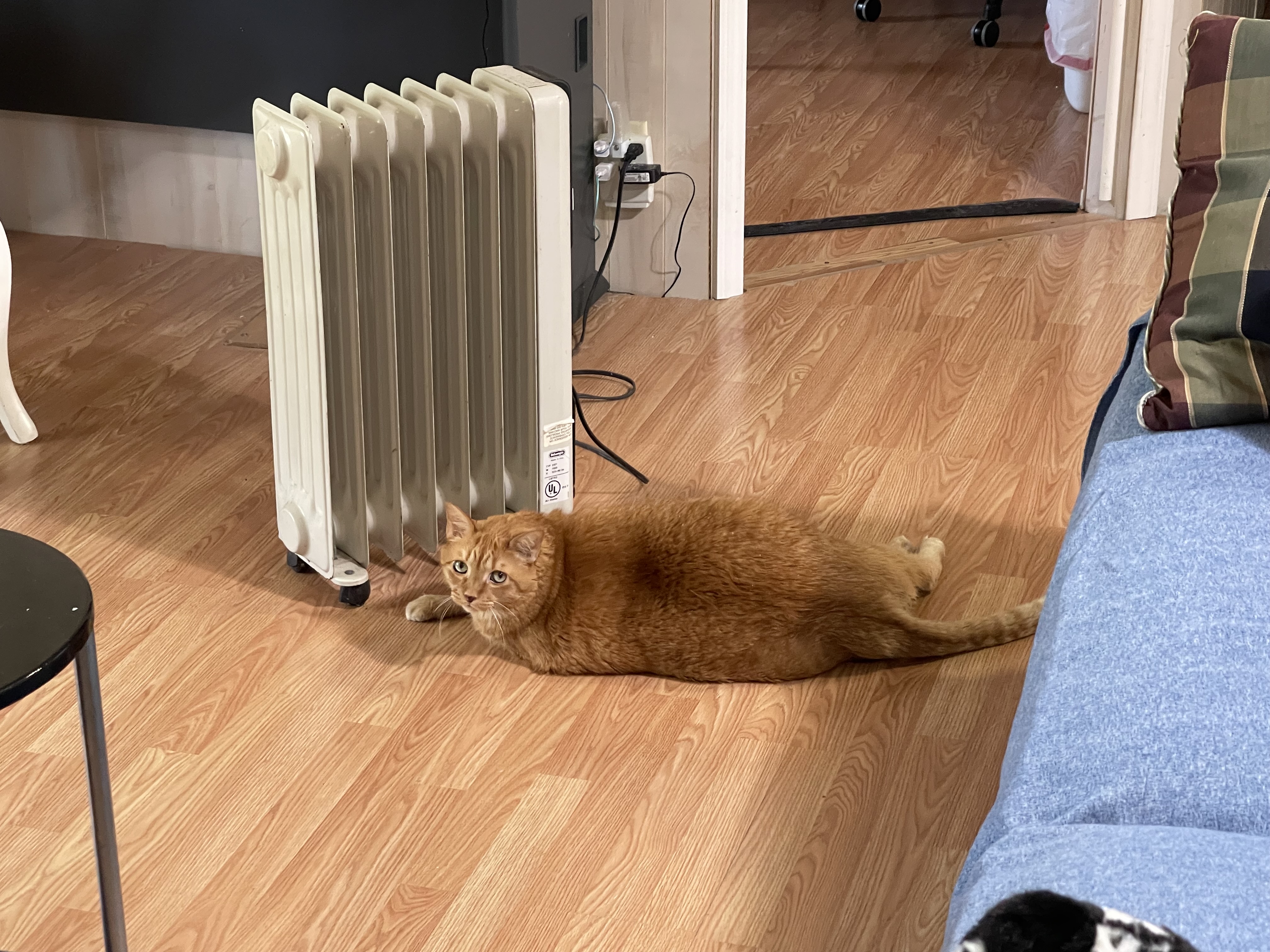
Odie has fallen in thrall of our radiator heater.

Ron is out grocery shopping.   I want to start going with him, and have a few times, but lately I am not up to it and there are things I need to take care of while he is shopping.  I was doing the dishes so he would have counters to put the groceries on when he got home.  Yes, I am tired.   But the funniest thing happened while I was doing them.

It has been cold on and off here in Florida during January and February.   This last few nights it has been around 46 degrees or lower at sunrise.   So before he goes to bed Ron turns the radiator on low with the temp dial about 72.  The heater we have in our bedroom bathroom heats both rooms and as I get up about every hour to pee, when it gets cool enough I turn it on.   Between the both of them they heat the main space and we keep the other doors closed until it warms up outside.   Also the electronics in the Pink Palace keep the room about 74 on the coldest nights so far.   I just have to remember to leave the computers up and running with the door closed.  

So to the point of the post, while I was doing the dishes Odie wanted food.  I gave it to him.  But Odie is older, we think at least 12 but more likely older, and not in the best health.  So while I went back to doing dishes after he finished eating, he went to the radiator heater that he often lays next to when it is running.  We have noticed that when it is active he will lay near it or against it.   He clearly loves the warm heat coming off it.  

So he finished eating, came out, stretched out next to the heater.  But no heat came out.   So he got closer.  Then he tried hitting it with his paw.  Finally, as I was rushing to get my phone, I saw him rubbing his face on the fins.  Yes even though the house was warm enough I gave in and turned on the radiator to the lower setting.  But that was not working fast enough for him and he was getting upset so I went over and activated the medium 1,600 watt setting.  That made it heat up fast enough and he laid back down next to it happy.  As he fell asleep, I turned it back to the lower watt setting.   Below is the pictures of our really spoiled fat cat.  Hugs.  Scottie

IMG_0672IMG_0673IMG_0674IMG_0675IMG_0676IMG_0677

Sad Cat Diary

Cats In Therapy

PetsTalk Holidays

Dogs In Therapy