Alabama Gov. Kay Ivey signs DEI bill into law: What the ‘divisive concepts’ ban will do

https://www.al.com/news/2024/03/alabama-gov-kay-ivey-signs-dei-bill-into-law-what-the-divisive-concepts-ban-will-do.html

Let’s look at what is driving this push to end of diversity, equality, and inclusion.  Seem that most people would want those things.  Why would anyone want a large segment of the population to be treated as lessor, denied jobs, denied housing, denied loans, face unrestrained bigotry.   It can only come down to bigotry and the fragility of white males, the need for fundamentalist to return to a time of strict gender roles, and a push by religious people to put their religious bigotry before the rights of LGBTQ+ people to just be themselves in society and at work.   It is OK for black kids at the youngest ages to suffer discrimination, be made to feel bad about their skin color or have to feel fear of harm.   But it is illegal to make white kids feel uncomfortable that 150 years ago white people kept black / brown people as property doing horrible things to them as slaves.  WTF.  The only reason any white kids would feel uncomfortable or hate themselves for hearing this is if their come from a white supremacist family.   It they themselves have been taught that black people are inferior or lesser.  But what it can do is teach empathy for those who are different from you.  It simply is some people thinking they are superior to others and should have privilege.  And it is needed because systemic racism in the country still exists.  Don’t think so, look at large company corporate structures.  Most management is white males, most workers are mixed, and white males get promoted faster.  Look at congress, mostly white males despite them not being such a large majority in the population.  Look at loan rates, higher in black neighborhoods, yet home sales prices lower than a white home comparable in a white neighborhood.  The Steven Millers of the US feel that if any white straight cis male loses a job offer, promotion, or school placement for anyone else it is wrong and a crime.  No matter if the other person was more qualified, mo matter the situation, in their minds whites straight cis males always come first.  Hugs.  Scottie


A new Alabama law banning diversity, equity and inclusion offices, programming and training in public colleges and other state agencies will go into effect this fall.


Gov. Kay Ivey signed SB129, known as the “divisive concepts” bill, into law Wednesday. The law will become effective Oct. 1, 2024.


“My Administration has and will continue to value Alabama’s rich diversity, however, I refuse to allow a few bad actors on college campuses – or wherever else for that matter – to go under the acronym of DEI, using taxpayer funds, to push their liberal political movement counter to what the majority of Alabamians believe,” Ivey said in a statement Wednesday.


“We have already taken action to prevent this in our K-12 classrooms, and I am pleased to sign SB129 to protect our college campuses. Supporting academic freedom, embracing diversity of cultures and backgrounds and treating people fairly are all key components of what we believe in Alabama, and I am more than confident that will continue.”


Alabama joins Florida and Texas in enacting the wide-ranging legislation, which asks for sweeping changes or cancellations to state agencies and public colleges that currently fund DEI offices and programming. It is not clear yet whether the law will force some state colleges, which support a combined $16 million in diversity spending, to lay off staff.


The law bans any program that “advocates for a divisive concept.” It also would prohibit higher education institutions from allowing individuals to use a restroom that is different from their sex as assigned at birth.


Passage of the Republican-backed legislation comes after lengthy debate in the House and Senatemultiple student protests and criticism from civil rights advocates and educators.


Ban supporters said the legislation would prevent “indoctrination” and “far-left ideology” in classrooms, and gave some examples of where they believed white students were made to feel uncomfortable on college campuses.


Opponents of the ban credited DEI programs for providing access and financial support, improving their campus experience, and in some cases, saving their lives. Others also worried that a ban would deter businesses and athletes from coming to the state.


“This unjust and inhumane bill ignores the will of the people and threatens years of progress toward racial and social justice and LGBTQ+ rights for generations to come,” said Jerome Dees, Alabama policy director for the SPLC Action Fund. “Students and workers value diversity, equity and inclusion in their schools and workplaces because it makes us all more safe.”


In a message to students and faculty Tuesday evening, University of Alabama System Chancellor Finis St. John IV and presidents of the System’s three campuses said leadership and legal counsel are working to determine what actions the colleges will need to take to ensure their programs are in compliance with the law.


“It is important to note that SB 129 defines divisive concepts and DEI programs in specific terms, and it offers several exceptions for accreditation requirements, academic freedom, medical and mental health care, research, recruiting and outreach, and a host of other areas. Please look to official university communications for guidance as we continue to assess the legislation,” the statement read.


“We recognize differences strengthen our campuses and help us successfully prepare students to live and work in a global society. We remain committed to recruiting and retaining outstanding students, faculty and staff from all backgrounds, providing open and equal access to resources and opportunities, and equipping all campus community members for success at our universities and beyond.”


What would the law do?


The law lists eight so-called “divisive concepts,” with most covering topics related to race, ethnicity, sex, religion and national origin.


Its sponsor, Sen. Will Barfoot, R-Pike Road, said nothing in the legislation prevents the accurate teaching of history. Educators who knowingly “compel” students to believe certain banned ideas, however, could be terminated or disciplined at the discretion of college and school board leaders.


After debate on the Senate floor last month, the law will no longer prohibit college staff from discussing whether slavery and racism are aligned with the founding principles of the United States.


Democrats also added specific protections for women’s sports, the state Office of Minority Affairs, and changes to ensure “sex” was added to the list of protected classes in places where it was omitted.


Recent changes, which were approved on Tuesday, more clearly define the role of a contractor and protect those individuals from termination if they violate the law by accident. Another amendment ensures that nothing in the law would infringe on First Amendment rights of students or employees.


The law says it will not impede academic or medical research, federal reporting requirements or support services. It also does not prohibit housing or organizations that are segregated by sex, or affect “certain circumstances relating to accreditation.”


Students or staff may host a DEI program or event, it added, but must not use state money to fund it.
 

Thumbnail

They came for Florida’s sun and sand. They got soaring costs and a culture war.

*** Edit to include Ten Bears site I got the link from.  I was so tired I for got to include it.  Thank you Ten Bears. ***

Firstday Forage …

This is what is and has happened in Florida.   We moved to the state in 1994, a poor gay couple.  But the state was a blue state with an extremely progressive government.  I loved the idea of being so near amusement parks I never had seen before.  But over the years we have seen our state torn apart as hard right leaning people moved from other northern states to Florida, like we had done.  But those people changed the state.  They voted Republican, those republicans changed laws about voting, making it harder for people to vote.  I once had to give up voting because I showed up at the early voting place only to see a several hour long line.  There was no way I could stand that long, at the time I had only one hip joint.  But when Ron complained we were told that was the rules, stay in line and vote.   Republicans won the election.   That is what republicans are doing everywhere they control.   It is horrible.  We must do what ever we can to resist. 

Please read this article.   It is and has been our experience.  We have seen prices grow so high we struggle today to make ends meet and even buy groceries.  Our medical costs are out of sight and imagination.  And the republican hard right wants to make our existence as a gay couple a crime.  I have talked about how over the last tRump administration, how over the last three years maga thugs have moved in to our area, our mobile home park.  They put up pro-tRump posters, signs, and banners all which are against the rules but they are not made to take them down.   Our former open and welcoming community divided into with maga or be … shut down and made unwelcome.   These maga people have only one setting, they do not believe everyone has the right to their opinion or their political views, you either see it their way or you’re the enemy.  Ron and I have withdrawn from most of the community when after the hurricane we were walking around the park and just down the street from us a new move in from NY was offering coffee to people … he had a tRump sign and a slur for president Biden on his home before the hurricane.  They were not welcoming to Ron and I to say the least.  We had never had that happen in our neighborohood before.   Luckily, we had our own big generator that provided for all our needs and also was powering our ill neighbor’s oxygen machine and his refrigerator.  We did not need their coffee, we were able to power our own coffee maker and hot plates and a microwave along with our A/c units and Ron’s C-pap.  After hurricane Maria Ron insisted we buy a huge powerful generator.   After Ian tore up our home and we were without power for three weeks that generator saved us.  The name on the generator is The Beast.  It really is.  Hugs.  Scottie

———————————————————————————————————————–

https://www.nbcnews.com/politics/economics/leaving-florida-rcna142316

Florida has seen a population boom in recent years, but many longtime residents and recent transplants say rising costs and divisive politics have them fleeing the Sunshine State.
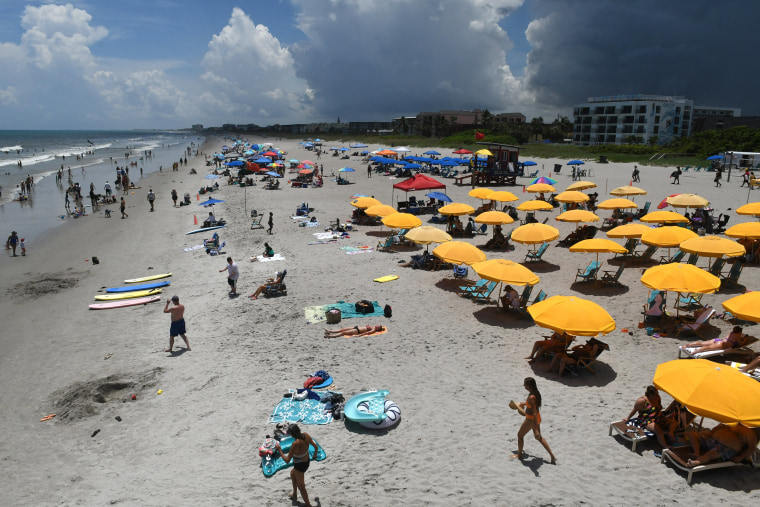
Beachgoers in Cocoa Beach

Beachgoers in Cocoa Beach on July 29, 2023, when ocean temperatures reached 101 degrees around the Florida Keys.Paul Hennesy / Anadolu Agency via Getty Images file


One of the first signs Barb Carter’s move to Florida wasn’t the postcard life she’d envisioned was the armadillo infestation in her home that caused $9,000 in damages. Then came a hurricane, ever present feuding over politics, and an inability to find a doctor to remove a tumor from her liver.

After a year in the Sunshine State, Carter packed her car with whatever belongings she could fit and headed back to her home state of Kansas — selling her Florida home at a $40,000 loss and leaving behind the children and grandchildren she’d moved to be closer to.


“So many people ask, ‘Why would you move back to Kansas?’ I tell them all the same thing — you’ve got to take your vacation goggles off,” Carter said. “For me, it was very falsely promoted. Once living there, I thought, you know, this isn’t all you guys have cracked this up to be, at all.”

Florida has had a population boom over the past several years, with more than 700,000 people moving there in 2022, and it was the second-fastest-growing state as of July 2023, according to Census Bureau data. While there are some indications that migration to the state has slowed from its pandemic highs, only Texas saw more one-way U-Haul moves into the state than Florida last year. Mortgage application data indicated there were nearly two homebuyers moving to Florida in 2023 for every one leaving, according to data analytics firm CoreLogic.

But while hundreds of thousands of new residents have flocked to the state on the promise of beautiful weather, no income tax and lower costs, nearly 500,000 left in 2022, according to the most recent census data. Contributing to their move was a perfect storm of soaring insurance costs, a hostile political environment, worsening traffic and extreme weather, according to interviews with more than a dozen recent transplants and longtime residents who left the state in the past two years.


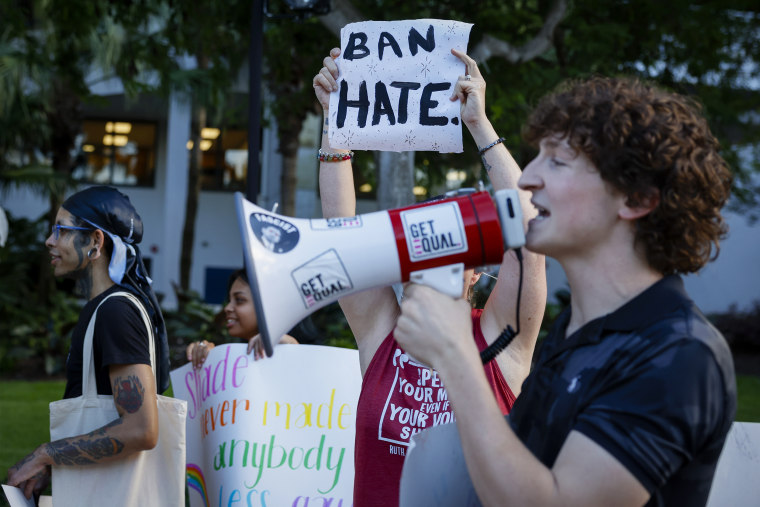
A demonstrator holds a placard reading "Ban Hate" during a 'Walkout 2 Learn' rally
Young people in Miami demonstrate in 2023 in response to Florida’s crackdown on lessons surrounding race and Black history, and against a string of anti-LGBTQ laws that are affecting students.Eva Marie Uzcategui / Bloomberg via Getty Images


“It wasn’t the utopia on any level that I thought it would be,” said Jodi Cummings, who moved to Florida from Connecticut in 2021. “I thought Florida would be an easier lifestyle, I thought the pace would be a little bit quieter, I thought it would be warmer. I didn’t expect it to be literally 100 degrees at night. It was incredibly difficult to make friends, and it was expensive, very expensive.”

Cummings expected she’d have extra money in her paycheck working as a private chef in the Palm Beach area since the state doesn’t have an income tax. But the high costs of car insurance, rent and food cut into that additional take-home pay. After six months of dealing with South Florida’s heat and traffic, she began planning a move back to the Northeast.

“I had been so disenchanted with Florida so quickly,” Cummings said. “There was this feeling of confusion and guilt about wanting to leave, of moving there then realizing this is not anything like I thought it would be.”


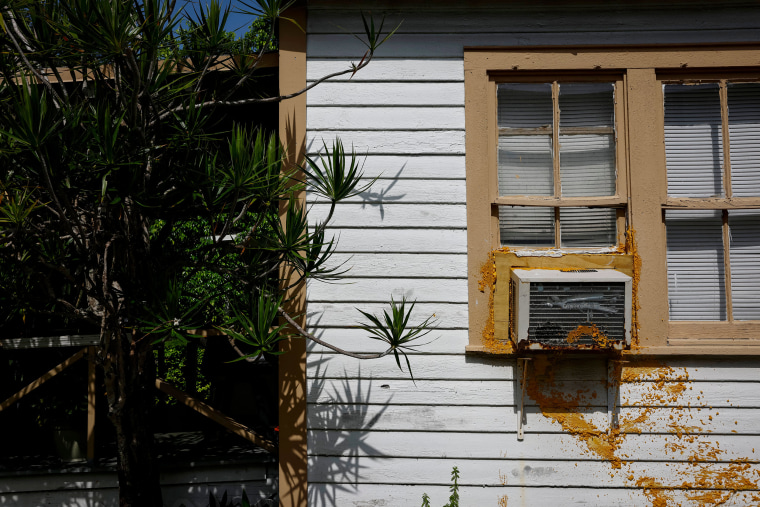
A window air conditioning unit during a heat wave in Miami

A window air conditioning unit during a heat wave in Miami in 2023.Eva Marie Uzcategui / Bloomberg via Getty Images


While costs have been rising across the country, some areas of Florida have been hit particularly hard. In the South Florida region, which includes Miami, Fort Lauderdale and Palm Beach, consumer prices in February were up nearly 5% over the prior year, compared to 3.2% nationally, according to the most recent data from the Bureau of Labor Statistics.

Homeowners insurance rates in Florida rose 42% last year to an average of $6,000 annually, driven by hurricanes and climate change, and car insurance in Florida is more than 50% higher than the national average, according to the Insurance Information Institute. While once seen as an affordable housing market, Florida is now among the more expensive states to buy a home in, with prices up 60% since 2020 to an average of $388,500, according to Zillow.

For Carter, who made the move in 2022 from Kansas to a suburb of Orlando for the weather, beaches and to be closer to her grandchildren, the costs began to quickly pile up. She purchased a manufactured home and initially expected the lot rent in her community to be $580 a month. But when she arrived she learned her monthly bill was actually $750, and by the time she left it had jumped to $875 a month. Along with the $9,000 in repairs from the armadillos, her car insurance doubled and Hurricane Ian destroyed her home’s roof on her 62nd birthday.


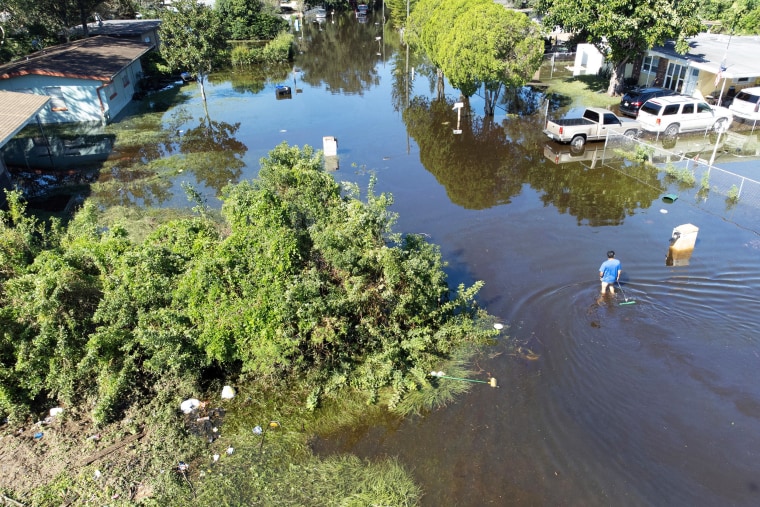
A aerial view of a man wading through a flooded street.

A flooded street in Orlando, Fla., following Hurricane Ian in 2022.Bryan R. Smith / AFP via Getty Images


There were also the ever-present conversations and disagreements over politics that started to wear on her. Carter, who describes herself as a “middle of the road” Republican, said she learned to keep her opinions to herself.

“You cannot engage in a conversation there without politics coming up, it is just crazy. We’re retired, we’re supposed to be in our fun time of life,” she said. “I learned quickly, just keep your mouth shut, because I saw people in my own community break up their friendships over it. I don’t like losing friends, and especially over politics.”


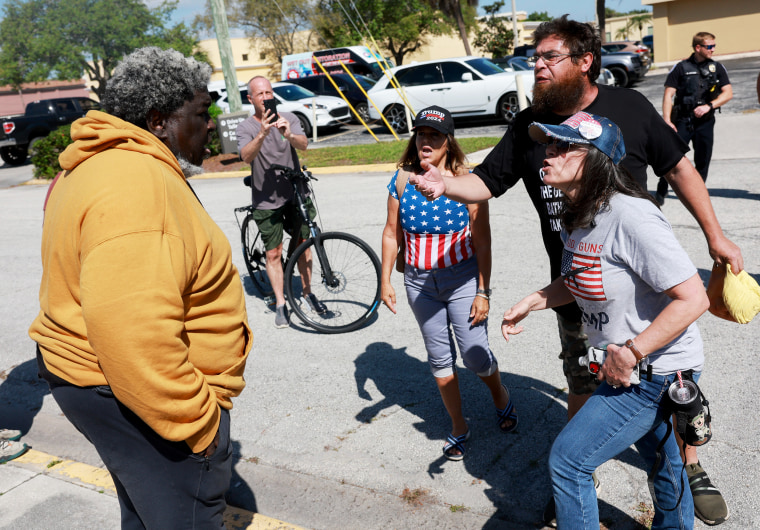
A supporter of President Joe Biden faces supporters of Donald Trump outside of the courthouse in Fort Pierce, Fla., where Trump attended a hearing in his classified records case on March 14.

A supporter of President Joe Biden faces supporters of Donald Trump outside of the courthouse in Fort Pierce, Fla., where Trump attended a hearing in his classified records case on March 14.Joe Raedle / Getty Images


But she said the final straw was when she couldn’t find a surgeon to remove a 6-inch tumor from her liver that doctors warned could burst at any moment and lead to life-threatening sepsis. After being passed among doctors, she finally found one willing to remove the tumor. But when she called to schedule the surgery, her calls went unanswered and her messages weren’t returned. After months of trying and fearing for her life, she returned to Kansas to have the procedure done.“It just seemed like one challenge after another, but I kept with it until there was literally a lifesaving event that I needed to get handled and I wasn’t able to do it there,” she said. “I think it was the most difficult year of my life.”

No state has had more residents relocate to Florida in recent years than New York, with 90,000 New Yorkers moving there in 2022, according to census data. Among all out-of-state mortgage applicants, nearly 9% were from New York in 2023, slightly lower than the previous two years but similar to 2019, according to CoreLogic. One of those New York transplants was Louis Rotkowitz. He lasted less than two years in Florida.

“Like every good New Yorker, this is where you want to go,” he said by phone while driving the last of his belongings out of the state to his new home in Charlotte, North Carolina. “It’s a complete fallacy.”

After years working in emergency medicine, and nearly dying from a Covid-19 infection he contracted at work, Rotkowitz said he and his wife were looking for a more pleasant, affordable lifestyle and warmer weather when they decided to buy a house in the West Palm Beach area in 2022. He got a job there as a primary care physician and his wife took a teaching position.

But he said he quickly found the Florida he’d moved to wasn’t the one he’d experienced on regular visits there over the years. His commute to work often took more than an hour each way, he struggled to get basic services like a dishwasher repair, and the cost of his homeowners association fees doubled.

“I had a good salary, but we were barely making ends meet. We had zero quality of life,” said Rotkowitz.

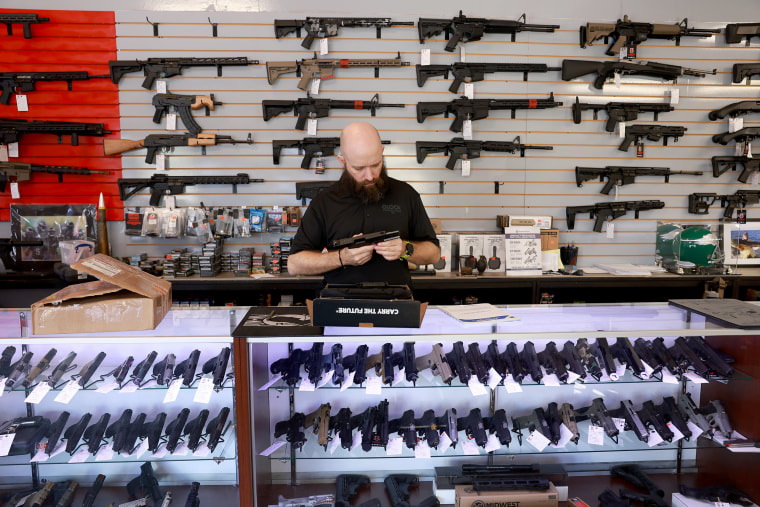
Along with the rising costs, Rotkowitz said he generally felt unsafe in the state between the erratic traffic — which resulted in a number of his patients being injured by vehicles — and a state law passed in 2023 that allowed people to carry a concealed weapon without a license.


A handgun is inventoried at store that sells guns in Delray Beach

A handgun is inventoried at store that sells guns in Delray Beach, Fla., in 2023.Joe Raedle / Getty Images file


“Everyone is walking around with guns there,” he said. “I consider myself a conservative guy, but if you want to carry a gun you should be licensed, there should be some sort of process.”

Veronica Blaski, who moved to Florida from Connecticut, said rising costs drove her out of the state after less than three years. When at the start of the pandemic her husband was offered a job in Florida making more money as a manager for a landscaping company, Blaski envisioned warm weather and a more comfortable lifestyle.

The couple, both in their 40s, sold their home in Connecticut and were starting to settle into their new community when Blaski said they were hit with a “bulldozer” of costs at the start of 2023.

Her homeowners insurance company threatened to drop her coverage if she didn’t replace her home’s 9-year-old roof, a $16,000 to $30,000 project, and even with a new roof, she was expecting her home insurance rates to double — one neighbor saw their insurance go from $600 a month to $1,200 a month.

She was also facing rising property taxes as the value of her home increased, her homeowners association fees went from $326 a month to $480, and her insurance agent warned that her car insurance would likely double when it was time to renew her policy. Her husband had to get a second job on weekends to cover the higher costs.

While Florida has an unemployment rate below the national average, Blaski and others said wages weren’t enough to keep up with their expenses. The median salary in Florida is among the lowest in the country, according to payroll processor ADP. To afford a home in one of Florida’s more affordable metro areas, like Jacksonville, a homebuyer would need to earn $109,000 a year, around twice as much income as a buyer would have needed just four years ago, according to an analysis by Zillow.

“My little part-time job making $600, $700 a month went to paying either car insurance or homeowners insurance, and forget about groceries,” said Blaski, who was working in retail. “There are all these hidden things that people don’t know about. Make sure you have extra money saved somewhere because you will need it.”


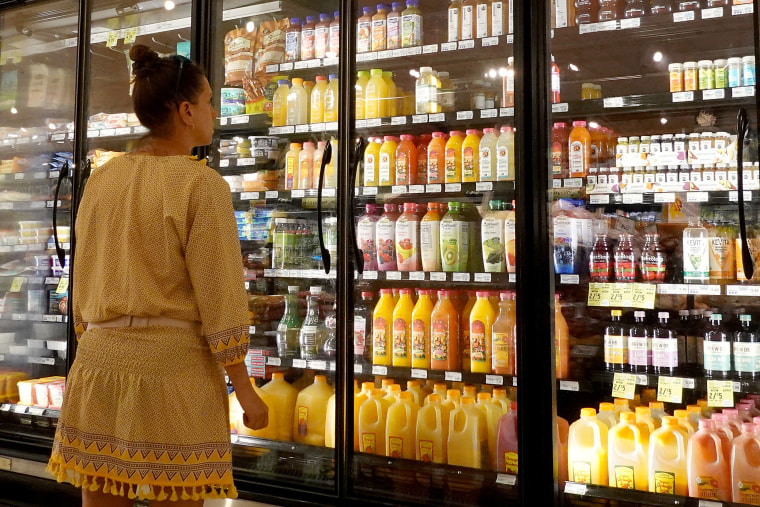
A woman looks at bottle of juice.

A person shops in a grocery store on July 13, 2022, in Miami as the consumer price index soared to 9.1%, marking the fastest pace for inflation since November 1981.Joe Raedle / Getty Images file


When her husband’s former boss in Connecticut reached out to see if he’d be willing to return, the couple leaped at the chance.

The reverse migration out of Florida isn’t just among newcomers, but also among longtime residents who said they can no longer afford to live there and are uncomfortable with the state’s increasingly conservative policies, which in recent years have included a crackdown on undocumented immigrants, a ban on transgender care for minors, state interventions in how race, slavery and sexuality are taught in schools, and a six-week ban on abortions.

After more than three decades in the Tampa Bay area, Donna Smith left the state for Pennsylvania in December, with politics and rising insurance costs playing a major role in her decision to leave.

“It breaks my heart, it really does, because Florida was really a pretty great place when I first moved there,” Smith said.

Having grown up in Oklahoma, Smith considered herself a Republican, but as Florida’s politics shifted to the right, she said she began to consider herself a Democrat. It wasn’t until the past several years, though, that politics started to encroach on her daily life — from feuds between neighbors and friends to neo-Nazis showing up at a Black Lives Matter rally in her small town.

“When I first moved to Florida, it was a live-and-let-live sort of beach feel. You met people from all over, everybody was relaxed. That’s just gone now, and it’s shocking. It’s just gone,” said Smith, 61, who works as a graphic designer and illustrator. “Instead, it’s just a constant stressful atmosphere. I feel as though it could ignite at any point, and I’m not a fearmonger. It’s just the atmosphere, the feeling there.”

She was already considering a move out of the state when she was told by her homeowners insurance company that she would need to replace her home’s roof because it was older than four years or her insurance premium would be going up to $12,000 a year from $3,600, which was already double what she had been paying. Even with a new roof, she was told her premium would be $6,900 a year. Before she could make a decision about what to do, her insurance policy was canceled.

Shortly after, Smith ended up moving to the Lancaster, Pennsylvania, area, where she is closer to her adult children. While the majority of voters in her new county chose Donald Trump in the last election, she said politics is no longer such a heavy presence in her everyday life.

“I don’t feel it is as oppressive. People don’t wear it on their sleeve like they did in Florida,” she said. “When you walk in a room, you don’t overhear a conversation all the time where people are saying ‘Trump is the best’ or ‘I went to that last rally,’ and they’re telling total strangers while you’re just waiting for your car or something. It was just everywhere.”


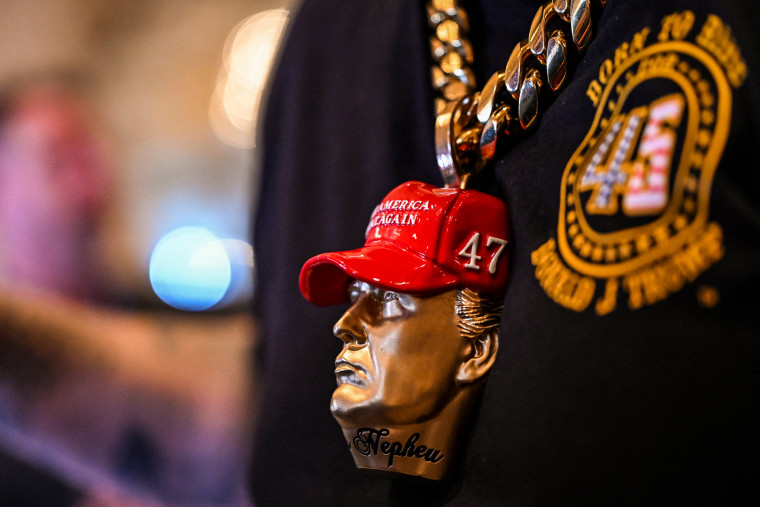
A supporter of Donald Trump wears a Trump bust jewelry.

A supporter of Donald Trump at a Super Tuesday election-night watch party at Mar-a-Lago in Palm Beach, Fla., on March 5.Chandan Khanna / AFP – Getty Images


Costs and politics were also enough to cause Noelle Schmitz to leave the state after more than 30 years, despite her son having a year left in high school, and relocate to Winchester, Virginia. She said the politics became ever-present in her daily life — one former neighbor had a massive Trump banner in front of their house for years, and another had Trump written in big letters across their yard. When she put out a Hillary Clinton sign in 2016, it was stolen and her house was egged.“I saw my neighbors and co-workers become more radicalized, more aggressive and more angry about politics. I’m thinking, where is this coming from? These are not the people I remember,” Schmitz said. “I was finally like, we need to get the hell out of here, things are not going well.”

For some Florida newcomers though, politics is the main draw to the state, said John Desautels, who has sold real estate in Florida for decades. While politics never used to be a topic for homebuyers, Desautels said it is now a regular subject his clients bring up. Rather than asking about schools or amenities in a community, prospective buyers are asking him about the political affiliations of a certain neighborhood.

“One of the first things they say is, ‘I don’t want to be in one of them X or Y political party neighborhoods,’” Desautels said. “I spend hours listening to people vent to me about fleeing the communist government of XYZ and they want to come to freedom or whatever. So the politics have been the biggest issue when we get the call.”

Even home showings have become a politically sensitive issue. He recalled showing an elderly woman one property where there were Confederate flags at the gate and swastikas on the fish tank.

But while politics are a lure to people arriving in the state, he said they’re also among the reasons sellers tell him they’re leaving, and the state’s politics have deterred some of his gay or nonwhite clients from moving there.

“The problem is, when we alienate protected classes, it sounds like a good sound bite, but you’ve got to remember those are people who spend money in our community,” he said. “For this pro-business, free state, I’m feeling it in the wallet, bad.”

In Kansas, Carter says it’s good to be home. She moved into a 55-plus community in a small town about 10 miles from Wichita. While in Florida she was paying nearly $900 in lot rent for her manufactured home, she now pays just $520 in rent for a cottage-style apartment — a place she estimates would have cost her $1,800 a month in Florida.

With the money she’s saving in Kansas, she can afford to visit Florida.

“People call me the modern-day Dorothy,” she said. “There’s no place like home.”


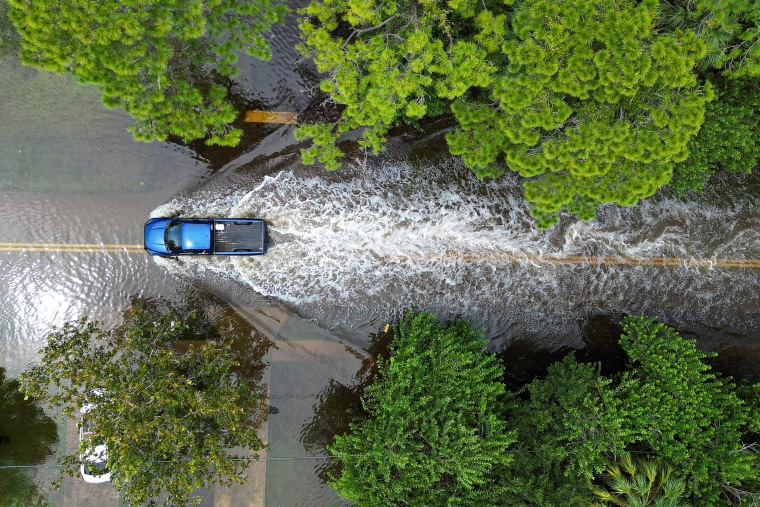
An aerial view of a vehicle driving along a flooded street.

A flooded street in New Port Richey, Fla., after Hurricane Idalia made landfall in 2023.Miguel J. Rodriguez Carrillo / AFP via Getty Images

Why the era of cheap streaming is over

TRUMP Gag Order…AGAIN! Boeing News! ALL HELL’S BREAKING LOOSE! | Christopher Titus

Donald Trump LOVES black people???

Information from VOX, The Atlantic and NBC News! He inherited this father’s business and his racism!

Man!!! I am upsetting the Right 😳🥴😏

I am sick to death about the right-wing lazy bas*ards sitting on their ass and blaming The REAL President for things that aren’t in his control!! They sit back, do nothing, and thousands of them don’t even VOTE!! if you don’t vote, you have no right to complain!!@

Don’t get conned folks. I haven’t reached out to you.

Is TikTok a threat to US national security?

This is about profit and which company gets it.  The data of every one of us is all over the internet.  I run several programs that block the invasive cookies and website to website movement I make across the internet.  Why?  No I am not doing anything wrong, I just feel if the businesses that build these huge databases about all of us should pay me for that information as they sell it to other companies at a huge profit to gain access to me for their adverts.  If you doubt that check your emails or ads on sites you visit and think how closely they compare to your web history.    It is incredible how much companies know about us … by my dogs that love gravy I recently went to a website and my ad blocker did not catch the advert for therapist for people abused as children, on a website totally not about that.  They could only have gotten my information on me being an abused child by combing my blog with WordPress’s permission, or from violating the policies of the survivor site I have shared my abuse on.  Either way it is not their right to have this information on me or use it to push me to a paid sponsor.  Face it people today we, each are the product, keeping us on each web page, the more clicks to the next story the better, that drives their advertisement dollars and the clicks add to what they can tell their bosses to keep them or to generate new shareholders to join.  The likes drive their income.  It is a sad place we are in.  I use two different anti tracker programs and one really good ad blocker program because I am not a number / cog for their sales divisions.   But still they somehow sometimes get through.  Hugs Scottie 

Many members of Congress who voted for the recent bill say tiktok is a threat and claim to have intel “we can’t see” but is it a danger? Research groups and congressman Jim Himes (the top Democrat on the intelligence committee) say it isn’t,

ALT RIGHT A.I.?

I am so tired right now having not slept last night, but I wanted to post this as I felt it was important.  This is a direct diversion of every search to the Republican agenda presenting in the best most convincing light.  Pushing project 2025.   So much for a neutral only the facts’ news AI media.  Seriously a bot designed to push pro-fundamentalist republican anti-choice regressive view points?  Is it deliberate? We people that love our democracy and progressive country better get engaged and vote, or we lose it all.  The wealthy owner class wants us to return to the guided age, when only businesses had a say, government had no power, and workers were slaves to be worked to death for profit.    Hugs.  Scottie

Microsoft’s A.I. bot copilot has been produced some strange results lately that make it seem like it may have been trained by alt right bros.

Why it’s hard for Americans to retire

This video starts out talking to people with higher incomes than most of the working public.  Most make less than a living wage, are paid barely over the minimum allowed by law, some have short or weird day shifts requiring the hold of multiple jobs.  Millions of people can not work to gain retirement.  I was lucky, I worked a high paying job in my mid 20s to early 30s.  That meant I get the same as my husband, who worked in low paying jobs and then as a CNAA in a hospital.  Retiring at 67 and 3 months a man who after a 12 hour shift could barely walk and was worn out.  Retirement shrank our income drastically but it saved his life I think.  Only the high paid people can save, as the video says towards the end the rest of us need everything and more to survive.  Life shouldn’t be a drudgery for most until death, and a grand time for the few, but in the US profit is king.  Those companies need that retirement money for higher dividends and more profit for the wealthy.   What the video doesn’t mention is those other countries pay more, have better social services, and much less costly medical systems for the public.   Hugs.  Scottie

There’s a reason so many of us don’t have enough retirement savings.

Vox sat down with people in our New York City studio to talk to them about the state of their retirement savings. By the standards of most financial experts, Americans are woefully behind on saving for retirement. The reason why is rooted in changes in policy to our retirement system with today’s result being a flawed design in how people set aside money so they can one day stop working. In this video, we interviewed four people about their level of retirement preparedness and two experts about the state of retirement readiness more broadly in the US. One culprit lies in changes to the country’s pension system, which sets the US apart from countries like Australia and the UK; these places have systems which help more people save more money for retirement.