I want to thank Ten Bears for the link. He often posts links to important information. This information needs to be spread far and wide. Hugs. Scottie
Here are a few quotes from the article.
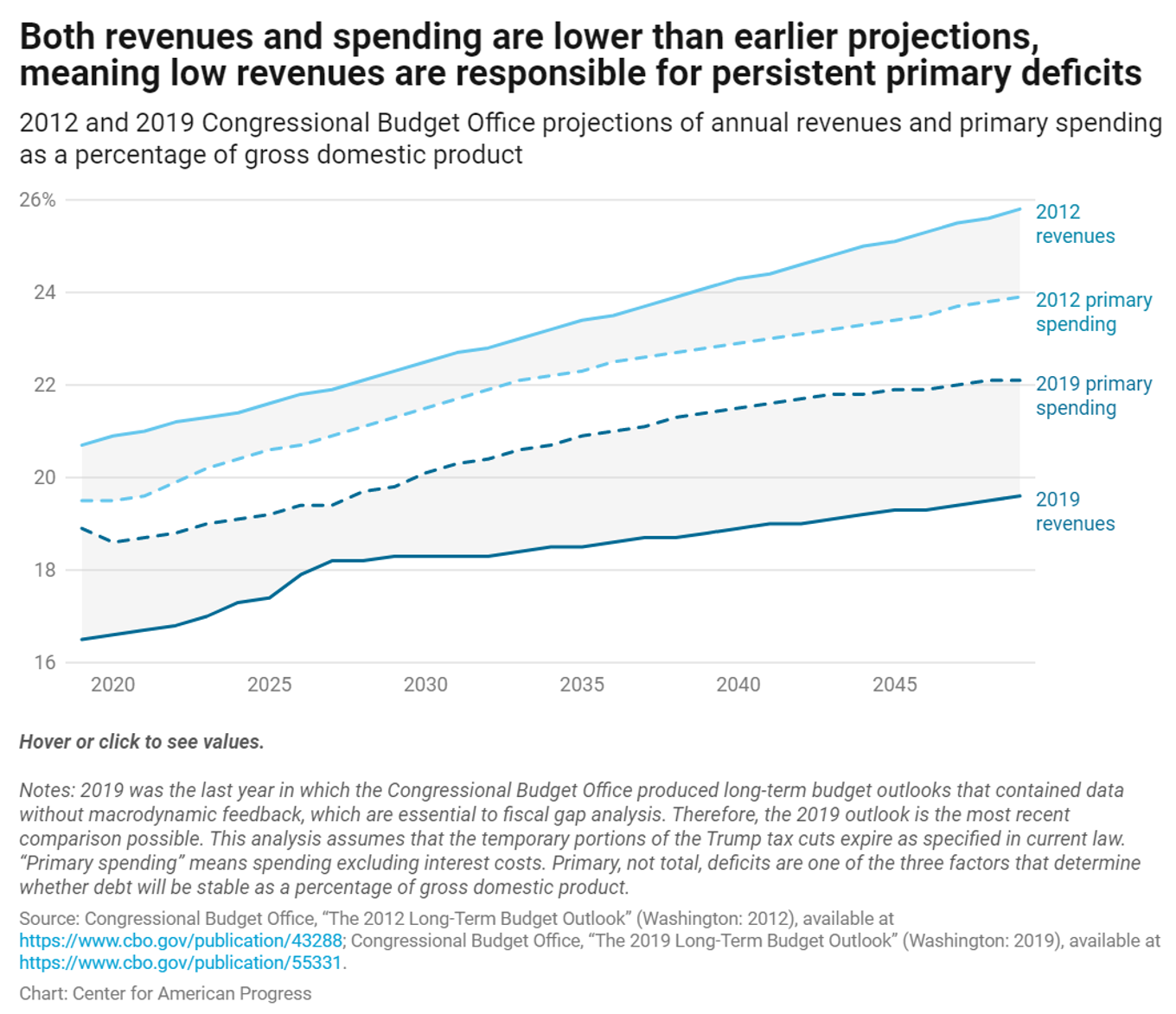
“The point I want to make again and again and again is that, relative to the last time CBO was projecting stable debt/GDP, spending is down, not up,” Kogan said in a tweet Friday night. “It’s lower revenue that’s 100% responsible for the change in debt projections. If you take away nothing else, leave with this point.”
“Tax giveaways for the wealthy are continuing to starve the federal government of needed revenue: those passed by former Presidents Trump and Bush have added $10 trillion to the debt and account for 57 percent of the increase in the debt-to-GDP ratio since 2001,” read the statement. “If not for those tax cuts, U.S. debt would be declining as a share of the economy.”
“Republicans racked up the national debt by giving tax breaks to their billionaire buddies, and now they want everyone else to pay for them.”
“Republicans racked up the national debt by giving tax breaks to their billionaire buddies, and now they want everyone else to pay for them,” Sen. Whitehouse said at the time. “It is one of life’s great enigmas that Republicans can keep a straight face while they simultaneously cite the deficit to extort massive spending cuts to critical programs and support a bill that would blow up deficits to extend trillions in tax cuts for the people who need them the least.”
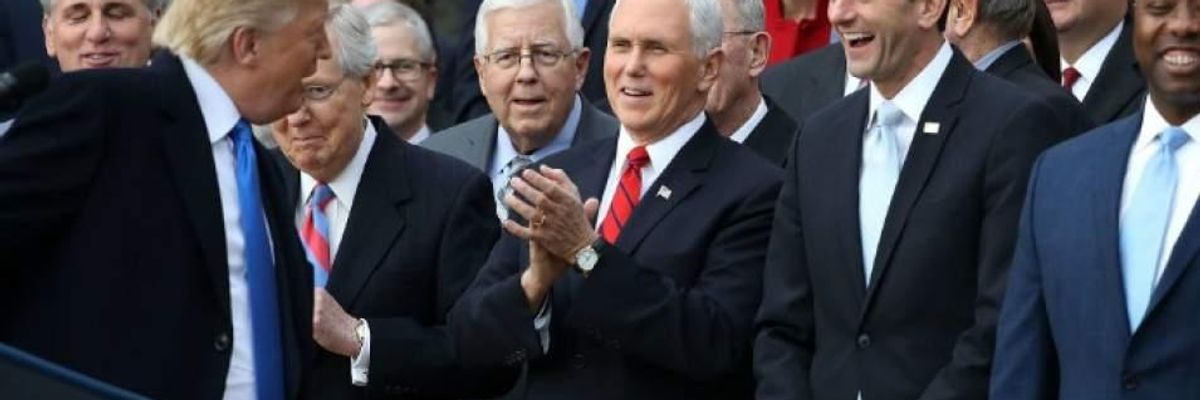
President Donald Trump jokes with Senate Majority Leader Mitch McConnell (R-Ky.), Sen. Mike Enzi (R-Wy.), Vice President Mike Pence, Speaker of the House Paul Ryan (R-Wis.) and Sen. Tim Scott (R-S.C.) during an event celebrating the passage of the Tax Cuts and Jobs Act on the South Lawn of the White House December 20, 2017 in Washington, DC.
(Photo: Chip Somodevilla/Getty Images)
“In their blind loyalty to their mega-donors, Republicans’ fixation on giant tax cuts for billionaires has created a revenue problem that is driving up our national debt,” said Sen. Sheldon Whitehouse in response to new Treasury Department figures.
The U.S. Treasury Department on Friday released new figures related to the 2023 budget that showed a troubling drop in the nation’s tax revenue compared to GDP—a measure which fell to 16.5% despite a growing economy—and an annual deficit increase that essentially doubled from the previous year.
“After record U.S. government spending in 2020 and 2021” due to programs related to the economic fallout from the Covid-19 crisis, the Washington Postreports, “the deficit dropped from close to $3 trillion to close to $1 trillion in 2022. But rather than continue to fall to its pre-pandemic levels, the deficit unexpectedly jumped this year to roughly $2 trillion.”
While much of the reporting on the Treasury figures painted a picture of various and overlapping dynamics to explain the surge in the deficit—including higher payments on debt due to interest rates, tax filing waivers related to extreme weather events, the impact of a student loan forgiveness program that was later rescinded, or a dip in capital gains receipts—progressive tax experts say none of those complexities should act to shield what’s at the heart of a budget that brings in less than it spends: tax giveaways to the rich.
Bobby Kogan, senior director for federal budget policy at the Center for American Progress, has argued repeatedly that growing deficits in recent years have a clear and singular chief cause: Republican tax cuts that benefit mostly the wealthy and profitable corporations.
In response to the Treasury figures released Friday, Kogan said that “roughly 75%” of the surge in the deficit and the debt ratio, the amount of federal debt relative to the overall size of the economy, was due to revenue decreases resulting from GOP-approved tax cuts over recent decades. “Of the remaining 25%,” he said, “more than half” was higher interest payments on the debt related to Federal Reserve policy.
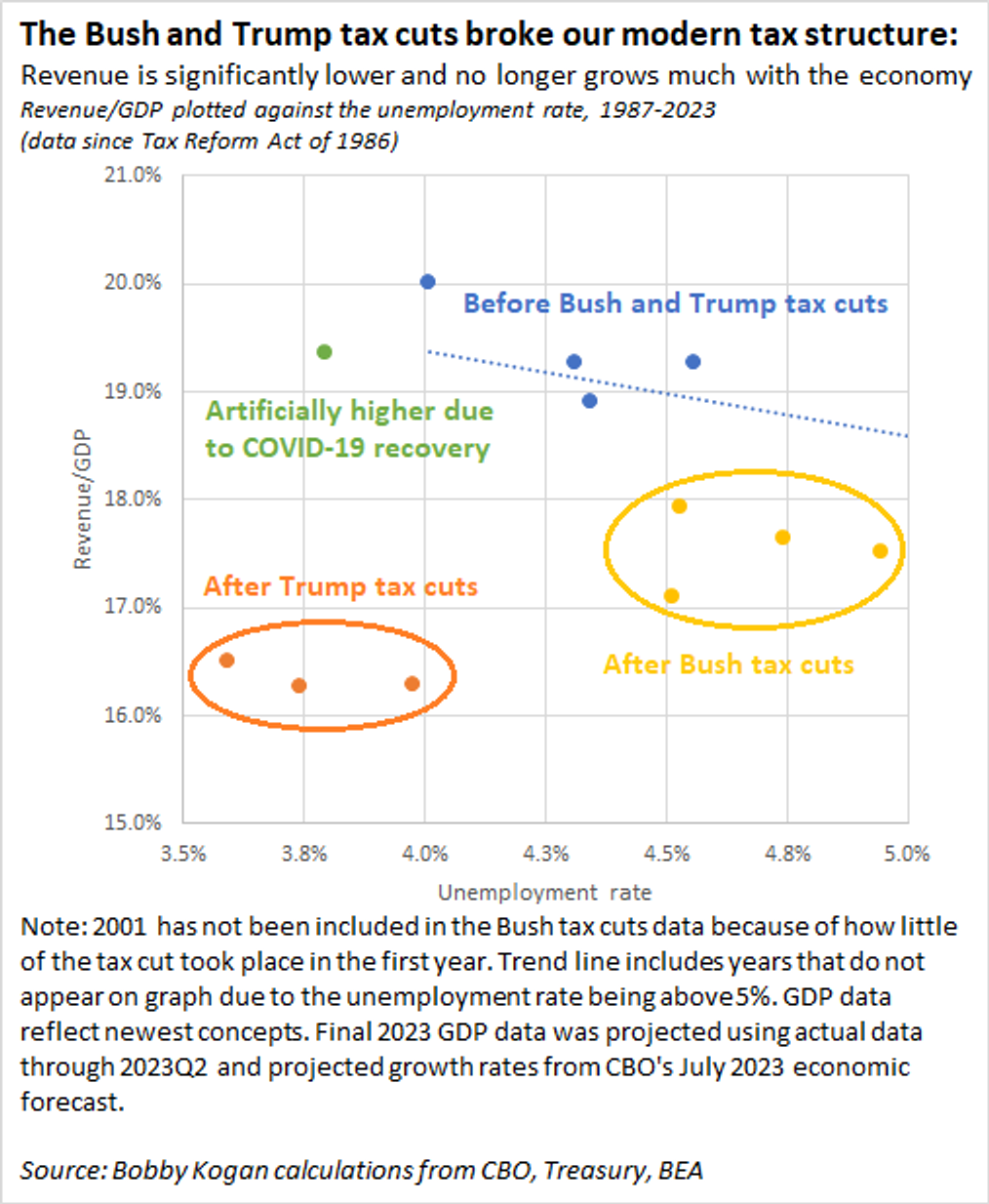
“We have a revenue problem, due to tax cuts,” said Kogan, pointing to the major tax laws enacted under the administrations of George W. Bush and Donald Trump. “The Bush and Trump tax cuts broke our modern tax structure. Revenue is significantly lower and no longer grows much with the economy.” And he offered this visualization about a growing debt ratio:
“The point I want to make again and again and again is that, relative to the last time CBO was projecting stable debt/GDP, spending is down, not up,” Kogan said in a tweet Friday night. “It’s lower revenue that’s 100% responsible for the change in debt projections. If you take away nothing else, leave with this point.”
Holy moly! Revenues fell to 16.5% of GDP last year. They're only that low after tax cuts or the Great Recession. No wonder there's a deficit.
Since 1962: 1965: after tax cuts 2003-04: after Bush tax cuts 2009-2012: after Great Recession 2018-2020: after Trump tax cuts
In his tweet, Kogan offered the following chart to show recent and projected levels of both federal revenue and spending relative to gross domestic product (GDP):
In a detailed analysis produced in March, Kogan explained that, “If not for the Bush tax cuts and their extensions—as well as the Trump tax cuts—revenues would be on track to keep pace with spending indefinitely, and the debt ratio (debt as a percentage of the economy) would be declining. Instead, these tax cuts have added $10 trillion to the debt since their enactment and are responsible for 57 percent of the increase in the debt ratio since 2001, and more than 90 percent of the increase in the debt ratio if the one-time costs of bills responding to COVID-19 and the Great Recession are excluded.”
On Friday, the office of Sen. Sheldon Whitehouse (D-R.I.) cited those same numbers in a press release responding to the Treasury’s new report.
“Tax giveaways for the wealthy are continuing to starve the federal government of needed revenue: those passed by former Presidents Trump and Bush have added $10 trillion to the debt and account for 57 percent of the increase in the debt-to-GDP ratio since 2001,” read the statement. “If not for those tax cuts, U.S. debt would be declining as a share of the economy.”
Trump tax cuts went overwhelmingly to the richest (and foreign investors), cost hundreds of billions each year, ballooned the deficit and gave $49,000 to each one percenter. Get the details here. #GOPDebatehttps://t.co/1u9K8Cfsv1
Whitehouse, who chairs the Senate Budget Committee, said the dip in federal revenue and growth in the overall deficit both have the same primary cause: GOP fealty to the wealthy individuals and powerful corporations that bankroll their campaigns.
“In their blind loyalty to their mega-donors, Republicans’ fixation on giant tax cuts for billionaires has created a revenue problem that is driving up our national debt,” Whitehouse said Friday night. “Even as federal spending fell over the last year relative to the size of the economy, the deficit increased because Republicans have rigged the tax code so that big corporations and the wealthy can avoid paying their fair share.”
Offering a solution, Whitehouse said, “Fixing our corrupted tax code and cracking down on wealthy tax cheats would help bring down the deficit. It would also ensure teachers and firefighters don’t pay higher tax rates than billionaires, level the playing field for small businesses, and promote a stronger economy for all.”
None of the latest figures—those showing that tax cuts have injured revenues and therefore spiked deficits and increased debt—should be a surprise.
In 2018, shortly after the Trump tax cuts were signed into law, a Congressional Budget Office (CBo) report predicted precisely this result: that revenues would plummet; annual deficits would grow; and not even the promise of economic growth made by Republicans to justify the giveaway would be enough to make up the difference in the budget.
“The CBO’s latest report exposes the scam behind the rosy rhetoric from Republicans that their tax bill would pay for itself,” Sen. Chuck Schumer (D-N.Y.), and now Senate Majority Leader, said at the time.
“Republicans racked up the national debt by giving tax breaks to their billionaire buddies, and now they want everyone else to pay for them.”
In its 2018 report, the CBO predicted the deficit would rise to $804 billion by the end of that fiscal year. Now, for all the empty promises and howling from the GOP and their allied deficit hawks, the economic prescription they forced through Congress has resulted in an annual deficit of more than double that, all while demanding the nation’s poorest and most vulnerable pay the price by demanding key social programs—including food aid, education budgets, unemployment benefits, and housing assistance—be slashed.
Meanwhile, the GOP majority in the U.S. House—with or without a Speaker currently holding the gavel—still has plans to extend the Trump tax cuts if given half a chance. In May, a CBO analysis of that pending legislation found that such an extension would add an additional $3.5 trillion to the national debt.
“Republicans racked up the national debt by giving tax breaks to their billionaire buddies, and now they want everyone else to pay for them,” Sen. Whitehouse said at the time. “It is one of life’s great enigmas that Republicans can keep a straight face while they simultaneously cite the deficit to extort massive spending cuts to critical programs and support a bill that would blow up deficits to extend trillions in tax cuts for the people who need them the least.”
Our work is licensed under Creative Commons (CC BY-NC-ND 3.0). Feel free to republish and share widely.
There are metallic deposits scattered throughout our ocean floors — among hydrothermal vents, under the crust of seamounts, and scattered along sea plains in the form of rocks. As it happens, in our search for climate solutions, these metals have become more critical than ever to help us transition away from fossil fuels. We need them for everything like electric car batteries, copper wiring for electrification and wind turbines. Our land-based deposits have met our needs so far, but it’s unclear whether they will continue to, or whether we’ll want to keep destroying the environment to do so.
This video explains the history and the debate over mining metals in the deep sea and why one Canadian company, The Metals Company, is leading the rush there. There are huge environmental implications for digging up seafloor ecosystems as well as ethical ones: Metal-rich zones like the Clarion-Clipperton Zone lie in international waters that technically belong to everyone. A United Nations body located in Kingston, Jamaica, the International Seabed Authority, is faced with an urgent dilemma over how to regulate mining, whether the environmental harm is worth the benefits to solving our climate crisis, and how to fairly share the profits from this shared resource.
Remember during lockdown, how we all got obsessed with ordering everything online and having it delivered right to our doorsteps? Yeah, turns out that isn’t going away anytime soon, and we’re starting to understand the many downsides. The delivery vans that make our next-day shipping dreams come true are driving up C02 emissions while making our streets more crowded and less safe.
Fortunately, there’s a hero waiting in the wings: the e-cargo bike. Not only can these bad boys deliver packages in urban environments just as quickly (and sometimes faster) than delivery vans, they take up far less space and are much less likely to cause pedestrian deaths. Companies like Amazon, DHL, and UPS are using them in several European cities, but American cities haven’t followed suit.
In this video, we explore why that is, and lay out some of the big steps American cities would need to take to join the e-bike delivery revolution.
Very informative how conservative and fundamentalist religious leaders have been attacking the public school system with disastrous results. She does talk rapidly but the CC is pretty good for YouTube. Hugs
Public education is under attack from all sides in this country, typically at the hands of a few wealthy and powerful conservatives who stand to benefit from the failure of public education at the expense of children and teachers.
A supreme court justice and his wife plot how to get more wealth and increase the control of the super wealthy over politicians. The justice helps push the over turning of laws limiting how much money the wealthy can use to buy / control politicians while his wife and the religious fundamentalist Christian nationalist pushing the courts to be filled with fundamentalist Christian nationalist start a new organization, a super PAC, to use the new power of the Citizens United decision pushed by her husband. Insidious. But it shows how corrupt some members of the SCOTUS are. This article is very long but informative. Joe My God has a shorter version he posted a few days ago. Hugs
Thanks to the Supreme Court’s Citizens United ruling, a trove of so-called “dark money” was about to be unleashed. Two activists prepared to seize the moment.
Leonard Leo’s role as the central figure in the conservative legal movement has long been known, culminating in his acquisition last year of what many believe to be the largest political donation in history. | POLITICO illustration/Photos by AP Photo, Getty Images
Heidi Przybyla is a Washington, D.C. journalist. You can find her on Twitter @HeidiReports.
The Supreme Court’s decision in the 2010 Citizens United case transformed the world of politics. It loosened restrictions on campaign spending and unleashed a flow of anonymous donor money to nonprofit groups run by political activists.
In the months before the ruling dropped in January of that year, a group of conservative activists came together to create just such an organization. Its mission would be to, at the time, block then-President Barack Obama’s pet initiatives.
The activists included Federalist Society leader Leonard Leo and his ideological soulmate, a hard-edged activist named Virginia Thomas, the wife of Supreme Court Justice Clarence Thomas.
“Ginni really wanted to build an organization and be a movement leader,” said a person familiar with her thinking at that time. “Leonard [Leo] was going to be the conduit of that.”
She also had a rich backer: Harlan Crow, the manufacturing billionaire who had helped Thomas and her husband in many ways, from funding luxury vacations to picking up tuition payments for their great-nephew.
At the time, the Citizens United ruling was widely expected, as the court had already signaled its intentions. When it came, it upended nearly 100 years of campaign spending restrictions.
The conservative legal movement seized the moment with greater success than any other group, and the consequences have shaped American jurisprudence and politics in dramatic ways.
From those early discussions among Leo, Thomas and Crow would spring a billion-dollar force that has helped remake the judiciary and overturn longstanding legal precedents on abortion, affirmative action and many other issues. It funded legal scholars to devise theories to challenge liberal precedents, helped to elect state attorneys general willing to apply those theories and launched lavish campaigns for conservative judicial nominees who would cite those theories in their rulings from the bench.
The movement’s triumphs are now visible but its engine remains hidden: A billion-dollar network of groups, most of which are registered as tax-exempt charities or social welfare organizations. Taking advantage of gaps in disclosure laws, they shield the identities of most of their donors and some of the recipients of the funds. Among those who’ve been paid by the groups are leading thinkers and individuals with close personal ties to Leo — including a whopping $7 million to a group run by a close friend and his wife. They also include a for-profit business for which Leo himself is chairman and which received tens of millions of dollars from his nonprofit network.
Leo’s role as the central figure in this movement has long been known, culminating in his acquisition last year of what many believe to be the largest political donation in history. Few are aware of the extent to which the movement’s baby steps were taken in concert with Ginni Thomas.
Two months before the Citizens United decision, but after the justices had signaled their intentions by requesting new arguments, attorney Cleta Mitchell — later to play a role in Donald Trump’s false claims about the 2020 elections — filed papers for Ginni Thomas to create a nonprofit group of a type that ultimately benefited from the decision. Leo was one of two directors listed on a separate application to conduct business in the state of Virginia. Thomas was president. She signed it on New Year’s Eve of 2009, and Crow provided much of the initial cash. A key Leo aide, Sarah Field, would come aboard to help Thomas manage the group, which they called Liberty Central.
After Liberty Central went public, it provoked an outcry over a Supreme Court justice’s wife promoting causes like overturning Obamacare that were before her husband’s court. Leo and Thomas changed gears. His network reactivated a dormant group, the Judicial Education Project, which would go on to become a major supplier of amicus briefs before the nation’s highest court. She created a for-profit consulting business using a similar name — Liberty Consulting — that enabled her to perform consulting work for conservative activist groups.
The Judicial Education Project supplied some of her business: Documents indicate Leo ordered at least one recipient of his groups’ funds, Kellyanne Conway, to make payments to Ginni Thomas for unspecified work, according to a Washington Post story earlier this year.
Now, Liberty Consulting is a focus of interest from congressional committees probing the Supreme Court’s ethics disclosures. Senate Democrats have demanded that Leo and Crow provide a list of “gifts, payments, or other items of value” they’ve given Thomas and her husband.
Meanwhile, Leo’s network of nonprofits — whose annual donations have skyrocketed into the hundreds of millions of dollars — is the subject of an investigation by the Washington, D.C., attorney general, POLITICO reported last month. The probe followed a POLITICO report in March that raised questions about whether Leo’s groups were enriching him and his friends by hiring their businesses and donating to their nonprofit groups.
Together, the probes have combined to raise the question of whether Leo’s groups have taken advantage of lax disclosure laws to send additional business and funds to Ginni Thomas, among other activists. That would be legal as long as Thomas was providing services commensurate with the payments.
“The real question then is, ‘what is Ginni Thomas qualified to do, what did they pay her to do, and was it fair market value?’” said Laura Solomon, a Pennsylvania tax attorney who represents hundreds of charitable and other tax-exempt organizations and philanthropists.
Leo, Thomas, Crow and Conway did not respond to questions about their financial relationships, and whether Leo’s groups continued to ask contractors to work with Thomas.
Asked how much money overall Leo has directed to Thomas, when the payments began and if they ever stopped, a Leo spokesman responded: “No comment.”
Thomas’ representative, attorney Mark Paoletta, did not respond to questions.
In a July 25 letter to Congress, Leo’s lawyers said his advocacy work is protected under the First Amendment and that any congressional inquiry into his relationships with Supreme Court justices is “politically charged” and tantamount to harassment.
In a July interview with The Maine Wire, a conservative outlet near his home, Leo spoke about his efforts to “defend the Constitution” and why his nonprofit groups don’t reveal their donors.
“It’s not to hide in the shadows,” he said. “It’s because we want ideas judged by their own moral and intellectual force.”
Launching a Movement
Many people trace the start of the conservative legal movement to 1982, the year of the founding of the Federalist Society, which provided a forum for law students and professors with conservative ideas to incubate their theories.
But the movement that has had such a profound impact on the courts today — one that involves money and politics, more than legal theories or principles — gained steam in the wake of the Citizens United decision.
The case followed a highly unusual path — one blazed by a five-justice conservative majority who seemed determined to strike a blow against campaign finance restrictions.
Initially, the dispute centered on whether a conservative nonprofit’s unflattering documentary on former Democratic presidential candidate Hillary Clinton violated campaign finance laws. Instead of resolving the case along the lines argued by the lawyers, the justices took the unusual step of asking for re-arguments based on a sweeping question — whether they should overrule prior decisions approving laws that limited spending on political campaigns.
The re-argument took place on Sept. 9, 2009. Two months later, on Nov. 6, Mitchell filed an IRS application on behalf of Ginni Thomas to form the group that becameLiberty Central Inc. Paperwork Thomas signed on New Year’s Eve listed Leo, then the Federalist Society’s executive vice president, as one of two directors. Field, one of Leo’s right-hand people on state courts at the Federalist Society, came aboard to help Thomas in her new endeavor.
Neither Field nor Mitchell responded to requests for comment.
The application was approved seven days before Clarence Thomas joined the 5-4 majority on a decision that wouldopen the door to a new era of major spending on groups like the one his wife was forming. After putting up $500,000, the lion’s share of her nonprofit’s seed money, Crow held an event for Ginni Thomas at his palatial home in Dallas. The group later made clear its goal was disassembling President Barack Obama’s agenda, mainly the Affordable Care Act.
Justice Anthony Kennedy, a Ronald Reagan appointee, assumed in his majority opinion in Citizens United that donations and spending around such groups would be transparent. Justice Thomas, in his concurring opinion, argued against “forcibly disclosed donor information,” which could “pre-empt citizens’ exercise of their First Amendment rights.”
The Citizens United decision — which extended free speech rights to corporations, nonprofits and unions — effectively curbed efforts to rein in political spending, while paving the way for follow-up rulings from courts and the Federal Election Commission that would unleash additional billions of dollars in donations. Those donors would spawn a boom in tax-exempt “charitable” and “social welfare” groups as vehicles for spending on political activity.
A key part of the attraction to these groups was that they could shield the identity of donors, many of whom are reluctant to invite scrutiny of their own agendas.
Speaking out
Just five weeks after the decision, on Feb. 18, Ginni Thomas took the stage at CPAC, an annual gathering of the nation’s most prominent conservative activists. Wearing a white T-shirt emblazoned with a Liberty Central logo, Thomas introduced herself as an “ordinary citizen from Omaha, Nebraska” who felt “called to the front lines” of a battle against “arrogant elites” who “think they know how to manage our lives from cradle to grave.” She evoked the passing of “patriots,” including her 91-year-old mother and Barbara Olson, who had perished in the plane that hit the Pentagon on Sept. 11, 2001, as her inspiration.
“When she was gone, I knew I had to work harder,” Thomas said of Olson, whose widower, Ted, had been a lawyer for Citizens United.
Thomas did not credit Crow, Leo or the Citizens United decision for her new grassroots initiative. That year, she was paid $120,500 from Liberty Central, according to tax records.
The group was destined to have only a short lifespan, thanks in part to a misstep by Thomas. In October, she left a voicemail for Anita Hill, the woman who had accused her husband of sexual harassment during his confirmation hearings in 1991. In it, Thomas demanded an apology for the 19-year-old accusations.
“I would love you to consider an apology sometime and some full explanation of why you did what you did with my husband,” Thomas reportedly said, asking Hill to “pray about this.”
The ensuing news reports drew unwanted attention to Thomas’ new nonprofit, which by then was expressly targeting Obama and his agenda. The news led many ethics specialists to question whether it was appropriate for a Supreme Court justice’s spouse to be leading such a political effort, especially with the court preparing to consider a high-profile challenge to Obama’s health care initiative.
Incorporation records show Thomas had already pivoted to form her own for-profit consulting firm in the state of Virginia. On Nov. 16, Thomas’ “expedited service request” to incorporate her consulting business was approved. And Leo turned to another vehicle he could use to pay her with no apparent paper trail. The Judicial Education Project, a tax-exempt charity that had been founded by three of Leo’s associates in 2004 but soon became dormant, was reactivated and began receiving donations in 2010.
And far from retreating, Thomas merely moved her networking behind the scenes.
“She remained active in the [conservative legal] movement for sure,” said the person who had attended early meetings about her plans and who was granted anonymity to discuss private meetings. “People just always assumed she had to stay below the radar.”
She was a frequent attendee at major coordinating events among conservative nonprofits and was considered “a very popular activist figure,” the person said.
Thomas’ brief run as president of her own nonprofit had given her a taste of a lifelong dream. Thomas grew up tagging along with her mother, a Nebraska GOP Party activist. A 1986 Good Housekeeping article that mentioned the young Virginia Lamp said she aspired to run for Congress, but her biggest challenge was “finding a husband who’ll be supportive of a woman in public life.”
Liberty Central had been explicit about its intent to assist “citizen activists,” launching an “activism how-to website” in August and an ad campaign a month before the 2010 midterm election in which challenging Obamacare was the conservative movement’s primary objective.
Thomas continued her activism after leaving the nonprofit, with Leo helping to send money in her direction.
According to the documents obtained by the Post, Leo told Conway he wanted her to “give … another $25K” to Thomas and that the records should have “no mention of Ginni, of course.” At Leo’s behest, Conway’s polling firm billed the Leo-affiliated JEP $25,000 that day as a “Supplement for Constitution Polling and Opinion Consulting,” the documents show.
In all, Leo arranged for between $80,000 and $100,000 to go to Thomas through Conway for unspecified work in 2011 and 2012, according to the documents.
Limiting disclosures
There is no direct paper trail for JEP’s spending on Conway’s business, let alone Thomas.
The IRS requires that nonprofits must identify only their top five highest-paid contractors making more than $100,000 annually, but that leaves many contractors off the list. True North Research, an investigative watchdog group, found at least $25 million of the $240 million that JEP has spent on grants and expenses since 2010 — including salaries and contractor fees — went to people whose identities were not revealed.
“This money could have gone to anyone,” said Lisa Graves, the leader of True North Research and former deputy assistant attorney general in the Clinton administration.
In its filings for the year after Leo asked Conway to give money to Thomas, the JEP reported spending a total of $150,000 on “polling,” which could have covered the payments, but Conway’s firm, The Polling Company, was not listed on its paperwork. A spokesman for Leo said JEP used “multiple polling contractors” and that he is “unaware” of any connections between Thomas and those contractors.
In 2011, the judiciary’s policy-making body, a panel overseen by Chief Justice John Roberts, received a complaint from a sitting judge after a watchdog group revealed that Clarence Thomas hadn’t reported hundreds of thousands of dollars earned by his wife.
Clarence Thomas filed amended reports, explaining that his wife’s income was “inadvertently omitted due to a misunderstanding of the filing instructions.” No formal review was conducted, though the panel asserted there was no “willful” wrongdoing by the justice.
The filing requirements themselves were porous enough, however, that justices could effectively omit naming any of their spouse’s clients or the amount of money they were receiving. Thus, in subsequent disclosures, Clarence Thomas would go on to simply list that his wife had received money from her consulting business, without detailing how much or from whom, or whether any of the people paying her had interests before the Supreme Court.
Likewise, gaps in disclosure requirements for nonprofits were large enough that no one could keep track of who was funding Leo’s network. In some instances, the gaps were exacerbated by irregularities. In 2011, JEP reported to the IRS having received no more than $50,000 in donations, even though another Leo-aligned entity, the Wellspring Committee, reported having given JEP $136,000 that year. A spokesman said JEP took in more than expected and accounted for the surplus in a subsequent reports.
The lack of a requirement to report donors became more noteworthy as JEP’s revenue began to grow.
In 2012 — the year Leo asked Conway to direct payments to Thomas through Conway’s polling business — the formerly inactive nonprofit reported receiving $1.5 million. The next year, Thomas’ former law clerk, Carrie Severino, became one of the group’s three directors; by 2014, the nonprofit’s annual revenues were up to $9 million from nothing reported just five years previously, according to tax filings.
Severino did not respond to questions through the Judicial Crisis Network, another Leo-aligned group which she heads.
Pushing an agenda
Meanwhile, JEP was becoming a major vehicle for filing amicus briefs on behalf of the conservative legal movement seeking to influence the Supreme Court. More than just expressions of support for one side or the other, these briefs often encompassed extensive fact-finding and analysis, spanning scores of pages. The goal was to offer conservative justices arguments that they could incorporate into their opinions.
The lead attorney on the first amicus brief JEP joined was former Thomas law clerk John Eastman, who would later advise Trump on theories for overturning the 2020 election. The brief argued that Obamacare’s provision requiring minimum coverage was an “oppressive mandate” and that it was “tainted” by “abuses of the legislative process.” With the support of Roberts, the court ruled against JEP’s position. ClarenceThomas, along with the other conservative justices, joined a dissent that would have found the individual mandate unconstitutional. In later years, the mandate would be effectively ended by Congress repealing its tax penalties.
Many of the JEP’s subsequent briefs listed Severino as counsel of record.
In 2013, JEP filed a Severino-authored brief arguing in favor of striking down a Massachusetts law that made it a crime to stand within 35 feet of entrances to abortion clinics. The state claimed the law was necessary to prevent clashes between demonstrators. JEP, however, argued that abortion clinics provide “incomplete and misleading information about the abortion procedure” and that the law interfered with the rights of “sidewalk counselors.” The court unanimously struck down the law, though a five-justice majority rejected JEP’s contention that the law was aimed at curbing the rights of anti-abortion protesters.
In 2014, JEP weighed in on the landmark case of Burwell v. Hobby Lobby, in which the court decided that companies can opt out of contraception coverage for employees based on the owners’ religious objections. The opinion, written by Justice Samuel Alito and joined by ClarenceThomas, adopted many of the arguments JEP made in its Severino-authored brief, mainly that Obamacare’s coverage requirements burdened the Hobby Lobby owner’s right to free exercise of religion.
In 2015, JEP filed a brief in support of a petitioner challenging a University of Texas affirmative action program, which it called a “back-door” and secretive process. Clarence Thomas and Alito agreed it was “categorically unconstitutional.” The court’s majority disagreed, but later, in 2023, a more conservative court would adopt the position advocated by JEP.
Curbing oversight
Efforts to determine who was funding such advocacy, and whether they had direct interest in the cases, are complicated by gaps in disclosure rules and oversight of nonprofit groups. The rules governing such groups were designed for traditional charities such as Kiwanis Clubs or PTAs. But once activist groups started organizing under the same tax provisions, the IRS was forced to become the arbiter of what constituted politics and what did not.
Since JEP was registered as a charity, “the [IRS] limitations are very clear that you can’t do anything engaged in politics” and cannot organize a nonprofit for the benefit of any private interest or individual, said John Koskinen, a former IRS commissioner from 2013 to 2017 who reviewed the paperwork provided by POLITICO. Though such groups can engage in advocacy and limited lobbying, they are prohibited from participating in campaigns for or against political candidates.
Those who claimed the IRS wasn’t properly scrutinizing such groups quickly ran into a powerful countermovement claiming the opposite.
Mitchell, the lawyer who had helped Thomas set up her own ill-fated nonprofit, began championing a public relations offensive to combat IRS scrutiny of the same nonprofits her allies were erecting. She claimed that the tax agency, then overseen by the Obama administration, was disproportionately targeting conservative groups and called for an independent counsel.
The agency “is so corrupt and so rotten to the core that it cannot be salvaged,” Mitchell said in 2014.
A two-year investigation by the Department of Justice “found no evidence that any IRS official acted based on political, discriminatory, corrupt or other inappropriate motives” and closed with no charges. It did find “substantial evidence of mismanagement, poor judgment and institutional inertia” as IRS officials cut corners to deal with an explosion of Tea Party-aligned nonprofit applications similar to Thomas’ group. But it also found that some progressive groups experienced similar processing delays and extra scrutiny.
Thereafter, the division that polices such nonprofits was effectively neutered by budget cuts. Audit rates plunged as the division became overwhelmed by hundreds of new nonprofits supposedly doing charitable and educational work but actually doing mostly political work. Clawing back funding for the IRS remains a top demand of conservative lawmakers in annual congressional budget negotiations.
The timing of the campaign against the IRS was no coincidence, said Koskinen, the former IRS commissioner who was in office during that period in the Obama administration.
“It shouldn’t surprise anyone that some of the people attacking the IRS and supporting cuts to its budget after 2010 were the same people pushing the envelope of how to move ‘dark money’ around to maximize its political effect,” Koskinen said. “The fewer auditors the IRS had, the lower the odds of being caught.”
Backing Trump
The election of Donald Trump in 2016 opened the door to countless new opportunities for the burgeoning conservative legal movement.
Leo himself had played a strong role in ensuring Trump’s election. When conservatives expressed doubts about the surprise GOP nominee, Leo helped reassure them by persuading Trump to commit to choosing Supreme Court nominees from a list that Leo himself drafted.
Then, after Trump’s victory, Leo worked hard to ensure that the president followed through.
When Conway joined the White House as an adviser to new president, with a hand in judicial nominations, Leo helped facilitate the sale of her polling firm to a Virginia company where he is now chairman.
Leo’s closeness to the White House sparked a fresh surge in donations to his network. In 2020, he announced JEP was being rebranded as the 85 Fund, and its annual fundraising skyrocketed to $65.7 million.
That year also marked the ultimate triumph of the conservative legal movement, as the confirmation of Justice Amy Coney Barrett established a 6-3 majority of justices aligned with Leo’s Federalist Society. Leo used his dark-money groups to fund campaigns urging the confirmation of those justices, including Barrett.
Then, as Trump approached a difficult re-election campaign in 2020, the 85 Fund created a subgroup, The Honest Elections Project, dedicated to amplifying claims of Democrats cheating in elections and pushing for voting restrictions.
Since Trump’s defeat, the Honest Elections Project has seized on momentum created by his unfounded claims of a stolen election to push anti-fraud measures that critics say will make voting harder for everyone.
“Tens of millions of voters harbor grave doubts about the future legitimacy of the democratic process,” the group says on its website. “They expect voting to be secure, accessible, and honest — even in a pandemic. What they got was an election marred by dysfunction, hundreds of agenda-driven progressive lawsuits that undermined voting safeguards, and a system that in many places failed to deliver prompt results. That is not how elections are supposed to work.”
A growing network
The Honest Elections Project is now just one limb of Leo’s fast-growingoperation, fortified by what is believed to be the largest political donation in history: $1.6 billion from 91-year-old manufacturing magnate Barre Seid.
But with that immense war chest has come further scrutiny of the network’s spending. In March, POLITICO reported that since Leo became chairman of the for-profit CRC Advisors in 2020, the JEP and another Leo-affiliated group has paid the firm at least $43 million. A few weeks later, a progressive watchdog group filed a complaint with the D.C. attorney general and the IRS requesting a probe into what services were provided and whether Leo was in violation of laws against using charities for personal enrichment.
The probe is ongoing, and a lawyer for the Leo-affiliated groups involved called the complaint “sloppy, deceptive and legally flawed.”
Leo did not respond previously over multiple weeks to requests for information about what services the public relations firm provided to his nonprofits.
He wasn’t alone in declining to do so.
Other Leo allies have nonprofits and have declined comment to POLITICO on what services they provided in exchange for millions of dollars, including Ronald Cass, a Boston University law school dean emeritus who runs a nonprofit registered to his home address in Virginia called The Center for the Rule of Law.
Leo was best man at Cass’ wedding and, in 2018, when Cass’ daughter was a debutante featured at one of the nation’s most exclusive galas, Leo and his wife Sally were among the attendees. Cass was also a longtime friend of Justice Antonin Scalia. In a sign of the family’s proximity to the Supreme Court, Cass was the master of ceremonies at a July 2016 dinner honoring Scalia’s memory. (Leo and Cass both sat at ClarenceThomas’ VIP table according to a seating chart.) Cass’ daughter is slated to clerk for Alito.
Cass’ group, described as an independent “center of international scholars analyzing rule of law issues,” doesn’t have much of a footprint. His wife, Susan, is the only other principal officer listed on paperwork filed in Virginia.
Between 2013 and 2021, Cass’ nonprofit took in nearly $7 million from JEP, according to tax filings. Yet POLITICO did not find a record of the annual paperwork the IRS requires of grantees detailing revenues and expenditures. Further, the group’s tax-exempt status had been auto-revoked by the IRS in 2011, the documents show.
Unless an exception is granted, the IRS requires such organizations to file the forms to keep their tax-exempt status, and all charitable grantors like JEP are required by federal and state laws to ensure grantees are using funds for charitable or educational purposes.
If Cass were running a charitable organization, as indicated on JEP’s annual filings for several years, it should have been filing the IRS forms. If not, it should have paid tax as a for-profit entity, said Koskinen.
Ronald and Susan Cass did not respond to multiple emails seeking comment about whether their organization paid tax, a record that is not subject to public disclosure.
In addition, Cass and Leo have both declined to comment on the nature of Cass’ services since POLITICO first reported in March about sizable payments received by his Center for the Rule of Law.
“Mr. Cass is a recognized expert across a wide variety of legal topics such as administrative law, antitrust, constitutional law, intellectual property, international trade and the legal process,” said the Leo spokesman. “Any organization would be fortunate to work with Mr. Cass and his wealth of knowledge.”
Pushing for answers
Philip Hackney, an expert on tax law and charities who worked in the Office of the Chief Counsel at the IRS under former Presidents George W. Bush and Obama, said he thinks the payments to Cass’ group merit further investigation.
“It’s not a small amount of money going to an organization that lost their tax-exempt status, and they started paying them after they lost their tax-exempt status,” said Hackney, who is now a professor at the University of Pittsburgh. “This is not a good look.”
Ellen Aprill, a tax law professor at Loyola Law School in Los Angeles who reviewed the same documents, called the filings “especially odd,” while cautioning further facts are needed before judging whether they are “inconsistent with the rule of law.”
Such potential IRS filing inconsistencies, JEP’s reactivation at the time when Thomas’ own nonprofit experiment fell apart and the large sums JEP has taken in and paid out make a compelling case for a closer look at how much money Thomas may have received from Leo-affiliated sources, said Eric Havian, a San Francisco attorney who has represented whistleblowers for more than 25 years and reviewed tax records at POLITICO’s request.
Whatever the state of their financial dealings, the personal and professional relationship between Thomas and Leo clearly remains strong.
Last year, Thomas came under fire over text messages revealing she pressured the Trump White House to challenge the 2020 election, a move that put renewed scrutiny on her husband, who had participated in cases related to the election. A day before the news broke, the Judicial Crisis Network, another part of Leo’s nonprofit constellation that is headed by Severino, launched a $1.5 million ad buy entitled “Misunderstood” that promoted Clarence Thomas and his judicial record.
Leo’s firm CRC Advisors has reportedly been the registered agent for several web domains related to ClarenceThomas and was responsible for promoting a PBS documentary on his life and audio and Kindle releases of his memoir.
In 2017, a conservative news site published remarks from what was supposed to be a private confab of conservative luminaries attending an awards ceremony honoring “heroes of liberty.” Ginni Thomas presented the newly created awards, including one to her one-time nonprofit business partner.
In introducing him, Thomas said Leo has “single-handedly changed the face of the judiciary,” and described him as a “disciplined strategist,” “wonderful father” and “mentor to me.”
Thomas also gave a nod to Leo’s role as a behind-the-scenes player.
“He has many hats,” she said. “That isn’t even all he does. He doesn’t really tell all that he does.”
So these Christian Nationalist racist bigots are OK and promote businesses harming / refusing service to LGBTQIA people, but refuse and will use their office to demand no business offer a safe welcoming space to those same targeted LGBTQIA people. That should tell you their goal. Remove all LGBTQIA and anything supporting it from public society. They basically are demanding a cis straight society only, a complete return back to the 1950s or earlier. Hugs
Some central Florida lawmakers said they were considering “all legislative, legal and executive options available” to stop business owners in a small town from voluntarily displaying rainbow decals in their windows indicating that they are “safe place” for LGBTQ+ people who feel threatened.
Four Republican lawmakers wrote a letter to officials in Mount Dora two weeks ago warning that the new, optional city-sponsored program could put the central Florida community outside Orlando “in the crosshairs of potentially detrimental and absolutely unnecessary economic harm.”
Mount Dora’s city council approved the Safe Place Initiative last month. The city of 17,000 residents is known for its antique shops and weekend festivals. The council’s decision to approve the program has coincided with an uptick in anti-LGBTQ+ incidents, including vandalism last month at two LGBTQ+ centers in Orlando.
The initiative was approved by the City Council in a unanimous vote last week, but now may be reconsidered after city officials received the letter signed by Republican Sen. Dennis Baxley, and Reps. Keith Truenow, Taylor Yarkosky and Stan McClain.
“In light of what we have seen around this country in regards to the pushback and unprecedented financial harm to long standing American made companies such as Anheuser-Busch and Target Corporation, this local ‘Safe Place’ program is negligent, irresponsible and divisive at best.”
In a Facebook post applauding the letter – claiming a “legislative wipeout INCOMING” – the Lake County Republican Party said the city “passed a woke program demanding local business owners display ‘Anti-LGBTQ+ hate crime stickers’ on the front doors of their businesses.”
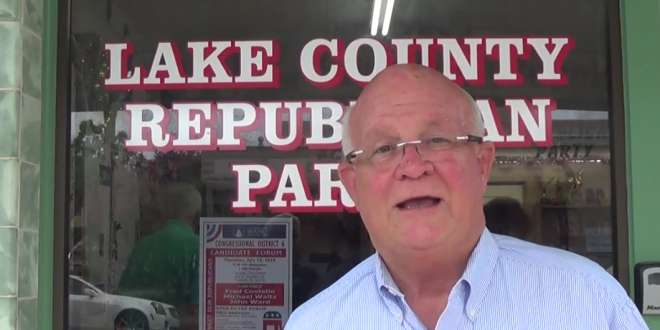
State Sen. Dennis Baxley [photo above] last year led the push in his chamber to pass the “Don’t Say Gay” bill. In 2019, he appeared here for his failed bill that would have directed public school teachers to argue against climate change and evolution. In 2005 he introduced the NRA-written “Stand Your Ground” bill that was successfully used in the murder of Trayvon Martin. That same year he introduced a failed bill that would have allowed students to sue university professors if they failed, for example, to allow students to promote Holocaust denial in classroom discussions. A descendant of a Confederate soldier, Baxley fought against the creation of the Florida Slavery Memorial, which was approved in 2018 and remains unbuilt.
'SAFE PLACES': Some central Florida lawmakers said they were considering “all legislative, legal and executive options available” to stop business owners in a small town from voluntarily displaying rainbow decals in their windows. https://t.co/bPrNBoxCfx
OK, WE GET IT ALREADY. Florida Republican lawmakers have made it absolutely, and unequivocally clear that they do not want any safe spaces for LGBTQ people in our state.
So the “free state” of Florida is prohibiting businesses from expressing their free speech and policies. I bet other businesses are allowed to display crosses in their windows in support of Christianity or Christofascists.
Picturesque and hilly, Mount Dora has become an LGBTQ enclave of sorts in recent years due to its robust arts scene and the welcoming stance of town leaders. The town is centered around a lake of the same name about 40 minutes northwest of Orlando.
If a business wants to post a sign in the window saying “Safe Space” ,great! Other businesses should feel free to post a sign saying “Hate Space” so customers can make their own decision.
treating people equally, fairly, and with respect – is negligent, irresponsible and divisive at best.” Let that sink in. What the fuck is wrong with these shit-stirring assholes – let alone harassing small businesses.
1) I’m pretty sure that will not pass any kind of court challenge; 2) This is how far gone the GQP’s rotted little nazi brains are that they think it will; and 3) So much for the RepubliQans being the party of freedom for business!
What part of “voluntary” and “optional” fries your socks, Senator Baxley? Oh, it’s the “voluntary” and “optional” part …can’t go letting people make their own decisions, now can we?


 Scottie's Playtime