I want to thank PERSONNELENTE for the link. Most things I am hearing about the Hamas attack on Israel is all the horrible things that Hamas committed. And I 100% agree that what they did is horrible. But that doesn’t give the Israeli government and Israeli military the right to also commit horrible tragedies to the civilian Palestinian population. If it is wrong for Israeli children to be harmed, it is also just as wrong for Palestinian children to be harmed. Period full stop. Palestinian civilians and children have as much worth as Israeli civilians and children! Israel is using US supplied planes and missiles to level entire city blocks in Gaza while the people are still in them. Israeli military is bombing UN schools and hospitals. All things the US / world said was a war crime when Russia was doing them.
Please watch the very short subtitled clip of a Palestinian child showing the rubble that was her home, and saying how scared she is. Sad tearful hugs.
Antonia Hylton, investigative reporter for NBC News and co-host of the new podcast Grapevine, reports on the infiltration of far-right Christian ideology into classrooms in Texas and across America.
The hate and misinformation continues and spreads. The over the top rush to return to a regressive past of strict gender roles, censorship, and an enforced social acceptance of only what is acceptable to the leading churches in the area. Think of the time these people want desperately to return to, and ask why. It did not fix anything, it did not solve any problems. Gay kids were still born, they just had miserable lives. Trans people were still born, they just had to suffer with no social acceptance or relief. These people hate civil rights for anyone but themselves. They are demanding a return to a time when it was not only legal but acceptable to discriminate against anyone who was not a straight cis white person. That is what they want so badly, the right to insult, shame, targeting for bullying and harming people who are different. I have to ask why, what makes that time so attractive for these people. I think it is the right to abuse others, to feel superior to them! Again I repeat that a lot of this hate and bigotry is driven by fundmentlist religious sects. Below is are two quote. Hugs
The ALA said book challenges nearly doubled nationally in 2022 and are “evidence of a growing, well-organized, conservative political movement, the goals of which include removing books about race, history, gender identity, sexuality, and reproductive health from America’s public and school libraries that do not meet their approval.”
“The book fair is one of our biggest fundraisers, but unfortunately, we have seen more and more books that promote and support LBGTQ+ views,” the school wrote. “We’re at a crossroads where we share different values and beliefs, especially when it comes to exposing young children to adult topics. Friendswood Christian School is a private institution devoted to creating a complete learning environment for children by incorporating Christian principles into the academic framework. We want to provide an environment where children can hang on to their innocence as long as possible.”
As Texas enters its third straight school year of coordinated book banning activity, a growing number of districts are targeting library books. Caught in the dragnet: books featuring a “naked” crayon and one with a cartoon butt.
The American flag reflects off a Houston Little Free Library designed to look like a prison filled with banned books. Credit: Callaghan O’Hare/Reuters
This article is co-published with ProPublica, a nonprofit newsroom that investigates abuses of power. Sign up for ProPublica’s Big Story newsletter to receive stories like this one in your inbox as soon as they are published. Also, sign up for The Brief, our daily newsletter that keeps readers up to speed on the most essential Texas news.
As a new Texas law further restricting what books students can check out of school libraries takes effect, local bans are gaining steam in districts across the state — in some cases going in startling directions.
In Katy, a growing Houston suburb, school officials recently bought $93,000 worth of new library books and promptly put them in storage so an internal committee could review them. The district then banned 14 titles (bringing its total since 2021 to 30), including popular books by Dr. Seuss and Judy Blume, as well as “No, David!” an award-winning children’s book featuring a mischievous cartoon character who at one point jumps out of a bathtub, exposing a cartoon backside. (This wasn’t the district’s first foray into regulating cartoon nudity; over the summer, a book about a crayon that lost its wrapper, becoming “naked” in the process, was flagged for review but ultimately retained.)
Following the latest removals, the Katy school board decided that cartoon butts would be exempted from a district policy that called for removing books showing nudity. “Explicit frontal nudity,” on the other hand, would not be allowed.
“The board’s intent was never to remove well-known cartoon-like children’s books just because they showed a little drawing of a little boy’s rear-end,” its president, Victor Perez, said, according to the Houston Chronicle.
One hundred miles to the east, a school district near Beaumont made headlines last month after removing a substitute middle school teacher who had read students portions of an illustrated adaptation of Anne Frank’s diary, which detailed her hiding from the Nazis and was published after her death in the Holocaust.
The book, which had not been approved as part of the district’s curriculum, had been included on a reading list sent to parents at the start of the school year, according to television station KFDM.
The district is investigating whether administrators knew the book was being used in the class, according to news reports.
And just south of Houston, the private Friendswood Christian School announced it was canceling its Scholastic Book Fair, barring the nation’s largest children’s book publisher, which has put on book fairs at schools around the country for decades.
In a letter to parents, obtained by ABC13 in Houston, the school made clear the decision was aimed at books featuring LGBTQ+ themes and characters.
“The book fair is one of our biggest fundraisers, but unfortunately, we have seen more and more books that promote and support LBGTQ+ views,” the school wrote. “We’re at a crossroads where we share different values and beliefs, especially when it comes to exposing young children to adult topics. Friendswood Christian School is a private institution devoted to creating a complete learning environment for children by incorporating Christian principles into the academic framework. We want to provide an environment where children can hang on to their innocence as long as possible.”
Kasey Meehan, the Freedom to Read program director for the New York-based free speech organization PEN America, said that as Texas enters what is essentially its third consecutive school year of book banning activity, efforts have taken some troubling directions.
“Even after that first removal of books, what we see is a continued chilling effect that happens across schools,” she said in an interview. “There are these ripples that are going to extend beyond simply removing a book to just read, erring on the side of caution and bringing a bit more scrutiny to any availability of books and any opportunities that students can have to access books.”
The local censorship efforts come as courts wrestle with a new Texas law that requires booksellers to rate public school library books based on their depictions of or references to sex. Books in which such references are deemed “patently offensive” by the vendors will be issued a “sexually explicit” rating and can’t be sold to schools and must be removed from shelves of school libraries. Books that reference or depict sex generally will be rated “sexually relevant” and require parental permission to read.
Texas schools would be barred from buying books from vendors who don’t use the ratings.
On Sept. 18, a U.S. district judge in Austin issued a written order blocking the law, which was passed this spring, from taking effect. Judge Alan D. Albright, a Trump appointee, ruled the law would impose “unconstitutionally vague requirements” on booksellers and “misses the mark on obscenity.”
“And the state,” he wrote, “in abdicating its responsibility to protect children, forces private individuals and corporations into compliance with an unconstitutional law that violates the First Amendment.”
A week later, the 5th U.S. Circuit Court of Appeals blocked the judge’s ruling, temporarily allowing the law to go into effect while the court considers the case, which it is expected to take up this month.
Book bannings have increased precipitously in the state since ProPublica and The Texas Tribune started reporting on the issue in rural Hood County two years ago, where a fight over library books foreshadowed the intense partisanship that has come to mark many Texas school board races. The U.S. Department of Education launched an investigation into the Granbury Independent School District after the superintendent was secretly recorded ordering librarians to remove library books with LGBTQ+ themes.
The federal probe, which followed a ProPublica-Tribune investigation with NBC News, remains open, according to the Department of Education’s Office of Civil Rights. Last year, in response to the outlets’ investigation, the district said it was committed to supporting students of all backgrounds.
The issue continues to roil Granbury, as some community members and trustees don’t believe the district has gone far enough to remove books. Last month, the school board censured a trustee who wants additional titles removed after she was accused of sneaking into a school library to examine books with a cellphone flashlight.
Of the 1,269 documented attempts to remove books from school or public libraries across the nation in 2022, 93 took place in Texas, affecting over 2,300 titles, the association’s Office of Intellectual Freedom found. The ALA said book challenges nearly doubled nationally in 2022 and are “evidence of a growing, well-organized, conservative political movement, the goals of which include removing books about race, history, gender identity, sexuality, and reproductive health from America’s public and school libraries that do not meet their approval.”
The American Library Association itself has come under fire among conservative circles in Texas. In August, Midland County commissioners voted to withdraw from the association. Days later, the Texas State Library and Archives Commission pulled out.
What’s been your experience with school library book bans in Texas? Email Austin-based reporter Jeremy Schwartz at jeremy.schwartz@propublica.org to let him know.
Texans need truth. Help us report it.
Independent Texas reporting needs your support. The Texas Tribune delivers fact-based journalism for Texans, by Texans — and our community of members, the readers who donate, make our work possible. Help us bring you and millions of others in-depth news and information. Will you support our nonprofit newsroom with a donation of any amount?
How far will these racist bigots take their crusade to take the US society back to the 1950s? Books banned not for sexual content but for the fact that the last name of the author being gay and another for the fact that an unarmed black teenager is shot. Only white cis straight morally Christian sanitized stuff is fit for people to read. Banning adult magazines for adult people is coming next. Below is a quote from the article. Hugs
“This proves, as always, that censorship is never about limiting access to this book or that one. It is about sending the message to children that certain ideas—or even certain people—are not worthy of discussion or acknowledgement or consideration,” Brassard said. “This is a hateful message in a place like a public library, where all children are meant to feel safe, and where their curiosity about the world is meant to be nurtured.”
“Read Me A Story, Stella” was added to a book list of potentially sexually explicit books at the Huntsville-Madison County Public Library because the author’s last name is Gay.
“Read Me a Story, Stella” is a children’s picture book about a pair of siblings reading books together and building a doghouse. However, because the author’s name is Marie-Louise Gay, the book was added to a list of potentially “sexually explicit” books to be moved from the children’s section of the Huntsville-Madison County Public Library (HCPL) system.
Gay’s book has never been “mistakenly censored,” according to Kirsten Brassard, Gay’s publicist at Groundwood Books.
“Although it is obviously laughable that our picture book shows up on their list of censored books simply because the author’s last name is Gay, the ridiculousness of that fact should not detract from the seriousness of the situation,” Brassard said in a statement.
Brassard mentioned other books on the list, including Angie Thomas’ “The Hate U Give,” which has no LGBTQ themes or sexual content but does depict the shooting of an unarmed Black teenager at the hands of police.
“This proves, as always, that censorship is never about limiting access to this book or that one. It is about sending the message to children that certain ideas—or even certain people—are not worthy of discussion or acknowledgement or consideration,” Brassard said. “This is a hateful message in a place like a public library, where all children are meant to feel safe, and where their curiosity about the world is meant to be nurtured.”
HCPL executive director Cindy Hewitt admitted “Read Me a Story, Stella” should not have been put on the list and was added because of the keyword “gay.”
“Obviously, we’re not going to touch that book for any reason,” Hewitt said. She’s also read “The Hate U Give” and said it’s an excellent book that no librarian should remove from the young adult section. Hewitt insists there was never any intention to target the LGBTQ community. Instead, she was hoping to be “proactive instead of reactive.”
“Read Me a Story, Stella” was one of 233 titles slated to be reviewed and potentially moved. However, after internal and public criticism that the list targeted the LGBTQ community, the process was halted. Librarians moved some of the books to the adult section, and some have not been re-catalogued.
“We wanted to be proactive and allow our library staff to look at our collection and make decisions about moving material to an older age group and not have someone from outside dictating that for us,” Hewitt said. She added that HCPL considers public opinion, but “our librarians are trained in collection development, and it should be their responsibility to examine the collection and make those changes.”
Hewitt said the review was based on a list of 102 books compiled by Clean Up Alabama. Clean Up Alabama has been targeting “sexually explicit” books in libraries around the state this year. “Read Me A Story, Stella” is not on this list. She said the library was gearing up for “unprecedented” book challenges by using this list as a starting point.
AL.com received a copy of the book review list for the Madison branch and found that 91% of 233 titles had the words lesbian, gay, transgender, gender identity, or gender non-conforming in the subject header, which lists numerous themes for each book. Hewitt said the keywords she asked the 10 branch managers at HCPL to use were “sexuality, gender, sex, and dating.”
Hewitt insisted this was a miscommunication problem and there was confusion about the process. “We understand and appreciate our community, and the needs of our collection to reflect our community,” Hewitt said. “We were never eliminating any book. We were just looking at it as a whole.”
Alyx Kim-Yohn is a circulation manager at the Madison branch of the library and said it’s “cosmically ironic” that the situation escalated during Banned Books Week. Kim-Yohn was frustrated because the directive wasn’t simply a review of the books. They said this was a mandate to review and move the books based on a list from the Alabama Public Library Service, which Hewitt confirmed doesn’t exist yet.
“The decision had been made,” Kim-Yohn said. “There was no debate. There’s no conversation. This is what was happening.”
Kim-Yohn refused to participate because they said it violated their professional ethics. They said even if they weren’t queer, they wouldn’t participate.
“Why are we just unilaterally moving all of this before anyone’s even complained about these books yet?” Kim-Yohn wondered.
Hewitt said she didn’t know how many books librarians moved and returned because she took a “hands-off approach” to the process. Community members with the group Read Freely Alabama, which is against the book challenges, visited several branches and compiled a list of 40 books moved into the adult section from various branches in Madison County.
AL.com obtained this list and determined that at the time of publication, several books are designated as “adult” in the online catalog at the North Huntsville branch but “young adult” in other branches, including “A Quick and Easy Guide to They/Them Pronouns,” “What’s The T: The Guide to All Things Trans and/or Nonbinary,” and “We Deserve Monuments” a mystery novel about an LGBTQ biracial teen.
Kim-Yohn hopes Hewitt apologizes and hopes this never happens again. They also want to encourage the public to visit libraries and utilize staff despite this incident.
“If you’re mad, what we need you to do is to come check these books out, come to story times, put in purchase requests for books that you want to see,” Kim-Yohn said. “We need you to keep supporting the library.”
The books in question were checked out or renewed more than 8,000 times. The full list of books slated for review and potential relocation is below.
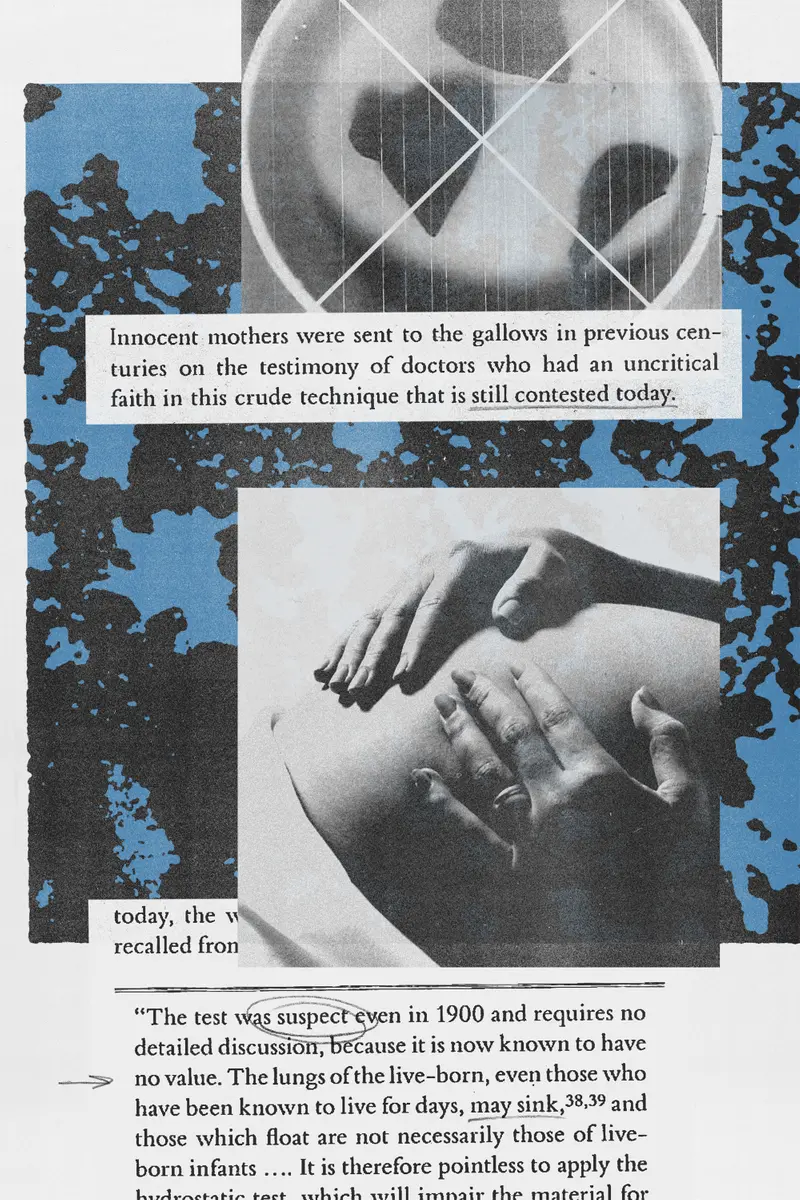
The “lung float” test claims to help determine if a baby was born alive or dead, but many medical examiners say it’s too unreliable. Yet the test is still being used to bring murder charges — and get convictions.
Credit:Illustration by Chantal Jahchan for ProPublica. Source images: Getty Images; “Knight’s Forensic Pathology”; “Forensic Pathology: Principles and Practice”; “The Pathology of Homicide”
ProPublica is a nonprofit newsroom that investigates abuses of power. Sign up to receive our biggest stories as soon as they’re published.
Inside the medical examiner’s office, two pathologists removed a baby’s lungs from his chest, clamped them together and placed them in a container of water. Then they watched.
They were examining the suspicious death of the baby whose body was found in a Maryland home; his mother said he was stillborn.
If the lungs floated, the theory behind the test holds, the baby likely was born alive. If they sank, the baby likely was stillborn.
“A very simple premise,” the assistant medical examiner later testified.
The lungs floated — and the mother was charged with murder.
In investigations across the country, the lung float test has emerged as a barometer of sorts to help determine if a mother suffered the devastating loss of a stillbirth or if she murdered her baby who was born alive. The test has been used in at least 11 cases where women were charged criminally since 2013 and has helped put nine of them behind bars, a ProPublica review of court records and news reports found. Some of those women remain in prison. Some had their charges dropped and were released.
But the test is so deeply flawed that many medical examiners say it cannot be trusted. They put it in the same company as the discredited analysis of bite marks and bloodstain patterns, 911 calls and hair comparisons, all of which lack solid scientific foundations and have contributed to wrongful convictions.
It is pseudoscience masquerading as sound forensics, they say. Some even liken the test to witch trials, where courts decided if a woman was a witch based on whether she floated or sank.
“Basing something so enormous on a test that should not be used, that has been completely discredited, is absolutely wrong,” said Dr. Ranit Mishori, the senior medical adviser for the nonprofit Physicians for Human Rights, which has been studying the test, and a professor of family medicine at Georgetown University School of Medicine. “You can send a person who is innocent to prison for many years.”
Medical examiners who rely on the lung float test typically do so in cases where someone gives birth outside of a hospital, often at home and far from the watchful eyes of medical professionals. Absent those witnesses, doubt can overshadow the insistence that the baby was stillborn.
Since the Supreme Court struck down the constitutional right to abortion, legal experts and reproductive justice advocates have voiced fears that an increased reliance on the lung float test will lead to more prosecutions in a landscape where any pregnancy that doesn’t end with a living, breathing baby can be viewed with suspicion. In several cases, the fact that a woman had considered abortion was used against her. Black, brown and poor women, research shows, already disproportionately face pregnancy-related prosecutions. Black women also are more than two times as likely to have a stillbirth as white women.
Even medical examiners who perform the test as part of an autopsy acknowledge its shortcomings. They concede that there are several ways to perform it, undermining the standardization that many forensic disciplines demand. Yet judges have allowed prosecutors to use it as evidence in court.
Basing something so enormous on a test that should not be used, that has been completely discredited, is absolutely wrong.”
—Dr. Ranit Mishori, senior medical adviser for Physicians for Human Rights
ProPublica contacted the nation’s largest medical examiners’ offices to ask if they use the lung float test and discovered a patchwork of practices. Many offices said they just don’t trust it. The County of Los Angeles Department of Medical Examiner called its results “inaccurate.” The Harris County Institute of Forensic Sciences in Houston said it found the test to be “very unreliable” and “not supported by empirical evidence.”
In Cook County, home to Chicago, pathologists use it, but give more weight to “more reliable methods” including X-rays, microscopic examinations and autopsy findings to determine whether a birth was live or still. Others, like the Virginia Office of the Chief Medical Examiner, said the test may be useful only if a baby was not born into a toilet, CPR was not performed and decomposition was not present. None of the 12 largest offices by jurisdiction expressed full-throated support for the test.
And while the national organization that represents medical examiners said that it doesn’t have an official stance on the lung float test, it said it “strongly advocates using scientifically validated and evidence-based practices in forensic pathology.” The National Association of Medical Examiners called the lung float test “a single, dated test” that has not been subjected to the organization’s rigorous evaluation process.
Dr. Gregory Davis, a forensic pathologist at the University of Kentucky College of Medicine and a consultant to the office of the medical examiner in Kentucky, called the test “an outrageous breach of science.” He said he has personally observed the lungs of stillborn babies float and those of live-born babies sink.
The fundamental problem with the test, he said, is that there are many ways that air can enter the lungs of a stillborn child.
“There’s no way,” Davis said, “you can determine live birth versus stillbirth with this test.”
Moira Akers, the Maryland woman whose baby died, didn’t intend to get pregnant. She and her husband, Ian, already had two young children and the couple worried they wouldn’t be able to handle another child.
They struggled financially — she was a stay-at-home mom and he worked only a few days a week as a first mate on a dinner cruise. Her previous pregnancies — both ending in cesarean sections — were difficult, and challenges with her youngest child demanded much of her attention.
Due to Akers’ age, 37, and weight, her pregnancy was considered high risk. The couple decided to terminate, but they didn’t tell her family, who are Catholic and who she worried may not have approved. When Akers was a little girl, her mother said, she dreamed of being a mother, and as an adult she doted on her children.
After her appointment with a gynecologist around 15 weeks into her pregnancy, court records show that Akers thought that it was too late for her to have an abortion in Maryland. She decided she would carry the baby to term without letting anyone know she was still pregnant and give it up at a firehouse.
“I wanted the baby to have a good life,” Akers later told police. “I just knew we weren’t going to be able to provide that.”
Moira AkersCredit:Courtesy of Debra Saltz
She didn’t gain much weight and she told her husband early on that the pregnancy had been terminated. She also didn’t divulge the fact that she was pregnant to other family members, who were going through their own hardships, court records and interviews show. Her sister was being treated for cancer and feared she’d never be able to have children of her own. Her brother was recovering from an accident that had left him temporarily using a wheelchair. And the family had recently buried her grandmother and aunt.
Akers declined comment through her attorney. But the description of the case is based on police and court records, including a trial transcript, as well as interviews with her family and her lawyer.
On Nov. 1, 2018, in the family’s three-bedroom duplex in suburban Baltimore, Akers had been having contractions when she felt a strong urge to use the bathroom. She delivered her son into the toilet. She said he was not breathing. She grabbed her older son’s Star Wars towel to wrap the baby in, then carried him into the bedroom to get scissors and cut the umbilical cord.
“I didn’t hear anything,” Akers later told a detective. The baby, she said, didn’t move.
She didn’t know what to do next. Akers scanned the room and spotted a large Ziploc bag meant to store her daughter’s clothes. She placed her baby in the blue bag, and she put the bag in the closet.
Akers was bleeding heavily from the delivery. Blood soaked the carpet and smeared the bathroom floor. It stained the bathtub, closet door and hallway.
Her husband came upstairs. Alarmed by all the blood, he called the paramedics. When they arrived, they asked Akers questions as she sat on the couch with her husband and two children. She denied being pregnant.
It wasn’t until later, after Akers arrived at the hospital, that she told a nurse that she had “delivered a stillborn child” at home, police records show.
The doctors, who came in next, saw a protruding umbilical cord still attached and asked if the baby was alive. Akers said she had delivered a stillborn baby and told them about the bag and the closet.
Police launched an investigation. Akers described being in denial about the pregnancy and sad about the baby’s death.
The two Maryland doctors conducted an autopsy. The baby, they wrote in their report, appeared to be “well-developed” and “well-nourished” and had been delivered after about 41-42 weeks of pregnancy. He had blue eyes and straight brown hair.
Neither the external exam of the baby nor his bloodwork nor an X-ray revealed signs of foul play. But the narrative from police described a woman who hid her pregnancy from her family and paramedics, considered an abortion and placed the baby’s body in a closet. A microscopic view of the lungs, which were soft and pink in some areas, also appeared to show that some parts had air in them and others did not.
They also had the results of the lung float test.
“A flotation test and microscopic examination of the lungs was consistent with a live birth,” the autopsy read. The baby, the medical examiners concluded, died of asphyxia and exposure from being left in the closet.
Prosecutors charged Akers with child abuse and murder.
The lung float test’s simplicity — essentially unchanged over centuries — is both a feature and a flaw.
Some medical examiners take out one lung at a time. Some cut the lungs up and test pieces, and may even go so far as to squeeze them. Others clamp them together or put the heart and lungs in a jar. Some drop in the liver as a control. Others submerge the lungs in liquid formaldehyde instead of water.
As the assistant medical examiner in Akers’ case testified, “there’s a million ways” to conduct the test.
In theory, the test is meant to determine whether air has reached the microscopic air sacs inside the lungs. If it has, the sacs open and spread out. If it hasn’t, the sacs remain collapsed.
It is not always possible to reach a definitive conclusion, but that may be preferable to [a case] that is based on a problematic test.”
—Capt. Kyle Kennedy, Oregon State Police
But the problem with using aeration as a proxy for proof of life, many medical experts argue, is that babies don’t have to take a breath for air to enter their lungs. Air can be introduced when the baby’s chest is compressed as it squeezes through the birth canal. If there is an attempt to resuscitate a stillborn baby, that pressure can inflate the lungs. And if a body has started to decompose, gases from that process can cause the lungs to float in water. Even the ordinary handling of a stillborn baby can allow air to enter the lungs.
Doctors have long struggled with the best way to determine whether a baby was born alive in unattended births. Many experts agree that it’s nearly impossible without incontrovertible evidence such as milk in the baby’s stomach or signs of the umbilical cord stump beginning to heal where it was cut.
The uncertainty can be difficult for juries to accept, especially when prosecutors present what appears to be a scientific test that proves a baby was born alive and, as a result, was murdered.
“It is not always possible to reach a definitive conclusion, but that may be preferable to one that is based on a problematic test,” said Capt. Kyle Kennedy of the Oregon State Police department, of which the Oregon State Medical Examiner is a part.
The Oregon State Medical Examiner, he said, does not use the lung float test.
The test can produce correct results, said Dr. Christopher Milroy, a forensic pathologist with the Eastern Ontario Regional Forensic Pathology Unit and a professor at the University of Ottawa in Canada. But given that it also produces inaccurate results, he said it should not be used in criminal cases.
“It’s not like some of the things we do,” he said, “where we are going, ‘Well, did they die of diabetes or did they die of something else natural?’”
Milroy has studied the test and its history and has found references to its use in the 17th century, when witch trials were still occurring. But by the late 1700s, its reliability was questioned by doctors and lawyers. More than 200 years later, in 2016, the authors of a forensic medicine textbook wrote that there were too many recorded instances of stillborn lungs floating and live-born lungs sinking for the test to be used in a criminal trial.
No agency currently tracks how often the lung float test is used in criminal cases. But the 11 cases ProPublica identified are likely an undercount because some cases weren’t covered in news reports, and plea deals and acquittals often create less of a public record.
Still, the test has been cited in medical textbooks and is often included in forensic pathology training. Its defenders say that there aren’t any better alternatives, and they may be criticized for not doing their job if they don’t use it. Some also say they don’t rely solely on the test; they acknowledge its weaknesses but say it complements other exams. In addition, some people do, in fact, kill their babies.
Prosecutors have often turned to a 2013 academic study from Germany to support admitting the lung float test as evidence. “The study proves that for contemporary medicine, the lung floating test is still a reliable indicator of a newborn’s breathing,” the authors wrote.
But some experts have questioned that study, saying its results have not been reproduced, its 98% accuracy rate is misleading and it didn’t actually answer whether a baby was born alive because the births in the study had been attended by medical professionals, so there was never any real question about what happened.
The hospital affiliated with the study’s authors declined to comment.
The dearth of research around the test raises critical questions about whether it should be allowed as evidence, said Marvin Schechter, a New York criminal defense lawyer who served on the committee that wrote a groundbreaking National Academy of Sciences report in 2009 on strengthening forensic science in the United States. Schechter said the lung float test wasn’t included because the commission reviewed only the most frequently cited forensic tests.
His concerns with the test mirror many of the ones flagged in the report. For example, he said, the lack of standardization is evident in the fact that some medical examiners squeeze the lungs as part of the test.
“What is that? Your squeeze is different than my squeeze,” he said. “That’s not science.”
Schechter called for a national conference to evaluate the test and its admissibility in court.
“If you apply the rules and regulations that follow science to the lung float test, how does it pass muster?” Schechter said. “The research doesn’t exist, and if the research doesn’t exist, then you shouldn’t be doing it.”
Every so often, after the lung float test has been used to help put a woman behind bars, the questions around it set her free.
In 2006, Bridget Lee had hid her pregnancy after having an affair. She didn’t want anyone in the small Alabama community where she played piano at her church to know.
Bridget Lee at her home in Carrollton, Alabama, in 2009Credit:Jay Reeves/AP
When she went into labor at home, she said her son was stillborn. She placed his body in a plastic container and put it in her SUV, where it sat for days.
The medical examiner used the lung float test and concluded that Lee’s son had been born alive. Lee was charged with murder, which in Alabama carried the possibility of the death penalty.
Lee’s lawyer called on Davis to review the autopsy report, which was the first time he saw the lung float test being used to support criminal charges against a mother. He concluded that the autopsy was filled with errors. It missed an infection in the umbilical cord and erroneously described decomposition as signs of injury.
Davis’ review led to the Alabama Department of Forensic Sciences to examine the case, and the agency ruled that not only had the medical examiner botched the autopsy, but the baby was stillborn. Neither the medical examiner nor the prosecutors responded to requests for comment.
Lee spent nine months in jail before prosecutors dropped the charges against her.
She later told reporters that she knows it’s hard for people to understand how she could put her baby’s body in a container and leave it in her car. But, she said, the best way to describe it was like having “an out-of-body experience.”
While individual reactions are hard to comprehend, mental health specialists say the shock and pain of delivering a stillborn baby at home can be so traumatic that people may detach or disassociate from reality, said Dr. Miriam Schultz, an associate clinical professor of psychiatry who specializes in reproductive psychiatry at Stanford Medicine Children’s Health.
“Sometimes a survival instinct will kick in to try to normalize what’s an absolutely incomprehensibly shocking and devastating reality,” Schultz said. “One could imagine possibly trying to make evidence of what just happened less visible and wanting to completely compartmentalize this traumatic event that just has occurred.”
Late one April night in 2017, Latice Fisher said she felt the urge to defecate. About three hours later, she delivered her son into the toilet at her home.
The medical examiner in Fisher’s case performed the lung float test, which revealed that parts of the lungs floated and parts didn’t. He ruled that the baby was born alive and died from asphyxiation. Police also found that Fisher had searched for abortion pills on her phone.
Yveka Pierre, senior litigation counsel with the reproductive justice nonprofit If/When/How, said the people who are prosecuted for their pregnancy outcomes are typically from marginalized communities. They’re Black, like Fisher; or they’re brown, like Purvi Patel, an Indiana woman who was sent to prison for feticide after self-inducing an abortion, a charge that was later vacated; or they face financial hurdles, like Akers.
“Some losses are tragedies, depending on your identity, and some losses are crimes, depending on your identity.” Pierre said. “That is not how we say the law should work.”
Pierre, who also worked on Akers’ case, said Fisher and her husband did what prosecutors say to do by calling 911, but Fisher was still arrested. Once the medical examiner’s investigation starts, she said, the office typically works in tandem with the police.
A grand jury indicted Fisher on second-degree murder charges in January 2018. But a few months later, a local group raised money to get her released on bond. The group also contacted a national nonprofit, now known as Pregnancy Justice, which helped connect Fisher with longtime criminal defense attorney Dan Arshack. He began researching the lung float test and came to an unmistakable conclusion.
“It should be permitted to the same extent that dunking a woman in water is permitted to determine if she’s a witch,” he said in an interview.
Some losses are tragedies, depending on your identity, and some losses are crimes, depending on your identity. That is not how we say the law should work.”
—Yveka Pierre, senior litigation counsel with If/When/How
Arshack asked Davis to review the autopsy, which he found troubling. Arshack also asked Aziza Ahmed, then a professor at Northeastern University School of Law, to focus specifically on the forensics of the lung float test.
By not requiring rigorous testing or proof of its accuracy, Ahmed wrote, the “courts themselves have played a key role in sustaining the inaccurate belief” that the test could reliably determine whether a child was born alive.
Arshack wrote letters to District Attorney Scott Colom explaining Davis and Ahmed’s findings, saying there was no “reasonable legal or scientific basis” to conclude that a crime occurred. He also explained that it wasn’t “good public policy to prosecute women for bad pregnancy outcomes, especially Black women in Mississippi,” who suffer higher rates of maternal mortality and stillbirth.
In May 2019, Colom announced that he had learned of concerns surrounding the reliability of the lung float test. Once the question of whether the child was born alive was scientifically in dispute, he said, he dismissed the charges against Fisher and sent the case to another grand jury armed with the details about the test.
“When you’re talking about a murder charge for a mother,” Colom said in an interview, “I felt that was crucial information because I certainly didn’t want to be prosecuting somebody for a stillborn death that could not be her fault.”
This time, the grand jury chose not to indict Fisher.
As Akers’ case made its way through court, Davis was asked to review the autopsy. He noted that Akers had classic risk factors for stillbirth: hypertension during pregnancy, obesity, advanced maternal age and previous pregnancies. She also was past her due date and reported not feeling the baby kick in the days leading up to the birth.
Dr. Gregory Davis at University of Kentucky College of MedicineCredit:Natosha Via for ProPublica
Davis agreed with the medical examiner, Dr. Nikki Mourtzinos, and the associate pathologist who conducted parts of the autopsy, that there were infections in the pancreas, placenta — the vital organ that provides the fetus with nutrients and oxygen — and the umbilical cord, which serves as the baby’s lifeline in the womb.
But what he found “perplexing,” he wrote, is that they did “not seem to take these critical findings into account regarding such findings being associated with stillbirth.” When it was his time to take the witness stand at trial, he said the infections in the placenta, umbilical cord and membranes were “a smoking gun association” with stillbirth.
An OB-GYN also testified that he believed Akers suffered from a placental abruption — a complication where the placenta separates from the wall of the uterus — which also can lead to a stillbirth and cause heavy bleeding.
Prosecutors said the case hinged on whether the baby was born alive. Among the evidence they pointed to were the results of the lung float test, the pinkish appearance of the lungs and lack of decomposition, malformation of the baby’s head or slippage of the skin.
“These lungs floated,” the prosecutor said during closing. “They floated because this child had breathed and was alive after he was delivered at home that day.”
The prosecution homed in on the fact that Akers had wanted an abortion, which was underscored by her cellphone search history. They said she never intended to have her baby live and breathe. When she didn’t get an abortion, they said, she chose to give birth at home and kill her son. They pointed out that she hadn’t received prenatal care and that she didn’t attempt to resuscitate the baby.
Akers told police she thought it was too late.
During closing arguments, prosecutors displayed an oversized photo of the baby on the screen and repeated that Akers put his body in a bag, using the word “bag” 26 times.
In April 2022, the jury found Akers guilty of second-degree murder and first-degree child abuse.
In response to questions from ProPublica, the state’s attorney declined to comment. Mourtzinos, the assistant medical examiner who testified in Akers’ case, did not respond to requests for comment. She’s no longer with the Maryland medical examiner’s office. The agency’s interim chief medical examiner said the office is accredited by the National Association of Medical Examiners and follows the organization’s autopsy performance standards. Any and all ancillary tests, she said, “are done on a case by case basis, at the discretion of the attending medical examiner” and interpreted in the context of the entire case.
When the verdict was read, Akers collapsed in her chair, dropped her head to the table and sobbed. Her family, who was seated behind her, filled the courtroom with their own cries.
Last summer, as much of the country awaited the aftermath of the Supreme Court’s Dobbs v. Jackson Women’s Health Organization decision, which eliminated a constitutional right to abortion, the New York-based nonprofit Pregnancy Justice released a guide for medical, legal and child welfare professionals on confronting pregnancy criminalization.
The organization advised defense attorneys and medical examiners to challenge the lung float test. In many cases, the authors wrote, criminal charges are based on “the erroneous assumption that a woman engaged in acts or omissions that harmed the fetus.”
The backdrop to the lung float test is the deeper issue of criminalizing pregnancy loss. That was already on the rise before the Dobbs decision, with data from Pregnancy Justice showing that nearly 1,400 pregnant women were arrested, prosecuted or sentenced between 2006 and the 2022 Dobbs decision, more than three times the total for the previous 33 years. Many of the charges were connected to drug use while pregnant.
Society often wants to hold someone responsible, said Dana Sussman, deputy executive director of Pregnancy Justice. Mothers are usually the easiest to blame.
One of the first things Pregnancy Justice lawyers now ask in a pregnancy loss case is whether the prosecutor is attempting to use the lung float test.
“It’s almost like an intake question,” Sussman said. “We will fight every attempt that we learn of to use that test because that is a life sentence based on unreliable information and unreliable science.”
The lack of understanding, research and education around stillbirth also contributes to the urge to assign blame. Every year in the U.S., more than 20,000 pregnancies end in stillbirth, defined as the death of an expected child at 20 weeks or more. But the public is often shocked to hear that number or learn that only a fraction of stillbirths are attributed to congenital abnormalities. Some babies died just minutes before they were born and were placed in their parents’ arms while they were warm to the touch and their cheeks were still rosy.
Davis, an affable man with a snow-white beard, has started to spread the word about the lung float test. At a post-Dobbs legal seminar in Tennessee over the summer, he told a room of lawyers about the test, one that many of them had not heard of but may soon encounter.
A lawyer sitting in the back told the crowd that the lung float test seemed to have the same validity as bite mark analysis, which for decades was accepted as evidence and now is considered junk science.
“What do you do when they say this test has been accepted in the past?” she asked.
Davis pointed her to a letter where he gathered signatures from more than two dozen forensic pathologists and medical examiners from around the world who declared that the lung float test is not a scientifically reliable test or indicator of live birth and “is not generally accepted within the forensic pathology community.”
He had submitted the letter in Akers’ case.
In July of last year, three months after the Akers verdict, prosecutors asked the judge to sentence her to 40 years. They said it was the “the most heinous of crimes that can be committed” and it was carried out by a woman who hid her pregnancy and took her baby’s life in a “detached and calculated manner.”
Akers’ family came to her defense. Her husband said that in their nearly 20 years together, Akers’ “devotion to her family defies description.” One of his greatest joys in life, he said, was seeing the way their kids light up anytime she enters a room.
Her lawyer, Debra Saltz, said Akers made “lapses in judgment” by not telling anyone she was pregnant, having the baby alone and then putting his body in the closet. But, she said, “There is in this life no way anybody will get me to believe that Moira Akers killed her baby. I believe Moira, and I believe the science, that this baby was stillborn.”
Before the judge imposed his sentence, Akers addressed him.
“My children are my entire world,” she said, “and I fell in love with my son as soon as I saw him.”
The judge, who acknowledged what an “extraordinarily difficult case” it was, said the charges against Akers were “particularly egregious because they were perpetrated against an innocent, helpless, newborn child.”
He sentenced her to 30 years in prison.
Akers’ appeal, now pending, focuses on the shortcomings of the lung float test.
As she waits for a ruling, she stays connected to her family from prison. Her mom, Mary Linehan, said most of their conversations revolve around the ordinary details of her children’s lives, their first day of school and their favorite new toys.
Akers’ mom, who retired from her job as an accountant at a Catholic church and school, helps watch her grandchildren. When they ask about their mom, she said, their dad tells them that she “got blamed for something she didn’t do, and we’re fighting to get her out.”
A quote below is the reason. We can not have anything not supporting racism and Christian nationalist 1950s strict gender roles in society / public view. We really must stop this religious racist take over of the country. Again a person born in the early part of the last century making decisions against modern society. Governor Ivey was born October 15, 1944. She is 79 years old. She can not accept the changes in society, in medical science, in the understandings we have learned since she was in her prime. She is extremely against the LGBTQIA and doesn’t support them having any rights. She believes that the nation was a founded as a religious nation and that attempts to stop the push of Christianity on kids in public schools via government is “destroying our nation’s religious heritage.” So, another Christian nationalist. Hugs
Emails show that during the legislative session in April, the Governor’s office received a document, created by Rep. Jamie Kiel, R-Russellvillle, that highlighted passages from the book referencing systemic racism, white privilege and LGTBQ families.
“I have been told by multiple education groups that ‘divisive concepts’ are not in our schools, yet the material I read was offensive to me and the majority of the people I represent,” Kiel said at the time.
————————————————————————————————————————————
|
AL.com received this photo of disposed teacher training manuals, which was taken at a Montgomery waste recycling plant on May 2, 2023. Gov. Kay Ivey disavowed a teaching manual from the National Association for the Education of Young Children in April 2023.
After Alabama’s governor ousted a top state official over a “woke” pre-K training manual, officials dumped dozens of the books, totaling thousands of dollars, in the trash.
A photograph shows more than 100 manuals, newly bought from the National Association for the Education of Young Children, scattered across the floor of a Montgomery waste recycling plant about 5 miles from the offices of the Alabama Department of Early Childhood Education.
The photo was taken May 2, a day after ADECE Secretary Barbara Cooper left office amid legislative pressure.
The person who took the photograph requested to remain anonymous. AL.com has confirmed the date and location of the photo. The books and registrations cost $165 apiece, according to officials. AL.com estimates the materials in the photo initially cost the department at least $16,500.
Just a year ago, officials spent $37,950 to buy 230 book registrations of the fourth edition of NAEYC’s Developmentally Appropriate Practices manual.
The books, a common teacher development tool, are not meant to be read as curriculum, but are supposed to help early childhood educators hone their skills in the classroom. Some passages of the manual’s fourth edition encouraged educators to consider their own biases and the social and cultural backgrounds of their students.
NAEYC is a leading national preschool group that accredits hundreds of high-quality early childcare facilities. Cooper, who was also a member of the group’s governing board, praised the new manual in a review, stating that it “fully supports our practice in the field of early learning and care.”
But months later, a complaint from a lawmaker forced a complete cleanout of the books – and Cooper’s sudden departure.
Emails show that during the legislative session in April, the Governor’s office received a document, created by Rep. Jamie Kiel, R-Russellvillle, that highlighted passages from the book referencing systemic racism, white privilege and LGTBQ families.
Kiel said he created the document after receiving a complaint from an educator.
“I have been told by multiple education groups that ‘divisive concepts’ are not in our schools, yet the material I read was offensive to me and the majority of the people I represent,” Kiel said at the time.
On April 13, Liz Filmore, the governor’s chief of staff, shared a copy of the document with Cooper, asking her to review the materials. Filmore called the complaint “obviously concerning!”
In a memo released a day later, Cooper disavowed the books, calling them “unacceptable” and asking staffers to promptly return the materials to their supervisors.
Then on April 21, a week later, Ivey abruptly announced Cooper’s resignation.
“The education of Alabama’s children is my top priority as governor, and there is absolutely no room to distract or take away from this mission,” the governor wrote. “Let me be crystal clear: Woke concepts that have zero to do with a proper education and that are divisive at the core have no place in Alabama classrooms at any age level, let alone with our youngest learners. We want our children to be focused on the fundamentals, such as reading and math.”
Ivey later told reporters that the two had “mutually agreed” to part ways after a conversation about the “direction” the department was going in.
But the extent of the fallout from Cooper’s ousting – including what actually happened to all of the tens of thousands of dollars worth of manuals and other NAEYC products – is unclear.
Neither Gina Maiola, a spokeswoman for the governor’s office, nor Samuel Adams, a spokesman for ADECE, initially responded to questions about where the books were stored, or whether officials had taken any steps to resell or donate them.
After AL.com presented officials with the photo of the books at the scrap yard, Maiola issued the following response:
“The governor immediately directed the department to disavow and discontinue the book,” she said. “That was done.”
In the US, UK and across Europe rules around age verification to access porn sites are tightening. But the Australian government has just bucked the trend by saying it won’t force porn sites to implement age verification – yet.
Australia’s Communications Minister Michelle Rowland suggested that concerns about privacy, plus any age verification processes needing to be robust and hard to circumnavigate, meant that it was not currently appropriate to force sites to adopt age verification in the country.
In the US, Pornhub, one of the world’s biggest porn sites, has blocked access in states such as Virginia and Mississippi, in reaction to tougher age verification rules being introduced there. France and Germany are steaming ahead with age verification measures, and the UK’s Online Safety Bill, expected to be passed soon, is designed to make it tougher for minors to access online porn, among a raft of other unrelated measures.
The Australian government said that rather than passing porn age verification laws, it would introduce a new industry code based on educating parents about how to prevent their children accessing porn, including the use of filtering software. Australia’s eSafety Commissioner, the government agency for online safety, has been charged with working with the porn industry to create the code.

/https://static.texastribune.org/media/files/b7698e76ed85a78aeaa4597883ac81e2/RTSITCDN_maxWidth_3000_maxHeight_3000_ppi_72_quality_95_embedColorProfile_true.jpg)
/https://static.texastribune.org/media/profiles/Jeremy_Schwartz_TT_01.jpg)

 A Flourish table


 Jamie F
 Scottie's Playtime