Yes because anything to defend white people holding black people as property and what the white people did to them. Don’t mention the bad thing, the rapes, humiliations, the being told what, when, where you were allowed to do anything including pee (sounds like how Amazon treats workers only without them being able to say no or go home) how and when they could eat, basically a white person had complete control over those black people and their bodies. Let’s obscure and fudge that anyway possible, even making up that white Irish people were also chattel slaves. That is a complete lie. But the people that wanted to push it built a whole mythology around the idea. Just like the anti-trans people have done with every mythical idea they can to try to discredit the idea of a person identifying as the gender not assigned at birth by a visual inspection of the genitals. What is it with these type people that they cannot simply accept the truth, the history, the science? Why is it so damn important for the to deny all of the science and history to protect their feelings or their views of the world? Hugs
Ron Peri, a member of the Board of Supervisors for the Reedy Creek Improvement District, listens during a monthly meeting on June 21, 2023 in Reedy Creek, Florida.
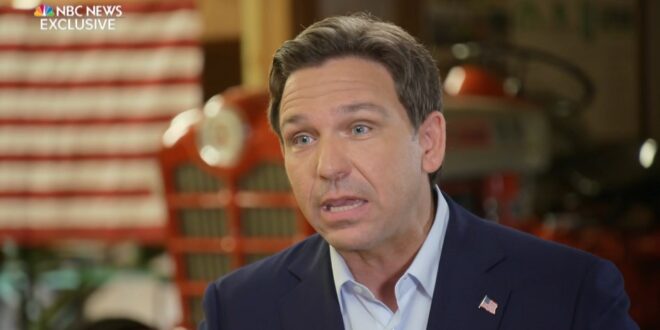
An appointee by Florida Gov. Ron DeSantis to an oversight board of Disney’s special tax district taught a seminar in 2021 falsely claiming “Whites were also slaves in America,” using discredited research to say there was an “Irish slave trade.”
The comments were made by Ron Peri, one of five people DeSantis appointed earlier this year to oversee the Central Florida Tourism Oversight District to replace the old board after the company spoke out against what critics dubbed the “Don’t Say Gay” law in Florida.
Peri, an Orlando-based pastor and CEO of a Christian ministry group called The Gathering, made the comments in an hourlong class for his group posted on YouTube about critical race theory called “Cunningly Devised Fables.”
In other comments Peri spread false claims that Irish slaves were forcibly bred with enslaved Africans. He also said a “significant” number of free Blacks in the antebellum era owned slaves, claims disputed by reputable historians who say the number was minimal. CNN archived Peri’s comments from 2021, which he deleted from YouTube following his appointment to the Disney oversight board.
The oversight board, previously called the Reedy Creek Improvement District, governed Disney’s sprawling 25,000 acre footprint around Orlando. Created in 1967, its duties include providing services like sewage, fire rescue and road maintenance and issuing debt for infrastructure projects supporting Disney’s theme park empire.
“Slavery is a moral wrong wherever it exists or existed and is one of America’s great historical wrongs,” Peri told CNN in a statement Tuesday. “Similarly, racism is likewise wrong. I countenance neither to any degree, so the criticism of the belief that thousands of people being held in slavery was significant and a terrible wrong is severely misplaced. Even one person in slavery is egregious and morally reprehensible, regardless of race.”
The DeSantis administration but did not respond to CNN’s request for comment.
Peri’s 2021 comments came in the context of him pushing back on claims of “systemic racism” in the United States from past White ownership of slaves.
“Look at old newspapers, as old as you can find, and you’ll find that Whites were also slaves in America,” said Peri. “The Irish slave trade began when James II sold 30,000 Irish prisoners as slaves to the new world. His proclamation of 1625, which you can go back and see, required Irish political prisoners be sent overseas and sold to English settlers in the West Indies.”
“By the mid 1600s, the Irish were the main slaves sold to Antigua and Montserrat,” Peri added. “From 1641 to 1652, over 500,000 Irish were killed by the English, and another 300,000 were sold as slaves.”
“The settlers began to breed Irish women and girls with African men to produce slaves with a distinct complexion,” Peri added.
Peri’s claims are based on fabricated material that has circled the Internet over the last two decades and has been the subject of repeated debunkings from news organizations like the New York Times, Reuters, the Associated Press, Snopes, and frustrated historians – many of whom signed an open letter in 2016 disputing the claims.
Even the article Peri cited as evidence was updated before he used it in the seminar to note it contained a number of factual errors.
Historians who spoke to CNN said that the research Peri cited is ahistorical and based on invented research: Whites were never considered slaves in America, legally or socially; 300,000 Irish were not sent as slaves to the Americas; English King James II – who Peri cited as issuing the proclamation in 1625 – was not born until 1633 and did not take the throne until 1685. Even then, no proclamations by King James II on Irish slaves exist. The Irish did not “breed” with African slaves, as Peri claimed.
Irish immigrants in North America and the Caribbean were never considered slaves but were indentured servants, said Matthew Reilly, a professor of anthropology at City College of New York.
Indentured servitude consisted of a fixed period of time, usually five to seven years, and was not inheritable. Whereas the race-based chattel form of slavery kept enslaved people as property for life and children would inherit their mother’s status.
“The conditions may have been like that of slavery, but socio-legally, it was a very different form of unfreedom,” said Reilly.
In another comment, Peri used data attributed to the 1830 census to say the numbers showed a “significant” and “large number” of free Blacks owned slaves. However, the 1830 census data cited by scholars show that out of 2,009,043 slaves in the United States, 3,776 free Blacks owned 12,907 slaves – 0.006%.
“The justification that they have for it is they claim that systemic racism emanates from White ownership of slaves,” Peri said. “Therefore, all White wealth is based on the hard work and abuse of Black slaves and women. That’s their justification. Well, the reality is all races owned slaves.”
“A significant number of these free Blacks were the owners of slaves,” Peri added.
Historians, like esteemed Harvard professor Henry Louis Gates, Jr., have noted that a large number of those Black slave owners “owned” their own family members to protect them – oftentimes by purchasing a family member. And that pointing to other races owning slaves is a way to minimize the brutal realities of slavery.
“The vast majority, the overwhelming majority – to the tune of millions of people who were brought from West and West Central Africa to the Americas – they were enslaved. Not people who were perpetrating slavery themselves,” Jenny Shaw, a professor of history at the University of Alabama, told CNN. “There’s a small number who did because they rose up in society and did what society was doing, which was enslaving people.” And that some people of African descent enslaved people because they were family members bringing them into their households with the intent of freeing them.
Peri’s appointment to the Disney oversight board followed a clash between the company and DeSantis over a state law that would restrict certain classroom instruction about sexual orientation and gender identity. While Disney first declined to weigh in publicly on the legislative fight over what critics called the “Don’t Say Gay” bill, then CEO Bob Chapek, under immense pressure from the company’s employees, later changed directions, and shared his concerns with the legislation. Later, after it became law, the company in a statement said it would work to get it repealed.
However, Peri has also accused Disney in the past of adopting teachings of critical race theory in its company training. The comments touched on another top concern of DeSantis, who sought to ban employers from training workers about privilege and systemic racism when he signed the Stop Woke Act, parts of which were blocked by a federal judge from going into effect.
“We’re seeing companies embracing CRT,” Peri said in his Zoom. “I’m gonna just share two – Walt Disney you’re quite familiar with. You know, down here in Orlando.”
DeSantis has faced backlash in recent days over Florida’s board of education approving controversial new standards for teaching Black history in the state, which includes teaching “how slaves developed skills which, in some instances, could be applied for their personal benefit.” DeSantis has defended the state’s curriculum.
Peri previously faced scrutiny after CNN’s KFile uncovered that the Orlando pastor had suggested tap water turned people gay. Peri disputed that he made the remark during a May 1 Central Florida Tourism Oversight District board meeting, saying from the dais, “I never said that. I don’t believe it, certainly.”
The latest revelations about Peri’s beliefs come as DeSantis’ conflict with Disney is embroiled in dueling legal challenges. Peri is named as a defendant in a lawsuit filed by Disney, which alleges that the Florida governor has punished the company for exercising its First Amendment rights while describing his hand-picked board as a pawn in his “retribution campaign” against the entertainment giant.
In its complaint, filed in the United States Circuit Court for the Northern District of Florida, Disney alleged DeSantis picked board members who would “censor Disney’s speech and discipline the Company” and that DeSantis’ action against the company “threatens Disney’s business operations, jeopardizes its economic future in the region, and violates its constitutional rights.”
Peri, meanwhile, voted with the rest of the Central Florida Tourism Oversight District board to sue Disney in state court. In the past week, a Central Florida judge rejected Disney’s request to dismiss the state lawsuit. In the federal case, lawyers for DeSantis have asked the court to delay a trial until after the presidential election while Disney attorneys suggested a timeline that would put the case before jurors next July.
The board installed by DeSantis has said much of its power was stripped by Disney in an agreement reached before the governor’s appointees took over in February.
Since then, DeSantis and the board have focused on clawing back authority while threatening to develop the land around Disney – including by building a prison or a competing theme park next to Disney World.
Students in teacher Kelly Meahl’s (right) AP American Literature class at Seminole High School listen during a lesson at the school in Sanford, Tuesday, Feb. 19, 2008. AP classes are popular in Florida, but Thursday the College Board said the state has effectively banned AP psychology because its lessons on sexual orientation and gender identity violate state laws and rules. (Joe Burbank/Orlando Sentinel)
Florida will not allow public school students to take Advanced Placement psychology because the course includes lessons on sexual orientation and gender identity, topics forbidden by the state, the College Board said Thursday.
The state, however, said the College Board was “playing games” and that the course could be offered. However, the Florida Department of Education had previously told the College Board it would need to sign an “assurance document” that AP psychology, and other AP courses, met Florida laws and rules.
The College Board would not do that and said to offer its course in Florida would mean dropping sexual orientation and gender identity – key topics in a college-level psychology course. As a result, it advised school districts not to make it part of their schedule for the coming school year.
That means the class schedules for thousands of students are likely up in the air now, with school starting Aug. 10 in most districts. About 5,000 students in Central Florida and about 28,000 statewide took AP psychology last year.
A spokeswoman for Lake County schools said the district would not offer AP psychology this year, based on guidance from the College Board and the education department. The district will be giving students options to take other college-level psychology courses that do not include the banned topics, Sherri Owens said in an email.
Orange County Public Schools sent messages late Thursday to parents of students enrolled in AP psychology, telling them the class cannot be offered because of “select content” that isn’t allowed by Florida rules and because the “College Board requires educators to teach the entire curriculum for an AP course for college credit.”
With AP psychology no longer an option, OCPS schools are “working to identify alternative options for your child’s schedule,” the message said.
Other Central Florida districts did not immediately respond to questions about their plans for AP psychology.
Cassie Palelis, an education department spokeswoman, said other “advanced course providers,” such as the International Baccalaureate program, had “no issue” with offering a college-level psychology course in Florida, and that the College Board should do the same.
“The Department didn’t ‘ban’ the course,” Palelis said in an email. “The course remains listed in Florida’s Course Code Directory for the 2023-24 school year. We encourage the College Board to stop playing games with Florida students and continue to offer the course and allow teachers to operate accordingly.”
But the College Board said it advised districts not to offer the course because doing so would violate state law or, if altered, the requirements of the class.
“We are sad to have learned that today the Florida Department of Education has effectively banned AP Psychology in the state by instructing Florida superintendents that teaching foundational content on sexual orientation and gender identity is illegal under state law,” the College Board said in a statement.
“Therefore, we advise Florida districts not to offer AP Psychology until Florida reverses their decision and allows parents and students to choose to take the full course.”
The College Board runs the 40-course AP program, which aims to offer high school students introductory college courses and a chance to earn college credit. AP psychology has been offered in the state since 1993.
According to the College Board, the education department told school superintendents they could offer AP psychology only if lessons on sexual orientation and gender identity were omitted.
But the College Board said those are part of the class and, if deleted, the course will not be able to carry the AP designation.
“This element of the framework is not new: gender and sexual orientation have been part of AP Psychology since the course launched 30 years ago. As we shared in June, we cannot modify AP Psychology in response to regulations that would censor college-level standards for credit, placement, and career readiness.”
Rep. Anna Eskamani, D-Orlando, called the state’s stance a “terrible decision” that is “100% politically motivated” and will hurt Florida students.
“As someone who graduated from Florida public schools with college credit via AP classes, I know how powerful and effective these classes are and I am sick to my stomach to see what Governor Ron DeSantis and the Republican Party are doing in our state,” she said in a statement.
Equality Florida, the state’s largest LGBTQ civil rights group, also criticized Florida’s decision, saying it was “at war with students and parents, censoring more AP curriculum and denying students the opportunity to earn college credit.”
Earlier this year, Gov. Ron DeSantis rejected the AP African American studies course, saying “woke” topics violated Florida laws.
In May, Florida asked the College Board to review all its courses to make sure they comply with Florida law, which because of new laws and rules, prohibits teaching about sexual orientation and gender identity as well as certain race-related topics.
In June, the College Board told the state it would not alter the AP psychology course, which had been taught at 562 Florida high schools.
Florida has had a two-decade relationship with the College Board and its courses are popular among public school students looking for challenging classes and a chance to early college credit.
In 2021, Florida had the highest AP participation rate in the country and ranked second, behind only Connecticut, for the percentage of high school seniors who had passed at least one AP exam, the Florida Department of Education said. In 2022, Florida high school students took nearly 364,000 AP exams, College Board data shows.
But that relationship soured in the last year, most notably when Gov. Ron DeSantis’ administration announced the rejection of the AP African American studies because of content it found objectionable.
DeSantis this spring signed legislation that authorizes the development of a state-based alternative to the AP program and allows students to use the Classic Learning Test in addition to the ACT and SAT to qualify for Bright Futures scholarships. The SAT, the most popular college admission tests in Florida, is made by the College Board.
Florida’s ban on instruction about sexual orientation and gender identity was part of its Parental Rights in Education law, dubbed “don’t say gay” by critics. The law, first applied to kindergarten through second grade, was expanded this year, and a new State Board of Education rule banned those topics in all grades through high school.
That April vote by the board immediately prompted questions about whether schools could keep AP psychology given that those topics could not be taught..
Florida is banning AP psychology courses across the state because of the Don't Say Gay law. pic.twitter.com/xWK46qoaSi
The DeSantis regime is at war with students and parents, censoring more AP curriculum and denying students the opportunity to earn college credit.https://t.co/Zn6p2yYPUQ
The medical science is in, the debate is over. Yes it is hard for some people to understand or change. All their lives they really thought biology of sex, who was male or female came down to if your part was an outtie or an innie. If it dangled outside the body or if you could put something in it. That is not how biologists classify male and female anymore. The notion that sex is not strictly binary is not even scientifically controversial. Among experts it is a given, an unavoidable conclusion derived from actually understanding the biology of sex. It is more accurate to describe biological sex in humans as bimodal, but not strictly binary. In order for sex to be binary there would need to be two non-overlapping and unambiguous ends to that continuum, but there clearly isn’t. There is every conceivable type of overlap in the middle – hence bimodal, but not binary.
There are two paraghraps that address the question of gametes and of sexual organs, again proving that they are not binary. Also the article address differences in sexual organs and how they are not the rare differences they once were thought to be. They are in fact much more common. This article is very informative and easy to read. It is a bit longer than some want to read but if you want to know the truth about sex, trans gender, and biology you will read it. If not you will repeat and stick to the same failed incorrect talking points. Hugs
What does the science actually say about biological sex?
The debate over how best to approach people who identify as transgender or non-binary is many-layered and can be complex. Medical questions about the evidence for the safety and efficacy of specific interventions, and the ethics of treating minors, deserve thoughtful and open discussion. The optimal way to incorporate transgender athletes into competition also could benefit from a good faith debate.
Unfortunately, discussion around transgender issues suffers from at least two sources. First, it has been coopted as part of a politically-motivated culture war. This reality is exactly the opposite of thoughtful good-faith discussion. Second, for most people wrapping their head around a reality that may not conform to traditional notions of strictly binary sex and gender takes a lot or processing. Misconceptions about the basic science are rampant, and are, in fact, encouraged by the culture warriors.
Many of those who are pushing back against trans healthcare and broader acceptance are explicitly premising their position on the claim that biological sex is strictly and obviously binary. They portray themselves as taking the scientific high ground, and anyone who questions this obvious biological fact are the ones engaged in pseudoscience.
Most of us are born male or female. This is not our “assigned gender”: it’s our biological sex. An individuals’s sex is determined in animals (and plants) via the chromosomes one is born with.
Wrong, right out of the gate (as I will detail below). He goes on:
For most of us, we ARE male, or we ARE female. Unfortunately, early scientific articles conflated “gender” and “sex”, and much of society conflate them this as well. Depending on context, someone might need to know your sex (karyotype).
He is saying that sex is strictly binary, it is entirely determined by karyotype, and it is completely distinct from gender. While these views are common, especially among those who are critical of the trans identity, they are also demonstrably scientifically wrong.
Biological sex is not binary
The notion that sex is not strictly binary is not even scientifically controversial. Among experts it is a given, an unavoidable conclusion derived from actually understanding the biology of sex. It is more accurate to describe biological sex in humans as bimodal, but not strictly binary. Bimodal means that there are essentially two dimensions to the continuum of biological sex. In order for sex to be binary there would need to be two non-overlapping and unambiguous ends to that continuum, but there clearly isn’t. There is every conceivable type of overlap in the middle – hence bimodal, but not binary.
This matters, and in fact it is the overlapping middle that is the very point of the discussion. Denying a trans identity is denying that overlapping middle. Let’s review the biology of sex to see what I mean.
It is absolutely true that humans display sexual dimorphism, with a typical male and typical female set of traits. There is no third sex, or pole, or sexual archetype. This can be distinguished, for example, from body type which is understood as trimodal – ectomorphic, endomorphic, and mesomorphic – forming a triangle with individuals falling somewhere between the three poles. Biological sex has only two poles, with one axis of variation between them. (See the main image for a good visual representation of binary vs bimodal.)
It is also true that most people tend to cluster around one of the two poles of biological sex. At first glance, looking superficially at the human population, it may seem binary. This is because binary and bimodal can look very similar if you don’t dig down into the details – so let’s do that.
First we need to consider all the traits relevant to sex that vary along this bimodal distribution. The language and concepts for these traits have been evolving too, but here is a current generally accepted scheme for organizing these traits:
Genetic sex
Morphological sex, which includes reproductive organs, external genitalia, gametes and secondary morphological sexual characteristics (sometimes these and genetic sex are referred to collectively as biological sex, but this is problematic for reasons I will go over)
Sexual orientation (sexual attraction)
Gender identity (how one understands and feels about their own gender)
Gender expression (how one expresses their gender to the world)
Let’s start with genetic sex. This may seem like a home run for binary sex, with females being XX and males XY, but on closer inspection this is not true. Again, yes, most people fall into one of these two chromosomal patterns, but we also see other patterns, such as XXY, XYY, XXX, etc. Further, some people can be mosaics, with some cells having XX and others XY.
But I think even more important than these chromosomal states is the fact that chromosomes alone do not fully tell the story of the genetics of sexual dimorphism. There are a number of genes involved in sexual characteristics (not all located on the sex chromosomes), and they can vary dramatically within chromosomal sex types, and even among the cells in an individual person, and throughout one’s life. John Achermann, who studies sex development and endocrinology at University College London’s Institute of Child Health, characterizes the situation this way:
I think there’s much greater diversity within male or female, and there is certainly an area of overlap where some people can’t easily define themselves within the binary structure.
Another layer of genetic complexity is gene copy number. For example, XY individuals with extra copies of the WNT4 gene can develop atypical genitals and gonads, and a rudimentary uterus and Fallopian tubes.
Further still, genes alone are not the whole picture of biological sex. There are a host of epigenetic factors at play, including hormone levels at different stages of development, hormone receptor sensitivity, and metabolic factors. All of these influence the development of sexual characteristics, which can vary along a spectrum. For example, there are XY females who are chromosomal males but develop mostly or entirely female because of androgen insensitivity. There are, essentially, women walking around who have no idea they have XY chromosomes.
Let’s move on to the primary sexual characteristics, which are essentially the internal reproductive organs and external genitalia; for females that is ovaries, uterus, and vagina, for males it is testes, prostate and penis. Do these characteristics vary in a strictly binary or bimodal way? When it comes to gametes, these are strictly binary – egg or sperm. However, even here there are intersex individuals with “ovotestes”, some of which can make both eggs and sperm. It is fair to say when it comes to reproduction the system is binary, but sex is about more than reproduction.
This is another concept that many people get caught up on, thinking in evolutionarily simplistic ways. The argument often goes that “sex is only about reproduction”, and since gametes are binary, sex in total is binary. This is incredibly reductionist, and misses the fact that traits often simultaneously serve multiple evolutionary ends. Sex, for example, is also about bonding, social relationships, power, and dominance. Think about this – what percentage of the time that humans have sex is the express purpose reproduction? How many people have no desire to ever have children, but still have an active sex life? Can there be romance without sex? Why are there so many aspects of sex that are not strictly reproductive?
Beyond gametes, other primary sexual characteristics are clearly bimodal but not strictly binary. Developmentally, the penis is the male correlate of the female clitoris. Both vary significantly in size, in rare cases meeting in the middle in what is called “ambiguous genitalia”. Some labia may partially fuse into a scrotum. There is also no sharp demarcation for how large a clitoris has to be or how small a penis has to be in order to be considered “ambiguous”. Such conditions are also not uncommon. A 2000 review found:
We surveyed the medical literature from 1955 to the present for studies of the frequency of deviation from the ideal male or female. We conclude that this frequency may be as high as 2% of live births. The frequency of individuals receiving “corrective” genital surgery, however, probably runs between 1 and 2 per 1,000 live births (0.1-0.2%).
A 2015 review puts the estimate at 1.7%. Still, some may argue, this is all not relevant to the question of, for example, gender identity. However, it establishes the complexity of sexual development, which results from not only chromosomes but a host of genetic and epigenetic factors, hormone levels, hormone receptor sensitivity, and metabolic factors. There is no one measure that by itself determines biological sex. And, most importantly, even within the subpopulation who have unambiguously male or female chromosomes, gametes, and genitals, there is considerable variation in their secondary sexual characteristics, which also vary in a bimodal and not strictly binary pattern.
Some secondary sexual characteristics are present from a young age while others emerge during puberty, and include bone structure, fat distribution, shape of the pelvis, muscular development, height, pitch of voice, and degree and pattern of hairiness. For all of these characteristics there are clusters of typically male or typically female, but these are statistical with great variation within groups. For example, if the only thing you knew about someone was how tall they were, or how hairy they were, you would likely not be able to determine their sex. Men are statistically taller and stronger than women, but many men are shorter than or weaker than many women. I have less body hair than many women I know.
If what I have discussed up to this point were all there were to sex, I honestly don’t think the topic would be that controversial. All biological traits vary in a complex and messy way, and sexual characteristics are no exception (why would they be?). Most of the controversy surrounds sexual dimorphism and the brain. Again, here we see that there are statistical differences only, with greater variation within the sexes than between them.
One brain feature that gets a lot of attention, however, is sexual orientation. I know I am framing this with a conclusion that some people contest, that sexual orientation is essentially determined by brain development, but that is the current consensus of scientific evidence and opinion. People are generally born with their sexual orientation, even if it is not fully realized until they go through puberty. In fact, I would consider sexual orientation to be part of biological sex (which is why I divided up sexuality as I did above).
Especially before the science dealing with this issue was more mature, this was a controversial question. Those who opposed gay rights claimed (and some still claim) that homosexuality is a choice, or a product of social influences, perhaps even a mental disorder or pathology. Years of research has lead to the conclusion that sexual orientation among humans is simply more fluid than old-school strictly binary concepts. People are heterosexual, homosexual, bisexual, pansexual (romantic feelings are blind to sex or gender), asexual, and everything in between. I don’t think that anyone can reasonable defend today the position that sexual orientation is strictly binary, and any deviation is pathological.
If, then (as seems clear), sexual orientation is a brain function largely determined by genes, hormones, receptor sensitivity, and other epigenetic factors all affecting brain development and physiology, then it’s reasonable to consider sexual orientation an aspect of biological sex also. In a 2018 commentary published in PNAS, neurobiologist Dick F. Swaab begins:
Current evidence indicates that sexual differentiation of the human brain occurs during fetal and neonatal development and programs our gender identity—our feeling of being male or female and our sexual orientation as hetero-, homo-, or bisexual.
What does this mean for our binary vs bimodal sex question? I think it makes it pretty clear that biological sex is not strictly binary, because we can see any combination of morphological sexual characteristics and sexual orientation – you can’t know someone’s sexual orientation by looking at their genitals.
This is where communicating these ideas gets tricky, because some experts might express this reality by saying that there are more than two sexes. I think this may be counterproductive conceptually. I prefer the “bimodal but not binary” approach. But understand the real point – a strictly binary definition of biological sex cannot possibly capture all of the actual variation, which includes many possible states of sexual orientation. You can also see, on the other side, that claiming there are only two sexes because “gametes” is hopelessly reductionist and poorly informed.
And now gender
The situation gets more complex when we turn to gender identity. All the old arguments that were marshalled against homosexuality (that it is deviant, pathological, a choice, a social contagion) are now being applied to those with a non-traditional gender identity, and with just as little scientific basis. The scientific research is not as well developed as it is for sexual orientation, but what we have so far strongly suggests (just as it did in previous decades for orientation) that people are essentially born with their gender identity. Many people who identify as trans knew their gender identity from a very young age, similar to sexual orientation. The principle of parsimony would suggest gender identity is also a brain phenomenon, and therefore just another aspect of biological sex.
What researchers find when they simply describe gender in the population are people who display pretty much every combination of morphological sex, gender identity, expression, and sexual orientation. Gender identity does not appear to be binary at all, and does not even fall into categories as cleanly as sexual orientation. What we know is that a small percentage of the population does not identify with the sex that they were assigned at birth. Why would I say it that way? This too has become an issue of controversy, as if sex is an opinion. However, given everything I reviewed above, what is the alternative? “Biological sex” doesn’t work, because it probably includes gender identity, so that becomes self-contradictory. Sex is assigned at birth based entirely (in most cases – unless for some reason there was a genetic test) on examination of the external genitalia. Sure, because we are a bimodal species, this is a reasonable marker for biological sex for many people. But of course it does not capture all of the biological aspects of sex we reviewed (such as genetics and hormone levels), does not capture sexual characteristics that do not emerge until puberty, and does not capture anything to do with brain development and function.
To take the position that the gender assigned at birth is completely objective and unambiguous, the beginning and ending of biological sex, is to also believe that external genitalia as manifested at birth are 100% determinative of every other aspect of biological sex. But we know this not to be true. It’s definitely not true for secondary sexual characteristics, which can vary significantly, it’s not true for sexual orientation, and it’s not true for gender identity.
In practice, therefore, someone who is trans (or gender non-binary or gender queer) does not have a gender identity that traditionally aligns with their external genitalia (as it is apparent shortly after birth). This is no different than people who have a sexual orientation that does not traditionally align with their external genitalia. This is not at all surprising once we understand the complex messiness of sexual development. In my opinion, a reasonably thorough and objective review of the current scientific understanding of biological sex results in the unavoidable conclusion that human sex is bimodal but not strictly binary.
Denying difference out of existence
Some people, however, may accept the specific arguments but reject the conclusion with what I consider to be dubious logic. One approach is to say – what is the practical difference between bimodal and binary? Why should sexuality in any way be defined by the 2% (to use a representative round figure) rather than the 98%? But this misses the actual issue, which is how we think about the 2% – are they part of biological diversity or can we define them out of existence?
The point of promoting the fiction of strictly binary sex is that it eliminates the middle ground. There are two sexes and nothing in between. Anyone who does, in some way, fall in between is clearly an “aberration”. Further (and this is often the point) they claim that any conflict between genitals and sexuality must be a mental disorder. Given all the biological evidence, however, it seems unavoidable to conclude that human sexuality is bimodal, with lots of variation in the middle. From this perspective trans individuals are just one more manifestation of the full and demonstrably biological diversity that is human sexuality.
The other related approach is to pathologize the trans identity. Just as with homosexuality in decades past, this view holds that a trans identity must be pathological, because there are only two “correct” gender identities, the ones that traditionally align with one’s external genitalia. This position ultimately rests on either circular reasoning or a flawed appeal to nature (again, “because gametes”).
With homosexuality, the question of “nature” is easier to answer. Homosexuality exists pretty much in every animal species we examine and to similar levels. Some (like bonobos) have extremely high rates of homosexual and/or bisexual behavior. So it’s hard to argue that homosexuality is “unnatural”. There is no equivalent to gender among non-human animals, however. Because gender expression is so cultural, it is hard to scientifically examine what an animal’s gender identity might be. Attempts to infer from sexual behavior would be confounded with sexual orientation. (There is some interest in researching this question among primates, however.)
It is also possible to argue that sexual orientation, which is pretty clearly biological, may be phenomenologically different in nature from gender identity – that while sexual orientation is biological, gender identity is not. This is not impossible, and we do need further research to have a confident answer. But given what we do know the simplest answer is that gender identity is a brain function as much as sexual orientation is. Gender identity awareness is usually established by age 2-3, which itself is strong evidence it is biological. Further, the position that “gender identity is all psychocultural” should not be treated as the default answer, and it is not reasonable to place the burden of proof entirely on the biological side of the question.
We could also approach this question scientifically by looking at the brains of cis vs trans individuals to see if there is a difference. This research is preliminary, with mixed findings, but is trending in the direction of showing some differences between cis and trans brains. Overall studies do find differences in some measured features, with trans brains looking more like the identified gender than the apparent biological sex (even prior to any medical interventions). A 2015 review found:
A difference in brain phenotype of people with GI compared to natal sex controls in various brain measures suggests a sex-atypical development of the brain. However, it remains unclear whether these changes originate from prenatal organization alone. Knowledge of the development of the brain during adolescence (Giedd et al., 2012), and the importance of puberty in the clinical presentation of GI (Steensma et al., 2013), suggest that this period is pivotal in understanding the development of GI. Recent work that found subtle deviations in GM volume (Hoekzema et al., 2015), and brain activation during executive functioning from their natal sex (Staphorsius et al., 2015), as well as a response to a pheromone-like substance that was similar to their experienced gender in transgender adolescents (Burke et al., 2014), underscores the need to determine the timing and nature of sex-atypical organization.
These results on brain structure are thus partially in line with a sex-atypical differentiation of the brain during early development in individuals with GD (gender dysphoria), but might also suggest that other mechanisms are involved. Indeed, using resting state MRI, we observed GD-specific functional connectivity in the visual network in adolescent girls with GD. The latter is in support of a more recent hypothesis on alterations in brain networks important for own body perception and self-referential processing in individuals with GD.
Overall it’s too early to form a confident conclusion, but the data is trending in the exact same direction as similar research into sexual orientation – the brains of trans individuals appear to be different than their cis counterparts.
All things considered, I think an objective look at the science of biological sex indicates that humans are sexually dimorphic and bimodal, but that biological sex is much more complicated than it may at first appear and is not strictly binary. While we still need to do a lot more research to fully understand the trans / gender non-binary phenomenon, it seems that variations in gender identity are just one more manifestation of biological sexual variability. There is also no one system to categorize all of biological sex (do we use chromosomes, genes, hormone levels, genitalia, gametes?), and certainly humanity cannot be placed entirely into two categories. The binary system breaks down in the middle.
Author
Steven NovellaFounder and currently Executive Editor of Science-Based Medicine Steven Novella, MD is an academic clinical neurologist at the Yale University School of Medicine. He is also the host and producer of the popular weekly science podcast, The Skeptics’ Guide to the Universe, and the author of the NeuroLogicaBlog, a daily blog that covers news and issues in neuroscience, but also general science, scientific skepticism, philosophy of science, critical thinking, and the intersection of science with the media and society. Dr. Novella also has produced two courses with The Great Courses, and published a book on critical thinking – also called The Skeptics Guide to the Universe.View all posts
Thanks to Ali for the link to this article. As the article mentions, the trans scare is simply because some people are not manly enough or feminine enough to fit in with other random people’s ideas of what men or women should look like. As I have posted that leads to cis women being accused of being trans and assaulted trying to use the bathroom. Hugs.
The Barbie movie was fun, but the right-wing reaction to it shows that we’re living in a scary time for anyone who doesn’t fit neatly into a box.
I finally saw the Barbie movie over the weekend. I liked it! Ryan Gosling and Margot Robbie are both fantastic, and it was good fun all around.
But today, I want to talk about something tangentially related to the movie (I promise that this will be my last post about Barbie or Oppenheimer… probably, at least). So, if you’ve seen the movie, you’ll probably recognize this actress as Doctor Barbie.
Hari Nef attends the World Premiere of “Barbie” at Shrine Auditorium and Expo Hall on July 09, 2023 in Los Angeles, California. (Photo by Rodin Eckenroth/WireImage)
That’s Hari Nef. She’s transgender. This doesn’t come up at all in the movie. Still, Fox News went so far as to claim that Barbie was pushing a “trans agenda” by… uh… allowing a trans woman to have a job. “They gave Barbie the Bud Light treatment,” said a Fox guest, who was both upset that a trans woman was in the movie and upset that the movie’s marketing didn’t involve mentions that Nef is trans (though, I’m sure if the movie had included that in the marketing, she’d have complained about this being shoved “in her face;” the truth is that these ghouls just don’t want trans people to exist in society at all).
And this was kind of an ongoing thing on the right… though it created a few funny situations. For instance:
“Last I checked the Barbie movie is promoting biological women,” wrote Dom Lucre (a.k.a. Dominick McGee) on Twitter X. “I can’t disagree with little girls being influenced to remain a girl.” Attached to the tweet post was a photo of six of the film’s Barbies, including Nef (2nd from the right, wearing the sailor hat).
Here’s a clearer picture:
People were quick to note that a.) you have to be truly deranged to see a movie and immediately try to shoehorn it into your obsession with trans people1, and b.) that there is literally a trans woman in this very photo. Har har, he he, etc. Very funny stuff.
But I wasn’t interested in his post so much as I was interested in the specific genre of unhinged responses from his supporters.
Lots of his followers correctly deduced that there was a trans woman in the movie. What they didn’t do was accurately identify which character was being played by a trans woman. Let’s look at some examples (click the images to expand them).
As you can see, you’ve got a mix of people convinced that the actress playing the character on the left in the green dress, Ana Cruz Kayne, is trans. Others are convinced that Margot Robbie, herself, is transgender. And then, just for good measure, there were people insisting that not only is Robbie secretly a trans woman, but that Ryan Gosling, who has been on TV since he was 13 years old, is secretly a trans man.
None of those people are trans. It wouldn’t be a big deal if they were, but they’re not. This is awkward, yet instructive.
Are you familiar with “transvestigators?”
If not, buckle up, because it’s going to be a ride.
You may see the certainty of the people in the above screenshots calling Margot Robbie and Ryan Gosling secretly trans and think, “Oh wow, what strange one-off claims!” And it’d be nice if that were true. Unfortunately, there’s a whole bunch of people on the internet who are absolutely convinced that pretty much every person in Hollywood is trans.
Here’s a video by Jamie Raines, a trans man, about the “transvestigator” conspiracy theory:
And here’s a longer video, by trans woman Mia Mulder, that contains even more examples and gets at the core beliefs of the conspiracy theorists:
And as Mia and Jamie both highlight in their videos, the targets of these sorts of “transvestigations” are often some of the world’s most attractive people. Like, oh, Brad Pitt was born female? And Angelina Jolie is male? Gisele Bündchen and Tom Brady, both trans? Sure! Why not?
Here’s the kind of stuff “transvestigators” will post online as evidence of someone’s transness. It’s pretty bizarre stuff. In an effort to out secret trans people, they begin seeing trans people everywhere they look. When all you have is a hammer…
A collection of “transvestigation” screenshots from Mia’s YouTube video (above)
But setting aside how weird and creepy it is for people to be staring at photos of complete strangers like, “Oh yeah, as you can see from the shoulder-to-hip ratio, that person is clearly…,” you may be wondering why this matters. After all, the “transvestigator” conspiracy theorists are a very small group of people. They’re not representative of your typical person who is opposed to trans rights, and they’re certainly not representative of society. That’s true. Still, this all ties together.
“We can always tell” … except for when they can’t.
The seemingly common belief that one can “always tell” who is and isn’t transgender is not only flawed but dangerous when combined with rising anti-trans sentiment and policies. And it’s not just harmful to trans individuals, but to anyone who doesn’t look “man-enough” or “woman-enough” to be a “real” man or woman — something that is itself a moving target that’s changed throughout history.
Transphobia affects anyone who doesn’t look enough like complete strangers’ ideas of what a man or woman should look like, and that’s why we all should care about just how intense the anti-trans sentiment is getting right now in society.
Transphobia is a belief that is being used to police bodies, scrutinize appearances, and justify discrimination and violence — all in the name of “safety” or faux concern for “the children.” This is all by design, since the current anti-trans movement has never actually been just about trans people. It’s all part of a larger effort to roll back rights for the broader LGBTQ community, women, people of color, the disabled community, and more.
Just look at this June 2015 “Issue Analysis” for “Understanding and Responding to the Transgender Movement,” put out by the anti-LGBTQ Family Research Council. Right from the start, it calls feminism, the gay rights movement, and the trans rights movement part of the same “assault on the sexes.”
These laws are being blocked by the courts because it clearly is an attempt to stop people from dressing in a way that fundamentalist conservatives don’t like. It is a way to attack trans people without saying trans. Drag is their word for men dressing as women, or women wearing the fabric of men. Notice they outlaw reading to kids or being in public wearing flamboyant clothing. Quote below. Glamorous or exaggerated costumes. So what are they protecting kids from, color? Are we all to wear drab Amish type clothing? There goes any dress up and make beleive. It is basically the Christian Taliban enforcing the dress code conservatives hope to push back to the stereotypes of the 1950s. What it comes down to is making laws to outlaw things that displease the most uptight right wing religious aunt in a family. Hugs
The law also made Montana the first state to specifically ban drag kings and drag queens — which it defined as performers who adopt a flamboyant or parodic male or female persona with glamorous or exaggerated costumes and makeup — from reading books to children in public schools or libraries, even though the performances do not have a sexual element.
The ruling will allow Montana Pride to advertise and hold some of its events in public places.
Scenes from a drag show at the Montana Capitol held in protest against a slate of bills aimed at how trans Montanans live, April 13, 2023, in Helena, Mont. | Thom Bridge/Independent Record/AP Photo
By ASSOCIATED PRESS
07/29/2023 01:08 PM EDT
HELENA, Mont. — A federal judge in Montana temporarily blocked a new law that restricts drag performances just days before thousands of people are expected to attend Montana Pride’s 30th anniversary celebration in Helena.
The way the law is written “will disproportionally harm not only drag performers, but any person who falls outside traditional gender and identity norms,” including transgender people, U.S. District Court Judge Brian Morris said Friday.
The law seeks to ban minors from attending what it calls “sexually oriented” performances, and bans such performances in public places where minors might be present. However, it does not adequately define many of the terms used in the law, causing people to self-censor out of fear of prosecution, plaintiff’s attorney Constance Van Kley with Upper Seven Law argued Wednesday.
“Plaintiffs, along with the approximately 15,000 Montanans who wish to attend the (Montana Pride) events, cannot avoid chilled speech or exposure to potential civil or criminal liability,” without the temporary restraining order, Morris wrote.
The ruling will allow Montana Pride to advertise and hold some of its events in public places, said Kevin Hamm, president of Montana Pride. The annual LGBTQ+ celebration — which includes a parade, street dance and drag brunch — begins on Sunday and runs through Aug. 6.
“The language used in the (temporary restraining order) is both impressive and should serve as a warning to discriminatory actions by legislators in the future,” Hamm said.
A lawsuit filed on July 6 challenges its constitutionality, and seeks a preliminary injunction to block it. The complaint was later amended to add the city of Helena as a defendant and Montana Pride as a plaintiff in order to request the more urgent move for a temporary restraining order. Montana Pride worked with the city to get permits to hold its public events.
The city of Helena supported the restraining order, saying the law put the city in the position of infringing on Montana Pride’s constitutional rights of free expression by denying the permit, or subjecting city employees to civil and criminal liability included in the law if it granted the permit. The lawsuit allows a minor who attends a drag performance that violates the law to file a civil lawsuit against organizers or participants at any time over the following 10 years.
The complaint — whose initial plaintiffs include a transgender woman, two small theaters and a bookstore that holds drag queen reading events — calls the Montana law “a breathtakingly ambiguous and overbroad bill, motivated by anti-LGBTQ+ animus.”
Judge Morris found that the law did not adequately define actions that might be illegal and appears likely to “encourage arbitrary and discriminatory enforcement.”
Montana’s law is flawed — like similar laws in Florida and Tennessee that have been blocked by courts — because it regulates speech based on its content and viewpoint, without taking into account its potential literary, artistic, political or scientific value, Morris found.
“Drag is definitionally political and artistic speech,” said Diana Bourgeois, president of the Imperial Sovereign Court of the State of Montana, an organization that puts on drag reading events and one of the plaintiffs. “The court’s order today protects our right to be commentators and artists and to create a safe, joyful and welcoming environment through our expression.”
Like many Republican-led states, Montana’s conservative lawmakers have passed other laws targeting transgender people. The state is among those to ban gender-affirming care for minors — which is also being challenged in court. It also passed a bill to define sex as only “male” or “female” in state law.
The law also made Montana the first state to specifically ban drag kings and drag queens — which it defined as performers who adopt a flamboyant or parodic male or female persona with glamorous or exaggerated costumes and makeup — from reading books to children in public schools or libraries, even though the performances do not have a sexual element.
The judge said the law does not define “flamboyant,” “parodic” or “glamorous,” among other terms.
Morris has scheduled an Aug. 26 hearing on the lawsuit’s request for a preliminary injunction, which could continue to block the law while the case moves through the courts.
“We look forward to presenting our written response and full argument at the upcoming preliminary injunction hearing to defend the law and protect minors from sexually oriented performances,” Emily Flower, a spokesperson for the Department of Justice, said in a statement.
The bill’s sponsor, Republican Rep. Braxton Mitchell, has said that to him and his constituents, “keeping hyper sexualized events out of taxpayer funded schools and libraries” does not violate the First Amendment.
Wow, oh wow. This is so informative and full of information I had to go over some spots several times. The host talks rather quickly, more than I am used to and I did not check the CC as I was listening only as I was doing something else. But my dogs that love gravy she has this stuff down. Hugs
Actor and filmmaker Tyler Perry is hoping to find answers in the killing of Josiah “Jonty” Robinson, offering $100,000 to anyone with information that leads to a conviction.
Perry announced the reward Wednesday on Instagram after 24-year-old Robinson, an openly gay singer in Grenada, was found dead on a local beach last month. Perry, a writer, director and producer known for wholesome comedies featuring mostly Black casts, said his friend Yvette Noel-Schure was in tears when she told him about the killing.
“My soul ached as she shared that he was a young, gifted singer who was murdered because he was gay,” he wrote. “Yvette and I are offering a $100,000 dollar reward to anyone who brings forth information that leads to the conviction of the murderer.”
Tyler Perry likened Josiah “Jonty” Robinson’s death to that of Matthew Shepard in 1998.
Robinson’s body was reportedly discovered in the same area of Grenadian town Morne Rouge where he had performed songs the day prior.
Speaking to The New Today, a source close to the Royal Grenada Police Force said an autopsy concluded that Robinson was strangled and thrown into the ocean. The local outlet later reported that police had questioned several people without making a breakthrough in the case.
Elsewhere in his Instagram post, Perry reflected on how Robinson’s death echoed similar tragedies from recent years.
“My mind immediately went to … [Matthew] Shepard, and all the other victims of racist, homophobic, antisemitic, xenophobic, senseless violence,” he said, referring to a gay student at the University of Wyoming whose 1998 killing sparked calls for stronger protections against hate crimes.
“While Pride month is celebrated annually in metropolises such as New York … his approach to activism in the Caribbean as a member of the LBGTQ community – his voracious desire to live in his simple, beautiful truth – often became a cyclic matter of life or death,” she wrote.
Anyone with information is urged to contact the Royal Grenada Criminal Investigation Division at +1 (473) 440-3921.
The murders keep happening just for being gay. Tears… Here is a photo of 24 yr old Josiah https://www.huffpost.com/en…
A minority of a minority with in a minority is trying to force a religious strict moral view of what is acceptable in society. These small groups of driven fundamentalist, who think any advances in society since the 1950s angers their deity they are desperate to please, use threats and violence to take the rights away from everyone else. This one man is demanding the right to decide what everyone’s children get to read and see. Removing other parents rights to bring up their children as accepting of others and themselves. Please note the harm he claims will happen because of this book, damaged souls. One line about playing spin the bottle. Tell me what five year even knows that could be sexual. Kids start playing that as preteens as they go through puberty, daring each to kiss someone. So it is an innocent line, there is no description of what it is. If a kid asks, the adult says it is a game played with the bottle to see how long you can keep it spinning or something. Even worse if they lose their attempts to get a book removed all they have to do is keep filing complaints which keeps it off the shelves or the book get removed as too much of a problem. Hugs
—————————————————————————————————–
The children’s book is under review in one school district after a local conservative activist ranted that one aspect of it could “DAMAGE SOULS.”
A lone parent filed a complaint to a Florida school district that a book in the Arthur series—yes, the same Arthur from the beloved PBS animated show—contained references to Spin the Bottle, and now it’s possibly on the district’s chopping block.
A member of the Clay County School District community, based in Green Cove Springs, filed the challenge on July 12 to Marc Brown’s Arthur’s Birthday, a children’s book geared towards students in kindergarten to sixth grade. District spokesperson Terri Dennis told The Daily Beast that it was among 45 challenged titles now “pending oversight committee review.”
On Wednesday, the district provided The Daily Beast with the stack of challenge forms the school district had received for July. At least eight book challenges filed that month were submitted by a local conservative activist named Bruce Friedman.
Arthur’s Birthday details the title character’s upcoming birthday and how it falls on the same day as another party for a classmate, who happens to be a girl. Arthur wants all of his friends to show up, and figures out a plan to combine the parties together. At the end, Arthur receives a “Spin the Bottle” present from one of the girls.
On his form, Friedman wrote, “PROTECT CHILDREN!! IT IS NOT APPROPRIATE TO DISCUSS ‘SPIN THE BOTTLE’ WITH ELEMENTARY SCHOOL CHILDREN. THIS BOOK IS FOUND IN ALL/ALMOST ALL [DISTRICT SCHOOLS]!”
Friedman continued to scribble across the form how “SPIN THE BOTTLE” is “NOT OKAY FOR K-5 KIDS!” and how the content could potentially “DAMAGE SOULS.” He also included images from the book that he felt were not suitable for its intended audience.
“The entire book is about being inclusive of all friends and not only inviting boys or girls (based on your gender) to your birthday party,” literary watchdog Florida Freedom to Read Project wrote on Twitter.
Reagan Miller, a member of Florida Freedom to Read Project, said she believes book banners are just trying to create “chaos in the education system” and make a boogeyman out of diversity, equity, and inclusion.
“I think it’s more to keep feeding a narrative,” she told The Daily Beast, suggesting that even Barney & Friends could be the next target.
And just like that, 20 additional titles have been added to the 23/24 list in @oneclayschools.
— Florida Freedom to Read Project (@FLFreedomRead) July 17, 2023
Friedman wrote disapproving notes on other book challenge forms. However, he also included disparaging comments about librarians, suggested that district administrators needed to be fired, and consistently berated some authors for being “repeat offenders.”
Dennis told The Daily Beast that “95 [percent] of the book challenges in Clay County come from one individual in the community.” She didn’t specify who that individual was, but Friedman is responsible for nearly all book challenges in the county, according to independent newsletter Popular Information.
Friedman is the president of Florida’s chapter of No Left Turn in Education, a group known for fear-mongering the teachings of Critical Race Theory. According to the group’s website, its goal is to “use all forms of media to expose the radical indoctrination in K-12 education.”
At a Florida Department of Education meeting in December, Friedman bragged about creating a list of over 3,600 books that he felt contained “concerning content,” Popular Information reported. In June 2022, Friedman’s mic was cut off when he attempted to read a rape scene aloud during a school board meeting.
Friedman declined an interview request with The Daily Beast on Thursday. “No thank you,” he wrote in an email.
Clay County School District’s Library Media Services Manual states that “challenged materials should be presented to the District Curriculum Council.”
“Materials under question will be held until a decision has been made,” the manual reads. “A decision to remove materials from the library media center is based on the recommendation of the District Curriculum Council and the final decision of the Superintendent or designee.”
If a book is resubmitted as part of a complaint, the oversight committee—media and academic administrators within the district—can choose to completely chuck the book from schools’ libraries or dismiss the challenge. If the person who filed the complaint wants to appeal the group’s decision, then the school board schedules a hearing and they make the final call.
According to district records, as of Thursday, Arthur’s Birthday is still “Pending Oversight Committee Review.”
So many of the horrible things happening in America right now, like teaching our children slaves were lucky to learn skills, or allowing women to bleed out in hospital parking lots, or pushing migrants into rivers to drown, could be stopped by the women who look exactly like me.