Pastor Mark Burns, a loyal supporter of former President Donald Trump and a Republican congressional candidate, said earlier this week that parents and teachers who communicate with children about LGBTQ issues pose a “national security threat” to the United States and added that those found guilty of “treason” should be executed. Coach D reacts.
A rightwing lawyer explained how the fights for reproductive rights and for transgender people’s access to gender-affirming medical care are connected when it comes to the law.
Ohio’s House Families, Aging, and Human Services Committee Meeting held a hearing today about H.B. 454, which would ban doctors from providing gender-affirming care to transgender youth and requires teachers to out trans kids to their parents. All of the witnesses at the hearing supported the bill, and most were from religiously affiliated organizations.
Citing an abortion rights case, Matt Sharp of the anti-LGBTQ hate group Alliance Defending Freedom (ADF) testified to explain that courts actually might uphold the law even though it’s telling doctors to practice medicine in a sub-optimal way.
“Opponents challenged the law on several grounds, including that the law’s requirements conflicted with best medical practice,” Sharp said. “But the Sixth Circuit upheld the law and the authority of the legislature to pass it.”
“The court found that states can enact laws that limit medical procedures even when opponents claim that the laws were, quote, ‘directly contrary to medical profession custom’ and that certain medical groups did not consider them to be necessary.”
Sharp was referring to the 2019 appeals court decision in EMW Women’s Surgical Center v. Beshear, where a reproductive health care provider challenged Kentucky’s 2017 Ultrasound Informed Consent Act. The bill required people who wanted an abortion to have an ultrasound over 24 hours before the procedure and required doctors to allow the pregnant person to hear the fetal heartbeat and explain the images the ultrasound produced. They argued that it violated doctors’ freedom of speech.
A Trump-appointed judge, John K. Bush, wrote the majority opinion and said that the bill was fine because it “provides relevant information” that “gives a patient greater knowledge of the unborn life inside her.”
Effectively, Sharp argued that a court already said that doctors’ opinions on what’s best for patients can be overridden by legislatures and that courts will allow the same to be done to transgender people.
In case you didn't believe us when we said it originally, here is the guy from Alliance Defending Freedom explicitly linking HB 454 which detransitions all trans teens, with fetal ultrasound and anti abortion bills.
What is it that some people have against sex and especially they are against other people having sex in a way that they don’t like? I don’t get it. I have lived in countries where prostitution was legal and regulated, which made it safe and available for everyone. I live in the US now where sex is repressively regulated making prostitution illegal which translates to it being unsafe for both the sex workers and the clients. By making sex illegal it introduces a criminal element into it, sex workers cannot report misuse / abuse to authorities as they are subject to punishment themselves. Also it leads to an extremely frustrated segment of the population who resort to calling themselves incels. I really don’t understand the motive of these anti-sex people. What is wrong with consensual sex between adults? Really the idea is it feels great and builds bonds. And if a certain way of having sex is icky or yucky to you, don’t do that type of sex. But why do these people feel they have the right to tell everyone else what sex to have, when, and with who? I really don’t understand. But I do notice again these anti-sex people have to fall back on tropes to make their proposals seem more reasonable than dictatorial. We have to protect the vulnerable, we have to protect the kids, we have to stop trafficking, we have to stop pimping … and so on. But they never mention the truth is that legalized sex work lowers crime in sex work, gives the vulnerable an economic way to advance themselves, gives the workers freedom to report abuses against them, removes the profit for illegal activities. A progressive attitude about sex leads to a healthier people and country. Anyway. Give it a read and let me know how you feel about consensual sex.
MADRID — Spanish sex workers and adult industry figures are sounding the alarm about a proposed new law, supported by politicians from both the ruling and opposition parties, aiming to outlaw all forms of paid sex work — including commercial pornography.
Last week, the ruling Spanish Socialist Workers’ Party, known as PSOE, introduced a proposal for an “abolitionist law against sexual exploitation,” something that had been included in the party’s platform.
But the draft includes a new section, 187, which explicitly outlaws audiovisual productions, magazines or internet content deemed “pornographic,” the El Español newspaper reported yesterday.
Prominent politicians within PSOE, which took power in 2019 after several years of conservative rule under the Partido Popular, have taken up the abolition of sex work as their personal cause. These include the party’s General Vice-Secretary Adriana Lastra, who last month took to the press to promote a change in the Spanish penal code to mandate up to three years of jail time for anyone paying for sex.
Lastra framed the effort as an attempt to reach out to the right, saying she hoped both the conservative PP and the left-wing minority alliance, Unidas Podemos, would vote for it.
The proposed legislation would revive the crimes of “proxenetism,” meaning pimping or pandering, and “tercería locativa” or brothel keeping. Both were removed from the penal code in 1995 by a previous Socialist administration.
The language used by the PSOE exclusively uses the Spanish feminine “prostituta,” which is both stigmatizing and criminalizing, and also essentializes sex work as a female occupation.
The law also conflates legal minors with the much vaguer “persons in situation of vulnerability,” which could be deployed by authorities to apply to whomever they wish.
A Left-Right Alliance to Re-Criminalize Consensual Sex Work
Prime Minister Pedro Sánchez has actively campaigned for “the abolition of prostitution,” including during the most recent PSOE convention, in Valencia last October.
Last month, PSOE attempted to sneak the new criminalization provision into a popular “Sólo Sí Es Sí” (“Only Yes Means Yes”) sexual consent law. A last-minute amendment outlawing sex work was requested by the conservative PP and Sánchez negotiated to slap it onto that much less controversial law, behind the backs of the minority parties that are part of his legislative alliance.
However, those parties — Unidas Podemos, ERC and Bildu — threatened to “vote against the entire ‘Sólo Sí Es Sí’ law if it included the PP-driven anti-sex-work amendment,” government sources leaked to the press.
PSOE decided to remove the amendment and reintroduce the abolitionist reform on its own. The ruling party also has shown a strange desire to rush the process “as soon as possible,” government sources confirmed to El Español.
Lastra told the press that Spain “must be a dignified country” and cannot continue “turning a blind eye to this grave violation of human rights.”
According to the PSOE, anyone who opposes to the party’s extreme Nordic Model reform is on the side of the “exploitation of women” and against “human rights.”
Noted Industry Voices Erika Lust, Paulita Pappel Speak Out Against the Law
Noted Swedish-Spanish adult filmmaker, producer and studio owner Erika Lust took to Twitter today to sound the alarm about the impending government attempt to ban all sex work, including adult performance.
“This International Sex Workers Day, I want to take the opportunity to express my unconditional support to all sex performers currently based in Spain, where the government is once again threatening their safety with prohibitionist bills that claim to ‘protect their rights,’” Lust tweeted.
Noting that the PSOE’s proposed reform “calls for the abolition of all forms of making a profit from the prostitution of others, including porn production,” Lust warned that “it would not matter whether the practice is carried out under exploitation — banned under current law — or if it is independent labor, with consent from all parties involved, following ethical production standards.
“What is presented as an effort to stop exploitation and violence in defense of human rights, in particular women’s rights, ends up being the main source of violence, precariousness and lack of protection for all sex workers — who are already vulnerable as it is,” the Barcelona-based feminist filmmaker continued.
Lust added that “if the government really cares about women’s rights, they should ask how women are treated in the porn industry. Are these women entirely in charge of their own careers? How can we guarantee the basic labor rights of sex workers?”
She quoted fellow pornographer and FSC Europe activist, Spanish-born Paulita Pappel, in noting that “sex work is only safe when it is decriminalized, and pornography is artistic expression and thus a right under freedom of speech.”
By condemning the porn industry “without taking all of these aspects into account, this bill only reinforces the stigma on sex workers and confuses sex work with sex trafficking,” Lust concluded.
Pappel herself issued an impassioned video through her social media explaining the background of the government’s attack on consensual sex work and urging support for the voices of actual sex workers and adult industry stakeholders.
Main Image: Spain’s self-described ‘prostitution abolitionist’ Prime Minister Pedro Sánchez
I want to point out that Turkey used to be a secular democracy and is still a member of NATO. They have transformed into a hardline strongman government with few democratic elements, and the government is promoting a Muslim theocracy. As for NATO Turkey has become one of the biggest obstacles for NATO growth and development. Recep Tayyip Erdoğan is close with Putin and so threatens the secrets of US systems used my NATO. It is a bad situation made worse by religion taking over the government. And again near the end I have highlighted the same slurs and attacks by government on the LGBTQ+. President Tayyip Erdoğan’s government has shamelessly sought to paint LGBTQ+ as “perverts” or claim they don’t even exist as they tear away at what little rights LGBTQ+ people have in Turkey.
Turkish police descended on a peaceful Istanbul Prude protest. (Screen capture via Twitter)
Turkish police brutally beat and allegedly “tortured” nearly a dozen LGBTQ+ activists in Istanbul who were simply celebrating the start of Pride Month.
On 5 June, members of İstanbul LGBTİ+ Onur Haftası, which organises Istanbul Pride, gathered in the Yeldeğirmeni neighbourhood of the Kadıköy district to read a statement welcoming the start of Pride.
But as activists came together to celebrate 30 years of Istanbul Pride at around 6.30pm, a wave of police swept over the street. Hundreds of officers wielding riot shields proceeded to arrest 11 LGBTQ+ campaigners, according to video footage shared by İstanbul LGBTİ+ Onur Haftası.
Officers from Turkey’s national police force, the General Directorate of Security, were joined by the Çevik Kuvvet riot squad to squash the peaceful protest.
Activists and onlookers alike booed as people were escorted into police vans. Cordons of police lined the street and raised their shields up high in an attempt to prevent bystanders from seeing officers handcuffing and shoving activists.
Remaining defiant, Pride organisers and other campaign groups continued to raise intersex-inclusive Progress flags and heckle even as police detained them.
“Istanbul LGBTI+ Pride week is 30th [sic] years old. Police attacked and arrested LGBTI+ people who met in Yeldegirmeni streets in Istanbul- Kadikoy to celebrate Pride Month,” İstanbul LGBTİ+ Onur Haftası tweeted.
“Queer pride will defeat police torture! Istanbul Pride March countdown just begun! This year to we will resist!”
Istanbul LGBTI+ Pride week is 30th years old. Police attacked and arrested Lgbti+ people who met in Yeldegirmeni streets in Istanbul- Kadikoy to celebrate Pride Month. Queer pride will defeat police torture!
— İstanbul LGBTİ+ Onur Haftası (@istanbulpride) June 5, 2022
Members of İstanbul LGBTİ+ Onur Haftası, as well as two members of Trans+ Korteji, were arrested by police that evening. Trans+ Korteji claimed that, while in custody at the Vatan Police Station, officers “tortured” activists and shared alarming photographs of their heavily bruised wrists and legs.
Those arrested were all released later that evening.
— İstanbul LGBTİ+ Onur Haftası (@istanbulpride) June 5, 2022
With the theme of “resistance” 2022’s Istanbul Pride parade is scheduled for 26 June. But how police crushed a small gathering was a troubling forewarning of what the coming weeks will be like for LGBTQ+ people.
Istanbul Pride’s parades attracted hundreds of thousands of attendees for 13 years before the governate of Istanbul banned LGBTQ+ Pride events in 2015. Each year since city officials have invented reasons to prohibit the parade, such as “safety concerns” or COVID-19 restrictions, all but going in the face of Turks’ constitutional right to hold a peaceful protest without prior permission.
Yet activists refuse to back down and march anyway – and they have their reasons to. President Tayyip Erdoğan’s government has shamelessly sought to paint LGBTQ+ as “perverts” or claim they don’t even exist as they tear away at what little rights LGBTQ+ people have in Turkey.
In one of the most violent crackdowns yet, 2021 Istanbul Pride saw a shower of rubber bullets and tear gas strike LGBTQ+ Pride-goers. Around 20 were detained.
İstanbul LGBTİ+ Onur Haftası knows that this year won’t be any different. In the statement the group intended to read out on 5 June, organisers hoped to say that Pride is not only a celebration but is and always will be a protest.
“We LGBTIQA+ people are on the streets again. Our voices, laughter, and slogans echo in these streets. We are here with our identities, orientations, queerness, and all our existences,” the statement said according to the Turkish press agency Bianet.
“We are strong together, we continue to exist,” İstanbul LGBTİ+ Onur Haftası added. “Happy Pride.”
Please read this short article. It details how the drive to return the country to 1950s was driven mostly by one man who was disgusted by the 1960s and any changes to his white Christian male dominated society. He quickly spread his message of hate to the party to win elections. Now that segment of the party has shrunk to about 20% but are the driving force behind the entire culture wars the republicans are pushing. The goal is return to 1950 where they felt happy and in charge, sex was still icky, and done in only one way. That is the other thing, what do these people have against sex, it is really wonderful, they should try it. Also notice the way they attack trans people. No real mention of trans, they ignore trans boys / men, instead focus only on bodies of trans girls and fear. It is really interesting how the lives of the people do not to matter as long as these people get the political power and the religious power they want. Hugs
The recent blitz of anti-trans bills may not align with what many Republicans believe, but party lawmakers pursue them on behalf of their most important interest group.
When it came down to it, Rick Colby called on his spirituality in deciding how to support his transgender child, Ashton.
It wasn’t a guarantee. Colby had dedicated his life to Republican politics, starting in 1984 on the field campaign to reelect Ronald Reagan. Reagan and the Republican Party with him and in the decades following would push anti-LGBTQ+ policies. But Colby’s Methodist church by comparison preached inclusivity and empathy, a message that conflicted with what he was hearing from Republicans.
Colby went with Ashton to his first endocrinologist appointment. He held Ashton’s hand the following year as Ashton awoke from gender-affirming top surgery.
“You know, as a parent, you want to protect your child from the nastiness of the world,” Colby said. “I was so relieved as a parent that he was being accepted. And it was just wonderful.”
Survey after survey show that Americans support LGBTQ+ equality, and Republicans are no exception. Still, Republican-dominated states have seen a blitz of anti-LGBTQ+ legislation since 2020, particularly anti-transgender bills. That dissonance — between the reality of the electorate and the priorities of Republican lawmakers — may seem counterintuitive to many.
Randall Balmer, a Dartmouth professor who was raised evangelical, has spent much of his career researching those kinds of contradictions. His book, Bad Faith: Race and the Rise of Religious Right traces the rise of the evangelical voting bloc from nonexistent in the 1960s to the single most important interest group for any Republican candidate in the 1980s. In a conversation with The 19th, Balmer said that rise was driving Republican support for anti-trans legislation now.
“They have an interest in keeping the base riled up about one thing or another, and when one issue fades, as with same-sex relationships and same-sex marriage, they’ve got to find something else,” Balmer said. “It’s almost frantic.”
Bob Jones University sign at entrance on Wade Hampton Boulevard, Greenville, South Carolina, United States. (John Foxe/Wikimedia) [CC BY-SA 3.0]
While many people believe that abortion was the issue that first galvanized evangelicals to the polls in the 1980s, Balmer points to a different issue. Paul Weyrich, an evangelical Christian who helped initially organize the “religious right,” had been testing out issues that would drive other evangelicals to the polls in the 1970s, Balmer says. Weyrich found it in Bob Jones University, a religious institution that was facing the loss of its tax-exempt status for refusing to racially integrate.
Weyrich’s strategy worked. In 1980, evangelicals – a group of denominations separate from mainline churches like Colby’s – flocked to the polls to back what had been billed as the freedom of a religious school to operate without government interference. Reagan backed Bob Jones University, with two-thirds of the evangelical vote, denied President Jimmy Carter, a Democrat and an evangelical himself, a second term. It cemented White evangelicals as the key ingredient to Republican wins.
Any Republican who wanted to cross the finish line would have to kneel at the feet of the evangelical base, Balmer says. Decades later, Donald Trump would initially campaign on welcoming LGBTQ+ people into his Republican platform, only to later adopt the ideology of the far-right evangelical base he needed to win.
While Trump appeared to start out a social moderate, far-right evangelical policies increasingly dominated his agenda. On the campaign trail, Trump briefly vowed to be an ally to queer Americans. In office, his administration made so many policy moves against LGBTQ+ Americans that advocacy organizations branded his leadership “The Discrimination Administration.”
The religious right’s fixation on “social issues” — abortion, religious-based education, LGBTQ+ rights — served two purposes. In addition to keeping evangelicals a cohesive voting unit, they also formed an ideological bedrock for the religious right. Before Weyrich died, he argued that conservatives should be fighting to return to family structures of the 1950s, a goal that has been picked up by leaders after him.
In his book The Next Conservatism, Weyrich wrote that the goal was to weed out “cultural Marxism,” and “restore a non-ideological American republic, which is what we had up until the wretched 1960s,” when women and Black and LGBTQ+ Americans pushed for and won greater rights.
After Reagan’s 1980 victory, Weyrich would continue to test issue after issue to keep evangelicals voting, including abortion. This idealized rewind to 1950s America would systematically challenge the basic rights gained by Black Americans, LGBTQ+ people and those with disabilities.
“As they were searching for different issues, I think they understood that any issue that had some sort of connection to sexuality or sexual behavior was going to work for them,” Balmer told The 19th.
The first issue was “sodomy laws,” which aimed to make gay sex illegal. The Supreme Court overruled the last of them in 2003 in Lawrence v. Texas. Next came marriage equality, which was granted nationwide by the Supreme Court’s Obergefell ruling in 2015. Still, according to the Public Religion Research Institute, evangelical Protestants were the only major religious group as of 2020 that opposed same-sex marriage: just 34 percent of those surveyed support marriage equality.
The country, however, moved on.
“It’s staggering how quickly [marriage] disappeared as an issue,” Balmer said “And so, they almost frantically began looking for something else. And of course, the trans thing was the next thing on the horizon.”
Today, nearly 8 in 10 Americans back nondiscrimination protections for LGBTQ+ people, according to a poll from the nonpartisan Public Religion Research Institute. That includes 65 percent of Republicans. A 2021 poll by PBS NewsHour/NPR/Marist poll found that two-thirds of Americans opposed bills limiting the rights of transgender people.
Maps of states that have passed laws that would ban abortion if the Supreme Court struck down Roe v. Wade almost mirror those that have passed anti-trans bans. Eleven of the 15 states with a sports participation ban for trans youth have also moved to curtail abortion rights.
Zein Murib, assistant political professor at Fordham University, says that overlap is no mistake.
“They’re saying, ‘Forget about rights. This is about bodies,’” Murib said. “This is about these bodies being in places where they again presumably do not belong. … You see them deploying scare tactics like, ‘men disguised as women in girls’ restrooms’ or ‘boys in girls’ locker rooms.’”
As 19th News found in an investigation in 2021, the vast majority of anti-transgender bills never use the word “transgender” at all. Lawmakers instead pitch the bills as critical to securing rights for women in sports and larger society. Those arguments fail to acknowledge transgender women, and advocates say they are increasingly out of touch with the general electorate.
Chris Bull is the editorial director of queer media firm Q.Digital and the author of the 2001 book Perfect Enemies: The Battle Between the Religious Right and the Gay Movement. Bull argues that Republican lawmakers have abandoned 80 percent of their voters to cater to a sliver of their voters.
“I think that the cliche of American politics is not holding anymore,” he said. “They’re really running base campaigns, that 20 percent of the electorate.”
Still, political scientists warn that the strategy to attack trans rights could backfire and cost them support among an increasingly diverse electorate. More Americans, like Colby, know transgender people than ever before. More than that, evangelicals are statistically shrinking as a voting block, while the number who support LGBTQ+ people continues to rapidly grow.
In the 2018 midterms, the Human Rights Campaign, with polling firm Catalyst, found that people they dubbed “equality voters,” those whose support for LGBTQ+ rights strongly influenced their voting choices, made up 29 percent of the electorate. White evangelicals made up 26 percent of the vote.
Please notice in this short article the references to protecting the children from the propaganda of LGBTQ+. This guy praises these laws that are more don’t say gay, outlawing any mention of the LGBTQ+ and the authoritarian strongman leaders that implement them. They want to outlaw the LGBTQ+ out of existence, and where do you think the US rabid right Republicans get these ideas. More and more as these laws pop up all across the world to either stop or roll back acceptance of the LGBTQ+ people / rights I remember how Brian Brown, Scott Lively, and other US religious figures went to developing nations and pushed for strict punishments for any same sex conduct, anti-LGBTQ+ laws, and helped elect politicians with religious views. Some big money person / groups are pushing this hate world wide. The haters are using the same laws and same talking points. Hugs
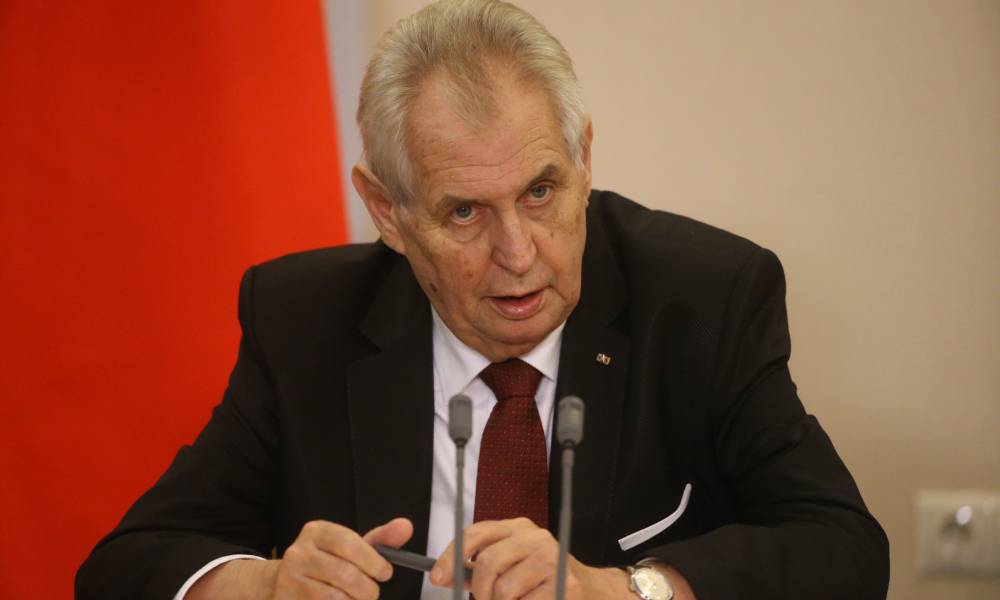
Miloš Zeman, president of the Czech Republic, vows to veto legislation that would give same-sex couples the right to hold civil weddings in the country. (Mateusz Wlodarczyk/NurPhoto via Getty)
Czech president Miloš Zeman has said he plans to veto proposed legislation that would give same-sex couples the right to get married in the country.
The measure, which was drafted by lawmakers across the Czech political spectrum, was submitted to the parliament’s lower house on Tuesday (7 June), the Associated Pressreported.
Lawmakers have yet to set a date to debate the proposed same-sex marriage legislation. Yet the country’s president has said he is strongly opposed to the measure and will strike it down should it even land on his desk.
“I’d like to announce that if I really receive such a law to sign I will veto it,” Zeman said.
Miloš Zeman has served as the president of the Czech Republic since 2013. The president is considered a largely ceremonial role as the elected leader has limited executive powers, but he does have a considerable role in political affairs.
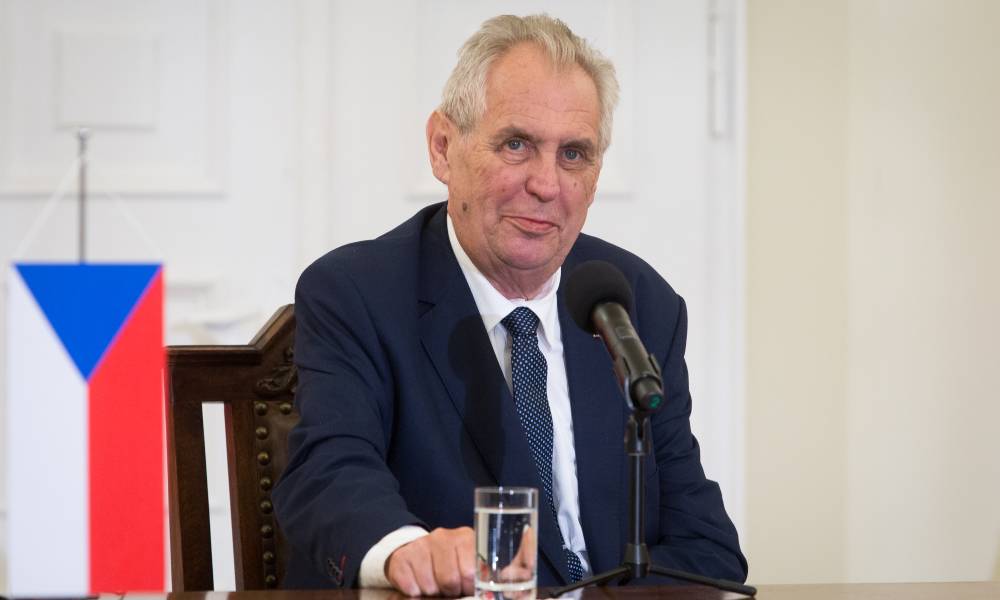
Zeman said that the Czech Republic passed a law in 2006 allowing same-sex couples to enter into registered partnerships, but he believed “family is a union between a man and a woman”, “full stop”.
Czech president Miloš Zeman said he believes “family is a union between a man and a woman”, “full stop”. (Getty/Mikhail Svetlov)
The registered partnership gives queer couples in the Czech Republic some rights similar to those of heterosexual married couples, but it stops short of placing same-sex couples on fully equal footing with their heterosexual counterparts.
Same-sex marriage remains illegal in the country because marriage is defined as a union between a man and a woman under the Czech Republic’s civil code.
Parliament started debating similar same-sex marriage legislation back in 2018, but the legislation stalled as lawmakers didn’t take a vote before last year’s general election. The measure had to then be re-submitted for debate.
Lawmakers in the Czech parliament’s lower house can override Zeman’s veto if they can reach a majority vote.
Miloš Zeman has often espoused anti-LGBTQ+ views in the past. Last June, Zeman said he finds trans people “disgusting” while discussing Hungary’s so-called LGBTQ+ ‘propaganda’ law, which bans any depiction or discussion of queer people in schools, the media and advertising.
Zema said he thought people who undergo gender-affirming treatments are “basically committing a crime of self-harm”.
“Every surgery is a risk, and these transgender people to me are disgusting,” he added.
Adults younger than 30 are more likely than older adults to say their gender differs from their sex assigned at birth, a new Pew Research Center report found.
The 45th annual Seattle Pride Parade on June 30, 2019. Genna Martin / San Francisco Chronicle via Getty Images file
By Zachary Schermele
Approximately 5 percent of young adults in the U.S. identify as transgender or nonbinary, and an increasing number say they know someone who is trans, according to data released Tuesday by the Pew Research Center.
Adults younger than 30 are more likely than older Americans to say their gender differs from their sex assigned at birth. The findings estimate that the total number of adults who identify as transgender or nonbinary (meaning they identify as neither exclusively male nor female) in the U.S. is 1.6 percent.
The new data, which was weighted to be representative of the entire U.S. adult population, comes from an online survey panel from mid-May of 10,188 randomly sampled people. The findings are part of a broader survey that will be released some point this summer about the general public’s “attitudes about gender identity and issues related to people who are transgender or nonbinary,” the report states.
Since 2017, the number of adults who say they know a trans person has been on a slight but steady increase, rising from 37 percent that year to 42 percent in 2021, and 44 percent this year. Although that number decreases as adults get older, a third of those 65 and older in the survey still said they know a transgender person.
More people know transgender people as friends than as co-workers or family members, according to the findings. A little over a quarter of adults said they have a friend who is trans, with roughly 1 in 10 having a trans co-worker or family member.
The survey also found 1 in 5 U.S. adults said they personally know a nonbinary person. A similar Pew survey from last year found an increase — from 18 percent in 2018 to 26 percent in 2021 — in the number of Americans who said they knew someone who preferred using gender-neutral pronouns.
The survey’s estimate of the percentage of trans and nonbinary people in the U.S. is notable because that figure has been historically difficult to gauge, as the Census Bureau has dragged its feet on updating its questions to be more inclusive. In 2016, research sponsored by the Department of Labor uncovered obstacles to the feasibility of adding questions about sexual orientation and gender identity to the current population survey, though the Census Bureau took the historic step last year of adding those questions to its household pulse survey, which measures the impact of the pandemic on families.
A 2021 estimate from UCLA Law’s Williams Institute estimated the number of nonbinary adults in the U.S. to be 1.2 million, and a 2016 report from the institute placed the number of transgender adults in the U.S. at 1.4 million.
Results from an Ipsos global survey released last year, which drew on data from 19,000 people in 27 countries, found 4 percent of young adult respondents identified as transgender, nonbinary, gender-nonconforming, gender-fluid or “in another way.”
The new Pew results found that while it is more likely for a Democrat than a Republican to know a trans person (48 percent vs. 42 percent), the split has narrowed since last year.
In addition, the Pew researchers conducted six focus groups in March with 27 trans and nonbinary people of different ages and racial identities to discuss a range of topics, from access to gender-affirming care to social policy. Those discussions, which were not intended to be statistically representative of the entire population in the U.S., showed that historic challenges — including employment discrimination, bias and violence — appear to persist.
Some participants said deciding whether to reveal their gender identities to other people can be a “constant calculation.” Many participants talked about hesitation in discussing their trans or nonbinary identities in work settings, for some because of a perceived lack of professionalism.
They also discussed financial barriers to medical treatments such as hormone therapy and surgery, with some leaning on “underground networks” for help. Some also described feeling a lack of connection with the larger LGBTQ community, while others felt more accepted.
The findings come amid a record surge in anti-LGBTQ legislation, particularly targeting the rights of trans people at the state level, with the Human Rights Campaign estimating that more than 320 anti-LGBTQ bills have been proposed in state legislatures so far this year.
Many of the participants said they did not become more certain of their gender identities until “well into adulthood.” A middle-aged trans man described not knowing “what trans was” until getting to college — “that was when I had a word for myself for the first time,” the participant said.
Many participants cited young people as a reason for optimism.
“They understand almost intrinsically so much more about these things than I feel like my generation did,” a nonbinary participant in their mid-30s said. “They give me so much hope for the future.”
German LGBT+ pride goers were subject to attack. (Photo by David Silverman/Getty Images)
A Pride event in Karlsruhe, Germany descended into chaos after 30 men violently attacked the crowd and set an LGBTQ+ flag ablaze.
The incident occurred on Saturday (4 June) when the group ganged up on the flag carrier and began to hurl a barrage of insults and hate speech, as reported by Queer.de.
Members of the crown attempted to help the person being attacked, but were in turn attacked themselves. People reported that they were pulled by their hair, kicked, brought to the ground and further beaten.
The attackers then proceeded to steal the flag and burn it. The person carrying the flag sustained several minor injuries and was transported to the hospital.
Karlsruhe police have opened an investigation into the incident, but have been accused of failing to prevent the attack and of reacting “inappropriately”.
An eyewitness at the event alleged that the police let the group of men “run on without being checked.”
German journalist Amelia Brandt wrote on Twitter: “The police who were called reacted to the situation in an extremely inappropriate way.”
She added: “Despite a police presence of at least 10 vans, only 9 police officers got out and took care of those affected.”
— 🍂 Armilla Brandt 🍂 (@armillabrandt) June 6, 2022
Brandt also alleged that the those who were injured and attended to by emergency services were met with anti-LGBTQ+ sentiments.
Criminal police are now investigating. A statement released on Monday (6 June) said: “Police headquarters in Karlsruhe have received allegations from various quarters that investigations were not carried out on site and subsequently not with the required intensity.”
The LGBTQ+ spokesperson for Germany’s ruling SPD party, Florian Wahl, said: “Our sympathy goes to the victims of this attack. But anti-queer attacks are increasing across Germany, and we have to take decisive action against them.”
Wahl said that allegations made about the Karlsruhe police would be investigated. He said: “An anti-queer attack is not a simple brawl… but an attack on the existence of the victim. The state government must ensure that the police recognize anti-queer attacks, call them by name and act appropriately and sensitively.”
Hate crimes continue to be a concern for the LGBTQ+ community in Germany. Reuters reported that violence against queer people increased by 36 per cent in 2020.
Markus Ulrich, a spokesperson for Germany’s biggest LGBTQ+ group LSVD, told Reuters at the time: “Hate crimes against queer people have been on the rise in the past three or four years.”
Same-sex marriage has been legal in Germany since 2017 and a Pew Research survey found that 86 per cent of Germans think homosexuality should be accepted.
What the republican right wants to happen here in the US. I have five of these stories in my news feed this morning. I doubt I will post all of them, but it shows that attacks on the LGBTQ+ is on the rise worldwide. This is not normal that this hate would continue unless it is fueled by something / someone. Here in this story it is politicians that refuse and block change. Why? Who is paying them to anti-LGBTQ+ instead of moving forward toward acceptance? Religions? Big money fascism? The worst of these stories come from the former Soviet countries and Russia. Russia is exporting anti-tolerance hard. No wonder the right wing in the US loves Putin, they all hate the same groups. Hugs
Uzbekistan LGBT+ continue to face violent human rights violations. (Photo by Monirul Bhuiyan / AFP) (Photo by MONIRUL BHUIYAN/AFP via Getty Images)
A new report has found that the LGBTQ+ community in Uzbekistan is under renewed threat as many face persecution, imprisonment, abuse, and brutal human rights violations.
Thirty-six LGBTQ+ people were convicted under the Article 120 of the Uzbek Criminal Code, which criminalises homosexuality in the majority Muslim country, in 2021, found a new report by the International Partnership for Human Rights, Association for Human Rights in Central Asia (AHRCA), and the Eurasian Coalition on Health, Rights, Gender and Sexual Diversity (ECOM).
Twenty-five of them were imprisoned.
Police play a key part in the persecution of queer folk, demanding money in exchange for not outing people to relatives, and torturing and humiliating them.
One young man recounted his experience in a detention centre in the report, and said: “They suspended me from the ceiling using handcuffs, beat me severely, and tried to rape me with a truncheon.
“I have never been beaten and intimidated like that in my entire life. I wanted to die to free myself from this torture.”
The police told him to pay $2,000 (£1,623) or face imprisonment under Article 120. The man paid the police officers and was released.
Elsewhere in the report, one gay man reflected on Uzbekistan attitudes towards the LGBTQ+ community. He said: “It’s as if we lived on a different planet, where it is normal to hate, imprison, discriminate, and kill people simply for who they are.”
Uzbekistan redrafting of the criminal code will make life harder for LGBT+ people. ( Credit: ATTILA KISBENEDEK/AFP via Getty Images)
Stories like this continue to crop up in the former Soviet country, the only one which still hasn’t removed its Soviet-era anti-LGBTQ+ laws.
The report even found that police use information from HIV centres to find people in order to exploit and extort money from them.
Currently under Article 120, same-sex sexual conduct can be a punishable offence up to three years. Uzbekistan is currently drafting a new criminal code but the law would merely transpose Article 120 into a new Article 154, with the wording unchanged, according to Human Rights Watch (HRW).
Between 2017 and 2021 it was reported by HRW that police carried out bogus, debunked anal examinations to find and prosecute men for same-sex relations, but these were in fact found to be forms of torture and abuse.
Politicians have stood in between any kind of legislation changes.
In 2021 Alisher Kadyrov, leader of Uzbekistan’s National Revival party, even suggested identifying LGBTQ+ people in the country and taking away their citizenship so that other countries could offer them refuge.
“When I put forward this proposal on social networks, up to 100 LGBT people got in touch with me and agreed with what I had said,” Kadyrov said, according to EurasiaNet.
I have heard of these studies before. But mostly it was from sites dedicated to LGBTQ+ issues. This is the first time I have heard these arguments put forth by an active preacher / priest. If you think the bible passages are against consensual homosexuality, please give this short video a listen. He clears that up well. Hugs

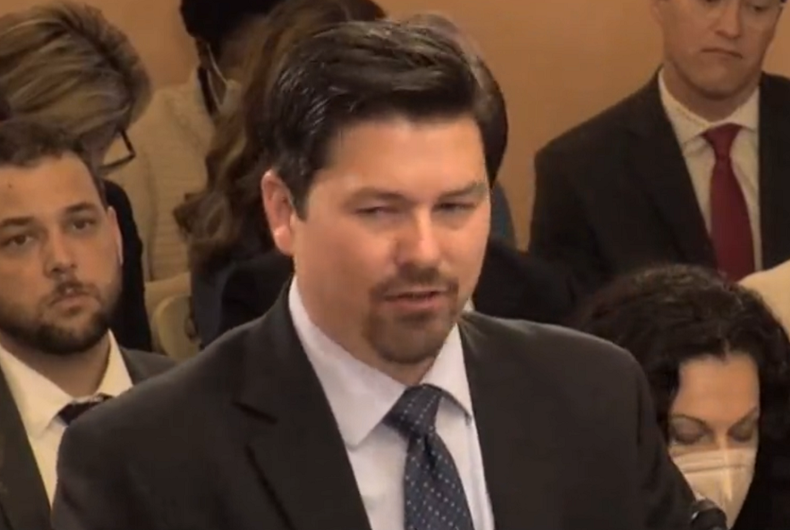 Matt Sharp of ADFPhoto: Screenshot