Data on transgender students from the Centers for Disease Control and Prevention, published Thursday. (CDC)
Nearly 2 percent of high school students in the United States identify as transgender, according to data published Thursday by the U.S. Centers for Disease Control and Prevention.
Other data show:
27 percent feel unsafe at school or traveling to or from campus.
35 percent are bullied at school.
35 percent attempt suicide.
Amit Paley, chief executive and executive director of the Trevor Project, the world’s largest suicide prevention and crisis intervention organization for LGBTQ youth, called the report’s findings “groundbreaking.”
“This is the first time we’ve had a federal government report of this magnitude showing that transgender youth exist in this country and in larger numbers than researchers had previously estimated,” he said in an interview. The report, he said, shows “the very real health risks” transgender youth face in school.
Paley said the Trump administration has moved to “erase the identity of transgender youth.” The administration has rolled back or frozen Obama-era anti-discrimination rules aimed at protecting the LGBTQ community in health, education and other areas.
The Supreme Court on Tuesday allowed President Trump’s broad restrictions on transgender people serving in the military to go into effect while the policy is fought in lower courts. In 2017, Education Secretary Betsy DeVos’s first major policy act was to support Trump’s decision to rescind the guidance protecting the right of transgender students to use the bathroom of their choice.
The data published by the CDC comes from the 2017 Youth Risk Behavior Survey in 10 states and nine large urban school districts. The survey is conducted biennially among a representative sample of U.S. high school students in the ninth through 12th grades. The findings were published in the CDC’s Morbidity and Mortality Weekly Report, an epidemiological digest with public health information and recommendations sent to the CDC by state health departments.
In 2017, 10 states and nine urban school districts piloted a measure of transgender identity. The states were Colorado, Delaware, Hawaii, Maine, Maryland, Massachusetts, Michigan, Rhode Island, Vermont and Wisconsin. The urban school districts included Boston, Cleveland, Detroit, the District, Los Angeles, New York, San Diego, San Francisco and Broward County, Fla.
The CDC said it pooled data from the 19 sites to assess the prevalence of transgender identity and the relationship between transgender identity and violence victimization, substance use, suicide risk and sexual risk behaviors. Transgender students were more likely to report substance use, suicide risk and being victims of violence, and, although more likely to report some sexual risk behaviors, they were also more likely to be tested for HIV infection, the CDC said.
“These findings indicate a need for intervention efforts to improve health outcomes among transgender youths,” the report said.
Across the 19 sites, 94.4 percent of students responded, “No, I am not transgender”; 1.8 percent responded, “Yes, I am transgender”; 1.6 percent responded, “I am not sure if I am transgender”; and 2.1 percent responded “I do not know what this question is asking.”
It has been difficult for health experts to determine the percentages of young people who identify as transgender or gender-nonconforming, and estimates have varied in recent years depending on the survey.
A 2018 report in the journal Pediatrics used a statewide survey of nearly 81,000 Minnesota ninth- and 11th-graders and found that nearly 3 percent identified as transgender or gender-nonconforming, meaning they do not identify as the gender they were assigned at birth. The authors of the study said their findings could be used to estimate numbers in those grades across the country.
A 2017 study by researchers at the University of California at Los Angeles estimated that about 150,000 youth aged 13 to 17, or 0.7 percent, identify as transgender, and 0.6 percent of U.S. adults identify as such.
A new study shows that gender-nonconforming kids who go on to transition already have a strong sense of their true identity—one that differs from their assigned gender.
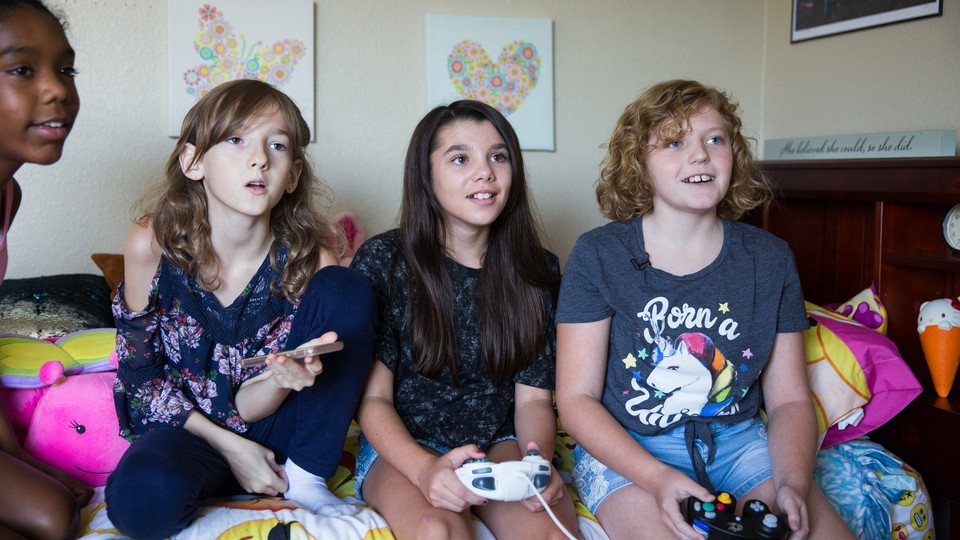
Lily Curran (far right), who is transgender, plays with a group of friends, some of whom are also trans. (Barcroft Media / Getty Images)
Since 2013, Kristina Olson, a psychologist at the University of Washington, has been running a large, long-term study to track the health and well-being of transgender children—those who identify as a different gender from the one they were assigned at birth. Since the study’s launch, Olson has also heard from the parents of gender-nonconforming kids, who consistently defy gender stereotypes but have not socially transitioned. They might include boys who like wearing dresses or girls who play with trucks, but who have not, for example, changed the pronouns they use. Those parents asked whether their children could participate in the study. Olson agreed.
After a while, she realized that she had inadvertently recruited a sizable group of 85 gender-nonconforming participants, ages 3 to 12. And as she kept in touch with the families over the years, she learned that some of those children eventually transitioned. “Enough of them were doing it that we had this unique opportunity to look back at our data to see whether the kids who went on to transition were different to those who didn’t,” Olson says.
By studying the 85 gender-nonconforming children she recruited, her team has now shown, in two separate ways, that those who go on to transition do so because they already have a strong sense of their identity.
This is a topic for which long-term data are scarce. And as transgender identities have gained more social acceptance, more parents are faced with questions about whether and how to support their young gender-nonconforming children.
“There’s a lot of public writing focused on the idea that we have no idea which of these gender-nonconforming kids will or will not eventually identify as trans,” says Olson. And if only small proportions do, as some studies have suggested, the argument goes that “they shouldn’t be transitioning.” She disputes that idea. “Our study suggests that it’s not random,” she says. “We can’t say this kid will be trans and this one won’t be, but it’s not that we have no idea!”
“This study provides further credence to guidance that practitioners and other professionals should affirm—rather than question—a child’s assertion of their gender, particularly for those who more strongly identify with their gender,” says Russell Toomey from the University of Arizona, who studies LGBTQ youth and is himself transgender.
(A brief note on terms, since there’s a lot of confusion about them: Some people think that kids who show any kind of gender nonconformity are transgender, while others equate the term with medical treatments such as hormone blockers or reassignment surgeries. Neither definition is right, and medical interventions aren’t even in the cards for young children of the age Olson studied. That’s why, in her study, she uses pronouns as the centerpiece marker of a social transition. Changing them is a significant statement of identity and is often accompanied by a change in hairstyle, clothing, and even names.)
When the 85 gender-nonconforming children first enrolled in Olson’s study, her team administered a series of five tests that asked what toys and clothes they preferred; whether they preferred hanging out with girls or boys; how similar they felt to girls or boys; and which genders they felt they currently were or would be. Together, these markers of identity gave the team a way to quantify each kid’s sense of gender.
The team, including James Rae, now at the University of Massachusetts Amherst, found that children who showed stronger gender nonconformity at this point were more likely to socially transition. So, for example, assigned boys who had the most extreme feminine identities were most likely to be living as girls two years later. This link couldn’t be explained by other factors, such as how liberal the children’s parents were. Instead, the children’s gender identity predicted their social transitions. “I think this wouldn’t surprise parents of trans kids, and my findings are often ‘duh’ findings for them,” says Olson. “It seems pretty intuitive.”
Charlotte Tate, a psychologist from San Francisco State University, says that this quantitative research supports what she and other transgender scholars have long noted through qualitative work: There really is something distinctive and different about the kids who eventually go on to transition. From interviews with trans people, “one of the most consistent themes is that at some early point, sometimes as early as age 3 to 5, there’s this feeling that the individual is part of another gender group,” Tate says. When told that they’re part of their assigned gender, “they’ll say, ‘No, that’s not right. That doesn’t fit me.’ They have self-knowledge that’s private and that they’re trying to communicate.”
Olson’s team also showed that those differences in gender identity are the cause of social transitions—and not, as some have suggested, their consequence. After assessing the group of 85 gender-nonconforming children, the team administered the same five tests of gender identity to a different group of 84 transgender children who had already transitioned, and to a third group of 85 cisgender children, who identify with the sex they were assigned to at birth. None of these three groups differed in the average strength of their identities and preferences. In other words, trans girls who are still living as boys identify as girls just as strongly as trans girls who have transitioned to living as girls, and as cis girls who have always lived as girls. Put another way: Being treated as a girl doesn’t make a trans child feel or act more like a girl, because she might have always felt like that.
“Implicit in a lot of people’s concerns about social transition is this idea that it changes the kids in some way, and that making this decision is going to necessarily put a kid on a particular path,” says Olson. “This suggests otherwise.” Children change their gender because of their identities; they don’t change their identities because they change their gender.
“The findings of this compelling study provide further evidence that decisions to socially transition are driven by a child’s understanding of their own gender,” says Toomey. “This is critically important information given that recent public debates and flawed empirical studies erroneously implicate ‘pushy’ parents, peers, or other sources, like social media, in the rising prevalence of children and adolescents who identify as transgender.”
Olson’s new findings come on the back of another controversial study, from 2013, in which Thomas Steensma from University Medical Center in Amsterdam studied 127 adolescents who had been referred to a clinic for “gender dysphoria”—a medical term describing the distress when someone’s gender identity doesn’t match the gender assigned at birth. Only four people in that cohort had socially transitioned in early childhood, and all of them ended up identifying as transgender. By contrast, most of those who had not transitioned did not have gender dysphoria later.
“People have taken from that study that a lot of these kids are not going to be trans adults so you shouldn’t be socially transitioning them, or that social transitions are changing kids’ identities,” Olson says. But “we’re suggesting that the kids who are socially transitioning seem to be different even before that transition, which shifts the interpretation of that past study.” (Steensma did not respond to requests for comment.)
Olson admits that there are weaknesses in her new study. It’s relatively small, and all the children came from wealthy, educated, and disproportionately white families. And since it began almost by accident, when parents of gender-nonconforming children approached her, she couldn’t preregister her research plans, a growing practice in psychology. (It reduces the temptation to fiddle with one’s methods until they yield positive results and instills confidence among other scientists.)
To at least partly address these shortcomings, Olson did a multiverse analysis: She reran her analyses in many different ways to see whether she still got the same result. What if, instead of using all five tests of gender identity, she just looked at combinations of four? Or three? Two? The team ran all these what-if scenarios, and in almost all of them, the results were the same. “They went above and beyond the analyses typically conducted and presented in scientific journals,” says Toomey. “Their results were robust across these additional tests, suggesting that readers can have a high level of confidence in these findings.”
Olson stresses that she has no magic test that can predict exactly which children will transition and which will not. It’s a question of probabilities. In her study, based on their answers, all the children got a gender-nonconformity score between 0 and 1. For comparison, those who scored 0.5 had a one-in-three chance of socially transitioning, while those who scored 0.75 had a one-in-two chance.
“How much gender nonconformity is ‘enough’ to allay the anxieties parents feel around transition is an open question,” says Tey Meadow, a sociologist from Columbia University who studies sexuality and gender and has written for The Atlantic. Parents are the ultimate arbiters of a child’s access to transition, and they make decisions “in a culture that encourages parents to look for every possible alternative to transness,” Meadow adds.
“It’s not like you can take a blood sample or do an MRI,” says Aaron Devor, the University of Victoria’s chair of transgender studies, who is himself transgender. “One of the phrases often used is ‘consistent, persistent, and insistent.’ When you get that constellation, that kid is also a kid who might want to transition. And that’s what [Olson’s] research is corroborating. It adds some very valuable data.”
Devor and others note that Olson’s earlier studies suggest that children who are supported and affirmed in their transitions are just as mentally healthy as cisgender peers. That reminds him of seminal work by the American psychologist Evelyn Hooker. In the 1950s, when many psychologists saw homosexuality as a mental illness (largely because they had only ever worked with gay people who had records of arrest or mental-health problems), Hooker surveyed a more representative sample and found that gay and straight men don’t differ in their mental health. That was instrumental in getting homosexuality removed from a list of mental-health disorders in 1987. “We’re sitting in a similar moment today with transgenderism,” says Devor. “The mental-health issues that we see are largely the result of living a life that blocks your expression of your gender. My view is that the work coming out of Olson’s group will have an Evelyn Hooker effect.”
I am reminded of what Robyn Kanner wrote in The Atlantic last year: “Society has done nothing for trans youth for so many years. People have to trust that the youth who sway in the breeze of gender will land on their feet when they’re ready. Wherever that is, it’ll be beautiful.”
The Florida residents say the state’s dissolution of the corporate giant’s private government — and its special tax status — will burden them with more than $1 billion in bond debt.
The Magic Kingdom at Walt Disney World in Lake Buena Vista, Florida. (John Raoux/AP)
MIAMI (CN) — Florida Governor Ron DeSantis violated the rights of taxpayers when he signed a law removing Disney’s self-governing status, three residents claim in a federal lawsuit filed on Tuesday.
In the 11-page complaint, Michael Foronda, Edward Foronda and Vivian Gorsky — all of whom live near the Walt Disney World theme park and resort — say the state’s actions will saddle them and other taxpayers with Disney’s bond debt estimated at more than $1 billion.
“Plaintiffs, who are property owners in the surrounding counties, fear that they will now have to assume the tax burden that Disney previously assumed under the special tax status,” the complaint states. “Their fear is well founded, and it is through this taxpayer lawsuit and mandamus action that they are able to protect their rights.”
The lawsuit, filed in the U.S. District Court for the Middle District of Florida, names the Republican governor, Florida Secretary of State Laurel M. Lee and Florida Department of Revenue Director Jim Zingale as defendants. DeSantis’ office did not immediately respond to a request for comment.
The GOP-controlled Florida Legislature voted to remove Disney’s self-governing status last month, following a battle over the corporation’s opposition to the state’s “Don’t Say Gay” law. DeSantis signed the bill, SB 4C, a few days later.
The law will dissolve independent special districts created before 1968, including the Reedy Creek Improvement District that contained Walt Disney World, in June 2023 unless a new agreement is reached.
The company lobbied for the special district more than 50 years ago so that it could act as a county government. Disney owns the roads and utilities in the 25,000-acre district and also operates a police force and fire department there.
Unless Disney and the state government reach another agreement, the special district will dissolve and all assets and liabilities will be transferred to local governments, according to the bill’s language. Disney would also lose the ability to construct new buildings or roads without local oversight and potentially cumbersome zoning restrictions.
The law is widely considered to be retaliation for Disney’s opposition to the state’s Parental Rights in Education law, known more commonly as the “Don’t Say Gay” law, which bans the teaching of sexual orientation and gender identity topics from kindergarten through third grade. Disney heavily criticized the bill, which was signed into law by DeSantis in March, and vowed to end any political contributions to state lawmakers.
The federal lawsuit makes note of this, claiming DeSantis “intended to punish Disney for a First Amendment protected ground of free speech,” which “directly resulted in a violation of plaintiffs’ Fourteenth Amendment rights to due process of law.”
The plaintiffs also allege stripping Disney of its special status, and burdening residents with debt and some public safety responsibilities now paid for by the theme park, violates the Florida Taxpayer’s Bill of Rights.
Disney has so far stayed mum on the issue, though the Reedy Creek Improvement District did send a message to bondholders last week reminding them that the law establishing the special district mandates all debts must be paid before changing its status.
“In light of the state of Florida’s pledge to the district’s bondholders, Reedy Creek expects to explore its options while continuing its present operations, including levying and collecting its ad valorem taxes and collecting its utility revenues, paying debt service on its ad valorem tax bonds and utility revenue bonds, complying with its bond covenants and operating and maintaining its properties,” the statement reads.
The plaintiffs are represented by Miami-based attorney William Sanchez.
Thomas Steensma, a gender clinician and researcher at the Center of Expertise on Gender Dysphoria, VU University Medical Center, in Amsterdam. (Courtesy Thomas Steensma)
The phenomenon of transgender children “growing out of” their transgender identity by the time they are adolescents or adults is called “desistance” by gender researchers.
For decades, follow-up studies of transgender kids have shown that a substantial majority — anywhere from 65 to 94 percent — eventually ceased to identify as transgender.
These findings have become part and parcel of the “How young is too young?” debate over “social transitioning,” the term for allowing kids to publicly live as their identified gender in every way short of medical treatment.
If most kids will eventually cease to be transgender, some clinicians have reasoned, isn’t it more prudent to take the least disruptive path in coping with a child’s gender dysphoria? That way, if or when kids later stop identifying as transgender, they will have less to “undo.”
In recent years, though, a new school of thought has emerged. Many gender specialists now believe that the best course for a transgender child is often “social transition,” where kids as young as three are allowed to change their names, pronouns and style of dress to match the gender they identify with.
Looking at the Research
One reason many researchers believe it’s unnecessary to delay the social transition of a child is that they don’t think the research on desistance is valid. In other words, they think the number of children who “grow out of” their transgender identity has been vastly overblown.
This school of thought holds that because the criteria for a diagnosis of gender dysphoria (previously called gender identity disorder) was less stringent in the past, the earlier desistance studies included a large cohort of children who today would not be diagnosed with gender dysphoria, gay boys who may have been experimenting with different ways of expressing gender but who were never really transgender in the first place.
“The methodology of those studies is very flawed, because they didn’t study gender identity,” said Diane Ehrensaft, director of mental health at UCSF’s Child and Adolescent Gender Clinic. “Those desistors were, a good majority of them, simply proto-gay boys whose parents were upset because they were boys wearing dresses. They were brought to the clinics because they weren’t fitting gender norms.”
In Amsterdam, clinicians at the Center of Expertise on Gender Dysphoria are much more cautious about recommending social transitions because of the statistics on desistance. Thomas Steensma, a researcher and clinician at the center, acknowledges these studies probably included some kids who would not be diagnosed with gender dysphoria today. Nevertheless, despite the problems with the way they classified children, “the only evidence I have from studies and reports in the literature … is that not all transgender children will persist in their transgender identity,” Steensma said.
In 2013, Steensma co-authored an oft-cited study that examined 127 adolescents, all of whom had displayed various levels of gender dysphoria as children. The researchers found that 80 of the children had desisted by the ages of 15 and 16. That works out to 63 percent of kids who basically stopped being transgender — a lower rate than in previous studies, but still a majority.
Some clinicians criticize this study, however, on methodological grounds, because the researchers defined anyone who did not return to their clinic as desisting. Fifty-two of the children classified as desistors or their parents did send back questionnaires showing the subjects’ present lack of gender dysphoria. But 28 neither responded nor could be tracked down.
“You can’t do that in scientific studies,” Ehrensaft said. “You have to have your subjects in front of you and know who they are. You can’t just assume somebody is in a category because you don’t see them anymore.”
In addition, 38 of the 127 kids were originally designated “subthreshold” for gender identity disorder, meaning they did not fulfill all the criteria for meeting the official diagnosis.
This, according to Erica Anderson, a gender clinician at UCSF, makes the desistance findings even more suspect.” [It] begs the question of whether these kids were actually divergent [in their gender identity] before the study selected them,” she said.
Steensma stands by the study’s methodology. But interestingly, he added that citing these findings as a measure of desistance is wrongheaded, because the study was never designed with that goal in mind.
“Providing these [desistance] numbers will only lead to wrong conclusions,” he said.
Diane Ehrensaft, director of mental health at UCSF’s gender clinic. (Lauren Hanussak/KQED)
Rather, he says, the researchers wanted to see if they could find predictors of persistence. Which they did: The study found that transgender children who were older, born female, and reported more intense gender dysphoria were more likely to stick with their transgender identity than younger children, natal boys and those with less pronounced gender dysphoric traits.
Steensma and colleagues also culled one very specific indicator of future persistence: When asked when they were children, “Are you a boy or a girl?” those who answered the opposite of their birth sex were found more likely to have retained their gender identity in adolescence. The desistors, on the other hand, tended to merely wish they were the opposite sex.
“(E)xplicitly asking children with GD (gender dysphoria) with which sex they identify seems to be of great value in predicting a future outcome for both boys and girls with GD,” the study says.
Today, Steensma cautions that this question is not a litmus test for which children will persist in their transgender identity. He believes that gender identity in kids is still developing, and that it’s responsive to what occurs at different life stages. He also says it’s possible that a social transition could lead to persistence where it otherwise might not have occurred.
“That’s not something we can answer,” he said. “It’s something we have to study and find out.”
‘It’s Time to Teach Society’
Another contentious topic in the transgender community is what the literature calls “detransitioning,” or reverting back to one’s natal gender.
The current Standards of Care written by the World Professional Association for Transgender Health cautions that “a change back to the original gender role can be highly distressing” The guidelines use that assertion as a reason to be cautious about early social transitioning.
But the cautionary language, Ehrensaft points out, is based on one qualitative study, coauthored by Steensma, which looked at the dilemma of just two Dutch girls who’d transitioned when they were in elementary school and wanted to switch back. She doesn’t think it’s particularly relevant.
“The stress [of detransitioning] comes from microaggressions and lack of acceptance in the environment,” she said. “If we offer social support and opportunities for children over time, we don’t have any evidence that [detransitioning] will be damaging for them.”
Ehrensaft believes the conventional treatment of transgender children has been based, for the most part, on traditionally negative views of gender nonconformity. So, she believes, the burden is now on the culture to see transgender children as they really are.
“Why are we asking a child to conform to something that is not them because society hasn’t done its learning yet?”she says. “It’s time to teach society.”
Toward the Nonbinary
One of the more interesting takes I heard on persistence and desistance came from UCSF gender clinician Erica Anderson, who is transgender herself. She views the very notion of measuring persistence/desistance as something of a fool’s errand, because such definitions are mediated by changing cultural norms, the self-perceptions of children and the ways that researchers interpret them.
“We’ve got kids of varying sophistication levels of language trying to explain to other people who have no experience [being transgender],” Anderson said, “and it’s being driven by shifting professional understanding or consensus and culture. You’ve got moving parts. In that context we’ve got a dynamic situation where kids who might say ‘I’m a girl’ might have said five years ago ‘maybe I’m a girl.’ ”
Ehrensaft herself doesn’t even like to use the terms persistence and desistance. Those words imply something fixed — a binary state of yes or no. But younger generations of transgender people — and even younger generations in the general population — see gender as more protean, even customizable. Of nearly 28,000 respondents to the 2015 U.S. Transgender Survey, more than one-third said they were some form of nonbinary. That means they may identify as both male and female, neither male nor female, or sometimes male, sometimes female.
This, in theory, could solve a lot of problems. After all, if the gender fluidity trend continues, perhaps many people will have no unitary gender to “persist” or “desist” from.
Are sex and gender the same? Or are they different? Confused? Read our explainer here.
If you’ve paid any attention to social media in the past couple of years, you know what a rainbow flag means. You’ve heard of ‘LGBTQ+ rights’ and ‘Queer Azadi’. You probably even know people who have attended a pride march in one of the metros. And since it became cool to ‘support gay rights’, you’ve perhaps changed your Facebook DP with the rainbow filter.
But while you ‘know’ all this, do you ‘understand’? What does each letter in LGBTQ+ stand for? What are the differences between these various identities? And are there just ‘L’, ‘G’, ‘B’, ‘T’ and ‘Q’? Are there no other identities in the gender and sexuality spectrum?
Well, here’s the exhaustive primer that you’ve been waiting for. This is Gender and Sexuality 101, and your world can only expand from here on.
Sex, gender and identity
Recall how they use ‘sex’ and ‘gender’ interchangeably in all the forms you’ve ever had to fill? Well, in real life, they are two different things and unless we get this straight in our heads, we will fail at every attempt to understand gender identities.
While sex is what your doctor says your birth anatomy says about you, gender is how you express yourself in the theatre of life. While ‘sex’ is what makes you ‘male’ or ‘female’ (or ‘intersex’, more on that later), gender is what makes you a ‘tomboy’, ‘macho’, ‘camp’, ‘femme’, ‘butch’ or pretty much anything that defines your personality.
That means you can be a ‘female’ (sex), who is ‘macho’ (a trait traditionally considered masculine). You can have masculinity and femininity to different extents in your personality, and you can then choose to identify more with either the masculine or feminine parts of yourself.
By separating ‘sex’ and ‘gender’, what we’re basically saying is that there’s no one way of being a ‘woman’ or a ‘man’, and that there are myriad of different possibilities in between.
Sexuality and sexual orientation
While sexuality makes a direct reference to ‘sex’ and sexual preferences of an individual, it refers to much more. People express their sexuality in a variety of ways — while some like to be ‘sensual’, others like to play it ‘modest’.
Sexuality lies at the intersection of sex, gender, expression, attraction, as well as things like body image and self-awareness. Sexuality refers to how you express yourself as a sexual being (or not).
Sexual orientation refers to lasting romantic and/or sexual desire for one or more sexes and/or genders, if at all. It is an important part of your sexuality, but it is not the whole story.
What does ‘queer’ mean and how is it different from LGBT identities?
Now, when the bracket is extended, you arrive at ‘Q’ or Questioning/Queer/Genderqueer. People who identify as queer feel their gender and/or sexual identities falls outside the categories of man or woman. They would either consider themselves as falling between the two, or wholly different from them.
A guide to common LGBTQ+ terms
Gay – Refers to a homosexual man, or a man who is sexually attracted to other men.
Lesbian – Refers to a homosexual woman, or a woman who is sexually attracted to other women.
Bisexual – A person who experiences sexual attraction to both men and women.
Transgender – According to the Gay and Lesbian Alliance Against Defamation’s (GLAAD) media reference guide, refers to a gender identity, which is a ‘social or psychological’ rather than a ‘biological’ identity. It may be different from their ‘sexual or biological identity’, which they were born with.
Therefore, a person who is assigned into the male sex but identifies as a woman may be a transgender person. Conversely, a person who has been assigned the female sex at birth and who identifies as a man instead is also be a transgender person (trans-man).
Isn’t ‘Hijra’ just the Indian term for transgender?
Many see the LGBTQ identities as influences of the western world on the pious Indian culture. However, our tryst with alternate sexual and gender identities began much earlier.
Everyone knows about ‘hijras’ – the people who appear ‘masculine’ but dress is ‘feminine’ attire, clapping their hands together in a peculiar way, asking for alms on the streets or on occasions like wedding and childbirth (that, sadly, is the limited perspective in which hijras are predominantly seen). However, the Indian transgender community does not comprise of Hijras alone.
The Indian Hijra community itself is over 4,000 years old. Although many of them have biological and sexual identities same as the above-mentioned globally recognized LGBT identities, cultural and behavioral differences make it imperative for their recognition as an identity of their own.
Often, they live together in mid to large sized communities. Many of them end up doing sex-work as they are discriminated against in spaces at other workspaces due to their gender identity. Many of them undergo a ritual known as ‘Nirwaan’, or the removal of their private parts. They have long been a part of Indian culture; though today have been pushed to the margins of society due to discrimination and ill-treatment.
Kothis, Double Deckers, Panthis, Jogappas – who are they?
Now let’s look at the non-mainstream gender and sexual identities particular to India and a few other Asian countries. These are predominantly used to categorise ‘MSMs’ or Men who have Sex with Men.
A Kothi is often mistaken as a Hijra but actually refers to a man or a boy who behaviourally takes on the role of the ‘female’ in same-sex relationships and would usually be the penetrated member during sex.
Panthi, on the other hand, is the term used for someone who takes on the behavioural role of the ‘male’ and would be the penetrator or inserter.
A double-decker is a term used for someone who functions as both. Double-deckers and Kothis have a high risk of HIV and sexually transmitted diseases according to studies among different MSM sub-groups in the nation.
Finally, gay or transgender men ritualistically married to the Goddess Yellama in South India are known as Jogappas. They are often seen handling various temple proceedings.
It is extremely difficult to apply international conventions of sexual identity on such groups, whose existence is guided by their profession, religions belief, and cultural rituals. The Indian law also doesn’t do much to protect their rights, or ensure that they carry on with their trade and livelihood properly. However, cases of STDs and exploitation remains high, and social discrimination is severe.
Who is a transsexual, and how is it different from ‘transgender’?
Sex change operations are no longer the hush-hush secret procedures they used to be. Many transgender persons now choose to have their bodies permanently changed through surgery or hormones, or wish to do so. These people may identify themselves as transsexual.
The ‘T’ doesn’t stop there. GLAAD’s guide goes on to tell that both transsexual and transgender can be suffixed by either ‘man’ or ‘women’. A transgender man is assigned the female gender based on the anatomy he was born with, but identifies himself and lives life as a man. A transsexual man was born biologically female, but either underwent a permanent sex change or wishes to go for one. Similarly, a female transgender or a female transsexual identifies herself in the same equation.
Now, you may wonder what this person prefers to be addressed as. Unfortunately, language provides us with limited options therefore, it is imperative to know which pronoun (he/she/him/her) they prefer be used for them.
Did you know transsexual/transgender is different from drag queen?
Drag queen has become something of a popular culture reference which has come to be considered synonymous with people who fall under the ‘transgender’ bracket. However, this term simply refers to someone who enjoys wearing clothes associated with the opposite sex, whether they are heterosexual, gay/lesbian, or bisexual.
Transgender and intersex are not the same
We have established so far that gender is not black and white. In fact, there’s a whole lot of grey there, even though social norms continue to try and contain it within arbitrary categories
What about the sexes though? There are only two – male and female – right? Wrong!
Even within assigned sexes, male and female form two ends of the spectrum. There exist many intermediate conditions arising from anomalies in sex chromosome configuration (beyond the XX and XY possibilities), differences in how the fetus or adolescent reacts to hormones, or variances in the mode of sexual development.
These are collectively referred to as intersex variations and may or may not be accompanied by ambiguous genitalia or reproductive organs which are neither strictly male nor female.
Asexual and pansexual
While there is growing awareness of divergent sexualities, there are also persons who feel sexual attraction towards none, and may identify themselves as asexual. Conversely, there are also persons who identify as pansexuals. The prefix ‘pan-‘ means ‘all’, which means that this person experiences attraction towards male, female as well as persons who identify as non-binary like transgender persons, genderqueer or agender persons.
Note: This explainer has not been updated. For an up to date media glossary of LGBTQIA+ terminology and meanings, prepared by Queer Chennai Chronicles and The News Minute and refer here.
A Fox News panel debating abortion rights got pretty heated as Cassie Smedile, the executive director of pro-Trump PAC America Rising, baselessly peddled a talking point about Democrats advocating for killing babies after birth. While this is obviously false and a deliberate smear attack, Democrat strategist Kevin Walling offered almost no pushback when he responded to her ridiculous claim.
“A Fox News panel discussion got heated on Tuesday when one of the guests falsely claimed Democrats are pushing to have “abortion beyond the birth of the child” during a discussion of yesterday’s leaked draft decision that would potentially overturn Roe v. Wade. Cassie Smedile, the executive director of America Rising pro-Trump PAC, was asked by anchor Sandra Smith to weigh in on Senator Majority Leader Chuck Schumer’s (D-NY) comments denouncing the draft decision by Justice Samuel Alito. “I think as a pro-life person what about the rights of the tens of millions of unborn babies relentlessly under attack by the left, for decades now,” responded Smedile. “We’re not talking about 40 years ago. Today’s Democrats are advocating for the right to have an abortion beyond the birth of the child. And most Americans would say, ‘That’s not something that sits well with me.’””
The Supreme Court ruled unanimously on Monday that the city of Boston violated the Constitution when it refused to let a local organization fly a Christian flag in front of city hall.
While the case had religious overtones, the decision was fundamentally about free speech rights. The court said the city created a public forum, open to all comers, when it allowed organizations to use a flagpole in front of City Hall for commemorative events. Denying the same treatment for the Christian flag was a violation of free expression, it said.
“When the government encourages diverse expression — say, by creating a forum for debate — the First Amendment prevents it from discriminating against speakers based on their viewpoint,” Justice Stephen Breyer wrote in the decision.
The case was filed in 2018 after a Boston official denied the application by the group Camp Constitution to raise a flag — described as “Christian” in the application — on one of the three flagpoles outside Boston’s city hall. The group is an all-volunteer association that seeks to “enhance understanding of the country’s Judeo-Christian moral heritage.”
Justice Samuel Alito, writing for Justices Neil Gorsuch and Clarence Thomas, said that though the court relied upon “history, the public’s perception of who is speaking, and the extent to which the government has exercised control over speech” to determine that the flag-raising program did not amount to government speech, he would have analyzed the case based on a more exacting definition of what constitutes government speech.
Under a more narrow definition of government speech, Alito wrote that it occurs “if — but only if” a government “purposefully expresses a message of its own through persons authorized to speak on its behalf.”
“This case is so much more significant than a flag,” said Mathew Staver, the founder and chairman of Liberty Counsel, a Christian legal group that represented Camp Constitution. “Boston openly discriminated against viewpoints it disfavored when it opened the flagpoles to all applicants and then excluded Christian viewpoints.”
Boston said it worried that losing the case would mean it might someday be required to fly a flag from a neo-Nazi group or an al-Qaida flag. Another option: The city could avoid flying flags inconsistent with its views by not flying any third-party flags in the first place.
Supreme Court says Boston violated the First Amendment rights of a group seeking to raise a Christian flag outside City Hallhttps://t.co/aeA5GNH7kx
I would imagine that that was the real reason for the case: to deny the Pride flag, etc. In that case by all means move any Pride flags off public property. Then let them try to fly theirs, it could fly alright.
No, it doesn’t, cause the Pride flag represents social acceptance and the Christian nationalist flag represents dominionism and overthrowing… the government?
They’re literally trying to use the government to mark territory by favoring their own version of their own religion, and claiming that that’s an equivalent ‘viewpoint’ cause their version of their religion hates the people the Pride flag shows acceptance of? Either way they’re using the government to impose their religion and silence minority voices.
The Christian superpower of always claiming constant victimhood and persecution will never allow that. They want special rights.
For their superpower, they get the keys to the kingdom. With those keys they are free to hate and harm as they originally wanted to do. The Muslim superpower of not depicting the profit (spelled that way on purpose) Mohamed is weak compared to the Christian superpower.
Christians lie about everything. They will twist this decision to get their wants
That’s precisely what the SCOTUS did here. And that’s why the SCOTUS needs to be expanded to balance secularists with the current crop of Dominionists.
Ugh. The decision was not based on religion, but it will be taken that way by every right-wing Christian religious group. I hope the Satanists are taking notes.
What SCOTUS is doing is pretending it’s just a ‘viewpoint’ and not an imposition of an establishment of religion when the CHristians want to impose their religion, either with their DOminionist flag or removing any symbols representing people they want to eliminate from the public square.
These are the official flag poles of the city, displaying the national and state flags.
Yes, the third pole is open to civic groups BUT flying a religious flag “on top of city hall” is an endorsement of religion. It’s absurd that SCOTUS ignored that aspect. Religion is privileged in this country but that comes with a few restrictions, which help guarantee the freedom, not hinder it.
There was zero chance that any of the six Federalist Society picks for SCOTUS would agree to ban all religious displays from government buildings. That is a nonstarter of an argument. I’m not saying it’s wrong, but this is the court we got from not enough Democrats turning out in 2000 and 2016. This is what we have to deal with now. Just wait and see what they do with Roe and Obergefell.
Let’s just cut to the chase Their objection was to a PRIDE flag It’s not that they want their flag to be flown its that the don’t want a PRIDE flag flown
Now that the Dominionists have won this nanometer case they will take a light year. So, this will be REPLICATED across the nation now. Dominionists will get more and more wins as time goes by.