The U.S. Supreme Court left abortion providers only the narrowest avenue to challenge the ban on abortions after about six weeks of pregnancy. Friday’s Texas Supreme Court ruling has effectively ended that federal legal challenge.
The Texas Supreme Court on Jan. 15, 2020 Credit: Miguel Gutierrez Jr./The Texas Tribune
Sign up for The Brief, our daily newsletter that keeps readers up to speed on the most essential Texas news.
The Texas Supreme Court dealt a final blow to abortion providers’ federal challenge to the state’s latest abortion restrictions Friday.
The court ruled that state medical licensing officials do not have authority to enforce the law, which bans abortions after about six weeks of pregnancy. This was the last, narrowly cracked window that abortion providers had left to challenge the law after the U.S. Supreme Court decimated their case in a December ruling.
The law has a unique private-enforcement mechanism that empowers private citizens to sue anyone who, in the law’s language, “aids or abets” an abortion after fetal cardiac activity is detected, usually around six weeks of pregnancy.
The law is designed to evade judicial review, a goal at which it has been largely successful so far. Abortion providers have tried to argue that the law is actually enforced by state officials — the clerks who docket the lawsuits, the attorney general and medical licensing officials who could discipline doctors, nurses or pharmacists who violate the law — which would give them someone to bring a constitutional challenge against in court.
The U.S. Supreme Court disagreed with all of those arguments but one, allowing a challenge against the medical licensing officials to proceed. That case then went back to the 5th U.S. Circuit Court of Appeals, which sent it to the Texas Supreme Court to weigh in on.
In a hearing last month, Texas Solicitor General Judd Stone argued that there was no “ordinary English interpretation that entertains any possibility of public enforcement.”
On Friday, the justices issued a ruling that seemed to agree with Stone’s “ordinary English interpretation” of the law.
“The Court concluded that Texas law does not authorize the state-agency executives to enforce the Act’s requirements, either directly or indirectly,” they wrote.
Abortion advocates, including those who brought this challenge, were unhappy with the ruling.
“We have been fighting this ban for six long months, but the courts have failed us,” Amy Hagstrom Miller, president and CEO of Whole Woman’s Health and Whole Woman’s Health Alliance, said in a statement. “The situation is becoming increasingly dire, and now neighboring states—where we have been sending patients—are about to pass similar bans. Where will Texans go then?”
Nancy Northup, president and CEO of the Center for Reproductive Rights, also issued a statement. “The courts have allowed Texas to nullify a constitutional right,” she said. “We will continue to do everything in our power to right this wrong.”
Meanwhile, anti-abortion groups cheered the court’s decision.
“The court recognized what we already knew: this law is constitutional,” said Chelsey Youman, state director and national legislative advisor with Human Coalition Action, in a statement. “It is the most successful piece of pro-life legislation in 50 years and should be replicated everywhere in states that are serious about rescuing pre-born lives.”
Texas is worried it could lose over a billion dollars in federal funding over Gov. Greg Abbott’s directive requiring medical professionals to report gender-affirming care for minors as child abuse.
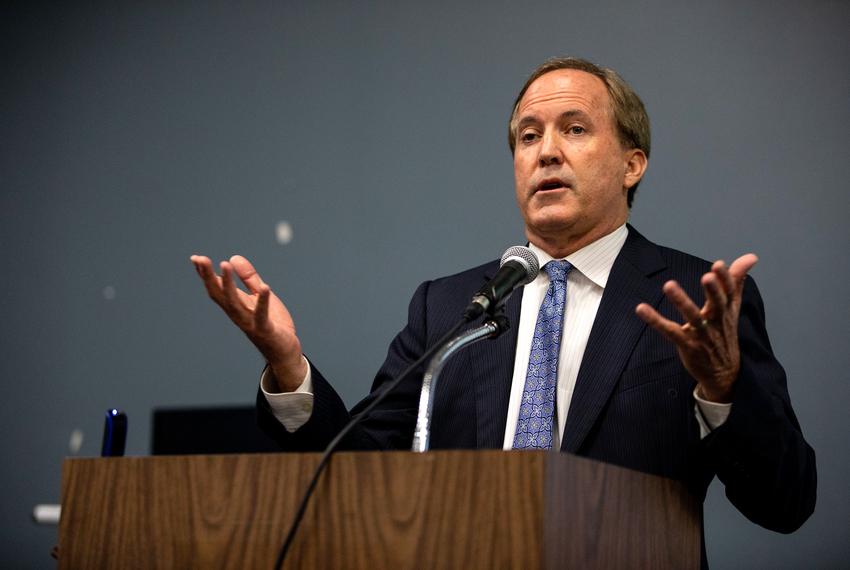
Attorney General Ken Paxton. Credit: USA TODAY NETWORK via Reuters
Sign up for The Brief, our daily newsletter that keeps readers up to speed on the most essential Texas news.
Texas is worried it could lose over a billion dollars in federal funding over Gov. Greg Abbott’s directive requiring medical professionals to report transgender children receiving gender-affirming health care as potential child abuse.
Texas Attorney General Ken Paxton amended an existing lawsuit suing the Biden administration Wednesday, attempting to void guidance issued by the U.S. Health and Human Services on March 2 that said restricting someone’s ability to receive medical care solely on the basis of their sex assigned at birth or gender identity is likely a violation of the Affordable Care Act for federally funded entities. That federal guidance came in response to Abbott’s directive issued late last month to treat certain medical treatments for trans children as possible crimes to be investigated by the Department of Family and Protective Services.
The federal guidance stated that health care providers do not need to disclose private patient information regarding gender-affirming care and that it is illegal to deny health care based on gender identity.
Paxton, in the lawsuit, said that guidance is based on “erroneous interpretation of sex discrimination.” The lawsuit says Texas does not aim to deny health care based on gender identity. Instead, the state argues its investigations disregard gender entirely, barring all children from “unnecessary medical interventions.”
In 2020, $1.36 billion in federal funds went to Texas’ Department of State Health Services, Paxton said in the lawsuit. More than $26 billion went to the State’s Health and Human Services Commission.
Before Abbott issued his directive essentially equating gender-affirming care to child abuse, Paxton issued a nonbinding legal opinion stating that health care treatments such as puberty blockers, prescription medicines whose effects are entirely reversible, constitute child abuse as well. These statements elicited intense criticism from the White House, doctors, lawmakers and advocacy organizations.
So far, the state has begun five investigations into parents of trans children since Abbott issued his directive Feb. 22. However, there may be more cases as the state declined to disclose active investigations amid pending litigation.
Paxton attempted to stop a ruling temporarily blocking the state from investigating the family of a trans child. But a Texas appeal court denied him Wednesday. On Friday, lawyers for the American Civil Liberties Union and Lambda Legal will ask a lower court judge to stop state investigations against parents who obtain gender-reaffirming care for their children.
The Élysée Palace released images of French President Macron after his call with Putin today, regarding the invasion of Ukraine. 🇫🇷🇷🇺🇺🇦 pic.twitter.com/I1uOgNMuma