The link Ten Grain has is a gift link which allows you to read the WaPo article. When I try to post them people hit the paywall. So please go enjoy the meme Ten Grain posted and follow the link. Hugs. Scottie
I have followed this young man for a while. He is easy to watch, for those of my viewers who like trimmed up well groomed people this young man fits the bill. His eyes are clear, his hair is nice and short, and his face hair is very well groomed and short. Personally I find him cute. But hey I am a 60-year-old gay guy crippled and today using a walker, a lot of young people are cute to me. Of both genders, young people just have an energy about / around them that somehow we lose as we age.
While this is a wonderfully great break down of the falsehoods of Christian nationalism and those who push it, complete with the background behind it. I caution that while the video has very high production values, is very well cc’d, the young man talks rather fast with a lot of information in each sentence. He puts thought into his presentations and the script he uses. But maybe I have been in slower talking territory too long, or I simply am getting older but I find that to get the full benefit of what he is saying I have to pay complete attention to the video, not doing other things while watching it like I normally do with other YouTubers. Most of the time I listen / watch a YouTube video on one screen while blogging on the other and I catch almost everything from each. I don’t know if it is my medications, my pain level, or what but today I had to stop everything else and just watch the 28:45 minute video. I was glad I did. If you wonder at the roots of Christian nationalism and the goal of it, please watch this 30-minute video. Hugs. Scottie
It’s been called “the greatest threat to religious freedom” in the country’s history. We have elected officials openly calling themselves christian nationalists. So…what exactly is it?
These false claims have a political purpose. In 2022, Barton traveled around the country on behalf of an organization called Faith Wins, working to mobilize Christian voters heading into the midterm elections by telling them that, according to the Bible, they were responsible for choosing our elected leaders.
An example of the sort of disinformation Barton peddled was on display when he spoke at Radiant Church in Colorado last September. During his presentation, Barton falsely asserted that jurist James Kent set up federal circuit courts and that the concept of circuit courts was rooted in 1 Samuel 7:15-16. That passages reads, “Samuel continued as Israel’s leader all the days of his life. From year to year he went on a circuit from Bethel to Gilgal to Mizpah, judging Israel.”
“James Kent, he’s known as the father of American jurisprudence,” Barton said. “He’s one of the two guys who helped set up the American judicial system. And when he set it up, he set it up with circuit courts. … Back at the beginning, when we had the original Supreme Court justices, they got on their horse, and they rode from town to town and from state to state to have court meetings.”
“And so we have this concept of circuit judges set up, and the guy who set it up said, ‘Well, we got it out of 1 Samuel 7:15-16,’” Barton continued. “It says that Samuel judged Israel, and Samuel rode the circuit. [Kent] said that if that’s the way the Bible does judges, then that’s a good way for us to do judges too.”
We had heard Barton make this claim multiple times before, but didn’t realize how wrong Barton was until we recently read the book, “John Jay: Founding Father,” by Walter Stahr. Jay served as the very first chief justice of the Supreme Court, a position to which he was nominated by President George Washington in 1789 on the same day that Washington signed the Judiciary Act of 1789, which created the federal court system.
As explicitly laid out in the Judiciary Act of 1789, Jay and his colleagues were required to travel among the 13 circuit courts established throughout the nation and hear cases in conjunction with local district judges.
While Kent was an acclaimed jurist in the Founding Era, he played no role in crafting this legislation, establishing circuit courts, or in helping to “set up the American judicial system.” In fact, Kent never even served in Congress, and the Judiciary Act of 1789, which laid out the concept of circuit courts, was drafted by Sen. Oliver Ellsworth of Connecticut.
Barton, of course, provided no evidence to support his claim regarding Kent’s supposed biblical inspiration for creating circuit courts during his presentation. But when Barton made this same false claim in his 2012 book, “The Founder’s Bible,” he cited “The Memoirs and Letters of James Kent.” Predictably, if one actually checks Kent’s memoirs, all that is found is an undated passage in Kent’s diary noting that “the Jewish judges rode the circuits” along with the quote from 1 Samuel.
This is, once again, an example of Barton exploiting the biblical and historical ignorance of his own audiences to feed them a false narrative regarding the founding of this nation that serves primarily to promote his own modern-day right-wing political agenda.
We need your help. Every day, Right Wing Watch exposes extremism to help the public, activists, and journalists understand the strategies and tactics of anti-democratic forces—and respond to an increasingly aggressive and authoritarian far-right movement. The threat is growing, but our resources are not. Any size contribution—or a small monthly donation—will help us continue our work and become more effective at disrupting the ideologies, people, and organizations that threaten our freedom and democracy. Please make an investment in Right Wing Watch’s defense of the values we share.
When the Family Research Council held its annual “Pray, Vote, Stand” summit last week, Christian nationalist pseudo-historian David Barton was given a prime speaking slot, along with dozens of right-wing pastors, activists, commentators, and members of Congress.
While introducing Barton, FRC’s president Tony Perkins declared that what critics deride as Christian nationalism is simply true American history, and he credited Barton for having “done more than anyone else to help Americans, and Christians in particular, to know their history”—a history that Perkins claimed has intentionally been “hidden” by mainstream historians.
Perkins is correct in noting that nobody has been as influential as Barton in convincing millions of Americans that the United States was founded to be an explicitly Christian nation. And that is a problem, given that Barton’s misuse and misrepresentation of both American history and theBiblehave beenwell-documented.
Barton’s willingness to misrepresent history and scripture to promote his right-wing political agenda was on display when he spoke at Calvary Church in Moline, Illinois, last Wednesday as part of the Faith Wins voter mobilization effort.
One of Barton’s favorite methods of convincing his audience that America was founded as a Christian nation is to assert that Americans of the founding era were so deeply knowledgeable about the Bible that they referenced it continuously in their writings and speeches. The problem today, Barton insists, is that modern Christians are ignorant of both history and scripture and are thus incapable of recognizing the fact that our founding documents are chock-full of Bible quotes.
The irony of this assertion is that it relies on the very ignorance Barton decries in order to be effective, as anyone willing to look into the claims Barton makes will inevitably find that he is lying.
While speaking at Calvary Church, Barton trotted out a new example of this technique, when he claimed that first- and second-grade students attending public schools in New Jersey in the early 1800s were required to memorize large portions of the Bible as part of their curriculum.
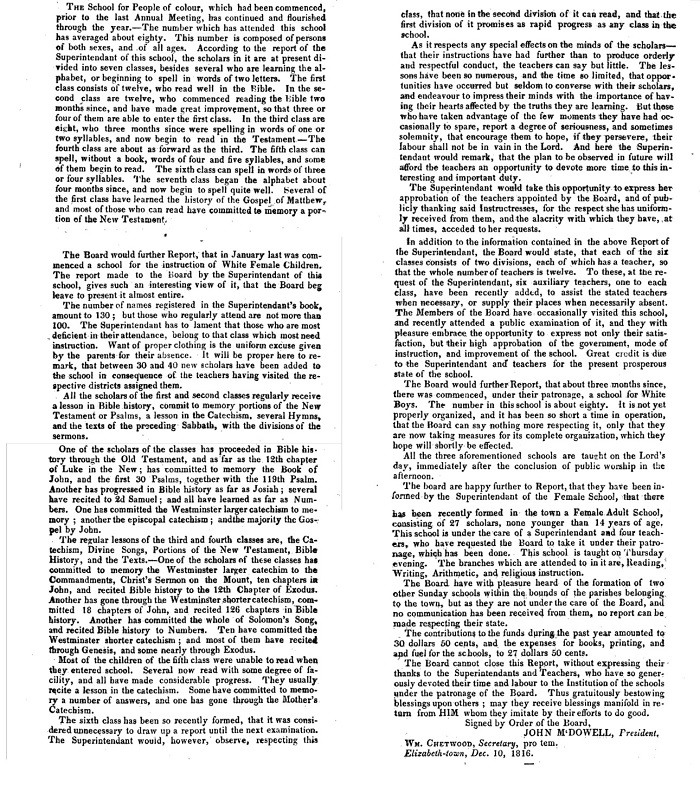
It’s interesting to go back in those early records and see what was being taught in the schools. For example, let me take you to some early schools. I want to take in New Jersey. And in this case, I’m just going to choose 1816 [in] New Jersey. They’re going to show you what happens with first- and second-graders in New Jersey. Here’s what they say. It says, ‘All the scholars of the first and second classes commit to memory portions of the New Testament or Psalms, a lesson of the Catechism, several hymns, and the text of the preceding Sabbath.’ Everybody in public school in New Jersey, if you’re in first and second grade, this is what you’re getting memorize. And by the way, what are the texts of the preceding Sabbath? That means whatever Pastor Tim talked about on Sunday, we’re going to memorize those Bible verses; so whatever verses he referenced, we’re going to memorize. A public school is doing this? Yes, absolutely. This is what public schools did.
As we all know, some kids are sharper than other kids, and they talked about one of the kids that was really sharp. They said, ‘One of the scholars has committed to memory the Book of John, and the first 30 Psalms, together with 119th Psalm.’ A [student] in first and second grade memorized the Gospel of John, 30 Psalms, and Psalm 119. He was really sharp. The rest of the kids weren’t quite so sharp. Here’s what it said about the rest of them, ‘The majority have committed to memory the Gospel of John.’ The average kid has memorized the Gospel of John. Everybody does that in first and second grade, but we got one kid that added 30 chapters out of Psalms and Psalm 119. Really? Common for first and second grade is everybody memorizes the Gospel of John? Maybe one in 1,000 Christians today has memorized the Gospel of John, and that was first and second grade stuff back then.
Thanks to the quotations Barton cited, we were able to track down the document he used in making this claim. It was a report from the board of directors of the Free School Association of Elizabeth-Town published in a periodical called The Christian Herald and, predictably, Barton was blatantly misrepresenting it.
The first thing one notices upon reading the report is that the reference to “the scholars of the first and second classes” does not refer to what today would be called first and second graders. The report explicitly states students are “divided into seven classes” based upon their reading and writing abilities and that “most of the children in the fifth class were unable to read when they entered school.”
It is unlikely that first- and second-graders were memorizing entire books of the Bible, as Barton claimed, while fifth-graders were unable to read.
But more importantly, the document further reveals that this was not a public school at all, as Barton claimed, but rather a Sunday school.
As it notes, the students were “taught on the Lord’s day, immediately after the conclusion of public worship in the afternoon.”
In fact, the document itself confirms that these students were enrolled in Sunday school when it notes the existence of “two other Sunday schools” that were not under the board’s control.
As author James J. Gigantino II explained in his book, “The Ragged Road to Abolition: Slavery and Freedom in New Jersey, 1775-1865,” the Free School Association of Elizabeth-Town grew out of the so-called “Sabbath school” movement, in which “schools sponsored by churches and private donors took over black education and continued white paternalistic control over it. These schools were led by white teachers and administrators, focused primarily on reading, writing, and basic mathematics, and taught biblical reading knowledge and prayer to instill religious and moral lessons in their students.”
From “Church of the Founding Fathers of New Jersey: A History,” a book chronicling the history of the First Presbyterian Church Elizabeth, it is clear that these were indeed Sunday schools set up by Rev. John McDowell, the author of the document that Barton cited.
One of the great and enduring achievements of the church during John McDowell’s ministry was the founding of the Sunday School. The first Sunday Schools in America were founded about 1805 in Boston and Philadelphia. The movement spread rapidly to other cities of the country, but not always with success. In many places, the schools were virtually forced upon the church members and the communities, and after a brief trial period, they were abandoned.
Reverend McDowell decided that the idea of founding a Sunday School was good, and used a very cautious approach in establishing the first school in this area. He enlisted the support of his Session, and then contacted Reverend John Churchill Rudd, Rector of St. John’s Church, and Reverend Thomas Morrell, minister of the Methodist Church, to ask their support. Both men became convinced that the purpose of the proposed Sunday School was good, and the three clergymen began to “sound out” their congregations on the idea. The groundwork was laid in 1812 and 1813.
By the spring of 1814, enough parents were convinced that religious training for their children was a desirable thing, so the school was opened, meeting in the Public Academy located on the north-east corner of the church property. Presbyterian, Episcopal, and Methodist children met together, and were taught by the three ministers, at the first sessions. At once the school was a success, and at the end of the first month, it was necessary to open a second school for the Negro children of the town. The colored Sunday School was taught by a student who was studying theology with Reverend McDowell. An organization calling itself the Free School Association of Elizabethtown was set up to handle the administration of the Sunday Schools, with Miss Maria Smith as superintendent.
According to professor John Fea, chair of the History Department at Messiah University and author of “Was America Founded as a Christian Nation?,” a search of American newspapers and periodicals published in the early 1800s “clearly show that this is a Sunday School.”
“This once again shows that Barton fails to understand the larger context of the periods from which he cherry-picks his facts,” Fea told Right Wing Watch. “It would have taken Barton less than an hour, with the historical databases available to professional historians, or even just a search on Google Books, for him to dig up multiple primary sources showing that the ‘Free School Association of Elizabeth-Town’ was, in fact, a Sunday School. In fact, ‘public schools’ as we know them today did not exist in the early decades of the 19th century. This is the kind of sloppy work—void of any concept of context or change over time—that has characterized Barton’s entire career as a Christian Right activist who raids the past for something useful to help him advance his political agenda in the present.”
We need your help. Every day, Right Wing Watch exposes extremism to help the public, activists, and journalists understand the strategies and tactics of anti-democratic forces—and respond to an increasingly aggressive and authoritarian far-right movement. The threat is growing, but our resources are not. Any size contribution—or a small monthly donation—will help us continue our work and become more effective at disrupting the ideologies, people, and organizations that threaten our freedom and democracy. Please make an investment in Right Wing Watch’s defense of the values we share.
Reread the title. How can shooting captives in a prison be justified. If the police / prison guards herded all the prisoners in to a small places and started to mow them down with gun fire, it is about what Israel is doing to Gaza. Hugs. Scottie
Israeli air strikes devastated parts of the Jabalia refugee camp in north Gaza this week, flattening buildings in a densely populated area where, Palestinian authorities say, at least 195 civilians were killed and scores more are still missing.
Israel says the attacks successfully targeted Hamas military leaders, their fighters and the tunnel network they dug beneath civilian areas and used for operations. Israeli Prime Minister Benjamin Netanyahu’s government has pledged to destroy Hamas – the Palestinian Islamic militant group that controls the Gaza Strip – in retaliation for its Oct. 7 attacks on Israel that killed 1,400 people, mostly civilians.
The strikes at the Jabalia camp – the largest of several refugee settlements in Gaza – have fuelled international concern at the mounting humanitarian toll of Israel’s offensive.
In the wake of the first airstrike on Oct. 31, which left deep craters filled with broken concrete and twisted metal in the midst of Jabalia’s tightly packed buildings, the Office of the U.N. Human Rights Commissioner Volker Turk said in a tweeted statement that the scale of the destruction and the high number of civilian casualties aroused “serious concerns that these are disproportionate attacks that could amount to war crimes.”
Turk had previously said on Oct. 7 that he was “shocked and appalled” at the killings of civilians, hostage-taking, and rocket attacks on Israel by Palestinian armed groups.
Hamas gunmen rampaged through Israeli border areas on Oct. 7, in the deadliest day of the nation’s 75-year history. Israel says around 240 people were taken as hostages into Gaza, where they are believed to be held in Hamas’ extensive tunnel network.
*** There is a drawing of the area and the places of strikes and other stuff talked about. I am unable to copy and paste it here. Please go to the link above to see the information. Hugs. Scottie ***
Erez crossing
Jabalia
camp
Refugee
camps
Evacuation
zone border
GAZA
STRIP
ISRAEL
Airstrike
Rafah
crossing
Jabalia camp
Satellite map of the Gaza Strip, showing the eight refugee camps. The Jabalia refugee camp is highlighted and the site of an airstrike within the camp shown.
Israel’s ensuing bombardment of the small Palestinian enclave of 2.3 million people has killed more than 9,000 people, according to health authorities in Gaza. Food and water are scarce, and medical services are collapsing.
At least five other refugee camps in the coastal enclave have been hit during Israel’s ongoing offensive, according to satellite images analysed by Masae Analytics. An Israeli military spokesman did not immediately respond to a request for comment on the images.
The United Nations refugee agency for Palestinians said that schools used as shelters by thousands of people have been damaged in the Jabalia, Beach and Al Bureij camps, and nearly 50 of its buildings and assets have been affected across the 360 sq km Gaza Strip. The U.N. agency said that more than 70 of its staff have been killed.
Israel has held Hamas accountable for the civilian death toll in Gaza, saying that it is using Gazans as human shields. Israeli officials note they have repeatedly warned residents to evacuate northern Gaza in recent days.
Reuters has used satellite images, pictures and videos shot by its journalists in Gaza to piece together an account of this week’s attacks in Jabalia.
GAZA STRIP
3
4
2
6
1
5
Evacuation zone
Beach camp
2
Rafah camp
Jabalia camp
3
1
90,713
2023 Population: 133,326
116,011
Buildings damaged
in refugee camps
as of Oct. 29
0.5 km
N
Maghazi camp
Bureij camp
Khan Younis camp
6
5
4
88,854
46,629
33,255
Maps of six refugee camps in the Gaza Strip, the Rafah, Jabalia, Beach, Khan Younis, Bureij and Maghazi camps. Estimated damage to buildings within each camp is shown. All have significant numbers of damaged buildings.
At 1.4-square kilometres, Jabalia is the largest of eight refugee camps in Gaza and is home to some 116,000 registered refugees, many of whom are dependent on food, medicine and other aid provided by the United Nations Relief and Works Agency for Palestinian Refugees (UNRWA).
The densely packed camp was set up in 1948 to shelter the wave of Palestinians who fled or were driven from their homes amid the fighting that accompanied the creation of the modern state of Israel. Palestinians lament this as the Nakba, or catastrophe. Israel contests that it drove Palestinians away, saying it was attacked by neighbouring Arab states.
The Jabalia camp decades ago evolved from its original temporary tents and huts into a maze of concrete and breeze-block buildings separated by shoulder-width alleyways.
Living conditions are poor: conflict and years of Israeli-led blockade on Hamas-run Gaza have led to high unemployment, poverty, contaminated water and a shortage of building supplies for new homes.
*** Below is a chart / drawing of the area and where the camps are that are being struck. Again it wouldn’t copy over, to see them please go to the link above. Hugs. Scottie ***
Jabalia
camp
Schools and
kindergartens
Hospitals
and clinics
Mosques
Airstrike
250 m
Map of the Jabalia camp with building footprints shown. Buildings which contain schools or kindergartens, hospitals or clinics and mosques are all highlighted. There are many of all categories both within and around the camp. The site of an airstrike within the camp is also shown.
The camp has long been a flashpoint for tensions. Jabalia was where the first Palestinian intifada, or uprising, against Israeli occupation erupted in 1987 after an Israeli truck driver crashed into a vehicle carrying Palestinian workers, some of them from the refugee camp.
Ever since it has been a hotspot. In 2008, Israeli ground forces went into Jabalia when Hamas began firing longer range rockets into Israel, killing more than 60 Palestinians during the military operation.
In 2009, an Israeli air strike killed senior Hamas leader Nizar Rayan and members of his family in an airstrike on his home in the camp.
Reuters live footage at 1224 GMT on Tuesday Oct. 31 showed the first sign of the air strike on the Jabalia refugee camp: the camera shakes and then captures a plume of black smoke rising over northern Gaza. Details in the camera shot – a water tower, minaret, solar panels – matched satellite images of the area and confirmed the blast was in the Jabalia camp.
First reports of the airstrike appeared online around 1235 GMT, a few minutes after the blast was seen in Reuters footage.
Standing at the edge of one of the craters in the wake of the attack, Abdel Kareem Rayan, a resident of the camp, held a paper listing the names of the 15 family members that he said he lost. “They were innocent, just staying (in the camp). What wrong did they do?” he said.
Smoke billows above a building. People and medics rush to the scene of an Israeli attack that hit the Jabalia refugee camp in north Gaza on Wednesday, Nov. 1.
*** There is a video of the bombing and people running with injured people / children while others rush to help. But it wont post here, to see it please go to the web site at the link above. Hugs. Scottie ***
Professor Justin Bronk, Senior Research Fellow for Airpower and Technology at the Royal United Services Institute (RUSI), a defence and security think tank headquartered in London, said that the Reuters images of the Oct. 31 attack showed “multiple sizeable bomb craters.”
Bronk said that, while it was hard to do an exact weapons identification from photographs, the craters were consistent with the Israeli Air Force’s standard guided air-to-surface Joint-Direct Attack Munitions (JDAMs) – specifically GBU-31 2000lb or GBU-32 1000lb JDAMs.
“The primary use for the GBU-31 family of 2000lb JDAMs in U.S. service is for striking relatively deeply buried targets or for demolishing large structures,” he said, adding that U.S.-led coalitions in Iraq and Afghanistan generally tried to use munitions with significantly smaller warheads such as Hellfire missiles or the GBU-38 family of 500lb JDAMs in densely populated areas. “However, these munitions lack the capacity to reliably penetrate and destroy structures several stories underground.”
Israeli defence officials have said aircraft were involved in the attack. A military spokesman did not immediately respond to a request for comment on the munitions used. The Pentagon declined to comment on the assessment.
*** Below is a single image of a complex tool on the orginal post that takes the before of the city and as you move the slider shows you the complete under devestation of that same city now. Hugs. Scottie ***
Oct. 31
Nov. 1
Satellite imagery shows that the location of the strike was near the intersection of Al Mouhawel and Al Almey streets.
Israel’s military said the Oct. 31 attack killed a significant military leader of Hamas: Ibrahim Biari, commander of the Jabalia Battalion and a ringleader of the Oct. 7 attack on Israeli towns and kibbutzim.
Israeli military spokesman Rear Admiral Daniel Hagari said that Biari was also “the dominant leader” of Hamas fighters operating in northern Gaza from a network of tunnels beneath the camp.
“He was killed while situating himself inside the Jabalia Camp – with dozens of additional terrorists around him in the same area – which contains a headquarters and other operational facilities located in buildings within the civilian camp,” Hagari said on Nov. 1.
Hagari said the strike caused the collapse of the tunnels and underground military infrastructure, which in turn brought down additional surface structures.
Hamas spokesman Hazem Qassem denied there was any senior commander present in the camp. Hamas’s armed wing, the Izz ad-Din al-Qassam Brigades, said seven civilian hostages were killed in the strikes on Jabalia, including three foreign passport holders. Reuters was unable to verify that independently.
The second airstrike hit on Wednesday Nov. 1 in the Falouja neighbourhood of Jabalia refugee camp, approximately half a mile from the site of Tuesday’s explosion.
The blast flattened several big apartment buildings. The Interior Ministry in Gaza said the strike had destroyed an entire residential block, which Reuters was unable to confirm.
As the wounded were being carried from the scene on blankets and in the arms of residents and rescue workers, one local man told Reuters he said been praying in a local mosque and had rushed out when he felt the blast. “It is a massacre,” said the man, who did not give his name, as emergency workers tried to free survivors from the rubble by hand.
Israel’s military said the second strike killed Muhammad A’sar, head of Hamas’s anti-tank missile unit.
According to the health ministry and the Hamas government media office, at least 195 people were killed in the two airstrikes on Oct. 31 and Nov. 1, which left 120 missing and more than 700 wounded.
A third Israeli airstrike hit the Jabalia refugee camp on Nov. 2, Reuters reported. The bombardment hit the UNRWA-sponsored Abu Hussein school, where many displaced Gazans were residing, according to eyewitnesses and a statement from the U.N. agency. Injured camp residents were rushed to the Indonesian hospital. Reuters was unable to determine the number of casualties.
Palestinians search for casualties a day after Israeli strikes on houses in Jabalia refugee camp in the northern Gaza Strip, Nov. 1, 2023. REUTERS/Mohammed Al-Masri
Israel said it has so far killed 10 Hamas commanders responsible for planning the Oct. 7 attack. Hamas – designated as a terrorist organisation by the European Union and the United States, among others – called in its 1988 founding charter for the destruction of Israel.
On a visit to Israel on Friday, U.S. Secretary of State Antony Blinken reiterated that Israel has a right to “do everything possible” to ensure that there would be no repetition of the Oct. 7 attack.
But he called called for a humanitarian pause: “It is very important when it comes to protection of civilians who are caught in the crossfire of Hamas’s making, that everything be done to protect them and to bring assistance to those who so desperately need it, who are not in any way responsible for what happened on Oct. 7.”
Speaking shortly after Blinken, Netanyahu said: “We are proceeding with all our might, and Israel refuses any temporary ceasefire that does not include the return of our kidnapped hostages.”
Top photo
A man reacts as Palestinians search for casualties a day after Israeli strikes on houses in Jabalia refugee camp in the northern Gaza Strip, Nov. 1, 2023. REUTERS/Mohammed Al-Masri
Note to analysis
Building damage provided by Masae Analytics change detection analysis based on Copernicus Sentinel-1 data. The analysis uses satellite images to estimate areas within the Gaza Strip affected by bombings since the Israeli campaign began. Analysis is further reviewed for false positives (areas that appear damaged in the analysis, but are not) and false negatives (areas that do not appear damaged, but are) by cross checking with other high resolution satellite imagery, media reports and other sources.
This is 4 years old and I guess the person speaking is from England. But this is a great talk. It covers so much of what I want to say. It explains why the don’t say gay laws that in so many red states are so dangerous and harmful. Please take 13 minutes and 41 seconds to learn about this issue, learn why it is so important to gay kids to see themselves in the surrounding society, and that yes there are gay kids, even young kids that know they are different, know they are gay, and are scared / worried about it that need support with love. I love the question he asks, when was your child too young to learn about being straight? Because from birth all around them kids see straight couples and symbols of being straight in society. The same with gender, the haters say they don’t want the children to be taught gender in schools as they claim it sexualizes them. But society is structured around gender. We learn it from birth with nursery colors, types of toys, and the clothing we are put in. Hugs. Scottie
Can a child be too young to learn about being LGBT? The answer: no child is ever too young. In this humorous and moving talk, Tim Ramsey argues that only when every parent explores about LGBT identities with their child from birth will we address the well being crisis facing LGBT young people.
Tim Ramsey, the founder of award-winning non-profit Just Like Us, grew up believing that being gay was the worst thing he could be. Having come out, Tim launched Just Like Us to change the lives of other LGBT+ school students by empowering young people to challenge prejudice and champion LGBT+ equality at school and work. As the founder of School Diversity Week, the national celebration of LGBT+ equality in education, Tim has involved over 650,000 school students and teachers work to ensure every young person can be themselves and their best at school.
This talk was given at a TEDx event using the TED conference format but independently organized by a local community. Learn more at https://www.ted.com/tedx Can a child be too young to learn about being LGBT? The answer: no child is ever too young. In this humorous and moving talk, Tim Ramsey, Founder of award-winning LGBT non-profit Just Like Us, argues that only when every parent explores about LGBT identities with their child from birth will we address the wellbeing crisis facing LGBT young people. This talk was given at a TEDx event using the TED conference format but independently organized by a local community. Learn more at https://www.ted.com/tedx

By Kyle Mantyla | February 14, 2023 4:28 pm