Typical hypocrite republican business owner and wealthy person. Vote against anything to help the country and then take credit for any good it does while using it to enrich themselves. Hugs. Scottie
Rep. Mike Kelly (R-Pa.) said the Inflation Reduction Act was “loaded with bad policy and wasteful spending.”
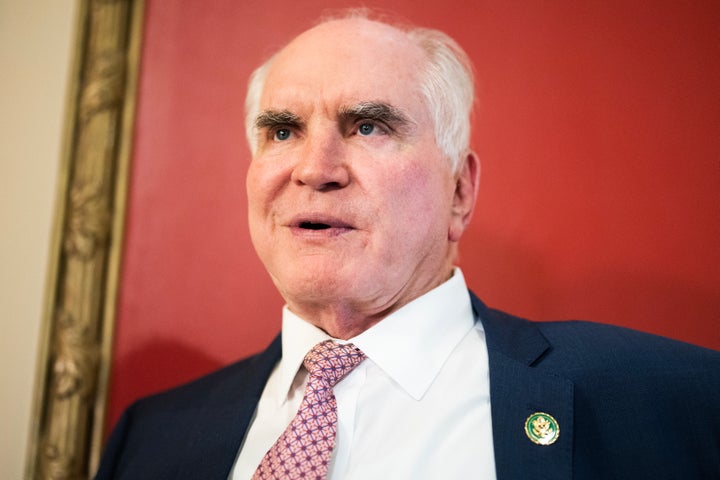
Rep. Mike Kelly (R-Pa.) in the U.S. Capitol on Thursday, Sept. 14, 2023. TOM WILLIAMS VIA GETTY IMAGES
Rep. Mike Kelly (R-Pa.), an outspoken critic of President Joe Biden’s Inflation Reduction Act, used the law to receive a grant to install solar panels at one of his car dealership locations.
The U.S. Department of Agriculture gave a Uniontown dealership owned by Mike Kelly Automotive Group a nearly $315,000 grant to install a 261.9-kilowatt solar panel array, according to the Erie Times-News, the local news outlet that first reported the grant on Monday. The grant is set to save the firm $23,700 per year in energy costs, according to the USDA.
The USDA distributed the grant through its Rural Energy for America Program (REAP). The program has existed since 2018, but the Inflation Reduction Act injected an additional $1 billion into the program dramatically expanding its scope. The federal government then announced that it would distribute that money in grants to rural businesses over the course of 2023 and 2024.
In his official statement following the bill’s passage, Kelly derided the legislation that made those grants possible as the “so-called Inflation Reduction Act,” charging that it was “loaded with bad policy and wasteful spending that will ultimately worsen inflation, expand government, and hurt the middle-class.”
His office singled out the bill’s climate provisions as damaging in bullet points accompanying the statement. “The bill provides $375 billion in so-called ‘climate change’ legislation, which include $7,500 tax credits for wealthy Americans to purchase electric vehicles (EV),” his office said.
Asked how the grant squares with Kelly’s opposition to the IRA, Kelly spokesperson Matt Knoedler referred HuffPost to the statement he provided the Erie Times-News.
“Representative Kelly’s energy policy has always supported an all-of-the-above approach,” Knoedler said. “Additionally, Rep. Kelly does not have an active role in the day-to-day operations of his family’s business.”
In his 2022 financial disclosure, Kelly reported an ownership stake in Mike Kelly Automotive Group worth between $50,001 and $100,000, and a salary from the company of just under $30,000. Kelly also reported a “note receivable” from the company worth between $500,001 and $1 million.
Mike Kelly Toyota, the dealership that got the grant, is located in GOP Rep. Guy Reschenthaler’s district south of the Erie-area seat that Kelly represents.
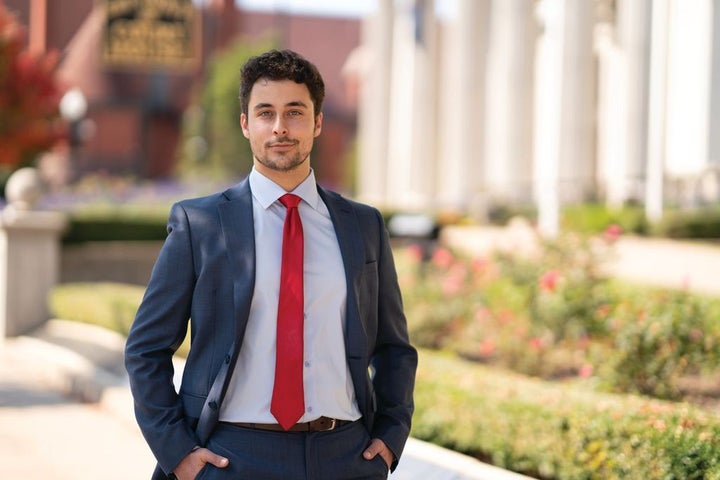
Preston Nouri, Kelly’s Democratic challenger, is calling on him to return the grant money. PRESTON NOURI FOR CONGRESS
Kelly has represented Pennsylvania’s northwestern corner since 2011 and has not faced a close re-election battle since 2018. Former President Donald Trump carried Kelly’s current district, Pennsylvania’s 16th, by nearly 21 percentage points in 2020.
This year, Preston Nouri, a 25-year-old legislative analyst for the Department of Defense, is the Democratic nominee to take on Kelly.
Nouri called on Kelly to return the money his family’s business received. “Mike Kelly shows his true colors once again,” Nouri said in a statement. “For over 13 years, he keeps getting caught with his hand in the cookie jar, taking taxpayer money to enrich himself while working against the interests of the people he’s supposed to represent.”
Kelly already underwent scrutiny for opposing student debt cancellation after accepting nearly $1 million in Paycheck Protection Program loans during the COVID-19 pandemic that were forgiven. “PPP loans are designed to be forgiven,” Kelly posted on X in August 2022. “Student loans are not. Big difference!”
Kelly is also a staunch Trump ally who has advocated for the rights of people arrested during the Jan. 6, 2021, riot at the U.S. Capitol. During a general election debate in 2022, he condemned the alleged mistreatment of Jan. 6 defendants, asking, “Is this America?”
This is my second attempt to post this, as after I started to post it I realized I might be able to use WordPress’s system of block editor against them. I did not mean for the first one to post but in trying to save it for this one it posted. Sorry. Hugs. Scottie
For those that don’t follow or subscribe to the comments on the blog here, you miss out on the grand comments but the wonderful links a few people like Ali leave knowing they help lift my spirits when I am feeling down or when things crash over me. This was one Ali left a few days ago that because I took one of the few very rare days that I stayed in bed rather than be dragged out by pain or nightmares to stay in bed until 8 am this morning. Even was Ron was shocked when he opened his eyes and seen me there. His first response was “Was I OK” as I rarely if ever stay in bed past 5 am. I honestly can not remember the last time I did. He got really worried until I assured him I was fine, but after not sleeping more than a few hours for the last few nights I managed to do so, and even had good dreams. I know most folks don’t remember their dreams, I wish a lot of times I did not, but most of the time I remember mine, sadly the abusive ones are the most vivid and stay with me long after waking up. Anyway here is the wonderful environmental news that Ali sent me. Hugs. Scottie
1 of 6 |
Divers with gloved hands gently nestled the first self-bred corals from the World Coral Conservatory project amongst their cousins in Europe’s largest coral reef at the Burgers’ Zoo in Arnhem, eastern Netherlands, Monday, April 22, 2024. (AP Photo/Peter Dejong)Read More
2 of 6 |
A fish swims in a coral reef as divers with gloved hands gently nestled the first self-bred corals from the World Coral Conservatory project amongst their cousins in Europe’s largest coral reef at the Burgers’ Zoo in Arnhem, eastern Netherlands, Monday, April 22, 2024. (AP Photo/Peter Dejong)Read More
3 of 6 |
Divers with gloved hands gently nestled the first self-bred corals from the World Coral Conservatory project amongst their cousins in Europe’s largest coral reef at the Burgers’ Zoo in Arnhem, eastern Netherlands, Monday, April 22, 2024. (AP Photo/Peter Dejong)Read More
4 of 6 |
Divers with gloved hands gently nestled the first self-bred corals from the World Coral Conservatory project amongst their cousins in Europe’s largest coral reef at the Burgers’ Zoo in Arnhem, eastern Netherlands, Monday, April 22, 2024. (AP Photo/Peter Dejong)Read More
5 of 6 |
Divers with gloved hands gently nestled the first self-bred corals from the World Coral Conservatory project amongst their cousins in Europe’s largest coral reef at the Burgers’ Zoo in Arnhem, eastern Netherlands, Monday, April 22, 2024. (AP Photo/Peter Dejong)Read More
6 of 6 |
Divers with gloved hands gently nestled the first self-bred corals from the World Coral Conservatory project amongst their cousins in Europe’s largest coral reef at the Burgers’ Zoo in Arnhem, eastern Netherlands, Monday, April 22, 2024. (AP Photo/Peter Dejong)Read More
BY MOLLY QUELL
Updated 3:53 AM EDT, April 26, 2024
ARNHEM, Netherlands (AP) — Just like the animals on Noah’s Ark, the corals arrived in a pair.
On Monday, divers with gloved hands gently nestled the self-bred corals from the World Coral Conservatory project among their cousins in Europe’s largest coral reef at the Burgers’ Zoo in the Netherlands.
“This is the first project where we started to keep these corals with a known origin. As we know exactly where they’re coming from, they have the potential to be placed back into the wild. … So it is very important to keep these corals, as it’s going not very well in the wild,” Nienke Klerks, a biologist at the Royal Burgers’ Zoo in Arnhem, told The Associated Press.
It’s among several projects worldwide seeking to address the decline of coral reef populations, which are suffering from bleaching caused by rising sea temperatures. Corals are central to marine ecosystems, and while these projects won’t stem the tide of damage from human-caused climate change, they are seen as part of broader solutions.
The World Coral Conservatory hopes to create a bank of corals in aquariums across Europe that could be used to repopulate wild coral reefs if they succumb to the stress of climate change or pollution.
Along with two zoos in France and the originator of the project — the Monaco Scientific Center — the zoo in the east of the Netherlands took in more than a dozen coral fragments from off the coast of Seychelles in east Africa.
The Dutch zoo has been propagating the corals since 2022, allowing them to grow in a highly regulated environment before they were large enough to join the rest of the reef.
“We test it behind the scenes … what works for these corals. In that way, we know where to place them and how to keep them,” zookeeper Pascal Kik said.
Each diver held up a coral — one that resembled a large mushroom, the other a decorative cookie — to be photographed by reporters before placing them on a ledge near the center of the 8-million-liter (2.1-million-gallon) tank.
Few of the other corals at the zoo come from the wild. They are either shared by other zoos or turned over by Dutch customs officers after being confiscated. Coral poaching is a major threat to coral reefs in parts of Asia.
That would make it difficult to return the corals to the wild. But the team knows exactly where their 14 corals came from, making it more likely they could be successfully reintroduced if needed.
Corals area keystone marine species, according to Mark Eakin, executive secretary for the International Coral Reef Society. Eakin, retired coral monitoring chief at the U.S. National Oceanic and Atmospheric Administration, says that around 25% of marine animals spend some part of their lives dependent on coral reefs.
That makes projects such as the one in Arnhem all the more important to pursue, he said.
“We are in a situation where we really need to be taking any possible action we can,” Eakin told AP.
Earlier in April, scientists from the NOAA and International Coral Reef Initiative said that coral reefs around the world are experiencing global bleaching for the fourth time.
Bleaching occurs when coral under stress expels the algae that gives them their vibrant colors. The algae is also a coral’s food source, and if the bleaching lasts for too long or is too severe, the coral could die.
Terry Hughes of Australia’s James Cook University, an expert on the Great Barrier Reef, argues that the world needs faster, bolder efforts to stop the damage from climate change, instead of small-scale restoration projects like this one.
“You can’t replace a magnificent ecosystem with an aquarium,” he said.
Others say every little bit helps.
“Coral reefs would be one of the first systems to totally collapse due to climate change,’’ said Ronald Osinga, a marine biologist who specializes in corals at Wageningen University in the Netherlands.
“It’s sad that it has to be like this,” said Osinga, who is not involved in the Dutch zoo initiative. But projects like this are a “good backup plan.”
The Rev has a wonderful way to think of being trans. In order to be the person god wanted me to become, I must let go of what I was. Or he rephrased, to be who god created me to be, I must leave / change who I was. What a compassionate Christian man, a good person. Hugs. Scottie
This may be one of the best short videos from a religious leader on why some people get stuff wrong when reading the bible. He explains how the bible shouldn’t be taken literally because it was first oral stories, then written down in one language, then translated over and over, often by people who did not get the exact word means correct. He talks about the wrong idea the bible says life begins at conception. Well worth the listening to even if you are not religious. Hugs. Scottie
It is a case of I don’t want my child to read these books so your child can’t read them either. These people want control over everyone, every child, they demand to rule your life. Hugs. Scottie
Hundreds of new books featuring characters of color and LGBTQ+ themes were found by the trash at a Staten Island elementary school, outraging some parents and sparking an education department investigation.
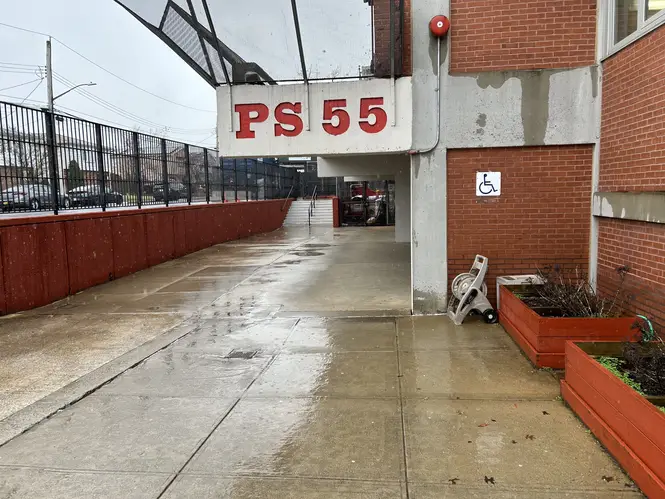
Gothamist obtained photos from a Brooklyn book lover that showed boxes of kids’ books left with the garbage at PS 55, known as the Henry Boehm School. Some had sticky notes on them detailing themes and content in the books, which appeared to be part of a 2019 initiative to diversify school materials. The city education department launched an investigation after Gothamist shared the images.
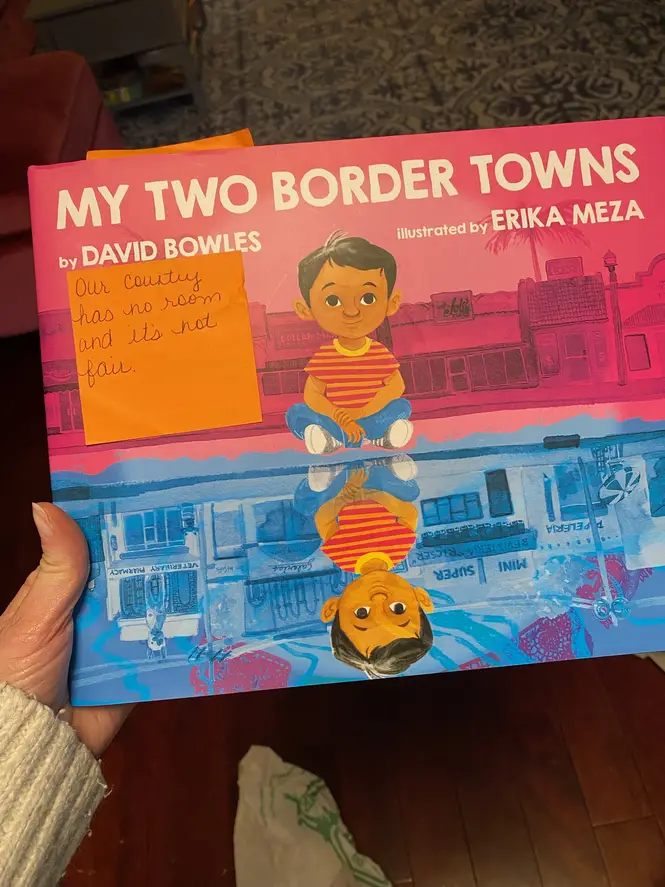
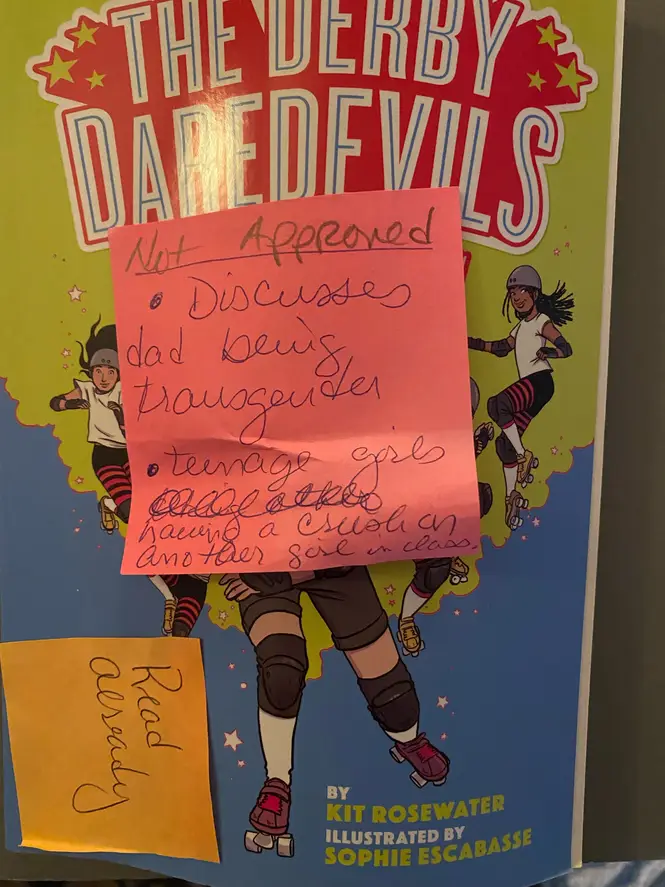
A note on “My Two Border Towns,” about a boy’s life on the United States-Mexico border, read “Our country has no room and it’s not fair.” A note on “The Derby Daredevils,” about a girls’ roller derby team, read “Not approved. Discusses dad being transgender. Teenage girls having a crush on another girl in class.” And a note on “We Are Still Here! Native American Truths Everyone Should Know” read “negative slant on white people.”
A note on a copy of “My Two Border Towns” taken from the school reads “Our country has no room and it’s not fair.”
Holly Spiegel
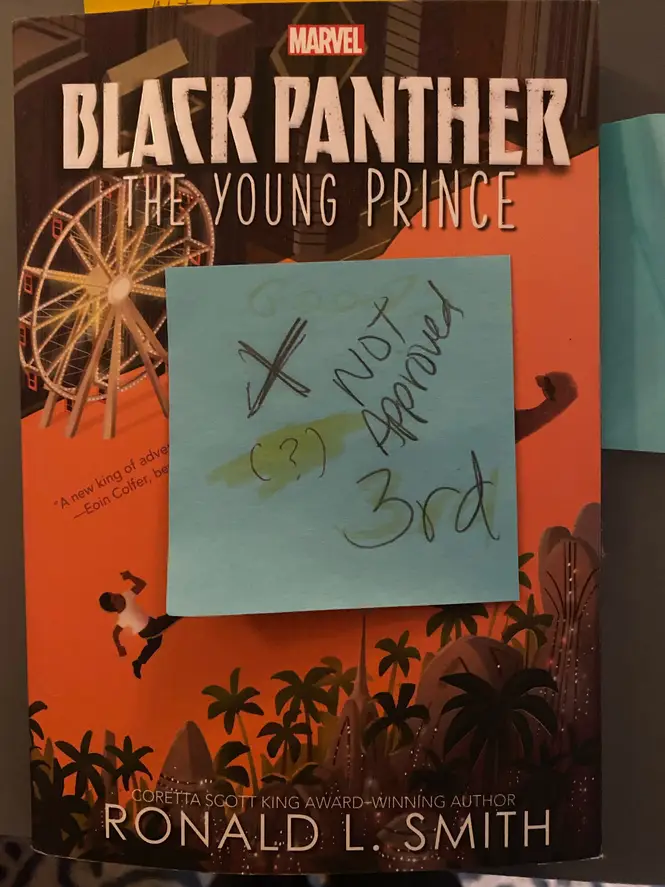
Even books about the Marvel Comics hero Black Panther and legendary singer and activist Nina Simone were discarded.
It was unclear whether the removal of the books resulted from an objection raised by staff or parents. The education department said no formal challenge to the books was raised through official channels, though a part-time librarian had inquired about the process.
Until this incident, New York City had seemed largely immune from the high-profile efforts to ban books that are roiling school communities in Florida, New Jersey and other parts of the country.
“Our public schools do not shy away from books that teach students about the diverse people and communities that make up the fabric of our society,” education department spokesperson Nicole Brownstein said, noting the removal of the books was not sanctioned.
The school principal and PTA president did not respond to inquiries.
Many PS 55 parents were surprised to learn the books had been removed.
The education department said it was investigating why the books were discarded from the PS 55 library.
Jessica Gould
“I don’t believe in banning books at all,” said Angela Hartje, whose daughter is in third grade.
“It’s one step closer to ‘Fahrenheit 451,’” she added, referencing the classic sci-fi novel by Ray Bradbury about a dystopian America where books have been outlawed.
‘Not approved’
Holly Spiegel, of East Flatbush, alerted Gothamist to the controversy. Her neighbor, who was working near the school in November, retrieved hundreds of the books from the trash and gave them to Spiegel, knowing she could use them for the free “Little Libraries” she manages around their neighborhood. Spiegel then got in touch with the school and made two additional trips where she recovered hundreds more books in boxes marked “not approved.”
Sticky notes on the books pointed to apparent reasons why they were censored. A note on “Julian Is A Mermaid,” about a boy who dresses as a mermaid, read “Boy questions gender.” A post-it on “Chester Nez and the Unbreakable Code: A Navajo Code Talker’s Story,” cited a specific page, along with the question “white man’s world?”
A copy of “Derby Daredevils” had a note reading “Not approved. Discusses being transgender. Teenage girls having a crush on another girl in class.”
Holly Spiegel
Notes on pages of “Black Panther: The Young Prince” read “Witchcraft? Human skulls” and “Pact with Devil. Burned in fire.”
A note on “Nina: A Story of Nina Simone” read “This is about how black people were treated poorly but overcame it. (Can go both ways).”
“At its heart, this feels like censorship,” Spiegel said. “It feels like book banning.”
City statistics show the student body at PS 55 is 78% white, 11% Hispanic and 8% Asian. The teachers are 92% white.
Two parents at the school, located in Staten Island’s Eltingville neighborhood, said they had heard rumblings about some controversy over books. But Gothamist was unable to confirm who led the effort that led to the books being tossed.
An unusual book battle
School controversies over books are rare in New York City. Since 2019, there have been only three challenges of books at other schools under an official protocol that involves the formation of a committee of parents, librarians, teachers and administrators, the education department confirmed. None of those books were removed.
“Should a parent feel concerned about the literature in their child’s classroom, they are encouraged to reach out to the teacher, principal, or superintendent,” said Brownstein, the department’s spokesperson.
It’s more common for discussions in the city to focus on ensuring access to the materials. The Brooklyn Public Library runs a program where local students talk about controversial books with students in other parts of the country where they’re actually being banned.
Alissa Barakakos, a PTA member at PS 55, said she was surprised that books about race, culture and sexuality had been removed — and that she would have opposed the effort if she’d known about it. She noted her son’s class just finished a series of discussions on Black History Month, and a unit on Native Americans.
“I don’t know why the books would be thrown out,” Barakakos said. “I want my kid to be a part of the school community where everything is open and honest and kids are being educated.”
Spiegel said she was upset to see the books were kept from children. “The books aren’t getting into the hands of kids who would identify with the characters, but they’re also not getting into the hands of kids whose worldview would be broadened by reading about people who aren’t like them,” she said.
‘Mosaic’ problems
Some of the boxes Spiegel retrieved were labeled “Mosaic,” the name of a $200 million initiative launched late in the de Blasio administration to diversify school lessons and materials. An analysis by the New York City Coalition for Educational Justice found in 2019 that only 16% of elementary and middle school books were by authors of color.
“Black Panther: The Young Prince” was also removed from the Staten Island elementary school.
Holly Spiegel
De Blasio called for a total rethinking of the K-12 curriculum with an eye toward diversity. Mayor Eric Adams then scaled back the Mosaic plan, launching his own literacy initiative and supplementing lessons with materials reflecting LGBTQ+, Asian American and Black communities.
Thousands of Mosaic books were still sent to school and classroom libraries. But Natasha Capers, the director of the Coalition for Educational Justice, said schools received little guidance about what to do with the new books.
“They just were like, ‘here’s a big box of books,’” said Capers, whose group advocates for more equity in public schools.
She added that she was glad to know the books found with the garbage at PS 55 were “rescued.” But she said she was outraged to hear they had nearly been discarded.
“I watched my children throughout their schooling read so many books that used horrific language about Black people,” Capers said. “There’s a book [that] used the N-word. You just had to suck it up because it’s part of the ‘canon.'”
She scoffed at the apparent discomfort with witchcraft and human skulls in the Black Panther book.
“You read Shakespeare, and [“Macbeth”] starts out with three witches around a cauldron,” she said. “Hamlet,” she noted, “is legitimately talking to a skull.”
Tagged
BOOKS
EDUCATION
STATEN ISLAND
Jessica Gould
Jessica is the education reporter for WNYC and Gothamist. During the Covid-19 pandemic, Jessica reported on the shutdown and reopening of the nation’s largest school system, highlighting the unprecedented impacts on learning, health and mental health for students, staff and families. Got a tip? Email jgould@nypublicradio.org