There are comments at the link above. I am sorry but I am too heart sick over the cruelty and inhumanity of one group of people to another. Jerry / Rawgod has been posting of the atrocities of the governments / religious groups that stole kids from their parents and abused them horribly to civilize them, He reported on the beating death of a black man whose family still fights for justice, on The Majority Report they just played a clip of Matt Walsh saying the colonization and killing of native populations was a good thing that white people should celebrate because they made everything better … for the white people, I have memories in my head of people who took enjoyment in hearing me cry both in sadness and crying out in pain. I can’t any more today. I am sorry I can’t. Religious people demanding the death and wiping from society of people like me, removing the protections for gay / lesbian / trans kids to return to a time when their lives in school were hell and fear. WHAT THE FUCK IS WRONG WITH HUMANS! Maybe it is time that humans move aside on the planet! We don’t deserve to be here. Hugs
They did this with Biden on the way! They are not using restraint and they don’t plan to. This is a war crime, just as when Russia did it. This has become a genocide! And if the US and Biden agree and sign on to this in any way, the stain is on the US also. Angry angry hugs. Scottie
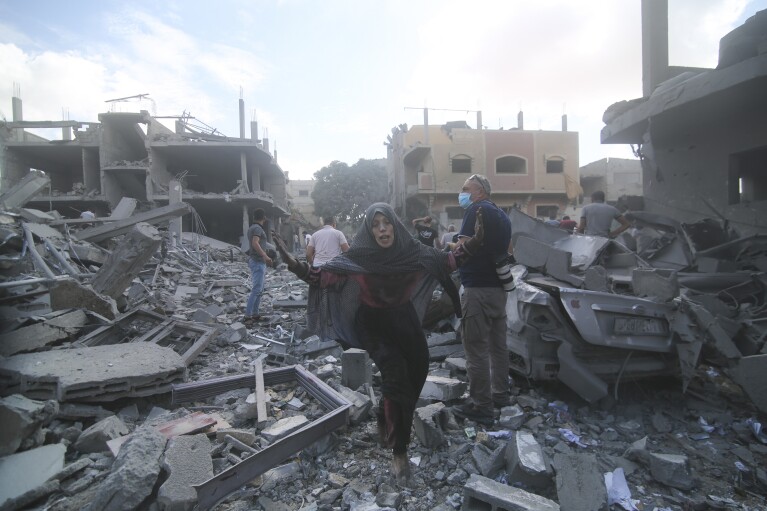
Palestinians evacuate wounded from a building destroyed in Israeli bombardment in Rafah refugee camp in Gaza Strip on Tuesday, Oct. 17, 2023. (AP Photo/Fatima Shbair)
BY NAJIB JOBAIN, SAMYA KULLAB, RAVI NESSMAN AND MATTHEW LEE
Updated 2:15 PM EDT, October 17, 2023
KHAN YOUNIS, Gaza Strip (AP) — The Health Ministry run by Hamas said an Israeli airstrike on Tuesday hit a Gaza City hospital packed with wounded and other Palestinians seeking shelter, killing hundreds. If confirmed, the attack would be by far the deadliest Israeli airstrike in five wars fought since 2008.
The health ministry, which is run by Hamas, said at least 500 people had been killed. Photos purportedly from al-Ahli Hospital shared widely on social video showed fire engulfing the building, widespread damage and bodies scattered in the wreckage. The photos could not be independently verified.
Several hospitals in Gaza City have become refuges for hundreds of people, hoping they would be spared bombardment after Israel ordered all residents of the city and surrounding areas to evacuate to the southern Gaza Strip.
Hamas, which sparked the latest war with an attack last week that killed more than 1,400 Israelis, called Tuesday’s hospital strike “a horrific massacre.” It said in a statement that most of the casualties were displaced families, patients, children and women.
Israeli military spokesman Rear Adm. Daniel Hagari said there were still no details on the hospital deaths: “We will get the details and update the public. I don’t know to say whether it was an Israeli air strike.”
In the south, Israeli airstrikes killed dozens of civilians and at least one senior Hamas figure Tuesday as U.S. officials worked to convince Israel to allow delivery of supplies to desperate civilians, aid groups and hospitals after days of failed hopes for an opening in the siege.
With Israel barring entry of water, fuel and food into Gaza since Hamas’ brutal attack last week, U.S. Secretary of State Antony Blinken secured an agreement with Israeli Prime Minister Benjamin Netanyahu to discuss creation of a mechanism for delivering aid to the territory’s 2.3 million people. U.S. officials said the gain might appear modest, but stressed that it was a significant step forward.
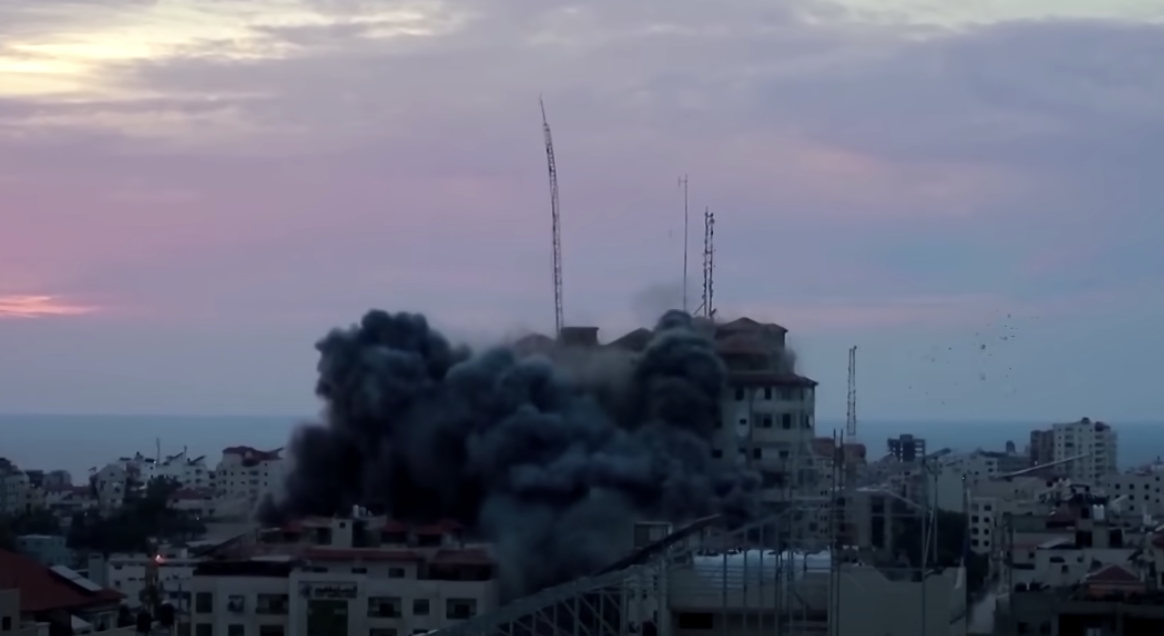
Smoke rises following an Israeli airstrike in Rafah, southern Gaza Strip, Tuesday, Oct. 17, 2023. (AP Photo/Hatem Ali)
Still, as of late Tuesday, there was no deal in place. A top Israeli official said Tuesday his country was demanding guarantees that Hamas militants would not seize any aid deliveries. Tzahi Hanegbi, head of Israel’s National Security Council, suggested entry of aid also depended on the return of hostages held by Hamas.
“The return of the hostages, which is sacred in our eyes, is a key component in any humanitarian efforts,” he told reporters, without elaborating whether Israel was demanding the release of all of the roughly 200 people Hamas abducted before allowing supplies in.
U.S. President Joe Biden prepared to head to the region as he and other world leaders tried to prevent the war from sparking a broader regional conflict. Violence flared Tuesday along Israel’s border with Lebanon, where Iranian-backed Hezbollah militants operate.
With tens of thousands of troops massed along the border, Israel has been expected to launch a ground invasion into Gaza — but plans remained uncertain.
Palestinians flee Israeli bombardment of Rafah, southern Gaza Strip, Tuesday, Oct. 17, 2023. (AP Photo/Hatem Ali)
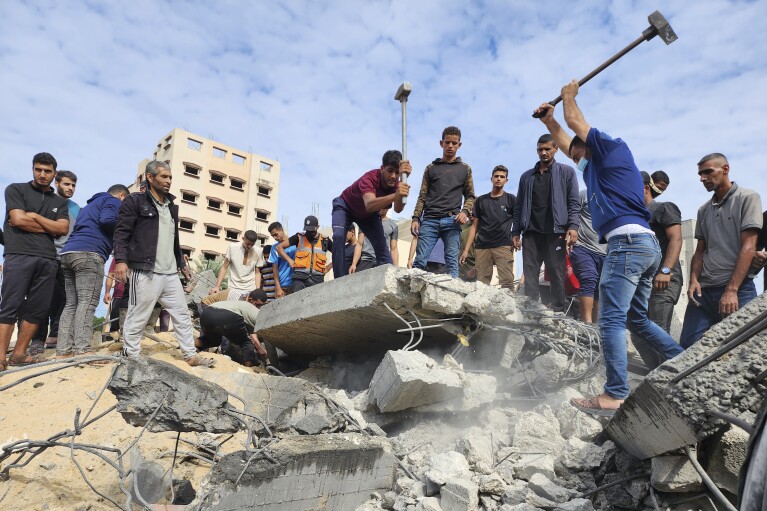
Palestinians look for survivors in buildings destroyed by Israeli airstrikes in Deir el-Balah, southern Gaza Strip, Tuesday, Oct. 17, 2023. (AP Photo/Hassan Eslaiah)
“We are preparing for the next stages of war,” military spokesman Lt. Col. Richard Hecht said. “We haven’t said what they will be. Everybody’s talking about a ground offensive. It might be something different.”
In Gaza, dozens of injured were rushed to hospitals after heavy attacks outside the southern cities of Rafah and Khan Younis, residents reported. Bassem Naim, a senior Hamas official and former health minister, reported 27 people were killed in Rafah and 30 in Khan Younis.
An Associated Press reporter saw around 50 bodies brought to Nasser Hospital in Khan Younis. Family members came to claim the bodies, wrapped in white bedsheets, some soaked in blood.
An airstrike in Deir al Balah reduced a house to rubble, killing a man and 11 women and children inside and in a neighboring house, some of whom had evacuated from Gaza City. Witnesses said there was no warning before the strike.
Shelling from Israeli tanks hit a U.N. school in central Gaza where 4,000 Palestinians had taken refuge, killing six people and wounding dozens, the United Nations Palestinian refugee agencysaid. At least 24 U.N. installations have been hit the past week, killing at least 14 of the agency’s staff.
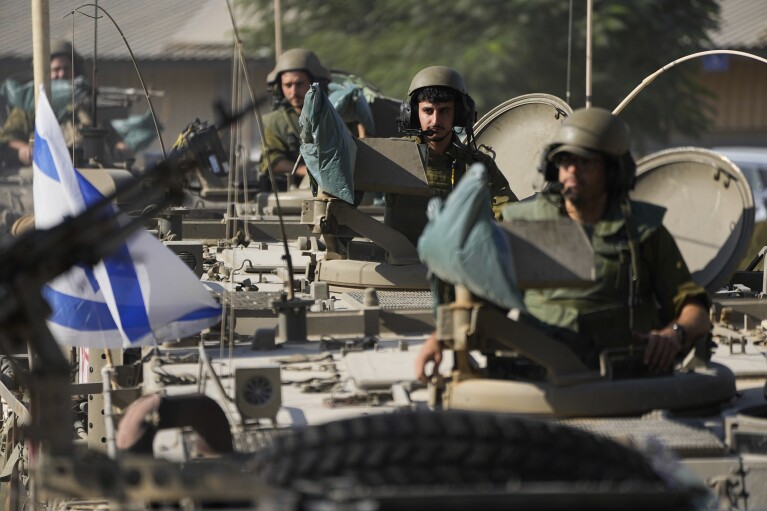
Israeli soldiers gather in a staging area near the border with Gaza Strip, in southern Israel Tuesday, Oct. 17, 2023. (AP Photo/Ariel Schalit)
Mourners gather around the five coffins of the Kotz family during their funeral in Gan Yavne, Israel, Tuesday, Oct. 17, 2023. (AP Photo/Ohad Zwigenberg)
The Israeli military said it was targeting Hamas hideouts, infrastructure and command centers.
A barrage of strikes crashed into the Bureij refugee camp in central Gaza, leveling an entire block of homes and causing dozens of casualties among families inside, residents said. Among those killed was one of Hamas’ top military commanders, Ayman Nofal, the group’s military wing said — the most high-profile militant known to have been killed so far in the war.
Nofal, formerly the intelligence chief of Hamas’ armed wing, was in charge of Hamas militant activities in the central Gaza Strip, including coordinating activities with other militant groups.
Netanyahu sought to put the blame on Hamas for Israel’s retaliatory attacks and the rising civilian casualties in Gaza. “Not only is it targeting and murdering civilians with unprecedented savagery, it’s hiding behind civilians,” he said.
In Gaza City, Israeli airstrikes also hit the house of Hamas’ top political official, Ismail Haniyeh, killing at least 14 people. Haniyeh is based in Doha, Qatar, but his family lives in Gaza City. The Hamas media office did not immediately identify those killed.
Israel sealed off Gaza after the Oct. 7 Hamas attack on southern Israel that killed over 1,400 people, mostly civilians, and resulted in some 200 taken captive into Gaza. Hamas militants in Gaza have launched rockets every day since, aiming at cities across Israel.
Israeli strikes on Gaza have killed at least 2,778 people and wounded 9,700, according to the Gaza Health Ministry. Nearly two-thirds of those killed were children, a ministry official said.
Aid workers warned that the territory was near complete collapse. Hospitals were on the verge of losing electricity, threatening the lives of thousands of patients, and hundreds of thousands of people searched for bread and water.
The U.N. agency for Palestinians said more than 400,000 displaced people are crowded into schools and other facilities in the south. The agency said it has only 1 liter of water a day for each of its staff members trapped in the territory.
Israel opened a water line into the south for three hours that benefitted only 14 percent of Gaza’s population, the U.N. said.
At the Rafah crossing, Gaza’s only connection to Egypt, truckloads of aid were waiting to enter. The World Food Program said that it had more than 300 tons of food waiting to cross into Gaza.
Civilians with foreign citizenship — many of them Palestinians with dual nationalities — also waited in Rafah, desperate to get out.
“We come to the border crossing hoping that it will open, but so far there is no information,” said Jameel Abdullah, a Swedish citizen.
Repeated reports that an opening was imminent have proven false as negotiations continued to grind on, including the U.S., Israel and Egypt.
A senior Egyptian official called it a “very tough, complicated back-and-forth process” and said talks were over deliveries through Rafah and Israel’s Karam Shalom crossing to Gaza. He said Israel was insisting to search all aid, and wants to “ensure that such aid won’t benefit Hamas.” He said Egypt proposed that the U.N. oversee the whole process, including inside Gaza. The official spoke on condition of anonymity because he was not allowed to brief the press on the talks.
Officials for Hamas and Israel cast doubt on an immediate opening, saying they were unaware of an agreement.
Blinken arrived in Israel last Thursday with a full-throated message of unequivocal U.S. support for Israel in its campaign to destroy Hamas. But in meetings with seven Arab leaders over the next three days, Blinken’s tone shifted subtly, talking more prominently about the need for humanitarian aid.
U.S. officials said it had become clear by then that already limited Arab tolerance of Israel’s military operations would evaporate entirely if conditions in Gaza worsened. They said that outright condemnation of Israel by Arab leaders would be a boon to Hamas and could encourage Iran, according to four officials who spoke on condition of anonymity to discuss internal administration thinking. That prompted Blinken to press Netanyahu on an aid deal.
Biden’s visit to Israel Wednesday will signal the White House’s support for a key ally. He will also travel to Jordan to meet with Arab leaders amid fears the fighting could spread in the region.
Israel evacuated towns near its northern border with Lebanon, where the military has exchanged fire repeatedly with Hezbollah militants.
Israel said it killed four militants wearing explosive vests who were attempting to cross into the country from Lebanon on Tuesday morning. No group immediately claimed responsibility.
Iran’s Supreme Leader Ayatollah Ali Khamenei warned that Israel’s continuing offensive in Gaza could cause a violent reaction across the region.
“Bombardments should be immediately stopped. Muslim nations are angry,” Khamenei said, according to state media.
___
Kullab reported from Baghdad. Nessman reported from Jerusalem. Lee reported from Amman. Associated Press journalists Amy Teibel in Jerusalem; Abby Sewell in Beirut; Samy Magdy and Jack Jeffrey in Cairo; and Ashraf Sweilam in el-Arish, Egypt contributed to this report.
Nessman is director of global text for The Associated Press. He has covered major news stories in the United States, Africa, the Middle East and South Asia.
This is one of the more honest videos done on the subject. It shows just how much control Israel has over Gaza and the horrible living conditions Israel has forced the people there to live in. It details with facts the dates that Israeli militants took over the deported over 750,000 Palestinians from their homes and lands so they could steal the land for Israel. Then the video report shows how Israeli settlements have grown in the West Bank, and some are so large they are the size of major cities. This mistreatment is the catalyst for the rage that keeps erupting as a desperate people with no hope, no home state, see everything taken from them as they are abused. Killing of civilians is wrong, but it is just as wrong on both sides. To answer the question of where was the Israeli army, guarding illegal settlements and the settlers who attack and harass Palestinians, destroying their homes, corps, and yes even killing them in an attempt to drive them out. Why because one god says the land is Jewish, another god says the land is Muslim, and no gods are real. Hugs
For decades, Israel has prioritized illegal settlements for Jewish Israelis in the West Bank
In the early hours of Saturday, October 7, Israelis living near the border with Gaza awoke to the sounds of Hamas fighters killing and kidnapping their neighbors. As the hours stretched on and they hid, terrified, their frantic text messages contained versions of this question: Where is the army?
To answer that question, we need to travel to the West Bank.
Watch this video to better understand how Israeli Prime Minister Benjamin Netanyahu’s obsessive focus on the West Bank has left Israelis everywhere vulnerable.
The Rational National points out in his normal reasonable way that holding the view that there is a difference in the worth of a Palestinian child and an Israeli child makes no sense. He also points out many incidents of Israeli soldiers killing Palestinian people, reporters, and children over the last year that received no news coverage. The video is done without sensationalism, which I appreciate. Hugs.
Breaking down the latest from the conflict, including what’s making me go crazy, a good clip from MSNBC, and where major Israeli media is correctly putting the blame.
WTF !!!! This is wealthy Jewish supporters doxing young adult students just for exercising free thought! It is entirely an attempt to stop any expression of support for anything but the Israeli ethnic cleansing of the Gaza Strip. Texas requires teachers to sign a pledge to Israel. It is not being done by Jewish people, it is being done by evangelical Christians to get to their end time. Hugs.
(Special to Informed Comment; Feature) – Over the years, the United States has endowed Israel with more than $150 billion in assistance, making it possible for the Jewish state to maintain its occupation, its ethnic cleansing of the indigenous people of the land, its unremitting seizure of territory, and its settlement project, the latter of which has intentionally and drastically diminished any possibility a fair peace could ever be negotiated between the parties.
Prominent Israelis have referred to Palestinians as donkeys, crocodiles, cockroaches, snakes, psychopaths and serial killers, animals, not human, not entitled to live, shrapnel in the buttocks, they deserve to have their heads chopped off, etc., etc.1 Convinced of the truth of these slurs, Jewish settlers, protected by Israeli soldiers, have made it a practice of entering Palestinian villages where they poison wells, cut down olive trees, physically assault villagers, teach their children to throw stones at Palestinian children coming home from school, and deface buildings, mosques, and churches with slogans such as “Death to the Arabs” and “Jesus is a monkey?”
With its United Nations security council veto, the United States shields Israel from accountability to international law, thereby giving it a green light to continue and even accelerate these crimes against humanity.
Hamas’s October 7 surprise breach of the Israel-Gaza border, followed by its killing, injuring, and hostage-taking of soldiers and civilians is horrifying. American media has been following the tragedy for hours daily and has been overwhelmingly sympathetic to Israel, rarely, if ever, mentioning the motivation behind Hamas’s assault, which are the generations of persecution, humiliation, and character assassination Israel has levied against its Palestinian subjects; never enunciating that it shouldn’t have come to this; not once admonishing Israel for prioritizing its lust for Palestinian land over the lives of its own citizens.
At the same time, the media has been interviewing Israeli citizens who, outraged at Hamas’s actions, likewise make no mention of the motivation behind the actions. Neither have they expressed a hint of empathy or a measure of self-reflection upon the role their attitudes may have played in the dehumanization of the Palestinian people who, for decades, have endured essentially the same horrors these Israelis are now having to endure.
On October 9, Hamas threatened to kill a Jewish hostage every time Israel bombs a civilian building without first giving its residents time to flee. Justifiably horrified and quick to excoriate Hamas, the Israelis I’ve watched have said nothing about Israel’s habit of bombing residential buildings. As prominent Israelis throughout its history have admitted, their nation always targets civilians. The implications behind the following admissions are as horrifying as Hamas’s pronouncement:
Ze’ev Schiff, Israel’s most respected military analyst (by all sides of the military spectrum): “the Israeli Army has always struck civilian populations, purposely and consciously . . . the Army . . . has never distinguished civilian [from military] targets . . . [but] purposely attacked civilian targets.”
General Yigal Allon with the approval of Ben-Gurion: “There is a need now for strong and brutal reaction If we accuse a family – we need to harm them without mercy, women and children included. Otherwise, this is not an effective reaction. During the operation there is no need to distinguish between guilty and not guilty.”
During Operation Cast Lead (2008-2009), Deputy Prime Minister Eliyahu Yishai urged the IDF to “bomb thousands of houses, to destroy Gaza.”
During Operation Pillar of Defense (November 2012), Ariel Sharon’s son Gilad: “They will pay the price and will remember the same for a long time. We need to flatten entire neighborhoods in Gaza. Flatten all of Gaza. The Americans didn’t stop with Hiroshima – the Japanese weren’t surrendering fast enough, so they hit Nagasaki, too. There should be no electricity in Gaza, no gasoline or moving vehicles, nothing.”
Israel’s past assaults on Gaza, which human rights organizations have documented in detail, are further testaments to Israel’s contempt for a defenseless civilian population.
The reaction from every American lawmaker I‘ve seen is that Hamas, not Israel, must pay for its crimes. How? By giving more weapons to Israel so it can kill even more families. That is exactly what the United States intends to do, despite its hollow assurances, past and present, that it seeks peace between the two parties; despite knowing that years of military assistance have sustained both Israel’s illegal occupation and the violence it perpetrates upon ordinary people.
In keeping with the past, and vowing to “crush and destroy” Hamas, Israeli prime minister Netanyahu warned that every Hamas member was “a dead man.” In keeping with his fellow lawmakers, President Biden condemned Hamas’s attack, again without acknowledging either its seeds or that Israel wrote the rules of the game and that Hamas is playing by those rules. Aware of the thousands of Gazan civilians, including a disproportionate number of children, whose lives Israel has snuffed out in previous operations, Biden said, “terrorists purposely target civilians, kill them.” Yes, they do Mr. President. As of the early morning of October 12, over 1,000 Gazans, mostly residents, have been killed, and 5,000 injured. Whole neighborhoods and refugee camps have been blown to smithereens, more than 120,000 displaced. And Israel has yet to commence its inevitable ground invasion. Fortunately, I’ve not seen any reports that Hamas has made good on its threat.
Israel has cut off the delivery of all fuel, food, water and medical supplies. If its assault doesn’t end soon, Gazans who survive the bombings could starve, freeze to death, or die from a lack of medicine and medical treatment. This is genocide, the Final Solution, all because “terrorists target civilians.”
The only way to stop this cycle is for the US to resist its habit of resorting to physical punishment, concede that arming Israel so it can do to Palestinians what it always does will only inflame hostilities, and demand that Israel break the cycle of violence and negotiate a fair peace. Or, at the very least, treat its subjects not as snakes and cockroaches but as human beings. Otherwise, America and Israel’s message to the world will continue to be that revenge is more satisfying than peace—the lives of Israelis and Palestinians be damned.
Thank you to Ten Bears for the link. Again it is becoming clear that the Israeli government is using this event to clear out and claim the entire territory of Gaza as Israeli and belonging to the Jewish people only. The goal of Israel has always been to remove the Palestinians and claim all the land, all the territory as its own. Hugs
As Israel engages in a massive air campaign ahead of an anticipated full-scale ground invasion of the Gaza Strip, Israeli President Isaac Herzog said on Friday that all citizens of Gaza are responsible for the attack Hamas perpetrated in Israel last weekend that left over 1,200 people dead.
“It is an entire nation out there that is responsible,” Herzog said at a press conference on Friday. “It is not true this rhetoric about civilians not being aware, not involved. It’s absolutely not true. They could have risen up. They could have fought against that evil regime which took over Gaza in a coup d’etat.”
Herzog’s statement has the same logic as “settlers aren’t civilians.” Given that this is coming from a president not a student group, the chorus of condemnations should be louder than that drawn by the Hamas apologists. Somehow, I don’t think it will be https://t.co/93SoZI3mBk
Holding civilians — half of them not adults — collectively responsible for atrocities committed by a democratically unaccountable regime and using this as a justification for destroying neighborhoods with little discrimination, cutting off water and electricity to an entire population, and ordering the 24-hour mass evacuation of over a million people from a tiny land mass with closed borders on both sides — if this isn’t a disproportionate response I’m not sure what would be.