Going over some of the news, good and bad, coming out of the campus protests. Including what happened to Emory University’s professor of economics Caroline Fohlin, but also a beautiful speech given by an 88-year-old activist.
A coach telling boys it is ok to masturbate and to call it rubbing themselves … wow those 1950s teachers were real groomers by standards of the Lib’s of TikTok. Mom’s of Liberty, and red state republicans. Hugs. Scottie
To me, this sex education high school film, which ran in thousands of schools across America back in the late 1950s, is perfectly reasonable. I saw something in school like it although I had already learned most of what it said from other boys in class talking.
But talking about sperm, ejaculation, the penis, having an erection, masturbation, about puberty in general and boys seems to me like in many schools in America today, they would not allow this conversation. I am interested to hear your comments on whether this is being taught in your child’s school.
Sex education in schools has been around a long time. Some parents and political leaders felt that it should never be taught in the schools. Some parents and political leaders today fear that has gone too far by teaching sex in such a way that alternatives to a man and a woman relationship are being discussed.
This is clearly a film for teenage boys in part because it just talks about the facts. No emotion. No other issues. I feel that even today, this is a manner of speaking that boys feel comfortable with.
In case you are asking, films for teenage girls talk about these issues such as a girls. In a completely different fashion and style. They were smart about that when they made these films.
I was a fairly shy teenager and did not kiss girls after a date until they kissed me. But I know that there were other boys in my class who are far more aggressive. as a teenage boy in the 1950s, I knew extraordinarily little about teenage girls and what their dating experience was like. If you are a teenage boy or a young man watching this, you have a lot more of a sense of what women are like then we did back then. If you are a teenage girl or young woman watching this, things I think have changed a great deal in terms of the ethics and morals this film is trying to convince teenage girls and boys to accept as the way things should be. I would be interested in comments on sexual mores today both in the United States and around the world and how they relate to what is being presented here.
The idea of banning these books about race and LGBTQ+ people is to remove representation of those concepts / people from society, from public view. It is not about protecting kids, it is about enforcing white straight cis fundamentalist Christian values on everyone and making everyone conform to a small segment of society view of what is proper to be allowed. So yes these guys pull this shit. After all who does this girl think she is to second guess old white Christian men. Hugs. Scottie
One of Hanover student and Girl Scout Kate’s “Banned Book Nook” at Morr Donuts in Mechanicsville, VA
The Hanover County Board of Supervisors spent their Wednesday afternoon meeting approving language to honor a handful of Girl Scouts for completing their Gold Award projects, among other items.
But one Girl Scout, whose project was designed to fight what she sees as censorship in the county’s school system, had her commendation “amended.”
Cold Harbor District Supervisor Michael Herzberg pulled out the proclamation for Hanover County student Kate Lindley from a group of proclamations for Girl Scouts achieving their highest honor.
It’s an idea she came up with after Hanover County removed over 75 titles from school libraries, claiming they contained “inappropriate language,” “violence” and “sexually explicit content.”
Lindley’s project got media attention, and she’s since grown her project’s collection to over 400 books, giving access to the censored literature where it might otherwise be denied.
You can find out more via Lindley’s Instagram account for the project here.
And while her original proclamation language specifically mentions quote “identifying locations where books were available that had been banned by Hanover County Public Schools libraries,” Supervisor Herzberg’s motion led to quote “amending” -Lindley says censoring- that detail along with any other mention of banned books or censorship.
“The Board of Supervisors has bestowed upon me the greatest honor anyone fighting censorship and banning could receive by censoring me and my project,” Lindley said.
In a statement, a spokesperson for Hanover County said that items on the consent agenda are quote “always subject to change or amendment” and that’s what happened Wednesday.
And while Lindley is set to graduate in the next few weeks before heading off to college, she plans to attend and receive whatever commendation the board of supervisors is willing to give her.
But she plans to let them know how she feels afterward.
All of these attacks exemplify pushback against inclusion and welcome for ‘the other’: “The first and most fundamental way in which white Christian nationalism threatens American liberal democracy is that it defines ‘the people’ in a way that excludes many Americans. White Christian nationalism is a form of what is often called ‘ethno-nationalism.’ Liberal democracy rests on what is usually called ‘civic nationalism’ It defines the nation in terms of values, laws, and institutions.’” (The Flag and The Cross, p. 114)
Throughout the book the authors explore and re-explore the meaning of the deep story of white Christian nationalism: “White Christian nationalism is our term for the ethno-traditionalism among many white Americans that conflates racial, religious, and national identity (the deep story) and pines for cultural and political power that demographic and cultural shifts have increasingly threatened…. (T)he term Christian in white Christian nationalism is often far more akin to a dog whistle that calls out to an aggrieved tribe than a description of the content of one’s faith.” (The Flag and The Cross, p. 44)
Some people weirdly think they have the right to tell others what to believe, what to wear, what to call themselves. The fundamentalist seem to want to force everyone to be like them, live like them, read only what they read. Hugs Scottie
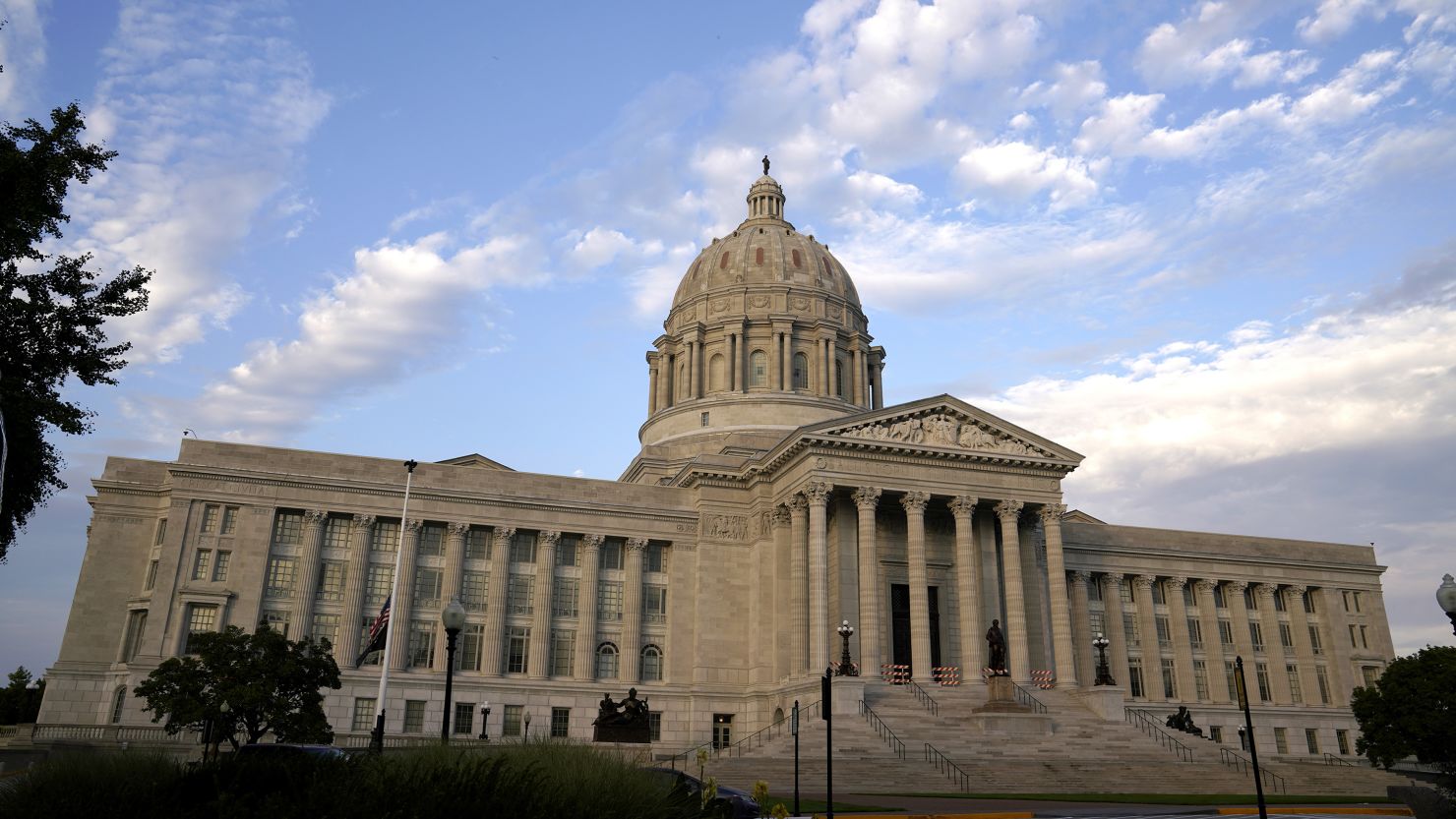
Clouds pass over the Missouri State Capitol on Sept. 16, 2022, in Jefferson City, Mo.
Jeff Roberson/AP
A newly proposed law in Missouri could charge teachers and counselors with a felony and require them to register as sex offenders if they’re found guilty of supporting transgender students who are socially transitioning.
Missouri state Rep. Jamie Gragg, a Republican, introduced HB 2885 last week. If passed and signed into law, the legislation would criminalize the act of “contributing to social transition” for anyone acting in an official capacity at their school, including providing informational or material support.
The proposed bill joins a string of anti-LGBTQ measures that have been filed in states across the US and comes amid a growing “parental rights” movement that seeks to empower parents to decide what can be taught in classrooms about gender, sexuality and race.
The bill defines social transitioning as “the process by which an individual adopts the name, pronouns, and gender expression, such as clothing or haircuts, that match the individual’s gender identity and not the gender assumed by the individual’s sex at birth.”
In Missouri, a person charged with a class E felony could face a maximum of four years in prison. A Tier I sex offender could also remain on the Sex Offender Registry for up to 15 years, according to another Missouri statute.
CNN has reached out to Gragg for comment.
In an interview with CNN affiliate KY3, Gragg said the goal of the bill is to “put the social learning development of our children back in the hands of the parents.”
“Ultimately, whose children are these? They belong to the family that they come from. If there is a situation where they don’t have that parental or guardian to go back on or to talk to, there is other help, professional help they can get,” Gragg told the outlet.
It is unclear if Gragg’s bill will be taken up in the state House and it has not been scheduled for a hearing.
‘Hateful and malicious’
LGBTQ advocates and Missourians have criticized the bill, including Gragg’s brother.
During a news conference Thursday, Charles Gragg, Jr., a retired and disabled veteran who lives in Springfield, Missouri, said he was shocked by the bill his younger brother authored and that the measure “took his breath away.”
“This bill is removing valuable support that is important for children. It needlessly targets teachers in addition to attacking those that they don’t agree with. It also attacks anyone who expresses compassion or tolerance and seeks to silence them. I believe it’s intended to remove them from the future conversations,” Gragg Jr. said.
Robert Fischer, communications director for PROMO, a LGBTQ+ policy and advocacy organization in Missouri that organized Thursday’s presser, said students and teachers have contacted the group to express concern about how the bill could impact educators.
“We will certainly have conversations with legislators to see what can be done, but also we’ll mobilize our community of LGBTQ+ Missourians and allies to fight back against this because teachers are an incredibly crucial part of our educational system,” Fischer said.
New survey finds a majority of teachers say state governments have too much influence over what’s taught in classrooms
GLSEN, an organization that aims to create safe and inclusive school environments for LGBTQ+ youth, also criticized the bill. Melanie Willingham-Jaggers, executive director of GLSEN, said the bill is “deeply transphobic.”
“While this egregious bill is expected to die in committee hearings, it is increasingly alarming to watch extremist state legislators peddle anti-trans hate and continue to introduce discriminatory policies,” Willingham-Jaggers said in a statement to CNN. “Hate speech, especially when enshrined into discriminatory policies like these transphobic bills in Oklahoma and Missouri, leads to hate crimes.”
Oklahoma’s governor signed a bill into law last year banning gender-affirming care for minors with the possibility of a felony charge for health care professionals who provide it.
Last month, Nex Benedict, a nonbinary high school student in Oklahoma, died a day after they told their family they were involved in a fight at school. Civil rights groups and advocates have blamed a heightened and hostile climate against the LGBTQ+ community for contributing to Benedict’s death.
In 2023, at least 510 anti-LGBTQ bills were introduced in state legislatures, according to data from the American Civil Liberties Union. The organization is also tracking 478 bills in the 2024 legislative session that restrict LGBTQ rights.
Gragg Jr. said he has not spoken with his brother about the bill and does not know what would inspire him to sponsor it.
“It’s just hateful and malicious. This legislation will cost lives and recklessly destroy others just for the sin of being compassionate.”
It is a case of I don’t want my child to read these books so your child can’t read them either. These people want control over everyone, every child, they demand to rule your life. Hugs. Scottie
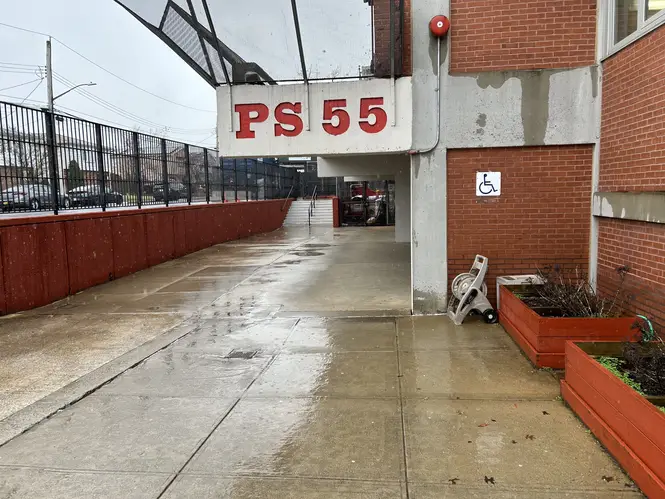
Hundreds of new books featuring characters of color and LGBTQ+ themes were found by the trash at a Staten Island elementary school, outraging some parents and sparking an education department investigation.
Gothamist obtained photos from a Brooklyn book lover that showed boxes of kids’ books left with the garbage at PS 55, known as the Henry Boehm School. Some had sticky notes on them detailing themes and content in the books, which appeared to be part of a 2019 initiative to diversify school materials. The city education department launched an investigation after Gothamist shared the images.
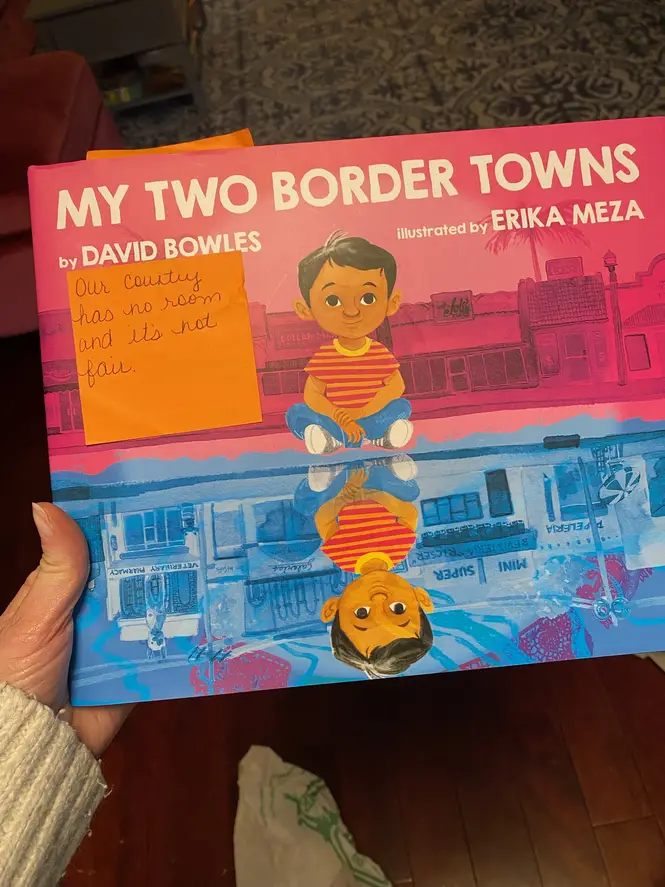
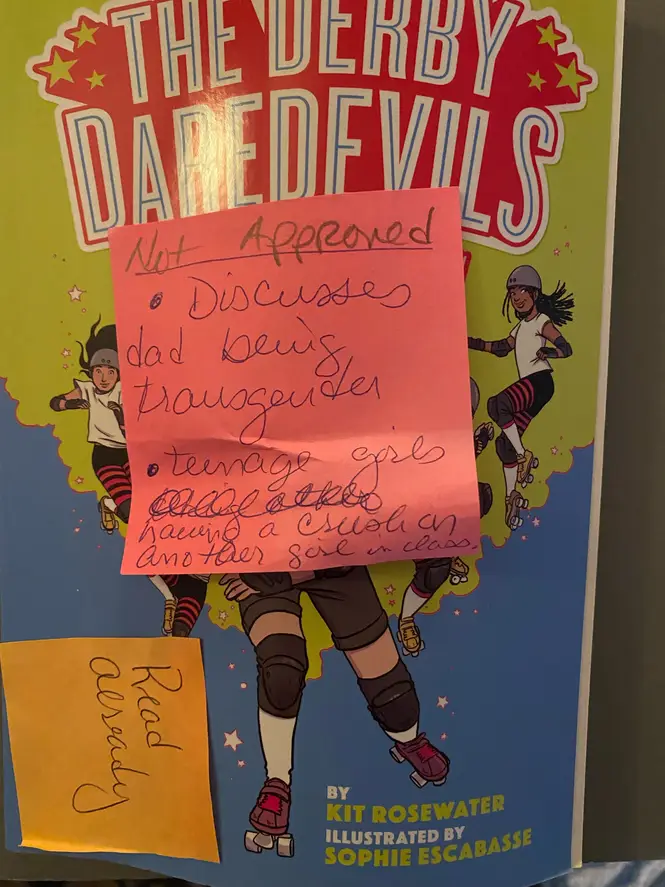
A note on “My Two Border Towns,” about a boy’s life on the United States-Mexico border, read “Our country has no room and it’s not fair.” A note on “The Derby Daredevils,” about a girls’ roller derby team, read “Not approved. Discusses dad being transgender. Teenage girls having a crush on another girl in class.” And a note on “We Are Still Here! Native American Truths Everyone Should Know” read “negative slant on white people.”
A note on a copy of “My Two Border Towns” taken from the school reads “Our country has no room and it’s not fair.”
Holly Spiegel
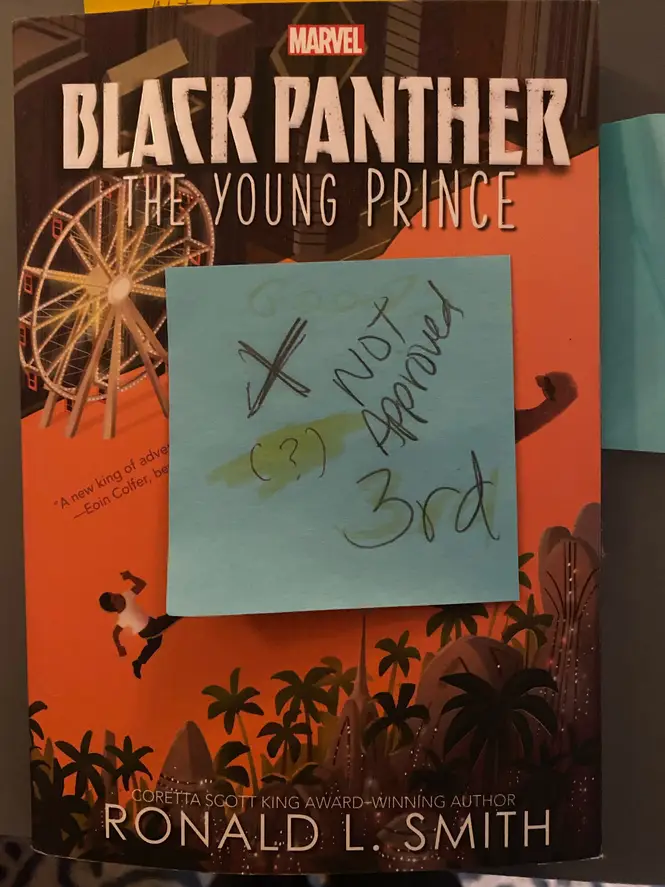
Even books about the Marvel Comics hero Black Panther and legendary singer and activist Nina Simone were discarded.
It was unclear whether the removal of the books resulted from an objection raised by staff or parents. The education department said no formal challenge to the books was raised through official channels, though a part-time librarian had inquired about the process.
Until this incident, New York City had seemed largely immune from the high-profile efforts to ban books that are roiling school communities in Florida, New Jersey and other parts of the country.
“Our public schools do not shy away from books that teach students about the diverse people and communities that make up the fabric of our society,” education department spokesperson Nicole Brownstein said, noting the removal of the books was not sanctioned.
The school principal and PTA president did not respond to inquiries.
Many PS 55 parents were surprised to learn the books had been removed.
The education department said it was investigating why the books were discarded from the PS 55 library.
Jessica Gould
“I don’t believe in banning books at all,” said Angela Hartje, whose daughter is in third grade.
“It’s one step closer to ‘Fahrenheit 451,’” she added, referencing the classic sci-fi novel by Ray Bradbury about a dystopian America where books have been outlawed.
‘Not approved’
Holly Spiegel, of East Flatbush, alerted Gothamist to the controversy. Her neighbor, who was working near the school in November, retrieved hundreds of the books from the trash and gave them to Spiegel, knowing she could use them for the free “Little Libraries” she manages around their neighborhood. Spiegel then got in touch with the school and made two additional trips where she recovered hundreds more books in boxes marked “not approved.”
Sticky notes on the books pointed to apparent reasons why they were censored. A note on “Julian Is A Mermaid,” about a boy who dresses as a mermaid, read “Boy questions gender.” A post-it on “Chester Nez and the Unbreakable Code: A Navajo Code Talker’s Story,” cited a specific page, along with the question “white man’s world?”
A copy of “Derby Daredevils” had a note reading “Not approved. Discusses being transgender. Teenage girls having a crush on another girl in class.”
Holly Spiegel
Notes on pages of “Black Panther: The Young Prince” read “Witchcraft? Human skulls” and “Pact with Devil. Burned in fire.”
A note on “Nina: A Story of Nina Simone” read “This is about how black people were treated poorly but overcame it. (Can go both ways).”
“At its heart, this feels like censorship,” Spiegel said. “It feels like book banning.”
City statistics show the student body at PS 55 is 78% white, 11% Hispanic and 8% Asian. The teachers are 92% white.
Two parents at the school, located in Staten Island’s Eltingville neighborhood, said they had heard rumblings about some controversy over books. But Gothamist was unable to confirm who led the effort that led to the books being tossed.
An unusual book battle
School controversies over books are rare in New York City. Since 2019, there have been only three challenges of books at other schools under an official protocol that involves the formation of a committee of parents, librarians, teachers and administrators, the education department confirmed. None of those books were removed.
“Should a parent feel concerned about the literature in their child’s classroom, they are encouraged to reach out to the teacher, principal, or superintendent,” said Brownstein, the department’s spokesperson.
It’s more common for discussions in the city to focus on ensuring access to the materials. The Brooklyn Public Library runs a program where local students talk about controversial books with students in other parts of the country where they’re actually being banned.
Alissa Barakakos, a PTA member at PS 55, said she was surprised that books about race, culture and sexuality had been removed — and that she would have opposed the effort if she’d known about it. She noted her son’s class just finished a series of discussions on Black History Month, and a unit on Native Americans.
“I don’t know why the books would be thrown out,” Barakakos said. “I want my kid to be a part of the school community where everything is open and honest and kids are being educated.”
Spiegel said she was upset to see the books were kept from children. “The books aren’t getting into the hands of kids who would identify with the characters, but they’re also not getting into the hands of kids whose worldview would be broadened by reading about people who aren’t like them,” she said.
‘Mosaic’ problems
Some of the boxes Spiegel retrieved were labeled “Mosaic,” the name of a $200 million initiative launched late in the de Blasio administration to diversify school lessons and materials. An analysis by the New York City Coalition for Educational Justice found in 2019 that only 16% of elementary and middle school books were by authors of color.
“Black Panther: The Young Prince” was also removed from the Staten Island elementary school.
Holly Spiegel
De Blasio called for a total rethinking of the K-12 curriculum with an eye toward diversity. Mayor Eric Adams then scaled back the Mosaic plan, launching his own literacy initiative and supplementing lessons with materials reflecting LGBTQ+, Asian American and Black communities.
Thousands of Mosaic books were still sent to school and classroom libraries. But Natasha Capers, the director of the Coalition for Educational Justice, said schools received little guidance about what to do with the new books.
“They just were like, ‘here’s a big box of books,’” said Capers, whose group advocates for more equity in public schools.
She added that she was glad to know the books found with the garbage at PS 55 were “rescued.” But she said she was outraged to hear they had nearly been discarded.
“I watched my children throughout their schooling read so many books that used horrific language about Black people,” Capers said. “There’s a book [that] used the N-word. You just had to suck it up because it’s part of the ‘canon.'”
She scoffed at the apparent discomfort with witchcraft and human skulls in the Black Panther book.
“You read Shakespeare, and [“Macbeth”] starts out with three witches around a cauldron,” she said. “Hamlet,” she noted, “is legitimately talking to a skull.”
Tagged
BOOKS
EDUCATION
STATEN ISLAND
Jessica Gould
Jessica is the education reporter for WNYC and Gothamist. During the Covid-19 pandemic, Jessica reported on the shutdown and reopening of the nation’s largest school system, highlighting the unprecedented impacts on learning, health and mental health for students, staff and families. Got a tip? Email jgould@nypublicradio.org





 Brad Kutner / Radio IQ




 Scottie's Playtime