Uterus transplant trial ends with bundles of joy

August 18, 2024 Ellen Phiddian

https://cosmosmagazine.com/health/medicine/uterus-transplant-trial-dallas/

(This piqued my interest for a number of reasons. It also made me think of Sen. Vance, very briefly. But it is news-y.)

A US study of 20 people who received uterus transplants has found the process feasible, with 14 recipients going on to have live births.

Researchers said there were no abnormalities in the children born via transplanted uterus, but they highlight risks from surgery that affected both recipients and donors.

The study, which is published in the Journal of the American Medical Association, reports on a clinical trial run at the Baylor University Medical Center in Dallas, USA.

Since the first successful uterus transplant in 2011, there have been about 100 transplants worldwide, from both living and deceased donors.

Recipients are generally women with “absolute uterine infertility” – that is, problems with their uterus that make them unable to have a successful pregnancy.

In the USA, there have been 48 uterus transplants since they began in 2016, with 33 of the recipients going on to have live births.

In this trial, researchers enrolled 20 people, aged between 20-36 years old, all of whom had absolute uterine infertility but at least 1 working ovary.

Participants received uterus transplants from 18 living and 2 deceased donors between 2016 and 2019.

Of the 20 participants, 6 had graft failures within a fortnight and lost the transplanted organ.

“During the study period, the technical success of graft survival improved with time and experience,” write the researchers in their paper.

All 14 of the successful transplant recipients went on to become pregnant via IVF, and give birth via caesarean.

Two of the recipients gave birth twice, resulting in 16 total live births. Some of the recipients had miscarriages, mostly early in their pregnancy, as well as having full-term pregnancies.

None of the 16 babies had congenital abnormalities, and none show any notable developmental delays to date (the oldest child the researchers have followed up with is 6). One child was diagnosed with autism at age 2 after missing communication milestones, and the researchers note his younger sister shows no signs of developmental delays.

Transplanted uteruses are typically removed again after 1 or 2 successful pregnancies, and this is the case with these 14 recipients. At the moment, 13 have had hysterectomies, while 1 still has the transplanted uterus in place for a second pregnancy.

Some of the surgeries in the trial – transplant donation, transplant reception, caesarean section, and graft hysterectomy – had complications.

Four of the living uterus donors had grade 3 complications – that is, they required surgery to fix – but none of them had experienced any long-term illness when they were followed up roughly 4 years later.

None of the successful graft recipients had severe complications from their transplant surgery, and while graft loss is a grade 3 complication, none of the 6 unsuccessful recipients had experienced long-term effects when they were followed up.

The researchers also point out that all recipients needed immunosuppression treatment to accept the donated organs, and the “long-term impact of immunosuppression in these otherwise healthy women remains unknown”.

In their paper, the researchers conclude that uterus transplants are technically feasible, but the surgeries involved carry risks for donors and recipients.

“The live birth success rate in this study suggests that a successfully transplanted uterus is capable of functioning at least on par with a native, in situ uterus,” they write.

But they also point out that the “currently prohibitive cost of uterus transplant” makes it difficult to tell how generalisable their results are.

Scientists saved crocs from cane toads by making them sick

August 17, 2024 Imma Perfetto

https://cosmosmagazine.com/australia/scientists-saved-crocs-from-cane-toads-by-making-them-sick/

(I know cane toads are an abhorrent, invasive species, being moved [by humans!] from their original place on the planet to another place, to try to control another species. However, there is a YA novel about cane toads that ended up being a “banned book” one year. The then-kid was really into banned books, so we bought it, and it was a bit of a tear-jerker and I have a tiny soft spot for them, since it wasn’t their faults they got transplanted; they were only doing the best they could. Anyway, here’s this.)

Scientists have successfully saved freshwater crocodiles from toxic cane toads invading northern Australia with an unusual new tactic – doctored cane toad carcases.

By teaching freshwater crocodiles (Crocodylus johnstoni) to associate cane toads (Rhinella marina) with a bout of food poisoning, they reduced death rates by at least 95%.

Across the dry season (May to October) between 2019 and 2022, Macquarie University scientists worked on the project with Bunuba Indigenous rangers and the Department of Biodiversity, Conservation and Attractions (DBCA) in Western Australia.

They collected cane toads, removed the poisonous parts, and injected the bodies with a nausea-inducing chemical that caused the crocs eating them to feel temporarily sick.

A black and white photograph of a crocodile sticking its head out of the water. It is about to eat a piece of meat hanging from a stick next to the shoreline
Freshwater crocodile taking doctored cane toad bait. Credit: Georgia Ward-Fear

It’s a behavioural ecology method known as conditioned taste aversion, and it worked remarkably well.

“The first three days we noticed the crocodiles were taking the cane toads, then they would go away,” says Bunuba ranger coordinator Paul Bin Busu, whose team set up hundreds of bait stations across 4 large gorge systems in the Kimberley region of north-western Australia.

The doctored cane toads were deployed alongside chicken meat control baits to monitor the effectiveness of the training.

“Then we noticed they would smell the cane toad before eating, and on the last day we noticed that it was mostly the chicken necks getting eaten,” says Bin Busu.

The team used nocturnal ‘spotlighting’ surveys and remotely triggered wildlife cameras to monitor crocodile and toad numbers following the intervention.

“Our baiting completely prevented deaths in areas where cane toads were arriving and decreased deaths by 95% in areas where toads had been for a couple of years,” says Macquarie’s Dr Georgia Ward-Fear, who is lead author of the report detailing the findings in Proceedings of the Royal Society B.

A black and white photograph of a crocodile sticking its head out of the water. It is about to eat a piece of meat hanging from a stick next to the shoreline
Freshwater crocodile taking doctored cane toad bait. Credit: Georgia Ward-Fear

Ward-Fear says these effects continued in the years following.

Some populations of freshwater crocodiles in tropical Australia have fallen by more than 70% due to ingesting cane toads.

“Freshwater crocs can be heavily impacted as their river systems dry out during the late dry season,” says Ward-Fear.

“They end up congregating in large numbers with very little food, and as toads begin to use these waterbodies for rehydration, the two come into contact and we see large numbers of crocodile deaths over a few months.”

Now, conditioned taste aversion interventions can be planned both ahead of and behind the cane toad invasion front in areas with similar ecology.

3 For Science

Stonehenge’s 6-tonne Altar Stone was transported from Scotland

August 15, 2024 Evrim Yazgin

How was Stonehenge built in ancient Britain 5,000 years ago?

New evidence suggests the Late Stone Age people who made the colossal structure would have to have used advanced transport methods to move the stones even further than previously thought.

Stonehenge at sunset
The Altar Stone at Stonehenge circled in black. Credit: English Heritage.

According to English Heritage, the largest stones – called sarsens and weighing up to 30 tonnes – are believed to have been transported from Marlborough Downs, about 32 kilometres away from the site.

The smaller stones weigh less than 10 tonnes. They were thought to have all come from the Preseli Hills in Wales more than 200km away. Transporting these gigantic stones this far would have been a monumental feat for ancient people in Britain.

But new research published in the journal Nature suggests that one stone, the 6-tonne Altar Stone, has its origins even further afield in Scotland.

Some stones at stonehenge
The Altar Stone, seen here underneath two bigger Sarsen stones. Credit: Professor Nick Pearce, Aberystwyth University. (snip-More)

https://cosmosmagazine.com/history/archaeology/stonehenge-altar-stone-scotland-transport/

=====

New liquids can safely extract nanoplastics from water

August 14, 2024 Ellen Phiddian Cosmos science journalist

Person in dark room looks at glowing vial
Gary Baker with the solvent. Credit: Sam O’Keefe/University of Missouri

US researchers have made substances that can extract nanoplastics from water.

The solvents, made from non-toxic components, could remove 98% of the tiny plastic particles from water in a lab environment.

The team has published its research in ACS Applied Engineering Materials.

 “Our strategy uses a small amount of designer solvent to absorb plastic particles from a large volume of water,” says corresponding author Gary Baker, an associate professor at the department of chemistry in the University of Missouri-Columbia. (snip-More)

https://cosmosmagazine.com/science/chemistry/nanoplastic-solvent-extraction/

=====

Elite woman’s grave dates from before Genghis Khan’s Mongolian Empire

August 14, 2024 Evrim Yazgin

Scientists have made an unexpected discovery in a thousand-year-old abandoned fortress in Mongolia.

Buried in the walls of the fortress is the grave of an elite woman who pre-dates the rise of the founder of the Mongolian Empire, Genghis Khan (also known as Chinggis Khan). The frontier fortress is about 1.4 km west of Khar Nuur lake in eastern Dornod province of Mongolia, only kilometres from the Chinese border.

Mongolia, zavkhan province, khar nuur lake
Khar Nuur lake. Credit: Tuul & Bruno Morandi / The Image Bank / Getty Images Plus.

Genghis Khan rose to prominence in 1206 CE. Before that, the Kitan-Liao Empire controlled great swaths of land between 916 and 1125 CE.

The period between these great dynasties is poorly understood as very few records survive. (snip-More)

https://cosmosmagazine.com/history/archaeology/mongolia-elite-woman-grave/

Gene linked to life-threatening respiratory viral infections

August 13, 2024 Imma Perfetto

https://cosmosmagazine.com/australia/gene-linked-to-life-threatening-respiratory-viral-infections/

Doctors may soon be able to predict whether your influenza infection will become life-threatening, or if you’ll recover quickly.

Scientists have identified a gene associated with whether patients hospitalised with respiratory viral infections experience mild disease or life-threatening complications.

According to the new study published in Cell, expression levels of the gene, OLAH, is critical in determining disease severity.

The University of Melbourne’s Dr Brendon Chua, a viral and translational immunologist at the Doherty Institute for Infection and Immunity and co-senior author of the paper, says: “Our first ‘aha’ moment occurred during our analysis of patients hospitalised with A(H7N9) [avian] influenza, where we discovered a consistent association between high expression levels of OLAH and fatal outcomes.

“Conversely, patients who recovered exhibited very low OLAH expression throughout their hospital stay.

Patients severely infected with seasonal influenza virus, SARS-CoV-2, respiratory syncytial virus (RSV) and children experiencing multisystem inflammatory syndrome, a rare but serious complication of COVID-19, also show elevated levels of OLAH expression.

A graphical abstract of the study showing that decreased olah expression results in mild disease and increased olah expression results in greater disease severity,
Credit: Jia XX, et al. High expression of oleoyl-ACP-hydrolase underpins life-threatening respiratory viral diseases. Cell (2024). DOI: https://doi.org/10.1016/j.cell.2024.07.026

The OLAH gene encodes an enzyme, oleoyl-acyl-carrier-protein hydrolase (OLAH), which mediates the production of a fatty acid. Higher expression of the gene results in higher levels of fatty acids, which exacerbates viral infections.

“Further investigation using animal models and cell cultures revealed that OLAH is pivotal in driving life-threatening inflammation associated with respiratory viruses,” says Chua.

“What’s interesting is that we all have this gene, but its expression varies during the early phases of a respiratory infection, which is why some of us recover faster while others experience severe complications.”

The research team is now working to develop OLAH-based diagnostic methods to screen hospitalised patients. They are also exploring how OLAH can inform the development of therapeutic treatments for viral pathogens.

The University of Melbourne’s Professor Katherine Kedzierska, head of the Human T cell Laboratory at the Doherty Institute and co-senior author of the paper, says: “We’re really excited about the potential of the OLAH gene to serve as a universal indicator of disease severity across different respiratory infections.

“Imagine if your doctor could predict whether your respiratory infection will become life-threatening or if you’ll recover quickly? Our findings suggest that OLAH expression levels could be used as a cutting-edge tool in assessing patients’ prognosis, empowering clinicians with crucial insights for early risk assessment and personalised treatment strategies.”

Egyptians of Old Could Have Used Hydraulic Lifts for Work

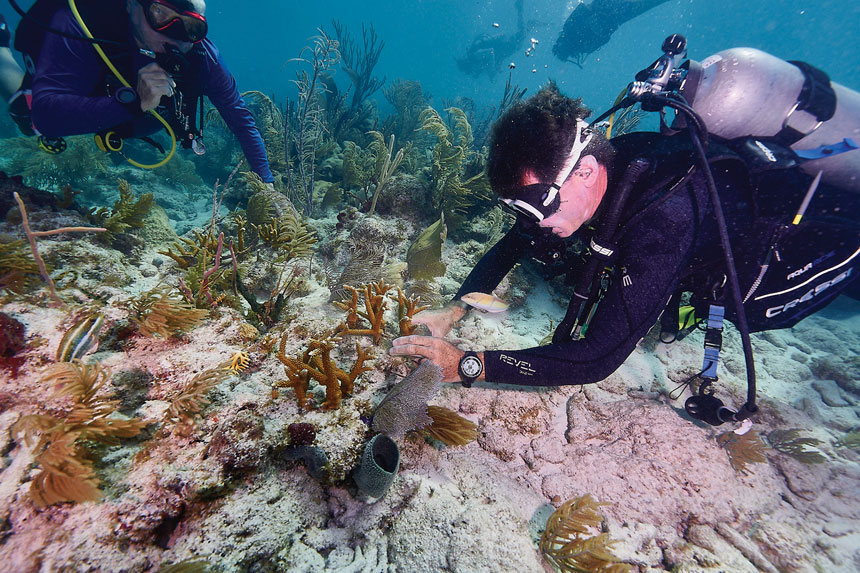
Saving an Underwater World

Michael Goldberg and his team of volunteer divers are resurrecting reefs, one coral at a time.

Ken Budd https://www.saturdayeveningpost.com/2024/08/saving-and-underwater-world/

Thirty years ago, when Michael Goldberg would dive in the glimmering blue water of the British Virgin Islands, the reefs were teeming with life. “The expanse of these reefs was astounding,” says Goldberg, a cofounder of I.CARE, a Florida-based reef restoration organization. “The corals were so thick and lush.”

Today those reefs are dying. In much of the Atlantic Ocean, including the Florida Keys, where the 61-year-old Goldberg lives, roughly 70-95 percent of the coral is gone, devastated by disease, rising sea temperatures, and other existential threats.

By 2015, as the reefs declined, Goldberg faced a decision. He would either leave the scuba industry — since 2004, he has owned Key Dives, which provides diving and snorkeling on the Keys’ Islamorada reefs — or take action to restore the coral. Fortunately for Florida, the ocean, and humanity, he chose the latter.

In 2019, Goldberg cofounded I.CARE (Islamorada Conservation and Restoration Education). The mission: To restore and maintain Islamorada’s reefs by teaming with local businesses, residents, and visitors, including local dive shops and recreational divers. Activities range from underwater trash clean-ups — since 2021, divers have lugged 20,000 pounds of debris to the surface — to coral transplants. Over the past three years, I.CARE has planted over 15,000 corals on six different reefs.

The need is urgent. Coral reefs provide food and shelter to thousands of organisms — crustaceans, fish, anemones, sponges — and protect shorelines from storms and erosion. The reefs’ economic benefits include tourism and commercial and recreational fishing. Coral has even been used in medical technologies such as “bone grafting techniques and possible treatments for diseases including Alzheimer’s and cancer,” I.CARE notes.

“I love educating people about the importance of this, but the most gratifying thing for me is seeing the coral grow,” Goldberg says. “I love seeing little baby corals thrive in a harsher environment than I ever imagined, and knowing that despite all the challenges, we’re seeing success.”

Goldberg’s career initially focused on money management rather than ocean management. His love of the water began when he was a boy in Los Angeles, but his family moved to Chicago when he was 10, and he later studied finance at Northern Illinois University. On a summer trip to Acapulco, he dove for the first time, purely, he says, “as a lark.”

“Someone got me some gear, and I wasn’t certified, and I didn’t know what I was doing,” he says. Acapulco is not known for stellar diving experiences, but he loved it: “I was just so enamored with being underwater.”

After that, he was hooked. He earned his diving certification and then moved back to one of L.A.’s beach communities and became an instructor. Before long, he and his wife decided to move to the British Virgin Islands. Eight years later, the couple returned to the United States and opened Key Dives in Islamorada.

Hope and water: “If I wasn’t optimistic, I wouldn’t keep doing this,” says I.CARE cofounder Michael Goldberg. (Photo courtesy Michael Goldberg)

Goldberg has made over 10,000 dives, swimming not only with dolphins and schooling sharks, but within 15 feet of a humpback whale as it breached. And yet the vast coral reefs have always intrigued him most, whether diving alone or taking clients off the island of Virgin Gorda in the British Virgin Islands.

“There was this one unique piece of coral that I would swim underneath — it was like a tree,” he says. “Most people want to see fish, but to me, that coral was always the highlight of the dive.”

In 2017, Goldberg met Kylie Smith, who was working on her Ph.D. at Clemson University and studying coral in the Florida Keys. Smith would fill her tank at Key Dives, and Goldberg, who was “already shifting my business toward conservation,” would tap into her aquatic expertise.

“When I met Dr. Smith, I would pepper her with questions — she couldn’t walk in my store and leave in quick fashion,” Goldberg says. Their discussions eventually moved from the dive shop to a beer garden at The Florida Keys Brewing Company. “We would sit and chat, and I kept saying to her, I’ve got an idea to empower recreational divers so that they can become citizen scientists — not only because they want to be part of the solution, but because they need to be a part of the solution. That’s the largest potential boots-on-the-ground army that can enact so much of what we do.”

Those discussions led them to co-launch I.CARE. By January 2021, volunteer divers had transplanted I.CARE’s first corals.

For the coral restoration, divers use coral raised in nurseries. Once it’s planted on the reefs, the coral will, hopefully, reproduce into a coral colony — but the process is slow. It can take 20-50 years for coral to grow large enough to spawn.

To speed up reproduction, I.CARE uses a process called micro-fragmentation. Larger corals are cut into thumbnail-size pieces and grown in a nursery. When those pieces grow to about the size of a 50-cent piece, they are planted edge to edge on a living coral structure. After a few years, the coral fuse to become one larger coral, and they’ll start to spawn in about 7 to 10 years.

For the micro-fragmentation work, I.CARE rescues coral that has broken free from the main reef structure due to storms and substrate erosion.

“What is cool about these corals is that these are the survivors. They are the most resilient, the ones that have persisted despite all the disease and heat,” says Goldberg. “It’s survival of the fittest in the truest sense, and the ones we are using to rebuild our precious reefs.”

Despite the advances, the challenges are huge, both for I.CARE and the planet. During the intense heat of summer 2023, most of I.CARE’s seemingly healthy coral fragments died at one of Goldberg’s favorite reefs. “I cried underwater,” he admits. But he prefers to focus on the organization’s victories. Seventy-seven of the fragments survived and are thriving.

“If I wasn’t optimistic, I wouldn’t keep doing this,” he says. “We’ve had successes, and we can build on those successes.”

When it comes to restoring the reefs for future generations, he offers a simple vow: “We’re not gonna give up.”

Ken Budd has written for The Washington Post, The Atlantic, The New York Times, National Geographic Traveler, and many more. He is the author of an award-winning memoir, The Voluntourist.

This article is featured in the July/August 2024 issue of The Saturday Evening Post.

Peace & Justice History 8/12

https://www.peacebuttons.info/E-News/peacehistoryaugust.htm#august12

August 12, 1953
The first Soviet hydrogen (thermonuclear or fusion) bomb, far more potentially damaging than those dropped on Japan, was exploded in the Kazakh desert, then part of the Soviet Union. Igor Vasziljevics Kurcsatov, head of the Soviet Uranium Committee, said to Josef Stalin at the time: “The atomic sword is in our hand. It is time to think about the peaceful use of nuclear energy.”
 The Soviet Nuclear Weapons Program: https://nuclearweaponarchive.org/Russia/Sovwpnprog.html
August 12, 1982
Open missile tubes on Trident sub
Twelve were arrested in an attempted blockade of the first Trident submarine, the USS Ohio, entering the Hood Canal in the state of Washington. In motorboats, sailboats and small handmade wooden vessels, the demonstrators were objecting to the presence of nuclear weapons in Seattle. The Coast Guard overturned some of the vessels with water cannon.
August 12, 1995

Thousands demonstrated in Philadelphia and other cities in support of journalist and former Black Panther Mumia Abu-Jamal (on death row for murder since 1982) in the largest anti-death-penalty demonstrations in the U.S. to date.
Who is Mumia Abu-Jamal? https://www.amnesty.org/en/wp-content/uploads/2021/06/amr510012000en.pdf

Sunday toon

Wee Pals by Morrie Turner for August 11, 2024

Wee Pals Comic Strip for August 11, 2024

https://www.gocomics.com/weepals/2024/08/11

I keep forgetting to read these until Sundays.

US Athletes Discover Joys Of Universal Healthcare In Olympic Village by Rebecca Schoenkopf

This is one of those feel-good stories that is actually very depressing when you think about it! Read on Substack

Snippets:

Wikimedia Commons

There’s a lot of money to be made on the Olympics — though not necessarily by the people participating in them (or most people who live in the host cities). Those athletes who participate don’t get paid (unless they get sponsorship deals) and, as a result, many of them go into poverty while trying to go for the gold. Training costs are huge and so, often, are the medical bills.

But not when they’re at the Olympic Village!

Ariana Ramsey, who won a bronze medal as part of the US female rugby team has been going viral on TikTok, talking about how amazing it’s been getting free healthcare at the Olympic Village — and in the days following her victory, she was able to celebrate by going to the gynecologist, dentist and an ophthalmologist, where she was able to get free glasses as well.

Via Sports Illustrated:

Ramsey came to Paris as a rugby player. She is leaving as a healthcare influencer. More than 135,000 people have watched her initial TikTok, and another of the half-dozen follow-up videos she has made has pulled in more than 570 views. That is fine with her. The more she thinks about it, the more frustrated she is that she’s so astonished by the concept. 

“That’s just America and their privatized healthcare system,” she laments in an interview, adding, “I’ll fight for universal healthcare.”

The idea has gone viral in France: American discovers healthcare. “A lot of people are kind of making a joke about it,” she says. “Like, welcome to France.” (snip)

Every other country has figured out that it makes far, far more sense (and is far, far more economically sane) for health care to be seen as a public good, but we’re still out here making insurance company CEOs obscenely rich for who knows what reason.

Many American athletes do have access to the United States Olympic and Paralympic Committee’s health insurance policy. But their eligibility for the program is up to their sport’s governing body, and an independent commission appointed by Congress found that “some of the most talented competitors under our flag go to sleep at night under the roof of a car or without sufficient food or adequate health insurance.” More than a quarter of U.S. athletes report earning less than $15,000 per year, and more than 40% said they paid out of pocket for healthcare, with an average cost of $9,200 per person. Only 16% said they’d been reimbursed.

Meanwhile, in 2022, the US Olympic and Paralympic Committee had a net revenue of 61 million dollars and paid their CEO a salary of $1.1 million.

Also meanwhile, NBCUniversal sold $1.2 billion in advertising ahead of the last Olympic Summer Games in Tokyo and say that they have surpassed that number this year (though an exact figure has not been given). (snip)

On the bright-ish side, because of Ramsey’s videos, hundreds of other Olympic athletes have taken advantage of the free healthcare at Olympic Village that they might not otherwise get at home. So that’s nice for them!

The Bird Conservancy

I subscribe to their newsletter because I love birds, but I don’t know a lot about them as to ID’ing them, their calls, etc. I love how birds simply keep on keeping on, not seeming to worry about much. Enjoy, if you like; there is lots of info, photos, and you can listen to calls. And more!