I keep hearing the anti-trans crowd scream about how so many people who have transitioned regret it. They constantly push that trans men who have mastectomies, removing their breasts then wish they had not done so. In fact, that myth is used to push anti-transitioning care laws. Even in the comments I have some who ask about the ones who have their breast removed as if it is a large and growing number. This is a new study, peer reviewed, done by medical professionals. It debunks that myth and shows it for the made up lie it is. I will post the entire thing, it is short but rather hard to read with all the numbers they throw in. But I will put the conclusion right at the top in bold red. It shows that the 1% regret rate is true. That means for every 100 people who female to male and have their breasts removed, 99 are happy and doing better. Only one person had regrets, and in truth they can get fake breasts implanted if they are that unhappy. Again for the sake of that one person the anti-trans people want to stop the good outcomes for the other 99 people. Doesn’t make sense, does it? Hugs
Conclusions and relevance:In this cross-sectional survey study, the results of validated survey instruments indicated low rates of decisional regret and high levels of satisfaction with decision following gender-affirming mastectomy. The lack of dissatisfaction and regret impeded the ability to perform a more complex statistical analysis, highlighting the need for condition-specific instruments to assess decisional regret and satisfaction with decision following gender-affirming surgery.
Long-Term Regret and Satisfaction With Decision Following Gender-Affirming Mastectomy
Importance: There has been increasing legislative interest in regulating gender-affirming surgery, in part due to the concern about decisional regret. The regret rate following gender-affirming surgery is thought to be approximately 1%; however, previous studies relied heavily on ad hoc instruments.
Objective: To evaluate long-term decisional regret and satisfaction with decision using validated instruments following gender-affirming mastectomy.
Design, setting, and participants: For this cross-sectional study, a survey of patient-reported outcomes was sent between February 1 and July 31, 2022, to patients who had undergone gender-affirming mastectomy at a US tertiary referral center between January 1, 1990, and February 29, 2020.
Exposure: Decisional regret and satisfaction with decision to undergo gender-affirming mastectomy.
Main outcomes and measures: Long-term patient-reported outcomes, including the Holmes-Rovner Satisfaction With Decision scale, the Decision Regret Scale, and demographic characteristics, were collected. Additional information was collected via medical record review. Descriptive statistics and univariable analysis using Fisher exact and Wilcoxon rank sum tests were performed to compare responders and nonresponders.
Results: A total of 235 patients were deemed eligible for the study, and 139 responded (59.1% response rate). Median age at the time of surgery was 27.1 (IQR, 23.0-33.4) years for responders and 26.4 (IQR, 23.1-32.7) years for nonresponders. Nonresponders (n = 96) had a longer postoperative follow-up period than responders (median follow-up, 4.6 [IQR, 3.1-8.6] vs 3.6 [IQR, 2.7-5.3] years, respectively; P = .002). Nonresponders vs responders also had lower rates of depression (42 [44%] vs 94 [68%]; P < .001) and anxiety (42 [44%] vs 97 [70%]; P < .001). No responders or nonresponders requested or underwent a reversal procedure. The median Satisfaction With Decision Scale score was 5.0 (IQR, 5.0-5.0) on a 5-point scale, with higher scores noting higher satisfaction. The median Decision Regret Scale score was 0.0 (IQR, 0.0-0.0) on a 100-point scale, with lower scores noting lower levels of regret. A univariable regression analysis could not be performed to identify characteristics associated with low satisfaction with decision or high decisional regret due to the lack of variation in these responses.
Conclusions and relevance: In this cross-sectional survey study, the results of validated survey instruments indicated low rates of decisional regret and high levels of satisfaction with decision following gender-affirming mastectomy. The lack of dissatisfaction and regret impeded the ability to perform a more complex statistical analysis, highlighting the need for condition-specific instruments to assess decisional regret and satisfaction with decision following gender-affirming surgery.
Conflict of interest statement
Conflict of Interest Disclosures: Ms Bruce and Dr Morrison reported receiving grants from The Plastic Surgery Foundation during the conduct of the study. Dr Lane reported receiving salary support via an F32 training grant (F32HS028748-01) from the Agency for Healthcare Research and Quality outside the submitted work. No other disclosures were reported.
Due to the mention in the comments of the trans haters favorite and only major strike against trans people and the medical treatment for those who do not identify as the gender assigned at birth. This article breaks it down for people. Somewhere I posted an even better one but I simply don’t have time to look for it. The woman leading the investigation had a well know bias against trans people and gender-affirming care. That is the reason the British right wing government picked her to do this. They wanted a hit job, not a way to fix problems. Cass believes in conversion therapy for cat’s sake. Hugs
This morning people who care about trans kids were reacting in utter dismay to hearing the Secretary of State for Health use the Cass interim review to justify the need to exclude trans people from a ban on conversion therapy.
I’ll link the lovely Olly Alexander linking to a clip of our Health Secretary using Cass to call for conversion therapy for trans kids – see here
Despite evidence that conversion therapy on trans children is particularly harmful, with research showing “For transgender adults who recalled gender identity conversion efforts before age 10 years, exposure was significantly associated with an increase in the lifetime odds of suicide attempts”.
For days now, MPs and commentators have cited the Cass review, in justification of the need for conversion therapy specifically for trans kids.
Of course they do not say conversion therapy for trans kids. They talk of ‘children suffering from gender confusion or gender distress’, they talk of ‘exploratory therapy. They talk of ‘unintended consequences, by which some clearly mean, they fear the law would stop them conducting conversion therapy on trans kids.
Those who want to conduct conversion therapy on trans kids hide behind a new favourite term of ‘exploratory therapy’. It is a friendly sounding rebrand of conversion therapy. It is focused on probing, delaying, questioning and at its heart, problematising trans identities. There is nothing wrong with being trans. Some kids are trans – get over it.
The same people who actually want conversion therapy for trans kids, are trying to create confusion on the meaning of affirmative therapy. They are trying to paint affirmation as a bad thing, as something forced. They are wrong and they know it. Affirmation is about meeting a person where they are, about listening to what they need. It has space for as much talk therapy on identity as a person wants. Without coercion. Without compulsion. Without considering trans or cis as a bad outcome.
Parents of trans kids are today VERY upset. People had put their faith in Cass to help our kids.
Personally, I feel something else other than upset. I feel cross at myself for not speaking up earlier.
Back when the Cass review was first announced, I had serious concerns. Concerns that have continued to mount.
There was Cass’ personal twitter following of a load of highly transphobic groups & no trans people.
There was the Cass review’s initial refusal to even say the word trans kids, in a review aimed primarily at helping trans kids.
There was the lack of any trans people on the Cass team, and the fact that the Cass team explicitly asked for people with no knowledge or experience of trans-ness, as though that was a preferable.
The fact there was no oversight group consisting of respected trans health experts and trans community leaders.
Back at the start I felt deep in my gut that this would go badly and would not serve the needs of trans kids. I seriously considered trying to get parents of trans kids together to stage a boycott until there was some proper trans representation. I didn’t for four major reasons. For one, the biggest reason, I was so tired & out of time and energy. For two, I wanted to give optimism a go – just cos everything else always fails trans kids in the UK, why couldn’t this be different – here we had a paediatrician reviewing trans kids healthcare, something I’d been asking for for years, maybe this time would be different. For three, I hoped having formal peer reviewed publications to feed into the process would make a difference (spoiler – it didn’t – the Cass team had my peer reviewed research article on the UK service from the highly respected international journal International Trans Health and didn’t even bother citing it). For four, I didn’t think things could really get much worse for trans kids in the UK, so I didn’t see how much real harm it could do.
Obviously I was very wrong. I noted my initial reaction to the pathologisation embedded in the Cass report.
The Cass interim report is now being cited everywhere to justify the need for conversion therapy for trans kids. It is being cited to deny inclusion of trans people of any age from a ban on conversion therapy.
The red flags about the Cass process meanwhile continue to grow.
I’ve been interviewed, found Cass on the face of it an empathetic listener who keeps her cards close to her chest.
Other parents of trans kids have been interviewed, again felt Cass had listened with kindness.
Many are deeply upset about the Cass interim report and the way it has encouraged further bigotry.
The Cass interim report couldn’t even take a decision on whether being trans is pathological. It couldn’t even take a decision on whether trans kids are better off being loved and supported or put through conversion torture. It is not acceptable.
I won’t dig into the details of the Cass report itself, but the references and evidence base are deeply biased and flawed. It is yet another total failure for trans kids in the UK.
There are still no trans experts involved in a senior role in the Cass review. There is no trans power at all.
The Cass process seem to think the exclusion of trans people is acceptable, because they have told themselves they are not dealing with trans people at all. They have told themselves they are dealing with healthcare for ‘children suffering from gender distress’. This phrasing has become standard.
Worryingly there are also trans-antagonistic people involved in the research for Cass.
This week, the world respected paediatrician with over a decade of practical hands on experience HELPING trans kids in Australia published a response to the Cass review in the British Medical Journal. That response is not open access to the public, but this is of incredible important to those who are directly affected (and now even threatened) by the Cass outputs, so I will put its text here:
Gender identity services for children and young people in England
Landmark review should interrogate existing international evidence and consensus
Ken C Pang, 1, 3 Jeremy Wiggins, 2 Michelle M Telfer1, 3
1 Royal Children’s Hospital; 2 Transcend Australia; 3 Murdoch Children’s Research Institute
The long awaited interim report of the Cass review was finally published in March this year.1 Commissioned in September 2020, the independent review led by paediatrician Hillary Cass examined NHS gender identity services for children and young people in England. These services are currently provided by a single specialist clinic known as the Gender Identity Development Service. After consulting people with gender diversity, health professionals, and support and advocacy groups, Cass expressed various concerns within her interim report, such as increasingly long waiting lists, the “unsustainable workload” being carried by the service, and the “considerable risk” this presented to children and young people.
Recognising that “one service is not going to be able to respond to the growing demand in a timely way,” Cass used her interim report to recommend creation of a “fundamentally different service model.” Under this model, the care of gender diverse children and young people becomes “everyone’s business” by expanding the number of providers to create a series of regional centres that have strong links to local services and a remit to provide training for clinicians at all levels.1 Although it remains to be seen how and when this key recommendation will be implemented, the proposal will be largely welcomed by gender diverse children and adolescents and their families in England. The shift away from centralised, tertiary, and quaternary centres is already occurring internationally, including in Australia,2 where local services are being enhanced to meet growing demand and provide more equitable and timely care.
Hormonal treatment In what was likely a disappointment to many, the interim report did not provide definitive advice on the use of puberty blockers and feminising or masculinising hormones. Instead, Cass advised that recommendations will be developed as the review’s research programme progresses. In particular, the report expresses the need for more long term data to assuage safety concerns regarding these hormonal interventions. Although additional data in this area are undoubtedly needed, the decision to delay recommendations pending more information on potential unknown side effects is problematic for several reasons.
Firstly, it ignores more than two decades of clinical experience in this area as well as existing evidence showing the benefits of these hormonal interventions on the mental health and quality of life of gender diverse young people.3 -9Secondly, it will take many years to obtain these long term data. Finally, Cass acknowledges that when there is no realistic prospect of filling evidence gaps in a timely way, professional consensus should be developed on the correct way to proceed.” Such consensus already exists outside the UK. The American Academy of Pediatrics, the Endocrine Society, and the World rofessional Association for Transgender Health have all endorsed the use of these hormonal treatments in gender diverse young people,10 -12 but curiously these consensus based clinical guidelines and position statements receive little or no mention in the interim report.
Indeed, there is no evidence, as yet, that the Cass review has consulted beyond the UK. This inward looking focus may be a reflection of how England’s gender identity service has come to chart its own path in this field. For example, its current use of puberty blockers diverges considerably from international best practice. In particular, NHS England mandates that any gender diverse person under the age of 18 years who wishes to access oestrogen or testosterone must first receive at least 12 months of puberty suppression.13 However, many young people in this situation will already be in late puberty or have finished their pubertal development, by which time the main potential benefits of puberty suppression have been lost.11 Moreover, using puberty blockers in such individuals is more likely to induce unwanted menopausal symptoms such as fatigue and disturbed mood.14 For these reasons, puberty suppression outside the UK is typically reserved for gender diverse young people who are in early or middle puberty, when there is a physiological reason for prescribing blockers.
Another possible reason exists for the Cass review appearing to have neglected international consensus around hormone prescribing. While the interim report often mentions the need to “build consensus,” Cass seems keen to find a way forward that ensures “conceptual agreement” and “shared understanding” across all interested parties, including those who view gender diversity as inherently pathological. Compromise can be productive in many situations, but the assumption that the middle ground serves the best interests of gender diverse children and young people is a fallacy. Where polarised opinions exist in medicine—as is true in this case—it can be harmful to give equal credence to all viewpoints, particularly the more extreme or outlying views on either side. Hopefully Cass will keep this in mind when preparing her final report.
(Back to me typing) The authors of the above include some of the most respected paediatricians with decade long expertise in working with trans kids in Australia. The Cass team should have been queuing up to learn from Australian experts. The fact they have totally ignored expertise from outside of the UK and its partner system in the Netherlands, strikes as amazing arrogance. The fact the Australian experts felt the need to write a submission to the BMJ to raise their concerns with the Cass report is again astonishing, and in another less transphobic country would set off alarm bells.
I don’t know where we go from here.
I do know the cards are now on the table. I have zero faith in the Cass process. It has already done more harm than good.
My number one hope for Cass was it would take significant strides in depathologising approaches to trans kids. It has done the exact opposite. 18 months in and they won’t even say the word trans.
I had hoped Cass would educate the public that being trans is not a problem or a pathology. It has done the opposite, and legitimised some incredibly problematising media pieces this week alone.
I had hoped it would move us from psychoanalysis to modern healthcare – instead people are using Cass to justify the need for exploratory therapy, conversion therapy by a different name.
I had hoped it would move trans kids’ healthcare away from a monopoly mental health trust to modern secondary or primary care. Instead, the focus appears to be on talk therapy to problematise trans-ness, without tackling the hostile climate that makes life so hard for trans kids, and perhaps with even less route to medical intervention where needed.
Cass has done nothing to highlight the biggest problem for many trans kids. The climate of societal transphobia. Just this week we have had headlines stating trans people can be humiliated and segregated as the UK tries to bring in a bathroom bill by the back door. Trans kids and adolescents have been in crisis again this week, many are really struggling with mental health. Not because there’s something inherently wrong with being trans, but because the UK is a hostile terrifying place to be trans as our rights are continually debated or taken away. Cass has done absolutely nothing to highlight the crisis in mental health caused by the terrible way our country treats trans people.
Cass has failed us on every level.
The whole process is cis-supremacism in full dominance.
Why do a bunch of cis people continue to debate and dictate whether or not trans kids should be put under conversion therapy.
Why do cis people continue to have all the power, and continue to use it to harm trans kids.
Trans liberation now. Trans kids deserve so much better than this.
I have to leave very soon for my allergy shots and won’t be home until around noon. Due to misinformation pushed in the comments, here is the full report. Because of its length I will post quotes, but if you doubt what I am posting please go to the link and read it for yourself. Hugs
Dissatisfaction and/or regret regarding the outcomes of GAS may be a source of impaired postoperative QoL. In the context of gender-affirming medical treatments, Pfäfflin (Citation1993) distinguishes between minor and major regret. Major regret (the wish to detransition) is rare and associated with psychological morbidity and poor social support (Gijs & Brewaeys, Citation2007). Minor regret is considered as disappointment and can overlap with dissatisfaction.
The satisfaction with feminizing surgeries was 96% to 100%, except for a single person receiving vocal cord surgery who was not satisfied. For trans men, complication rates were highest for penis construction and mastectomy procedures. Satisfaction with the surgeries ranged from 94% (mastectomy) to 100% (penis construction), although some procedures were provided to only a few participants.
None of the respondents reported major regret. Eight respondents reported minor regrets (disappointment) or/and dissatisfaction with the outcomes of surgery (Table 3). The group included five trans women and three trans men who represented all three clinics. Three participants reported dissatisfaction after vaginoplasty, two after mastectomy, one after vocal cord surgery, one after uterus extirpation, and one after breast augmentation. One person (no. 3) was more generally dissatisfied; she was also dissatisfied with the hormonal treatment. Two participants reported dissatisfaction related to long-term complications, mostly pain (no. 4 and no. 7). The remaining five reported dissatisfaction with other outcomes, both functional (no. 1: no effect of vocal cord surgery) and aesthetic (nos. 2, 5, 6, and 8).
Reporting dissatisfaction and/or regret at follow-up was associated with less positive feelings about life
Gender-affirming surgeries form an important part of medical treatment of gender dysphoria. In our study, participants reported high surgical satisfaction rates despite considerable numbers of postoperative complications.
With regard to regret, similar to other studies (De Cuypere et al., Citation2005; Lawrence, Citation2006; Smith et al., Citation2005), only a few study participants reported feelings of regret, which was exclusively related to disappointment and not to the wish to detransition. Amongst the eight people who reported dissatisfaction or/and regret with GAS, both genders and most surgical procedures were represented.
There is a lot more, but I don’t have time to quote anymore. Go to the article to read the entire thing. Hugs
I have to leave in 20 minutes for my allergy shots and won’t be back until about noon. But due to misinformation being pushed in comments, I am going to post a few studies to show that the dissatisfaction rate for transitioning or GAS is much lower than pushed by anti-trans people. Hugs
Of 546 eligible persons, 201 (37%) responded, of whom 136 had undergone GAS (genital, chest, facial, vocal cord and/or thyroid cartilage surgery). Main outcome measures were procedure performed, self-reported complications, and satisfaction with surgical outcomes (standardized questionnaires), QoL (Satisfaction With Life Scale, Subjective Happiness Scale, Cantril Ladder), gender dysphoria (Utrecht Gender Dysphoria Scale), and psychological symptoms (Symptom Checklist-90). Postoperative satisfaction was 94% to 100%, depending on the type of surgery performed.
Just to make sure everyone understands how the anti-trans hater bigots work, here is another debunking of Jamie Reed. Hugs
Missouri Independent | By Annelise Hanshaw
Published March 2, 2023 at 9:48 AM CST
Annelise Hanshaw
Missouri Independent
Casey Pick, Director of Law and Policy at The Trevor Project, speaks at a rally on the steps of the Missouri Capitol on Feb. 2, after testifying in two hearings. —————————————————————————————— The picture painted by whistleblower Jamie Reed of how patients were treated at the Washington University Transgender Center at St. Louis Children’s Hospital doesn’t match Jess Jones’ experience.
Jones worked alongside Reed for two years as the center’s educational coordinator before resigning in 2020. The allegations of misconduct laid out by Reed — both on a national news website called The Free Press and in an affidavit with the Missouri attorney general’s office — simply don’t match the reality during the time they worked together, Jones said.
“I feel like I could go line by line to her affidavit,” Jones said, “and debunk it all.”
And Jones is not alone.
The Independent spoke with numerous former patients of the Transgender Center, as well as parents of former patients. Some were eager to share their story, inspired by the onslaught of attention the center has received since Reed’s affidavit caused three state agencies to launch an investigation into its practices.
Others asked not to be named out of fear of retribution and concern about laws pending in the Missouri legislature that would criminalize gender-affirming care for minors.
Each person interviewed described a far different experience than Reed about how the Transgender Center operates and how minors seeking care are treated. And they want the state’s investigation to hear their experiences.
Reed, who lives in St. Louis County, has alleged minors were rushed into medical procedures without taking into account mental health, and that side effects of treatments were hidden from parents.
Those who received treatment from the center say that’s not the case, and any treatments were only undertaken after long consultations with doctors and mental health professionals. Often, patients were told they needed to wait for years.
Several of those interviewed by The Independent also recounted their experiences with Reed — both good and bad.
“There were parents of trans kids who also raised some red flags around Jamie. So I really wish the center had listened to trans people,” Jones said. “We said: ‘This is a person who isn’t safe for us.’”
Reed’s attorney, Vernadette Broyles, said Wednesday that it is not surprising that the only patients speaking up are those who have had good experiences.
Broyles said those unhappy with their transition often feel pressure to stay quiet. She said she’s heard from many former patients nationwide who have come to regret their treatment.
“It does not surprise me that you would find someone in that honeymoon phase,” she said.
Jamie Reed
Chris Hyman, who has a transgender son, remembered Reed’s magnetic energy at the center. She felt like an ally.
After Reed’s story became public, Hyman tuned into The Free Press webinar and saw a change in Reed and was stunned at some of the answers she gave to a Free Press editor.
“When [lawmakers] do their job, what happens to the transgender center you used to work at?” Free Press journalist Emily Yoffe asked.
“I do not believe it can continue to function,” said Reed, who is married to a transgender man.
“You want it closed down,” Yoffe inquired.
“I believe it’s the only way to stop hurting more kids,” Reed said.
Susan Halla, who is the mother of a transgender young adult, also thought of Reed as an advocate. Halla is the president of TransParent, a group that supports the caregivers of transgender people. Hyman is the organization’s at-large chapter chair.
“We were just apoplectic where this all came from,” Halla said.
Broyles, who serves as president of public interest law firm Child & Parental Rights Campaign, said during the webinar that Reed had tried to institute change at the Transgender Center.
“After trying to make changes happen internally, [the center directors] were just not going to honor her concerns. She appropriately made a complaint to the right governing official, and under Missouri law that’s the attorney general,” Broyles said.
She said Reed sought sanctuary under the state’s Whistleblower’s Protection Act, which states workplaces can’t fire an employee that reports an “unlawful act” committed by the employer.
Another one of Broyles’ cases was a key anecdote as Florida considered a law that bans the discussion of gender identity or sexual identity in grades K-3. Broyles is representing a family that alleges their child’s school helped the student socially transition without the parents’ knowledge.
Reed’s other attorney is Ernie Trakas, a Republican member of the St. Louis County Council who is involved with the Child & Parental Rights Campaign.
Currently, the Missouri Attorney General’s office, the Department of Social Services and the Division of Professional Registration are investigating Reed’s allegations. U.S. Sen. Josh Hawley has requested records from the center. Some state lawmakers expressed interest in launching an investigation, but no substantial action has been taken on their proposal.
Speed of treatment
Annelise Hanshaw
Missouri Independent
Missouri Attorney General Andrew Bailey speaks to the Missouri chapter of the Federalist Society on the Missouri House of Representatives floor on Jan. 20. He is currently overseeing an investigation into the Washington University Transgender Center at St. Louis Children’s Hospital ——————————————————————————– Reed’s affidavit to Attorney General Andrew Bailey alleges the Transgender Center quickly gave children hormones. The center “gave children puberty blockers and cross-sex hormones after just two one-hour visits (one with a therapist and one with a doctor at the Center),” she wrote in the affidavit.
Parents and former patients told The Independent it took months and multiple appointments before their transgender children received a puberty blocker or hormone treatment.
Rene and Kyle Freels called the Transgender Center in June of 2021 for their daughter. Reed answered the phone.
“What do you want from us?” Kyle Freels recalls Reed asking.
“I thought she had some sort of an agenda. Like the first time we called, she answered the phone. She was the opposite of helpful,” he said.
They didn’t know what treatment was recommended, and they were expecting more help on the other end of the line.
“For us, she was the ultimate gatekeeper. She was the ultimate person that kept our kid from getting an appointment and kept other kids from getting appointments at the center,” Rene Freels said.
They hung up confused and irritated but nonetheless determined to get medical care for their daughter. By August of 2021, their daughter had her first visit with a pediatric endocrinologist, a doctor specializing in hormones, at the center.
The doctor did not prescribe any hormones or puberty blockers and said he wanted their daughter to transition socially, meaning take on her new name and pronouns, prior to taking estrogen, the Freels said.
Their daughter did not have mental health conditions, like anxiety or depression, but attended therapy sessions and received a recommendation to receive hormone treatment.
The Freels returned for a second appointment with the endocrinologist a year later, and their daughter opted to get a puberty-blocking implant in November of 2022 — 17 months after coming out to her pediatrician.
Kyle Freels described the appointment as “so thorough.”
“There’s a lot of information,” Kyle Freels said. “He tells you the pros and cons of this method or that method.”
Lisa is the mother of a trans child who asked that her last name be withheld. She waited longer than the Freels family for her pre-teen son to receive a puberty blocker.
Her son had his first appointment at the Transgender Center in August 2019 but was too young for a puberty blocker. He had to wait three years.
He has had 21 visits with a psychologist and nine visits with an endocrinologist since the summer of 2019.
Joey, who also asked that his last name be withheld, started taking testosterone days before his seventeenth birthday and after nearly a year of therapy.
“Everything took a really really long time to get going,” he said.
The Transgender Center’s endocrinologist didn’t think he was ready for hormones after his first appointment because he wasn’t “out” yet at school, he said.
“Everything was so slow,” he said, later adding:. “Everything is so restricted and difficult for any kind of trans health care, particularly if you’re a minor.”
He opted to get “top surgery,” which removes breast tissue, a few weeks after he turned 18.
Reed alleges in her affidavit that the Transgender Center gives referrals for surgery to minors, but Jones said the center only provided patients with the names of surgeons that could provide the procedure.
“We did give out the information of surgeons,” Jones said, “but we never referred for surgery.”
Hyman’s son wanted top surgery but was immediately told “put that out of your mind until you’re 18,” she said.
Alison Maclean’s son was five or six months into his transition when she called the Transgender Center. Maclean was met with questions about her son’s social transition, like if his peers called him his name.
“I think they really gauge like where I think the clinic attempts to gauge where you’re at, kind of in your, in your journey with your child,” Maclean said.
Her son, now 12, does not receive any puberty blockers or hormones. He discusses with his Transgender Center doctor what may happen if he eventually takes testosterone, but Maclean said she and her son don’t feel pushed toward hormones.
The doctor told him he wouldn’t be old enough “for many years,” she said.
Mental Health
Jones said the center had one in-house psychiatrist but referred patients to other providers in the area and within St. Louis Children’s Hospital.
“It is true that many patients came in anxious and depressed, whether that was a diagnosis or just symptoms, but from my experience, that was alleviated with the start of gender affirming hormones,” Jones said.
Jones said Reed had a particular concern with patients’ ability to consent, alleging Reed wanted to make patients take an IQ test prior to accessing puberty blockers or cross-sex hormones.
Reed, speaking through her attorney to The Independent, didn’t directly address the IQ test accusation.
“She was always in favor of a full assessment being done and that full assessments should be done on every patient in accordance with the WPATH guidelines. So whatever was needed for any given patient, that was what she favored, as a general proposition,” Broyles said. “And that’s really as much as she feels comfortable saying at this point.”
The World Professional Association for Transgender Health sets standards of care for gender transition. In her affidavit, Reed said WPATH is considered an “activist organization.”
Danielle, who did not wish to share her last name, said her son walked into the center with depression at first. But that evaporated when he was able to be a boy.
“When [my child] came out as transgender, it was immediate, just the social transition results. Like he was not depressed anymore,” she said.
Maclean noticed her son becoming less like himself as the family moved and COVID-19 interrupted routines — and he also began puberty.
“He kind of withdrew and, like the light left him. He wasn’t depressed or suicidal or anything; he just was not himself,” she said.
The families noticed a positive difference after their child received gender-affirming care.
“We thought our kid was happy before, but after she came out and is living her true self, she’s so much happier,” Kyle Freels said. “You could tell the weight of the world was off her shoulders.”
“I would say I’ve only gotten benefits [from gender-affirming care],” Joey said. “It’s been awesome. And I wouldn’t trade it for the world.”
Side effects
Parents said they felt like they had the Transgender Center’s doctors’ full attention to ask questions and review possible side effects of treatments. When they left, they had multiple handouts — some provided to The Independent that had been emailed from Reed herself.
“Not only do they give you a paper handout, they give you a whole slew of materials to look at,” Lisa said.
Maclean has been given handouts with testosterone side effects listed and warnings about things Reed alleges goes unaddressed by the Transgender Center, like vaginal atrophy.
“I think these little bits have been cherry picked from people who maybe didn’t pay attention,” Maclean said.
“We were not rushed into it,” Danielle said. “We were not uninformed. Everything that I’ve read in the affidavit, the opposite is true for us.”
A Transgender Center handout sent to The Independent by a parent and a former employee discloses possible side effects of testosterone. ———————————————————————————- Parents, patients and Jones told The Independent the center would send children on hormone or puberty-blocking medication to get lab work before every visit.
At first, patients review their hormone levels and look for side effects, like cholesterol levels, every three months. Then, they reduce frequency to every six months.
Lisa’s son gets regular labs run to test his hormone levels and check his health, and doctors check his bone scans to check his calcium and bone density.
All the families interviewed said they were advised to consider fertility options, like storing eggs or sperm, if treatment would inhibit future plans to have children.
An April 2020 study by the Mayo Clinic notes that there is little research on fertility outcomes for transgender people but that fertility preservation is an option even after beginning hormones.
Parental consent
Reed alleges the center bullied parents into agreeing to their kids’ medical treatment.
“A common tactic was for doctors to tell the parent of a child assigned female at birth, ‘You can either have a living son or a dead daughter,’” she wrote in her affidavit.
The evening the affidavit became public, she told The Free Press subscribers it was only one doctor that said that, a doctor that no longer works at the center.
Jones said the center did not coerce consent.
“We were very adamant in my time working there that all guardians had to consent, and they needed to be present and receive informed consent around treatment,” Jones said.
Jones said physicians presented research that showed a lower rate of suicide with gender-affirming care as they explained the benefits and side-effects of hormones.
Divorced parents told The Independent the center contacted both parents prior to proceeding with treatment, including meeting via video chat for an out-of-state ex-husband.
“They made it very clear that until, until the other parent was in full agreement, they could not move forward if and when one of the parents wanted to move forward,” Lisa said.
Families addressed other sections of the affidavit, sharing concern for the investigation ahead of state agencies.
“If you go to a cardiologist and they give you bad drugs or whatever and you have a heart attack, you don’t shut down the office; there’s a medical malpractice suit,” Kyle Freels said. “These politicians are like, ‘Hey, one, two or three clients had adverse effects, just like any other doctor would have,’ but they want to shut down the transgender unit immediately without even an investigation.”
The attention the center has gotten since Reed’s allegations surfaced has given momentum to a spate of bills seeking to criminalize gender-affirming care.
Families of transgender children say fear of what’s to come has them looking at leaving the state.
“[My family is] from all over. We don’t have to stay here,” said Maclean. “We thought we were here for the long haul, but we don’t have to be.”
Her family is not the only one thinking about leaving the state.
“There’s already one family that’s moved, and there’s another family that’s about to move,” Halla said. “But not every family can do that.”
The Transgender Center did not comment on the allegations; its phone number dedicated to the media has given a busy signal during numerous attempts.
This story was originally published by the Missouri Independent, part of States Newsroom, a network of news outlets supported by grants and a coalition of donors as a 501c(3) public charity. Missouri Independent maintains editorial independence.
This is a clip from Boston Legal. Obviously I do not own any of the rights to Boston Legal, I simply own the DVD set to season 3. However, I believe it is both a tribute to the show and a good sales pitch towards purchasing a copy of this show to introduce herein a clip that demolishes the absurd religious views on homosexuality. In this clip, Alan Shore presents his case as to why the man he represents has been scammed out of $40k by a religious organization that intended to “cure” his SSAD (“same sex attraction disorder”, aka homosexuality). Brilliant and appropriate for this moment in time.
Thank you, Ali, for the link, just sorry it took me so long to post it. Hugs
I am waiting for the screaming comments about kids getting life changing surgeries, about kids / minors having body parts chopped off when they are too young to understand it. So before you get stupid and write that comment, read the entire story. Then think about the fact that kids as young as 13 and 14 years old get charged as adults in the US. Kids / minors as young as 12 get married in many states in the US, a very life changing even they are too young to understand. Kids / minors are being forced to carry pregnancies to term no matter how young (one was only ten), giving birth to children while they are children if they survive the ordeal which is a life-changing event / surgery that they are way too young to begin to understand or consent to. Plus breast surgery is common for young females in the US with girls 16 or younger getting reductions or enlargements as gifts from parents, and a popular surgery for minors is rhinoplasty. Yes kids / minors getting nose trims. The point is that many surgeries happen for kids, especially wealthy and or white kids. Look up the stats before you start screaming about kids being mutilated. Even more important is the saving of lives that transitioning does for trans kids, those studies are real, well documented, and are available for the haters to see anytime they could put their hate aside long enough to read them. Hugs
Top surgery, otherwise known as chest feminization or chest masculinization, is a gender-affirming procedure that changes the looks of a trans person’s chest. For female-to-male top surgery, breast tissue is removed to give a more masculine appearance for transgender males and non-binary people who are assigned female at birth.
This procedure, along with all forms of gender-affirming care, is surrounded by stigma and misinformation, especially when it comes to minors. Many parents fear that a teen could make a severe, irreversible decision regarding their gender presentation, given that adolescence is a time when the whole subject of identity is in flux.
It’s partially fears like this that have resulted in gender-affirming care receiving a wave of backlash in America, even being labeled as a form of child abuse.
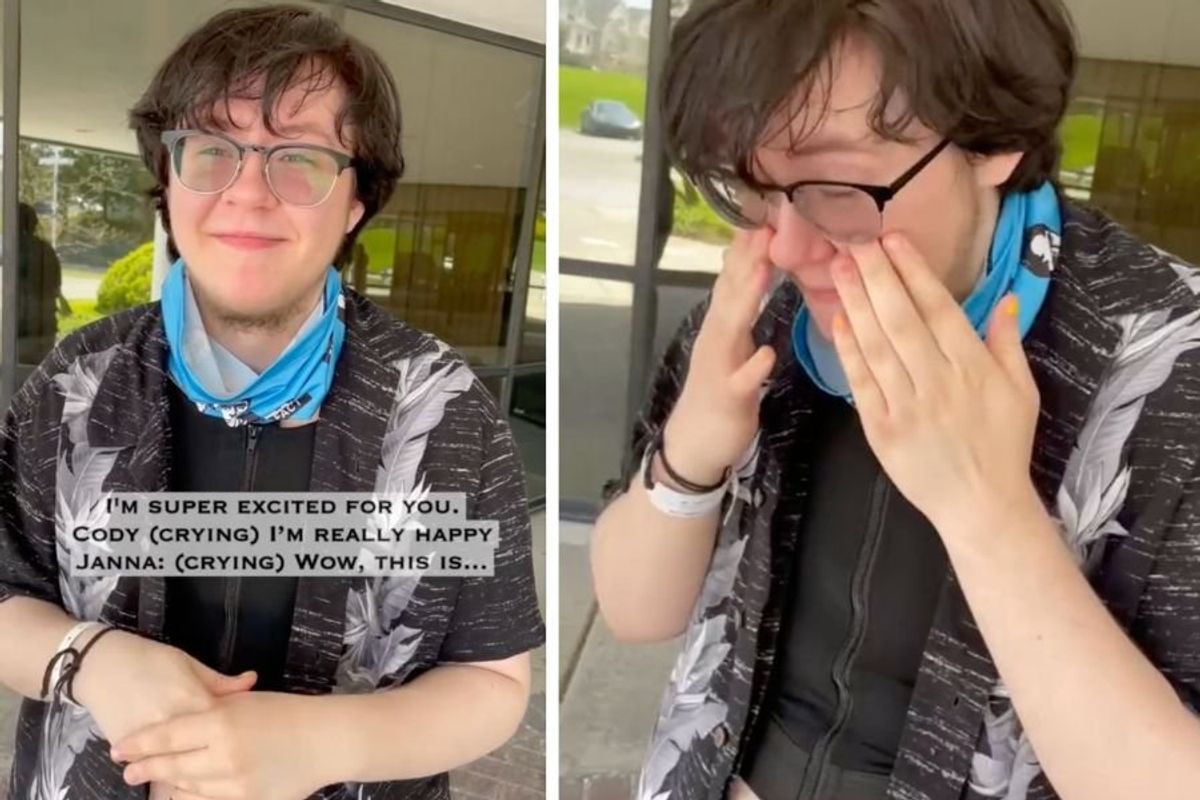
However, a mom by the name of Janna, who recently helped her 17-year-old son receive top surgery, sees it as a form of love.
“Why would I ever allow my 17-year-old to have top surgery? Why would I do that? That’s insane. That’s crazy. It’s child abuse,” says Janna in a clip posted to TikTok.
Her reasoning is really quite simple—and something that almost every parent can relate to in one way or another.
“You look at the really, really happy kid who walked out of the doctor’s office today, feeling really great about himself for the first time in I don’t even know how long.”
Janna then put the spotlight on her son Cody and asked what it felt like when he saw his chest for the first time.
Getting instantly teary, Cody replied, “Normal…It finally feels right for the first time.”
Janna’s video is captioned “Cody’s heart is so full right now.”
Janna, who regularly advocates for trans rights, has previously explained in another TikTok that Cody didn’t undergo any surgery until just before his 18th birthday, and that was only after “a lot of meetings” with doctors, therapists and both of his parents since coming out at the age of 15.
And prior to his procedure, Janna encouraged Cody to explore through a “social transition,” rather than a medical one. This basically means experimenting with other forms of gender presentation—changing their name, pronouns, wardrobe, etc.—that feel more fitting to their authentic identity before undergoing any surgeries.
Bottom line: “We are not just sending these kids to surgeons to have body parts removed. That doesn’t happen,” Janna stated.
When parents support their kids throughout their journey, “one of two things is going to happen,” she added. “They’re going to come out as trans when they’re old enough to really make that decision, or they’re going to say, ‘Yeah, I’m not really a boy.'”
“Either way,” she continued, “their relationship with you will not be tarnished because they know that my mom loved me no matter what my decisions were.”
Like every other turbulent and confusing chapter of teenage-hood, the waters are so much easier to navigate (for both the parent and the child) when there is compassion. Sometimes allowing kids to be who they really are is the best gift a parent can provide.
Lots of people want to clean up the Great Pacific Garbage Patch, and plastics have a huge impact on ocean environments. But marine wildlife are already adapting to our plastic waste, which means cleaning it up isn’t as simple as just… cleaning it up.
This is long, and maybe too long for most people. It took me three days to watch it all. But it is even handed, it is informative, it is well documented, and it is truly how I and so many feel. I loved TYT, but about the time Cenk decided to run for office and gave a lot of control over the company / show to Anna, I noticed a shift / change in both hosts and the company direction. Cenk became very bitter and anti-democratic party, while Anna became overly more assertive on every show. When Cenk came back so bitter from being what he felt was unfairly treated by the democrats but others felt was him trying to claim a position without doing the work others had done before him Anna started talking over him, interrupting him, not letting him finish his sentences. But at the same time if he tried to interrupt her she got very vocal about it and wouldn’t tolerate it. She was now in charge and she wanted the world to know it. It showed how she felt about her position, she had the authority and say, so don’t disagree with her. That was very off-putting for me a long time viewer and supporter of the show. But then Cenk’s constant vitriol against the Democratic Party started to interfere with his reporting on Biden. Right from the start he wanted Biden to do the impossible and when he did not Cenk couldn’t even give him credit for what he did get accomplish. Cenk being a bombastic fighter spent two years demanding Joe Biden attack and call out Joe Manchin and pushed for the most virulent attacks on him. Which would have lost the democrats the control of the Senate and stopped any left leaning judge appointments. Then Cenk got more bitter towards Biden and other progressive members of congress who did not throw the disruptive bombs he wanted to destroy the party, so he openly attacked the very groups he started along with attacking all progressives. What crossed the line for me what his attacks on Biden and openly trying to promote primary challengers to him talking up fringe candidates, knowing historically any time a sitting president was primaried they lost, giving the other party the win. He did not care, his bitter anger was more important to him. He kept up his now constant attempts to tear down Biden to the point he is doing the work of a republican challenger for president. I wrote that when I canceled my long time membership, that Cenk was doing the work of the Republican Party in tearing down and maligning Biden. This hard right turn of Anna’s and Cenk’s weirdly not even willing to listen to any criticism of her was the last straw for me. He is not even really addressing the issue that Anna made as the start of this problem, and keeps misrepresenting it. If Anna wants to be called woman that is great, if trans women demand to be called women that is great and everyone would do as they ask. But there are transmen with parts that medical people need to address and that are on medical forms / question forms. It was pointed out so often that no one in conversation referred to Anna as a “birthing person” but she still took offense to the term even existing. She was demanding a medical term to be inclusive not exist because she felt it diminished her as a female. Total right wing maga fundamentalist thinking. This is entirely a case of two people drinking their own Kool-Aid on their own importance and getting called out for it. Their egos have gotten in the way of the work they were doing. I can no longer support them as they are, and I hope people will watch this well researched and documented video. Hugs
Cenk Uyger, Ana Kasparian, and The Young Turks have had a history of scandals and controversies throughout the existence of the network. I want to talk about that history, as well as the events leading up to their recent meltdowns on the podcast circuit and Twitter.