These laws are being blocked by the courts because it clearly is an attempt to stop people from dressing in a way that fundamentalist conservatives don’t like. It is a way to attack trans people without saying trans. Drag is their word for men dressing as women, or women wearing the fabric of men. Notice they outlaw reading to kids or being in public wearing flamboyant clothing. Quote below. Glamorous or exaggerated costumes. So what are they protecting kids from, color? Are we all to wear drab Amish type clothing? There goes any dress up and make beleive. It is basically the Christian Taliban enforcing the dress code conservatives hope to push back to the stereotypes of the 1950s. What it comes down to is making laws to outlaw things that displease the most uptight right wing religious aunt in a family. Hugs
The law also made Montana the first state to specifically ban drag kings and drag queens — which it defined as performers who adopt a flamboyant or parodic male or female persona with glamorous or exaggerated costumes and makeup — from reading books to children in public schools or libraries, even though the performances do not have a sexual element.
The ruling will allow Montana Pride to advertise and hold some of its events in public places.
Scenes from a drag show at the Montana Capitol held in protest against a slate of bills aimed at how trans Montanans live, April 13, 2023, in Helena, Mont. | Thom Bridge/Independent Record/AP Photo
By ASSOCIATED PRESS
07/29/2023 01:08 PM EDT
HELENA, Mont. — A federal judge in Montana temporarily blocked a new law that restricts drag performances just days before thousands of people are expected to attend Montana Pride’s 30th anniversary celebration in Helena.
The way the law is written “will disproportionally harm not only drag performers, but any person who falls outside traditional gender and identity norms,” including transgender people, U.S. District Court Judge Brian Morris said Friday.
The law seeks to ban minors from attending what it calls “sexually oriented” performances, and bans such performances in public places where minors might be present. However, it does not adequately define many of the terms used in the law, causing people to self-censor out of fear of prosecution, plaintiff’s attorney Constance Van Kley with Upper Seven Law argued Wednesday.
“Plaintiffs, along with the approximately 15,000 Montanans who wish to attend the (Montana Pride) events, cannot avoid chilled speech or exposure to potential civil or criminal liability,” without the temporary restraining order, Morris wrote.
The ruling will allow Montana Pride to advertise and hold some of its events in public places, said Kevin Hamm, president of Montana Pride. The annual LGBTQ+ celebration — which includes a parade, street dance and drag brunch — begins on Sunday and runs through Aug. 6.
“The language used in the (temporary restraining order) is both impressive and should serve as a warning to discriminatory actions by legislators in the future,” Hamm said.
A lawsuit filed on July 6 challenges its constitutionality, and seeks a preliminary injunction to block it. The complaint was later amended to add the city of Helena as a defendant and Montana Pride as a plaintiff in order to request the more urgent move for a temporary restraining order. Montana Pride worked with the city to get permits to hold its public events.
The city of Helena supported the restraining order, saying the law put the city in the position of infringing on Montana Pride’s constitutional rights of free expression by denying the permit, or subjecting city employees to civil and criminal liability included in the law if it granted the permit. The lawsuit allows a minor who attends a drag performance that violates the law to file a civil lawsuit against organizers or participants at any time over the following 10 years.
The complaint — whose initial plaintiffs include a transgender woman, two small theaters and a bookstore that holds drag queen reading events — calls the Montana law “a breathtakingly ambiguous and overbroad bill, motivated by anti-LGBTQ+ animus.”
Judge Morris found that the law did not adequately define actions that might be illegal and appears likely to “encourage arbitrary and discriminatory enforcement.”
Montana’s law is flawed — like similar laws in Florida and Tennessee that have been blocked by courts — because it regulates speech based on its content and viewpoint, without taking into account its potential literary, artistic, political or scientific value, Morris found.
“Drag is definitionally political and artistic speech,” said Diana Bourgeois, president of the Imperial Sovereign Court of the State of Montana, an organization that puts on drag reading events and one of the plaintiffs. “The court’s order today protects our right to be commentators and artists and to create a safe, joyful and welcoming environment through our expression.”
Like many Republican-led states, Montana’s conservative lawmakers have passed other laws targeting transgender people. The state is among those to ban gender-affirming care for minors — which is also being challenged in court. It also passed a bill to define sex as only “male” or “female” in state law.
The law also made Montana the first state to specifically ban drag kings and drag queens — which it defined as performers who adopt a flamboyant or parodic male or female persona with glamorous or exaggerated costumes and makeup — from reading books to children in public schools or libraries, even though the performances do not have a sexual element.
The judge said the law does not define “flamboyant,” “parodic” or “glamorous,” among other terms.
Morris has scheduled an Aug. 26 hearing on the lawsuit’s request for a preliminary injunction, which could continue to block the law while the case moves through the courts.
“We look forward to presenting our written response and full argument at the upcoming preliminary injunction hearing to defend the law and protect minors from sexually oriented performances,” Emily Flower, a spokesperson for the Department of Justice, said in a statement.
The bill’s sponsor, Republican Rep. Braxton Mitchell, has said that to him and his constituents, “keeping hyper sexualized events out of taxpayer funded schools and libraries” does not violate the First Amendment.
Republican presidential candidate Florida Gov. Ron DeSantis speaks during the Family Leadership Summit, July 14, 2023, in Des Moines, Iowa. (AP Photo/Charlie Neibergall, File)
PUBLISHED: July 26, 2023 at 1:25 p.m. | UPDATED: July 28, 2023 at 4:43 a.m.
Long before Moms for Liberty, there were the United Daughters of the Confederacy.
Their passion and influence kept generations of Southern children ignorant of how slavery had caused the Civil War and how cruel it had been. The “war between the states” was rather over “states’ rights” and tariffs. Confederate soldiers were the heroes of a “Lost Cause.” Kindly masters had been considerate to contented slaves.
Reconstruction was bad. The Ku Klux Klan was a benevolent civic organization.
The Daughters didn’t have to pull the truth from shelves. Its influence with state boards kept offending books from ever being printed or bought. When a University of Florida professor wrote that the South had been more in the wrong in the Civil War, the Daughters of the Confederacy got him fired.
In Florida, more than a century later, Southern revisionism is at it again.
Here’s one of them: “Instruction includes how slaves developed skills which, in some instances, could be applied for their personal benefit.”
Another is worse: “Instruction includes acts of violence perpetrated against and by African Americans but is not limited to (the) 1906 Atlanta Race Riot, 1919 Washington, D.C., Race Riot, 1920 Ocoee Massacre, 1921 Tulsa Massacre and the 1923 Rosewood Massacre” (emphasis added).
Andby?
In each of those massacres, Black residents were not the instigators. It is a fraud on history and a libel on them to imply that they were. There were cases where residents of African American communities took up arms to defend their homes, their families and themselves. But they were guarding against armed mobs, seething with racism, bent on arson and murder.
Feeding a fiction
From Donald Trump on down, contemporary Americans playing on race for political advantage have been trying to denigrate the Black Lives Matter movement by accusing it of responsibility for violence. The “and by” phrase, unnecessary and gratuitous and now officially part of the Florida social studies curriculum, feeds that fiction.
Stephen Hudak/Orlando SentinelWilliam Maxwell, a Vietnam-era veteran and resident of Ocoee for two decades, kneels at the gravesite of July Perry in Greenwood Cemetery. Perry, who encouraged Blacks to register to vote, was lynched by a white mob after the Ocoee Massacre in 1920.
The mob that ravaged Ocoee in Orange County, where 25 homes burned and at least eight people died, was incited by two Black men attempting to vote. The massacre at Rosewood, which erased the settlement, was set off by a married white woman’s claim that a Black man had attacked her. The official state history cites Black survivors, who said the assailant was a white lover. (For a link to the Sentinel’s 100th-anniversary coverage of the Ocoee Massacre and images of our 1920s coverage, please visit our web site at orlandosentinel.com/opinion. We’re making that historic coverage, along with other fascinating local history, free for everyone this week.)
For Black history, Florida’s previous standards were extensive and objective, unlike Southern propaganda of the 1900s.
1 of 5
These images reflect the contemporary coverage of the Ocoee massacre by the Orlando Sentinel.
But one rotten apple can spoil a barrel, and this one has two. There was nothing beneficial about slavery, except to the masters. When slaves learned a trade, such as blacksmithing, carpentry, or caulking wooden ships, as Frederick Douglass did, it was not for their benefit but for the convenience and profit of their masters. And many of them arrived on these shores with those skills already mastered.
Vice President Kamala Harris accurately described slavery in her speech at Jacksonville, which was aimed at DeSantis without mentioning him.
“Adults know what slavery really involved,” Harris said. “It involved rape. It involved torture. It involved taking a baby from their mother. It involved some of the worst examples of depriving people of humanity … It involved subjecting to people the requirement that they would think of themselves and be thought as less than human… How is it that anyone could suggest that in the midst of these atrocities … that there was some benefit?”
A defense from DeSantis
After DeSantis first said he “wasn’t involved” in writing the standards, he is now defending them.
Florida Gov. Ron DeSantis is arguing that some Black people benefited from being enslaved and defending his state’s new African American history standards that civil rights leaders and scholars say misrepresents centuries of U.S. reality. https://t.co/LQwYSaqhPw
— The Washington Post (@washingtonpost) July 23, 2023
This would be a good time for him to begin admitting he was wrong. His critics are feasting on this one.
DeSantis owns this horrific mistake, even if he didn’t personally write the standards. It is his education department, run by his appointees.
Cues are obvious in the dog whistles he’s sent. He banned critical race theory in schools (where it wasn’t even being taught.) He signed a law meant to banish all talk of the relevance of past or present racism from Florida schools and workplaces. He’s made it easier to purge school library shelves of innocuous books some people found to be objectionable because they reflected other cultures or talked about the history of civil rights.
The Department of Education’s attempt to document the “personal benefit” issue backfired. Of the 16 historic Black people it cited, as many as half had never been enslaved, according to the Tampa Bay Times. Others, notably the educator Booker T. Washington, acquired their skills after they were freed.
Douglass’ master kept most of the money he earned caulking ships in the Baltimore yards. Fearful of being sold South, Douglass made his escape to become an eloquent, world-famous advocate for the millions in chains.
His memoir recalled how the master, Hugh Auld, rebuked his wife for teaching him the alphabet when he was 11.
Literacy would “forever unfit him for the duties of slave,” Auld said. He should “know nothing but the will of his master and learn to obey it.” This harsh reality, which viewed high-quality education for African Americans as a threat to Caucasian control of society, echoed for decades as Black students were forced into segregated schools. Even now, some schools in high-poverty areas with large minority populations can lack access to options such as advance placement or International Baccalaureate programs.
This is the hideous legacy DeSantis is trying to revive. And no matter how much he squirms and dodges, he can’t erase the stain his actions are leaving on Florida’s reputation.
Coming later this week
DeSantis’ attempts to weaponize racism are turning Florida into a laughingstock and, at long last, turning fellow Republicans and donors against him. Why did it take so long?
The Orlando Sentinel Editorial Board includes Editor-in-Chief Julie Anderson, Opinion Editor Krys Fluker and Viewpoints Editor Jay Reddick. The Sun Sentinel Editorial Board consists of Editorial Page Editor Steve Bousquet, Deputy Editorial Page Editor Dan Sweeney and Anderson. Send letters to insight@orlandosentinel.com.
Wow, oh wow. This is so informative and full of information I had to go over some spots several times. The host talks rather quickly, more than I am used to and I did not check the CC as I was listening only as I was doing something else. But my dogs that love gravy she has this stuff down. Hugs
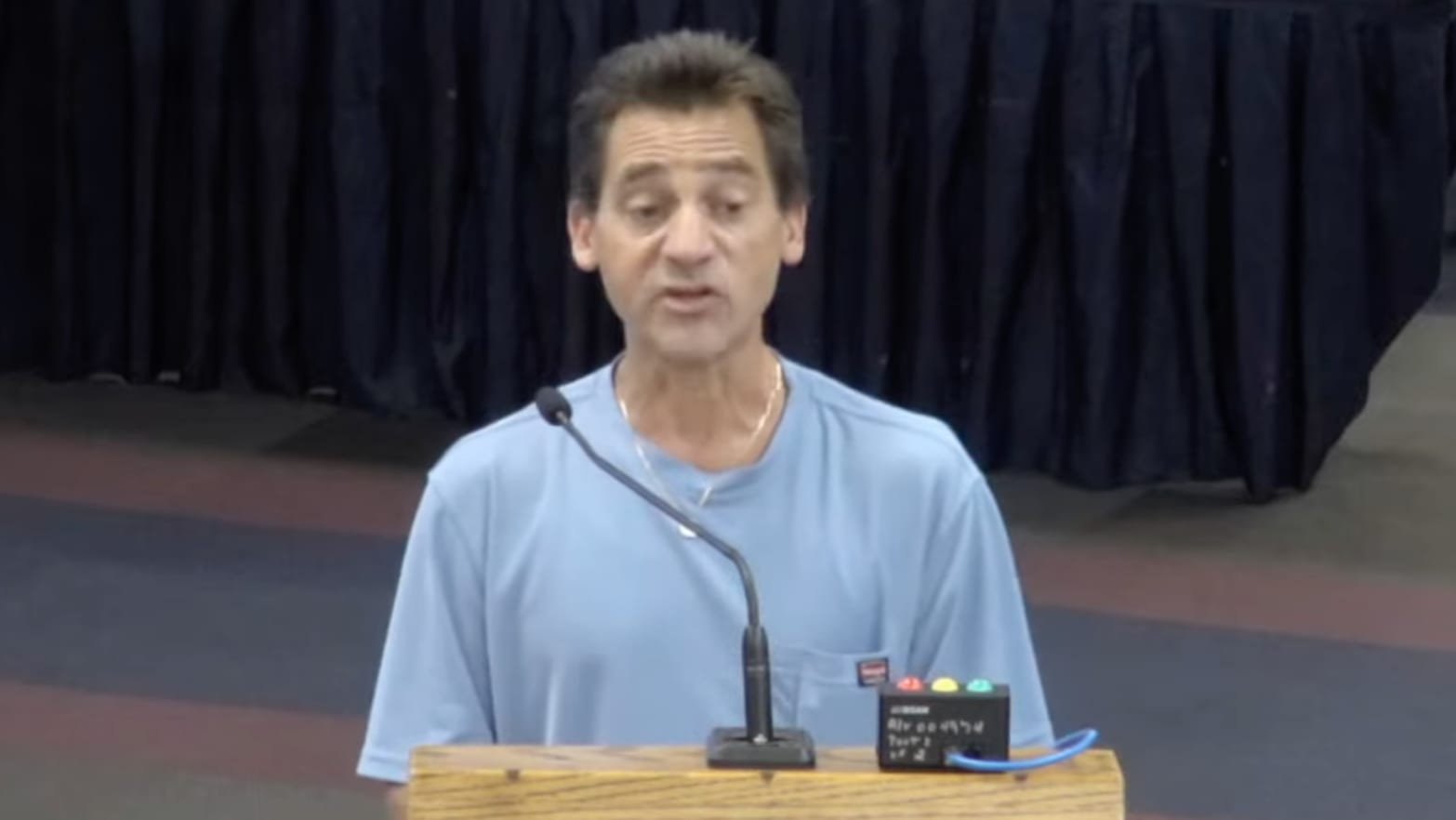
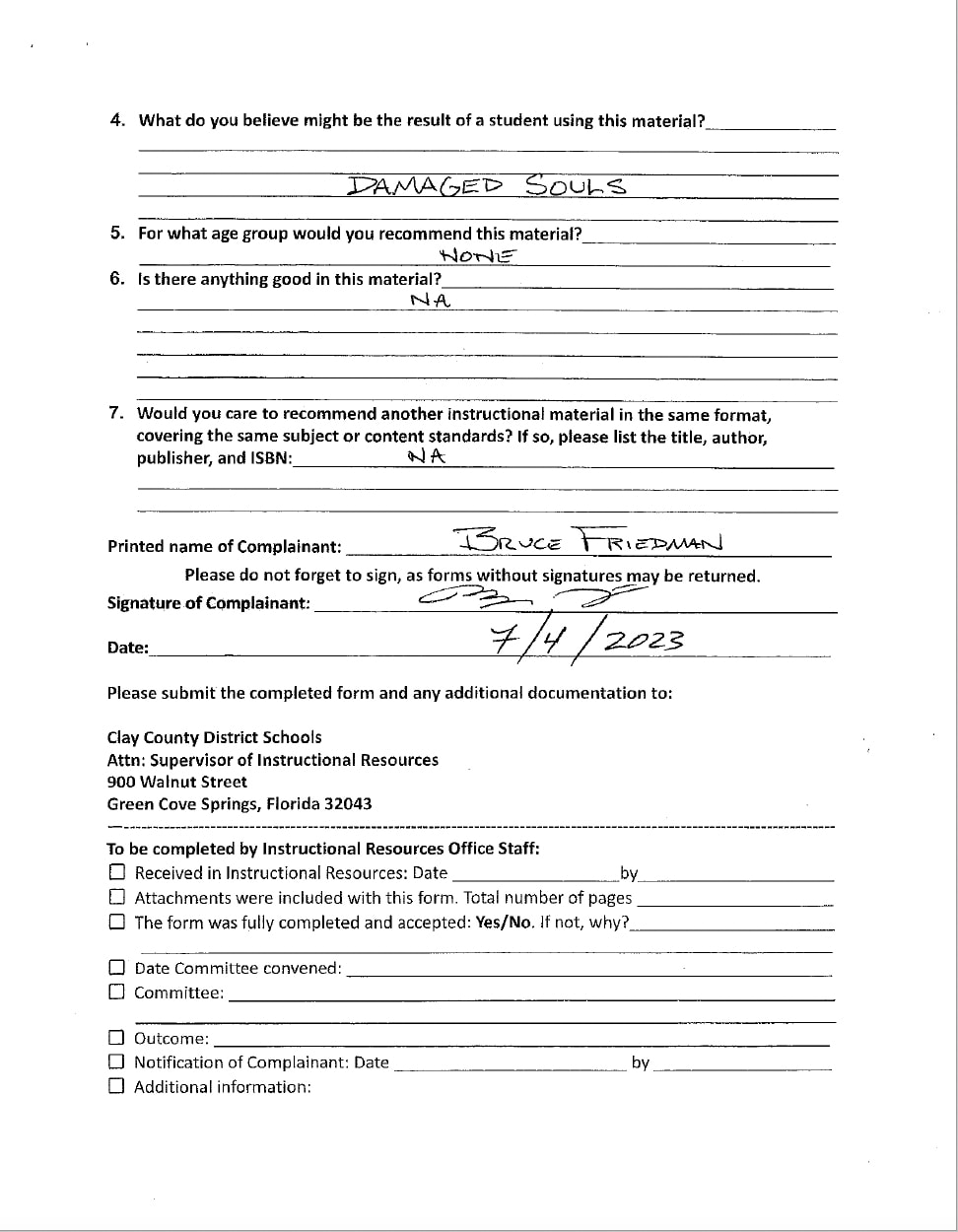
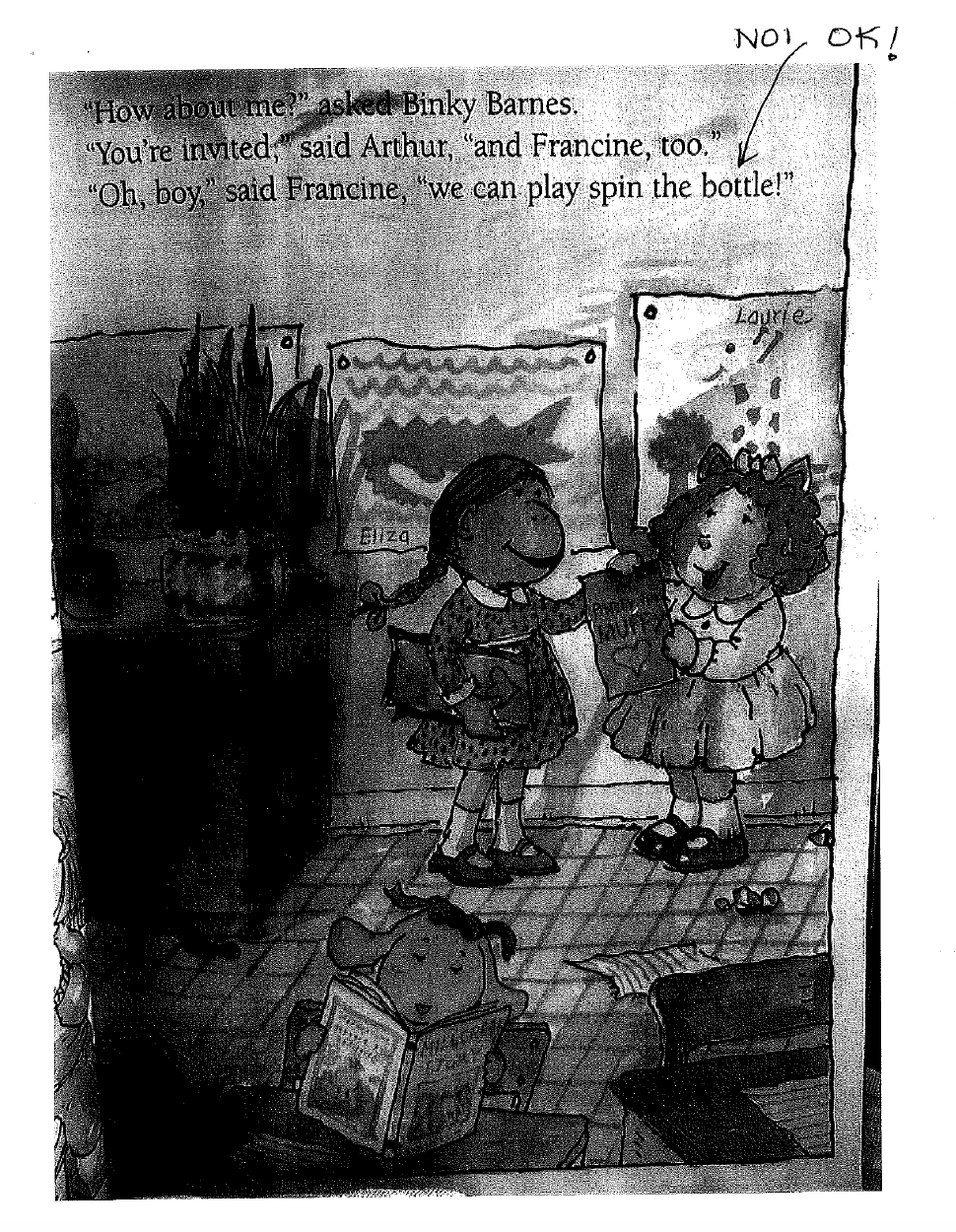
A minority of a minority with in a minority is trying to force a religious strict moral view of what is acceptable in society. These small groups of driven fundamentalist, who think any advances in society since the 1950s angers their deity they are desperate to please, use threats and violence to take the rights away from everyone else. This one man is demanding the right to decide what everyone’s children get to read and see. Removing other parents rights to bring up their children as accepting of others and themselves. Please note the harm he claims will happen because of this book, damaged souls. One line about playing spin the bottle. Tell me what five year even knows that could be sexual. Kids start playing that as preteens as they go through puberty, daring each to kiss someone. So it is an innocent line, there is no description of what it is. If a kid asks, the adult says it is a game played with the bottle to see how long you can keep it spinning or something. Even worse if they lose their attempts to get a book removed all they have to do is keep filing complaints which keeps it off the shelves or the book get removed as too much of a problem. Hugs
—————————————————————————————————–
The children’s book is under review in one school district after a local conservative activist ranted that one aspect of it could “DAMAGE SOULS.”
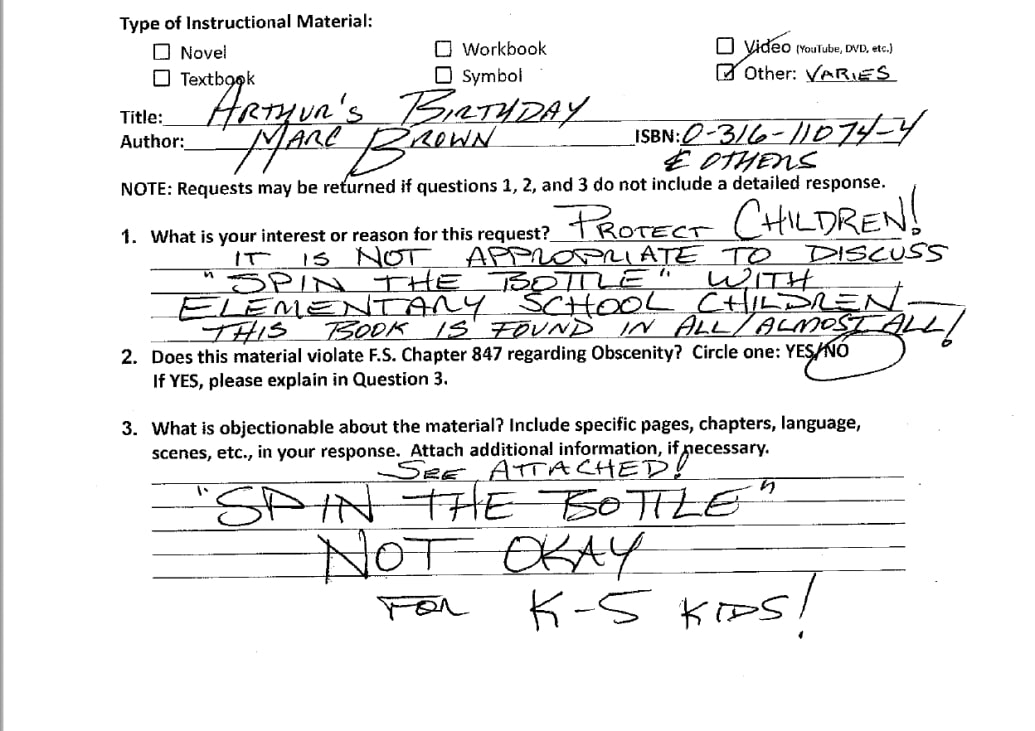
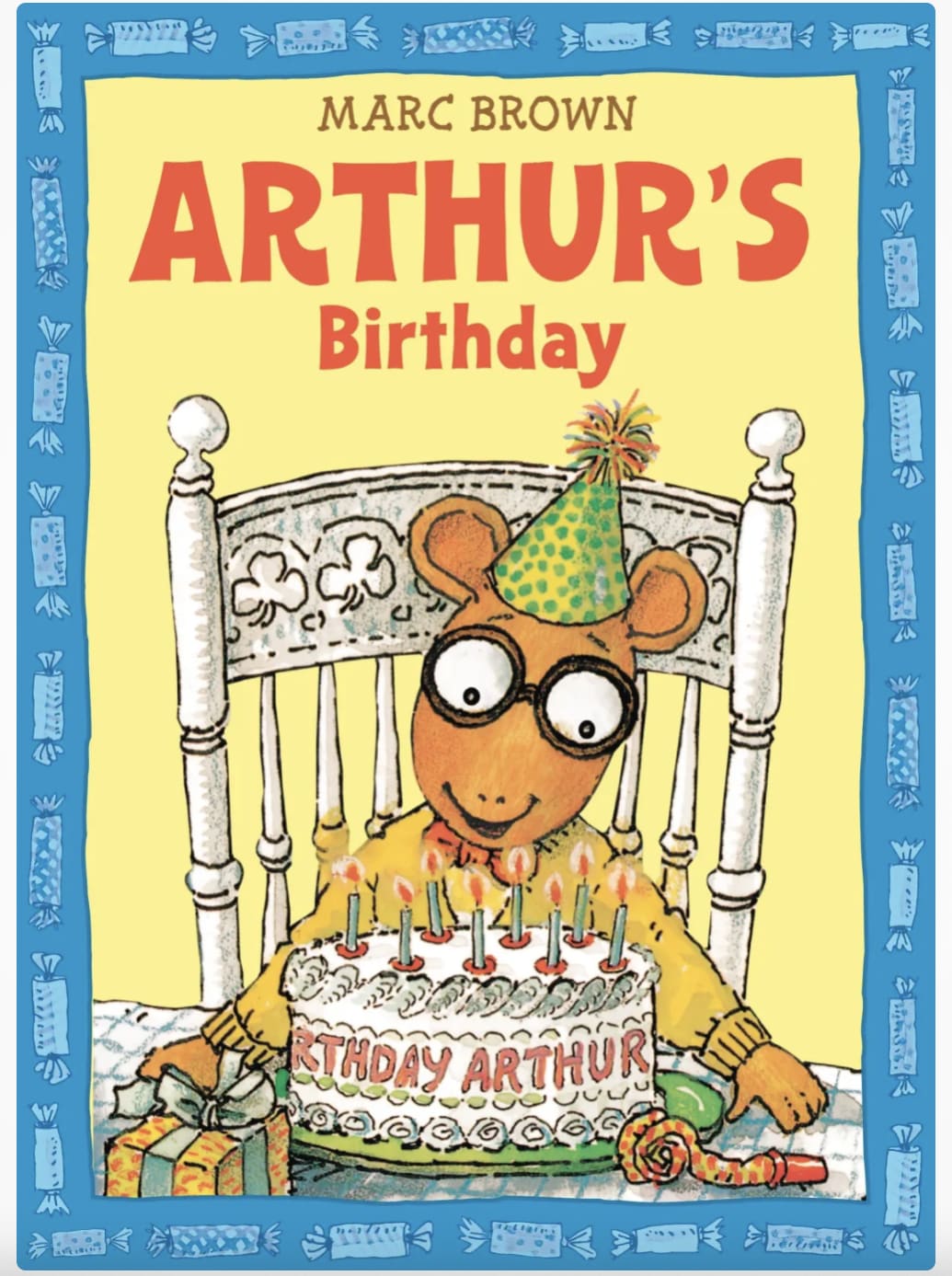
A lone parent filed a complaint to a Florida school district that a book in the Arthur series—yes, the same Arthur from the beloved PBS animated show—contained references to Spin the Bottle, and now it’s possibly on the district’s chopping block.
A member of the Clay County School District community, based in Green Cove Springs, filed the challenge on July 12 to Marc Brown’s Arthur’s Birthday, a children’s book geared towards students in kindergarten to sixth grade. District spokesperson Terri Dennis told The Daily Beast that it was among 45 challenged titles now “pending oversight committee review.”
On Wednesday, the district provided The Daily Beast with the stack of challenge forms the school district had received for July. At least eight book challenges filed that month were submitted by a local conservative activist named Bruce Friedman.
Arthur’s Birthday details the title character’s upcoming birthday and how it falls on the same day as another party for a classmate, who happens to be a girl. Arthur wants all of his friends to show up, and figures out a plan to combine the parties together. At the end, Arthur receives a “Spin the Bottle” present from one of the girls.
On his form, Friedman wrote, “PROTECT CHILDREN!! IT IS NOT APPROPRIATE TO DISCUSS ‘SPIN THE BOTTLE’ WITH ELEMENTARY SCHOOL CHILDREN. THIS BOOK IS FOUND IN ALL/ALMOST ALL [DISTRICT SCHOOLS]!”
Friedman continued to scribble across the form how “SPIN THE BOTTLE” is “NOT OKAY FOR K-5 KIDS!” and how the content could potentially “DAMAGE SOULS.” He also included images from the book that he felt were not suitable for its intended audience.
“The entire book is about being inclusive of all friends and not only inviting boys or girls (based on your gender) to your birthday party,” literary watchdog Florida Freedom to Read Project wrote on Twitter.
Reagan Miller, a member of Florida Freedom to Read Project, said she believes book banners are just trying to create “chaos in the education system” and make a boogeyman out of diversity, equity, and inclusion.
“I think it’s more to keep feeding a narrative,” she told The Daily Beast, suggesting that even Barney & Friends could be the next target.
And just like that, 20 additional titles have been added to the 23/24 list in @oneclayschools.
— Florida Freedom to Read Project (@FLFreedomRead) July 17, 2023
Friedman wrote disapproving notes on other book challenge forms. However, he also included disparaging comments about librarians, suggested that district administrators needed to be fired, and consistently berated some authors for being “repeat offenders.”
Dennis told The Daily Beast that “95 [percent] of the book challenges in Clay County come from one individual in the community.” She didn’t specify who that individual was, but Friedman is responsible for nearly all book challenges in the county, according to independent newsletter Popular Information.
Friedman is the president of Florida’s chapter of No Left Turn in Education, a group known for fear-mongering the teachings of Critical Race Theory. According to the group’s website, its goal is to “use all forms of media to expose the radical indoctrination in K-12 education.”
At a Florida Department of Education meeting in December, Friedman bragged about creating a list of over 3,600 books that he felt contained “concerning content,” Popular Information reported. In June 2022, Friedman’s mic was cut off when he attempted to read a rape scene aloud during a school board meeting.
Friedman declined an interview request with The Daily Beast on Thursday. “No thank you,” he wrote in an email.
Clay County School District’s Library Media Services Manual states that “challenged materials should be presented to the District Curriculum Council.”
“Materials under question will be held until a decision has been made,” the manual reads. “A decision to remove materials from the library media center is based on the recommendation of the District Curriculum Council and the final decision of the Superintendent or designee.”
If a book is resubmitted as part of a complaint, the oversight committee—media and academic administrators within the district—can choose to completely chuck the book from schools’ libraries or dismiss the challenge. If the person who filed the complaint wants to appeal the group’s decision, then the school board schedules a hearing and they make the final call.
According to district records, as of Thursday, Arthur’s Birthday is still “Pending Oversight Committee Review.”
So many of the horrible things happening in America right now, like teaching our children slaves were lucky to learn skills, or allowing women to bleed out in hospital parking lots, or pushing migrants into rivers to drown, could be stopped by the women who look exactly like me.
These white men won’t quit until the US is a Christian theocracy policed by Christian Taliban moral police thugs. Some important quotes that show their mindset. Regardless of the legislative strategy, the panelists agreed changing the culture of America to take on a Christian biblical worldview, which will require all pastors to take the same position on abortion as their own. Also week-long series of events hosted by Operation Save America, an anti-abortion, anti-LGBTQ and anti-Muslim religious group that wants all Americans to follow “God’s law” and their interpretation of the Christian gospel. The panel was part of a week-long series of events hosted by Operation Save America, an anti-abortion, anti-LGBTQ and anti-Muslim religious group that wants all Americans to follow “God’s law” and their interpretation of the Christian gospel. The moderator of the panel, Derin Stidd, opened by asking, “Why do you all hate women?” to which the men laughed. Hugs
Florida's new African American history standards include a requirement that middle schoolers learn "how slaves developed skills which, in some instances, could be applied for their personal benefit." @goni_lessanhttps://t.co/DCjauBVLbV
Enslavers defended slavery by claiming it was a “positive good” for Black people. Today Florida’s Board of Education approved new Black history standards that note enslaved Black people developed skills that “could be applied for their personal benefit.”https://t.co/xNEIZoK4o3
^ That captures it in a nutshell. The education of slaves was to benefit the people holding them in bondage as property.
Some of his fans are disappointed they don’t get to see him in action.
So DeSantis and his followers trash talk and urge boycotts against a company in which the trust fund HE oversees invests; and when his followers boycott the company and crash the sales, he threatens to sue the company. What a maroon.https://t.co/UcBeyANmTL
If I’m understanding this correctly, DeSantis praised the Bud Light boycott, claimed he’d never drink the beer again, and now wants to sue because … the boycott he endorsed and engaged in had consequences? https://t.co/cKJyHkvZVB
It seems entirely premature, but the looming Oct. 1 deadline for state parties to submit delegate changes to the RNC has the Trump team moving to lock down their support now—and know where they might stand if there’s a 2nd ballot on the floor. https://t.co/E4LE7i5we6
Texas A&M University said on Friday that its president would retire “immediately” after fallout surrounding political pushback of a new director of its journalism program because of her work promoting diversity, equity and inclusion.
Germany’s 1933 civil service law applied to university professors as well as elementary and secondary-school teachers. … Scholars who were Jewish or supported left-leaning parties struggled to find research and teaching positions in public, government-supported German universities and often worked in private ones instead. With the passage of the new law, the Nazis attempted to root out any dissent to their policies and ideology that remained in German higher education.
They call it other things, like “Protecting Children” or “Academic Freedom”. None of which is their actual goal, but it’s just bigotry and racism repackaged to make it more palatable.
Honestly, who would be against diversity? Racists… that’s who.
🚨BREAKING: Alabama Gov. Kay Ivey (R) signs new congressional map that does NOT contain the second majority-Black district that the U.S. Supreme Court required.
Again this shows the republicans in congress don’t care about national security, about law enforcement, intelligence assets, or even justice. Instead they want power and to destroy their enemy at any cost. They are teens playing a video game holding nothing back. They can’t see past their petty trolling and snarky insinuations. Hugs
‘We have repeatedly explained to Congress, in correspondence and in briefings, how critical it is to keep this source information confidential,’ the FBI tells The Messenger
Published 07/21/23 02:08 PM ET|Updated 07/21/23 03:45 PM ET
Stephen Neukam
The FBI repeatedly warned lawmakers not to share the contents of a sensitive document related to a Department of Justice investigation of Hunter Biden, The Messenger has learned.
In spite of those warnings, congressional Republicans have made the document a central focus of their investigation of President Joe Biden and his son. One senior Senate Republican on Thursday publicly released a semi-redacted version of the FBI report, which contains an informant’s allegations of bribery against the Bidens.
FBI officials cautioned lawmakers on several occasions about the dangers that releasing the document could pose to confidential informants and others, according to materials obtained by The Messenger.
“We have repeatedly explained to you, in correspondence and in briefings, how critical it is to keep this information confidential,” the FBI said in a June 9 letter, obtained by The Messenger, to the Democratic ranking member and chairman of the House Oversight Committee, Rep. James Comer, R-Ky., who has been scrutinizing the Biden family.
“We are concerned that Members disregarded the Committee’s agreement that information from the document should not be further disclosed,” the FBI said in the letter, which came one day after lawmakers on the Oversight Committee were permitted to view the document in a secured room.
Other documents obtained by The Messenger show that the FBI’s warnings not to release the confidential information extended back to May — before Comer and others were allowed to view the FBI form.
The FBI told lawmakers that protecting the secrecy of the FBI form is “critical” to the “physical safety” of the source and others, according to a May 30 letter sent to Comer.
The letter cited a May 22 meeting the FBI had with Oversight Committee staff, in which “the Deputy Assistant Director expressed the FBI’s concern over the chilling effect that could flow from the wide dissemination of investigative files.”
US President Joe Biden participates in the US-Nordic Leaders’ Summit at the presidential palace in Helsinki, Finland, on July 13, 2023.ANDREW CABALLERO-REYNOLDS/AFP via Getty Images
“As you know, confidential sources are critical to the FBI’s ability to build cases, including those against violent gangs, drug cartels, and terrorists,” the letter said. It explained that “closely protecting” information about the source could “prevent chilling of FBI’s recruitment of sources and their candor in reporting, and also to protect sources and individuals associated with them from being physically harmed or even killed.”
The FBI document in question, called a FD-1023 form — which is used by FBI agents to record unverified raw information from informants — has been at the center of Comer’s committee’s investigation of the Bidens. The FBI form contains allegations that Hunter Biden and another Biden family member received money from a Ukrainian energy firm in exchange for foreign policy decisions.
Lawmakers viewed the document behind closed doors last month, before Sen. Chuck Grassley, R-Iowa, released the document to the public on Thursday. Grassley said he obtained the document through a Justice Department whistleblower.
Members of Congress were also provided with a warning that the information contained in the document “should be treated confidentially,” before they viewed the form on June 8, saying the agency “expressly does not consent” to the release of the material.
The FBI also raised concerns that lawmakers were taking notes in the meeting, which was prohibited, according to the letter.
The document released by Grassley on Thursday was even less redacted than the one viewed by lawmakers, a Democratic source familiar with the form told The Messenger. The material released by the Republican senator revealed that Mykola Zlochevsky, the owner of Burisma, the Ukrainian energy firm named in the alleged bribery scheme, was the source of the information.
Asked for comment, the FBI told The Messenger on Friday that throughout the agency’s dealings with Congress over GOP committee investigations of Biden family matters, the “release of the 1023 – at a minimum – unnecessarily risks the safety of a confidential source.”
“We have repeatedly explained to Congress, in correspondence and in briefings, how critical it is to keep this source information confidential,” the FBI statement said, adding that “safeguards the FBI placed on the production of this information are necessary to protect the safety of confidential sources and the integrity of sensitive investigations.”
Grassley’s office on Friday defended the GOP senator’s public release of the sensitive FBI form, noting that the version released by Grassley included redactions and that the actual FBI document was marked “unclassified”
“Democrats and the media sought to link the FD-1023 to the Bidens’ activity in Ukraine long before this document became public, citing information that only the FBI and DOJ could have known,” a Grassley spokesperson said in a statement issued to The Messenger. “Those public statements exposed the source to those he or she communicated with. The FBI can’t cite risks to sources while thwarting congressional oversight in one breath and leak selective information to the news media in another.”
A spokesperson for Comer struck a similar note, saying criticism from the FBI was “a last-ditch effor… to thwart legitimate congressional oversight.”
Another letter obtained by The Messenger, sent from the agency to Comer on May 10, explained the “great risk to themselves and their loved ones” that confidential sources take on when providing information to the bureau.
“Significant harm to investigative work—and to the program as a whole—could result from dissemination of FD-1023s or other similar documents,” the letter said.
This about bigotry and erasing LGBTQ+ people from history. These same people refusing to teach kids about an openly gay political claiming he was a pedophile, insinuating he was abusing little children. He was said to be in relationships with a couple of older teens who were well over the age of consent. In NY at the time the age of consent was 14. But these same bigot haters have no trouble promoting the teaching of republican politicians who have been charged and found guilty of child sex abuse. Also there is a double standard. No one refers to Elvis as a pedophile or pederast. Priscilla Beaulieu was only 14 years old when she met 24-year-old Elvis Presley. At the age of 40, Elvis dated Reeca Smith, then 15 years of age. There are scores of examples of male celebrities and their 16-year-old girlfriends. This is just an excuse to prevent children from learning that gay people exist and are leaders in government. These haters want to wipe out any mention of gay or trans people from history and society. Plus these bigots refused to use the new textbooks with Milk in them even after the parents overwhelming told them to do so. Quotes below. Hugs
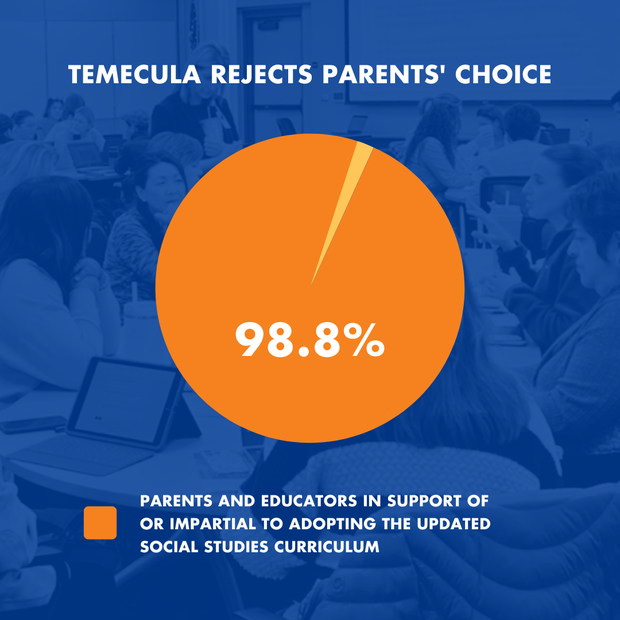
The repeated decisions by board members have drawn the ire of many Temecula parents, who have taken to city streets to protest the decision. They’re upset by the board’s conscious disregard of public opinion in which 98.8% of TVUSD parents voted to support the adoption of the new curriculum, according to data from the Governor’s office.
“Once again, it is clear that you are a homophobe,” the woman said while speaking during the public comment portion of the meeting.
California Governor Gavin Newsom on Wednesday announced that the state would be fining the Temecula Valley Unified School District in an ongoing battle over a social studies curriculum that involves gay rights activist Harvey Milk.
On Tuesday, the TVUSD board voted against the new curriculum, which has been endorsed by the state, adding to what has been a tumultuous span of weeks in which the governor and district have been trading jabs.
A 3-2 vote saw the board again reject the material solely based on the mention of Milk, a gay rights figure who paved the way for LGBTQ+ members today, becoming the first openly gay man elected into office in California. Board members and a group of parents are upset over allegations that Milk was a pedophile and had a relationship with a teenager while he was in his 30s.
As a result, Gov. Newsom imposed a $1.5 million fine for the district, in what he calls a “willful violation of the law.” He also plans on providing the new textbooks to TVUSD students prior to the start of the new school year, which begins on Aug. 14, along with the estimated $1.6 million price tag to acquire the textbooks.
“The three political activists on the school board have yet again proven they are more interested in breaking the law than doing their jobs of educating students — so the state will do their job for them,” Newsom said in a statement. “California will ensure students in Temecula begin the school year with access to materials reviewed by parents and recommended by teachers across the district. After we deliver the textbooks into the hands of students and their parents, the state will deliver the bill — along with a $1.5 million fine — to the school board for its decision to willfully violate the law, subvert the will of parents, and force children to use an out-of-print textbook from 17 years ago.”
OFFICE OF GOVERNOR GAVIN NEWSOM
The repeated decisions by board members have drawn the ire of many Temecula parents, who have taken to city streets to protest the decision. They’re upset by the board’s conscious disregard of public opinion in which 98.8% of TVUSD parents voted to support the adoption of the new curriculum, according to data from the Governor’s office.
“They embrace the fact that Governor Newsom is getting involved because it’s almost like that’s their goal,” said Aaron Cook, a TVUSD parent. “Rather than doing what’s best for the students.”
On top of that, their current textbooks are dated and don’t contain an accurate representation of the state’s history, preventing children from receiving a thorough education.
“This is not a religious school district,” said another TVUSD student. “It’s a public school district that has to abide by California Public Education Code.”
In what was yet another emotionally charged meeting on Tuesday, a video shows one woman being escorted out of the room after confronting board members.
“Once again, it is clear that you are a homophobe,” the woman said while speaking during the public comment portion of the meeting.
Other members voiced their full support for the efforts of the board members.
“I can tell you know that you have more support than you’ll ever know,” said one man, whose comment was met by cheers from others in the crowd.
Upon request for comment, TVUSD issued a statement on behalf of Board President Komrosky, which said:
“I speak personally here and not on behalf of the entire TVUSD Board when I say, the Temecula Valley Unified School District is not done with its work on curriculum for the 2023-2024 school year. We continue to engage our parents and work diligently towards finding the right solution for our community, and every day we make progress towards that goal. We still have the time to continue this critical process and meet all state and federal mandates before the next school year begins. Throughout this process, we have put a high value on Board priorities such as curriculum & instruction as well as family & community. One such policy priority of the Board is that “Our families and community members will feel connected, informed, and welcome to participate as true partners in the education of our students.” We take that policy seriously and intend for those words to have actual meaning. Additionally, parental feedback is critical in collaborating with our educators, and executive staff to find agreement on what standards will best achieve educational excellence.
A critical component of that exercise is to determine the subject matter’s age appropriateness for any curriculum and the specific grade level at hand. While engaged in this process, I am confident that while reviewing any curriculum for use in this District, TVUSD will select the best material that emphasizes our mission of, “High-Quality Teaching and Learning for All”, but that also avoids any teacher-to-student conversations related to sex and sexual activity at the elementary school level. These conversations are better left to the parents and their children.
Despite our continuing work and commitment to core values, Governor Newsom has taken unilateral action to intervene in the middle of our work without even contacting the school district first to understand what the school district may be further doing to meet all of the curriculum needs of our students. What he calls inaction we see as responsible considerations for all of our community’s viewpoints as we come to a final decision and with time left to do so. To that end, I will be calling a Special Meeting of the Board for July 21, 2023, to consider a culmination of our work on this issue and the potential adoption of curriculum that meets all state and federal mandates. We do not appreciate Governor Newsom’s effort to usurp local control and all that will apparently result from these tactics is a waste of the taxpayers’ money. We sincerely hope he has a 14-day return policy with the publisher of the books he just purchased.”
“My question is, why even mention a pedophile?” he said at the highly contentious meeting.
In the time since, Newsom has directed public comments towards the school board, referring to Komrosky as “an ignorant person.”
Komrosky responded to the governor, in a rhetorically-charged statement of his own.
“I assure you that I am anything but ignorant regarding what you said. Governor, you said it right when you said this isn’t Texas or Florida as we could be so much better than these states if we had better leadership than the top levels of government…,” Komrosky said.
This is the latest instance of the California governor’s attempts at preventing book banning, both in the Golden State and nationally, after interjecting himself into ongoing debates in Republican-controlled states like Texas and Florida.
The mention of LGBTQ+ material has been highly-divisive in school districts across the United States, with several notable instances taking place in Southern California in recent months.
OK the last article I posted from Scientific American may not have been clear enough that it is far to simplistic to claim that there are only two distinct genders. This article is long and more detailed with science then many will want to read, but it shows the idea of binary sex is wrong. A qoute from the article. Sex can be much more complicated than it at first seems. According to the simple scenario, the presence or absence of a Y chromosome is what counts: with it, you are male, and without it, you are female. But doctors have long known that some people straddle the boundary—their sex chromosomes say one thing, but their gonads (ovaries or testes) or sexual anatomy say another. The article talks about a woman giving birth to a baby and she found out the following. The baby was fine—but follow-up tests had revealed something astonishing about the mother. Her body was built of cells from two individuals, probably from twin embryos that had merged in her own mother’s womb. And there was more. One set of cells carried two X chromosomes, the complement that typically makes a person female; the other had an X and a Y. Halfway through her fifth decade and pregnant with her third child, the woman learned for the first time that a large part of her body was chromosomally male. And here is the kicker.What’s more, new technologies in DNA sequencing and cell biology are revealing that almost everyone is, to varying degrees, a patchwork of genetically distinct cells, some with a sex that might not match that of the rest of their body.
Often those who are stuck in the only two sexes camp claim any devation is intersexs or an anomoly that is rare and a small population. But the research shows there is a lot more variation than was know before new science was available. But beyond this, there could be even more variation. Since the 1990s, researchers have identified more than 25 genes involved in DSDs, and next-generation DNA sequencing in the past few years has uncovered a wide range of variations in these genes that have mild effects on individuals, rather than causing DSDs. “Biologically, it’s a spectrum,” says Vilain. Hugs
As a clinical geneticist, Paul James is accustomed to discussing some of the most delicate issues with his patients. But in early 2010, he found himself having a particularly awkward conversation about sex.
A 46-year-old pregnant woman had visited his clinic at the Royal Melbourne Hospital in Australia to hear the results of an amniocentesis test to screen her baby’s chromosomes for abnormalities. The baby was fine—but follow-up tests had revealed something astonishing about the mother. Her body was built of cells from two individuals, probably from twin embryos that had merged in her own mother’s womb. And there was more. One set of cells carried two X chromosomes, the complement that typically makes a person female; the other had an X and a Y. Halfway through her fifth decade and pregnant with her third child, the woman learned for the first time that a large part of her body was chromosomally male. “That’s kind of science-fiction material for someone who just came in for an amniocentesis,” says James.
Sex can be much more complicated than it at first seems. According to the simple scenario, the presence or absence of a Y chromosome is what counts: with it, you are male, and without it, you are female. But doctors have long known that some people straddle the boundary—their sex chromosomes say one thing, but their gonads (ovaries or testes) or sexual anatomy say another. Parents of children with these kinds of conditions—known as intersex conditions, or differences or disorders of sex development (DSDs)—often face difficult decisions about whether to bring up their child as a boy or a girl. Some researchers now say that as many as 1 person in 100 has some form of DSD.
When genetics is taken into consideration, the boundary between the sexes becomes even blurrier. Scientists have identified many of the genes involved in the main forms of DSD, and have uncovered variations in these genes that have subtle effects on a person’s anatomical or physiological sex. What’s more, new technologies in DNA sequencing and cell biology are revealing that almost everyone is, to varying degrees, a patchwork of genetically distinct cells, some with a sex that might not match that of the rest of their body. Some studies even suggest that the sex of each cell drives its behaviour, through a complicated network of molecular interactions. “I think there’s much greater diversity within male or female, and there is certainly an area of overlap where some people can’t easily define themselves within the binary structure,” says John Achermann, who studies sex development and endocrinology at University College London’s Institute of Child Health.
These discoveries do not sit well in a world in which sex is still defined in binary terms. Few legal systems allow for any ambiguity in biological sex, and a person’s legal rights and social status can be heavily influenced by whether their birth certificate says male or female.
“The main problem with a strong dichotomy is that there are intermediate cases that push the limits and ask us to figure out exactly where the dividing line is between males and females,” says Arthur Arnold at the University of California, Los Angeles, who studies biological sex differences. “And that’s often a very difficult problem, because sex can be defined a number of ways.”
THE START OF SEX
That the two sexes are physically different is obvious, but at the start of life, it is not. Five weeks into development, a human embryo has the potential to form both male and female anatomy. Next to the developing kidneys, two bulges known as the gonadal ridges emerge alongside two pairs of ducts, one of which can form the uterus and Fallopian tubes, and the other the male internal genital plumbing: the epididymes, vas deferentia and seminal vesicles. At six weeks, the gonad switches on the developmental pathway to become an ovary or a testis. If a testis develops, it secretes testosterone, which supports the development of the male ducts. It also makes other hormones that force the presumptive uterus and Fallopian tubes to shrink away. If the gonad becomes an ovary, it makes oestrogen, and the lack of testosterone causes the male plumbing to wither. The sex hormones also dictate the development of the external genitalia, and they come into play once more at puberty, triggering the development of secondary sexual characteristics such as breasts or facial hair.
Changes to any of these processes can have dramatic effects on an individual’s sex. Gene mutations affecting gonad development can result in a person with XY chromosomes developing typically female characteristics, whereas alterations in hormone signalling can cause XX individuals to develop along male lines.
For many years, scientists believed that female development was the default programme, and that male development was actively switched on by the presence of a particular gene on the Y chromosome. In 1990, researchers made headlines when they uncovered the identity of this gene, which they called SRY. Just by itself, this gene can switch the gonad from ovarian to testicular development. For example, XX individuals who carry a fragment of the Y chromosome that contains SRY develop as males.
By the turn of the millennium, however, the idea of femaleness being a passive default option had been toppled by the discovery of genes that actively promote ovarian development and suppress the testicular programme—such as one called WNT4. XY individuals with extra copies of this gene can develop atypical genitals and gonads, and a rudimentary uterus and Fallopian tubes. In 2011, researchers showed that if another key ovarian gene, RSPO1, is not working normally, it causes XX people to develop an ovotestis—a gonad with areas of both ovarian and testicular development.
These discoveries have pointed to a complex process of sex determination, in which the identity of the gonad emerges from a contest between two opposing networks of gene activity. Changes in the activity or amounts of molecules (such as WNT4) in the networks can tip the balance towards or away from the sex seemingly spelled out by the chromosomes. “It has been, in a sense, a philosophical change in our way of looking at sex; that it’s a balance,” says Eric Vilain, a clinician and the director of the Center for Gender-Based Biology at the University of California, Los Angeles. “It’s more of a systems-biology view of the world of sex.”
BATTLE OF THE SEXES
According to some scientists, that balance can shift long after development is over. Studies in mice suggest that the gonad teeters between being male and female throughout life, its identity requiring constant maintenance. In 2009, researchers reported deactivating an ovarian gene called Foxl2 in adult female mice; they found that the granulosa cells that support the development of eggs transformed into Sertoli cells, which support sperm development. Two years later, a separate team showed the opposite: that inactivating a gene called Dmrt1 could turn adult testicular cells into ovarian ones. “That was the big shock, the fact that it was going on post-natally,” says Vincent Harley, a geneticist who studies gonad development at the MIMR-PHI Institute for Medical Research in Melbourne.
The gonad is not the only source of diversity in sex. A number of DSDs are caused by changes in the machinery that responds to hormonal signals from the gonads and other glands. Complete androgen insensitivity syndrome, or CAIS, for example, arises when a person’s cells are deaf to male sex hormones, usually because the receptors that respond to the hormones are not working. People with CAIS have Y chromosomes and internal testes, but their external genitalia are female, and they develop as females at puberty.
Conditions such as these meet the medical definition of DSDs, in which an individual’s anatomical sex seems to be at odds with their chromosomal or gonadal sex. But they are rare—affecting about 1 in 4,500 people. Some researchers now say that the definition should be widened to include subtle variations of anatomy such as mild hypospadias, in which a man’s urethral opening is on the underside of his penis rather than at the tip. The most inclusive definitions point to the figure of 1 in 100 people having some form of DSD, says Vilain.
But beyond this, there could be even more variation. Since the 1990s, researchers have identified more than 25 genes involved in DSDs, and next-generation DNA sequencing in the past few years has uncovered a wide range of variations in these genes that have mild effects on individuals, rather than causing DSDs. “Biologically, it’s a spectrum,” says Vilain.
A DSD called congenital adrenal hyperplasia (CAH), for example, causes the body to produce excessive amounts of male sex hormones; XX individuals with this condition are born with ambiguous genitalia (an enlarged clitoris and fused labia that resemble a scrotum). It is usually caused by a severe deficiency in an enzyme called 21-hydroxylase. But women carrying mutations that result in a milder deficiency develop a ‘non-classical’ form of CAH, which affects about 1 in 1,000 individuals; they may have male-like facial and body hair, irregular periods or fertility problems—or they might have no obvious symptoms at all. Another gene, NR5A1, is currently fascinating researchers because variations in it cause a wide range of effects, from underdeveloped gonads to mild hypospadias in men, and premature menopause in women.
Many people never discover their condition unless they seek help for infertility, or discover it through some other brush with medicine. Last year, for example, surgeons reported that they had been operating on a hernia in a man, when they discovered that he had a womb. The man was 70, and had fathered four children.
CELLULAR SEX
Studies of DSDs have shown that sex is no simple dichotomy. But things become even more complex when scientists zoom in to look at individual cells. The common assumption that every cell contains the same set of genes is untrue. Some people have mosaicism: they develop from a single fertilized egg but become a patchwork of cells with different genetic make-ups. This can happen when sex chromosomes are doled out unevenly between dividing cells during early embryonic development. For example, an embryo that starts off as XY can lose a Y chromosome from a subset of its cells. If most cells end up as XY, the result is a physically typical male, but if most cells are X, the result is a female with a condition called Turner’s syndrome, which tends to result in restricted height and underdeveloped ovaries. This kind of mosaicism is rare, affecting about 1 in 15,000 people.
The effects of sex-chromosome mosaicism range from the prosaic to the extraordinary. A few cases have been documented in which a mosaic XXY embryo became a mix of two cell types—some with two X chromosomes and some with two Xs and a Y—and then split early in development. This results in ‘identical’ twins of different sexes.
There is a second way in which a person can end up with cells of different chromosomal sexes. James’s patient was a chimaera: a person who develops from a mixture of two fertilized eggs, usually owing to a merger between embryonic twins in the womb. This kind of chimaerism resulting in a DSD is extremely rare, representing about 1% of all DSD cases.
Another form of chimaerism, however, is now known to be widespread. Termed microchimaerism, it happens when stem cells from a fetus cross the placenta into the mother’s body, and vice versa. It was first identified in the early 1970s—but the big surprise came more than two decades later, when researchers discovered how long these crossover cells survive, even though they are foreign tissue that the body should, in theory, reject. A study in 1996 recorded women with fetal cells in their blood as many as 27 years after giving birth; another found that maternal cells remain in children up to adulthood. This type of work has further blurred the sex divide, because it means that men often carry cells from their mothers, and women who have been pregnant with a male fetus can carry a smattering of its discarded cells.
Microchimaeric cells have been found in many tissues. In 2012, for example, immunologist Lee Nelson and her team at the University of Washington in Seattle found XY cells in post-mortem samples of women’s brains. The oldest woman carrying male DNA was 94 years old. Other studies have shown that these immigrant cells are not idle; they integrate into their new environment and acquire specialized functions, including (in mice at least) forming neurons in the brain. But what is not known is how a peppering of male cells in a female, or vice versa, affects the health or characteristics of a tissue—for example, whether it makes the tissue more susceptible to diseases more common in the opposite sex. “I think that’s a great question,” says Nelson, “and it is essentially entirely unaddressed.” In terms of human behaviour, the consensus is that a few male microchimaeric cells in the brain seem unlikely to have a major effect on a woman.
Scientists are now finding that XX and XY cells behave in different ways, and that this can be independent of the action of sex hormones. “To tell you the truth, it’s actually kind of surprising how big an effect of sex chromosomes we’ve been able to see,” says Arnold. He and his colleagues have shown that the dose of X chromosomes in a mouse’s body can affect its metabolism, and studies in a lab dish suggest that XX and XY cells behave differently on a molecular level, for example with different metabolic responses to stress. The next challenge, says Arnold, is to uncover the mechanisms. His team is studying the handful of X-chromosome genes now known to be more active in females than in males. “I actually think that there are more sex differences than we know of,” says Arnold.
BEYOND THE BINARY
Biologists may have been building a more nuanced view of sex, but society has yet to catch up. True, more than half a century of activism from members of the lesbian, gay, bisexual and transgender community has softened social attitudes to sexual orientation and gender. Many societies are now comfortable with men and women crossing conventional societal boundaries in their choice of appearance, career and sexual partner. But when it comes to sex, there is still intense social pressure to conform to the binary model.
This pressure has meant that people born with clear DSDs often undergo surgery to ‘normalize’ their genitals. Such surgery is controversial because it is usually performed on babies, who are too young to consent, and risks assigning a sex at odds with the child’s ultimate gender identity—their sense of their own gender. Intersex advocacy groups have therefore argued that doctors and parents should at least wait until a child is old enough to communicate their gender identity, which typically manifests around the age of three, or old enough to decide whether they want surgery at all.
This issue was brought into focus by a lawsuit filed in South Carolina in May 2013 by the adoptive parents of a child known as MC, who was born with ovotesticular DSD, a condition that produces ambiguous genitalia and gonads with both ovarian and testicular tissue. When MC was 16 months old, doctors performed surgery to assign the child as female—but MC, who is now eight years old, went on to develop a male gender identity. Because he was in state care at the time of his treatment, the lawsuit alleged not only that the surgery constituted medical malpractice, but also that the state denied him his constitutional right to bodily integrity and his right to reproduce. Last month, a court decision prevented the federal case from going to trial, but a state case is ongoing.
“This is potentially a critically important decision for children born with intersex traits,” says Julie Greenberg, a specialist in legal issues relating to gender and sex at Thomas Jefferson School of Law in San Diego, California. The suit will hopefully encourage doctors in the United States to refrain from performing operations on infants with DSDs when there are questions about their medical necessity, she says. It could raise awareness about “the emotional and physical struggles intersex people are forced to endure because doctors wanted to ‘help’ us fit in,” says Georgiann Davis, a sociologist who studies issues surrounding intersex traits and gender at the University of Nevada, Las Vegas, who was born with CAIS.
Doctors and scientists are sympathetic to these concerns, but the MC case also makes some uneasy—because they know how much is still to be learned about the biology of sex. They think that changing medical practice by legal ruling is not ideal, and would like to see more data collected on outcomes such as quality of life and sexual function to help decide the best course of action for people with DSDs—something that researchers are starting to do.
Diagnoses of DSDs once relied on hormone tests, anatomical inspections and imaging, followed by painstaking tests of one gene at a time. Now, advances in genetic techniques mean that teams can analyse multiple genes at once, aiming straight for a genetic diagnosis and making the process less stressful for families. Vilain, for example, is using whole-exome sequencing—which sequences the protein-coding regions of a person’s entire genome—on XY people with DSDs. Last year, his team showed that exome sequencing could offer a probable diagnosis in 35% of the study participants whose genetic cause had been unknown.
Vilain, Harley and Achermann say that doctors are taking an increasingly circumspect attitude to genital surgery. Children with DSDs are treated by multidisciplinary teams that aim to tailor management and support to each individual and their family, but this usually involves raising a child as male or female even if no surgery is done. Scientists and advocacy groups mostly agree on this, says Vilain: “It might be difficult for children to be raised in a gender that just does not exist out there.” In most countries, it is legally impossible to be anything but male or female.
Yet if biologists continue to show that sex is a spectrum, then society and state will have to grapple with the consequences, and work out where and how to draw the line. Many transgender and intersex activists dream of a world where a person’s sex or gender is irrelevant. Although some governments are moving in this direction, Greenberg is pessimistic about the prospects of realizing this dream—in the United States, at least. “I think to get rid of gender markers altogether or to allow a third, indeterminate marker, is going to be difficult.”
So if the law requires that a person is male or female, should that sex be assigned by anatomy, hormones, cells or chromosomes, and what should be done if they clash? “My feeling is that since there is not one biological parameter that takes over every other parameter, at the end of the day, gender identity seems to be the most reasonable parameter,” says Vilain. In other words, if you want to know whether someone is male or female, it may be best just to ask.