
Just click through on the birds’s names to see more and hear their songs.
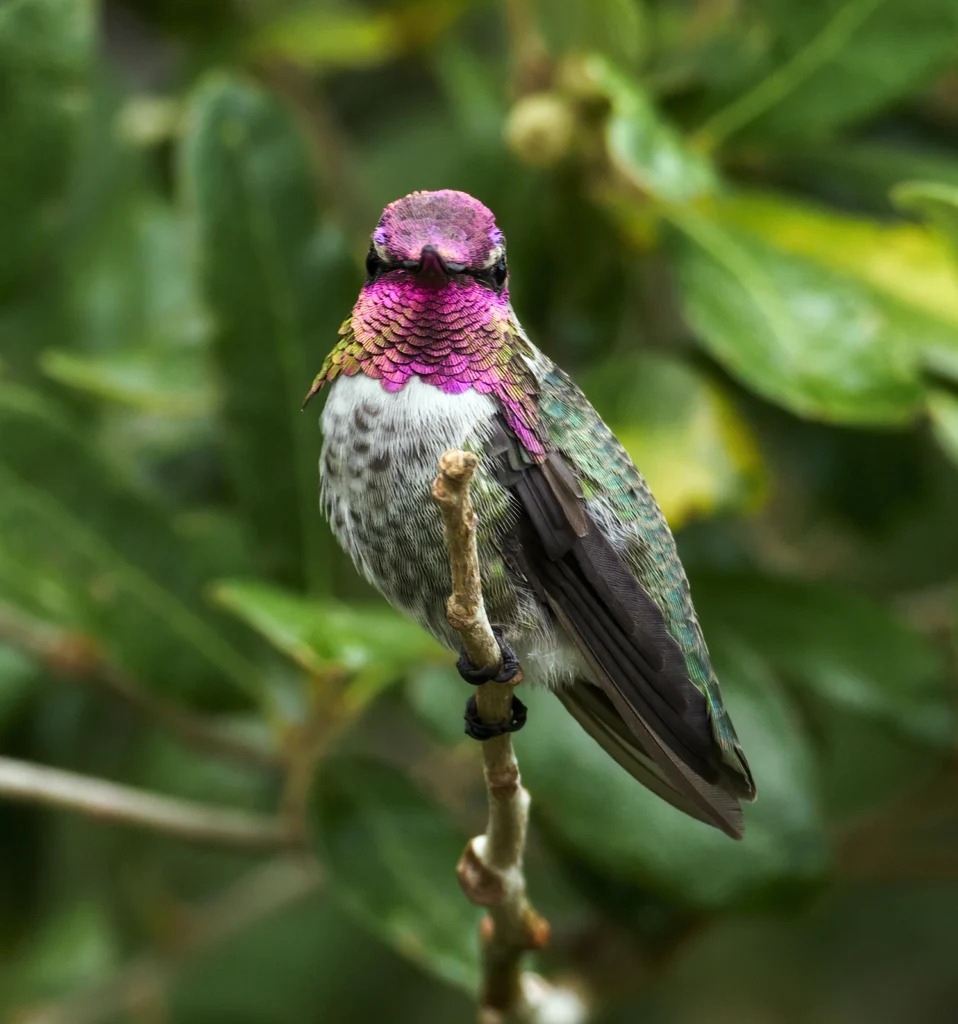
Anna’s Hummingbird
Calypte anna
Colibrí Cabeza Roja (Spanish)
About
The Anna’s Hummingbird is a characteristic and charismatic species of coastal Central, Southern, and Baja California, although this species has expanded its range northward along the Pacific Coast and eastward into the Desert Southwest. Like the Rufous Hummingbird, Anna’s is well known for its aggressive territorial behavior. Males fiercely defend feeding areas, where they chase away other male hummingbirds and even large insects such as bumblebees and hawk moths that try to feed there.
Although the Anna’s Hummingbird readily feeds from non-native plants, wild plants are still crucial to these birds — and the birds are just as critical to these native plants. Anna’s Hummingbirds are important pollinators of the chaparral flora of coastal California. Many of these plants flower in the winter months, coinciding with California’s wet season. To take advantage of this boon of nectar, Anna’s Hummingbirds in coastal California breed in what is the nonbreeding season for most North American species, nesting as early as mid-December. After the rains end, many hummingbirds will move up into the mountains to take advantage of blooms at higher elevations.
The Anna’s Hummingbird is a highly vocal species, especially for a hummingbird. Males sing a complex, scratchy-sounding song while perched and during their high-flying courtship spectacles. The male performs this diving display by first ascending to 100 feet or higher, then swooping toward the ground. At the bottom of his dive, he will be moving at about 60 miles per hour, just overhead of a female (or intruding male). At the last minute, he banks upward and flares his tail, causing his modified tail feathers to produce an explosive, high-pitched chirp. The gravitational force (“G-force”) caused by this maneuver would cause a human pilot to lose consciousness, but these little hummingbirds do it again and again, up to about 40 times back to back, when trying to impress a female. He also orients his dives to maximize the reflectance of his beautiful gorget — the gem-like patch of tiny iridescent purple-pink feathers on his throat. According to researchers Christopher Clark and Stephen Russell, from the perspective of a female, he looks like a “tiny, glowing magenta comet” plummeting towards her. (Snip-More on the page. Actually hear a hummingbird!)
=====
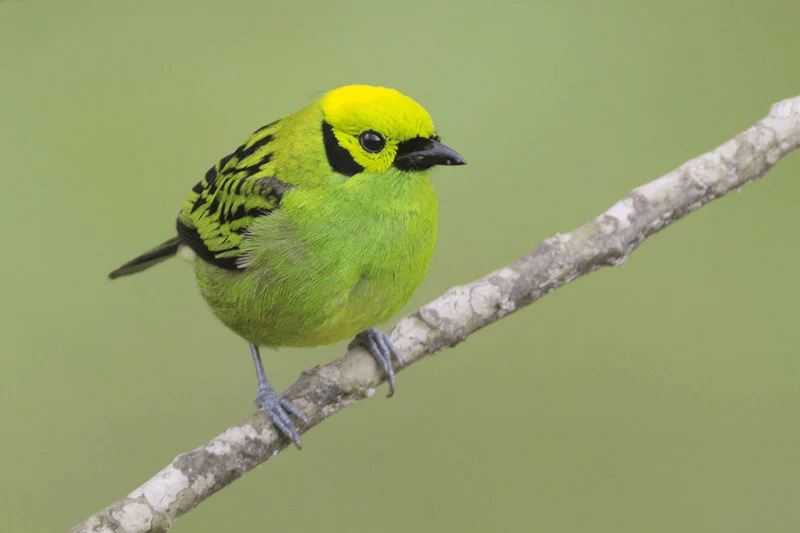
Emerald Tanager
Tangara florida
About
The Emerald Tanager is truly a gem of the forest, roaming through the canopy in search of fruiting trees in the humid montane forests of Central and northern South America. Although primarily a fruit-eater, this species is also adept at hunting insects and other invertebrates on tree branches, deftly manipulating mosses with its bill in search of prey. This behavior sets it apart from other tanager species it often flocks with, but outside of the Emerald Tanager’s range, other specialized tanager species may fill this niche.
The Emerald Tanager’s relationship with moss extends beyond its foraging habits. Though their breeding biology is largely undescribed in peer-reviewed literature, the nests that have been observed have either been made of moss entirely or thoroughly covered in it. This, of course, provides good camouflage on the mossy branches where these tanagers build their nests. (Snip; MORE, and hear the Emerald Tanager)
 Scottie's Playtime