U.S. v. Skrmetti, And More-

(And let me interject that I know that sometimes I’m a language/punctuation police officer, but I despise the term “reverse discrimination.” Either discrimination has happened, or it hasn’t, to be proven to whoever decides. There is no “reverse discrimination”. grr. Also, this is not a spoiler nor my opinion on the case, it’s simply that I guess it’s good for some people that I do not sit upon the SCOTUS, because I’d want to dismiss and tell them to use appropriate words so that the court could accurately decide based upon the evidence of discrimination, without being distracted by superfluous words. Please be at liberty to laugh at me about this. Then read all the following. -A)

The Week Ahead by Joyce Vance

June 1, 2025 Read on Substack

It’s June 1, and that means we’re starting the last month, more or less, of this Supreme Court term. The cases the Court has had briefing on and heard oral argument in will all be decided by the end of this month, although some years it spills over into the first week of July.

We never know which cases are coming next. The Court doesn’t decide them in the order they hear them argued. But usually the biggest, most impactful cases aren’t decided until the end.

This week for “The Week Ahead,” I’ve got a scorecard with some of the most important still-undecided cases for this term on it. The goal is to give you some background to refer to, so when you hear the Court has announced a decision in a certain case you’ll be prepared to understand its significance.

Here they are, in order of when they were argued, although that’s likely to have little to nothing to do with when we will see opinions.

U.S. v. Skrmetti

The issue in this case is whether states can ban gender-affirming care for trans youth in the context of a 2023 Tennessee law that bans gender-affirming care, like puberty blockers and hormone therapy, for transgender patients who are minors. The Biden administration intervened in the case and was a party along with three transgender teens and their parents. That changed with the change in administrations. The Trump Justice Department, as you would expect, is on the other side of the case.

A key issue in the case is whether denying treatment to trans youth that is available to their gender conforming peers violates the Constitution by denying them equal protection under the law. A federal district court judge held that it did. But the Court of Appeals reversed. About 25 other Republican dominated states have similar laws. The result in this case will apply beyond Tennessee.

At oral argument, the conservative Justices seemed disinclined to accept the argument that this law is a form of sex discrimination, even though cisgender kids will be able to access treatment that transgender people won’t be able to receive if these laws stand. But the votes seemed to be in place to permit Tennessee and other states to keep their restrictive laws in place.

Free Speech Coalition v. Paxton

The case involves a 2023 Texas law that is supposed to keep minors from accessing pornography online. It requires websites to verify a person’s age before they are admitted to the site. But an industry group that calls itself the Free Speech Coalition sued, claiming the law violates the rights of adults who want to access the content, an impermissible burden on free speech. The ACLU is on their side in the case.

There was at least some indication at oral argument that the Justices are aware we no longer live in a world of dial up internet connections and want to revisit the standards that are used to “protect kids.” The technical legal issue is whether the court of appeals used the wrong legal standard to decide the case. Instead of using the highest standard of review and requiring the Texas law to pass “strict scrutiny” before it could burden the adults’ right to have access to protected speech, they only required that there be a “rational basis” connecting the law to its intent to protect minors.

Ames v. Ohio Department of Youth Services

The Court’s decision in this case could potentially signal a sea change in reverse discrimination employment litigation. The case involves a straight woman who claims she faced “reverse discrimination” on the job because she wasn’t gay, leading her to be passed over for promotion opportunities. The issue is whether a plaintiff who is a member of a majority group has to show that her employer is the “unusual” one who discriminated against the majority, before bringing a case under Title VII of the Civil Rights Act of 1964. If she wins, this sort of reverse discrimination case could become easier to bring.

The plaintiff lost out on a promotion to a lesbian woman. She was subsequently demoted and the position she was removed from was given to a gay man. All of this started 13 years into her employment, after a new boss, who was a gay woman, became her supervisor.

There was speculation following oral argument that the plaintiff might win unanimously. Justice Sotomayor seemed to say she thought the plaintiff might have a valid claim, noting that based on the record before the Court, there was “something suspicious” about what happened. The consensus among the Justices seemed to be that everyone had to be treated equally.

Smith & Wesson Brands v. Estados Unidos Mexicanos

There are two technical legal issues in this case, but together, they add up to an answer to the question of whether Mexico can sue U.S. gunmakers for what it has long maintained is their responsibility for the epidemic of gun violence within its borders. Mexico argues that a number of U.S. gunmakers made it possible for traffickers to illegally purchase firearms in the U.S., only for them to be provided to Mexican drug cartels.

The Court will decide: (1) Whether the production and sale of firearms in the United States is the proximate cause of alleged injuries to the Mexican government stemming from violence committed by drug cartels in Mexico; and (2) whether the production and sale of firearms in the United States amounts to “aiding and abetting” illegal firearms trafficking because firearms companies allegedly know that some of their products are unlawfully trafficked.

If the Court decides in Mexico’s favor, its lawsuit against U.S. gun manufacturers will move forward.

Louisiana v. Callais

This is the Louisiana redistricting case. The issues revolve around whether a Louisiana congressional district created to comply with the Voting Rights Act resulted in an unconstitutional gerrymander that discriminates based on race. The Callais plaintiffs are a group of “non-African Americans” who say the redistricted map violates the Constitution because it takes race into account in violation of the 14th Amendment.

Although the Court may be inclined to do away with the Voting Rights Act at some point, this case is reminiscent of a 2023 gerrymandering case out of Alabama, where a 5-4 majority that included Chief Justice Roberts and Justice Kavanaugh upheld the Voting Rights Act and forced Alabama to comply with it, rejecting maps drawn by the state legislature that made it all but impossible for Black citizens to elect candidates of their choice to Congress.

This case might have a similar outcome. It has similarly complicated facts and an up-and-down history on appeal. It comes down to whether Louisiana, whose population is about 1/3 Black, will have a second Black opportunity district. The technical issues involve whether a three-judge district court in this case was mistaken when it ruled that race predominated in the Louisiana legislature’s decision on maps, whether it erred in finding those decisions couldn’t pass the strict scrutiny test and a set of preconditions known as the Gingles factors, and whether the case is the sort of “non-justiciable” matter that should be resolved through the political process, not decided in the courts.

Mahmoud v. Taylor

The issue here is whether religious parents’ rights are violated when a school board doesn’t give them the ability to opt out from having LGBTQ-themed books available to their children in elementary school. The issue is presented as: Whether public schools burden parents’ religious exercise when they compel elementary school children to participate in instruction on gender and sexuality against their parents’ religious convictions and without notice or opportunity to opt out.

At oral argument, the Court’s conservative majority seemed sympathetic toward the parents.

Trump v. CASA, Inc. (consolidated with Trump v. Washington and Trump v. New Jersey)

This is the birthright citizenship case that was argued only earlier this month. We discussed it here. The issue isn’t whether Trump can end birthright citizenship. Rather, it’s whether the Supreme Court should stay the district courts’ preliminary injunctions except as to the individual plaintiffs and identified members of the organizational plaintiffs or states while the litigation works its way through the courts.


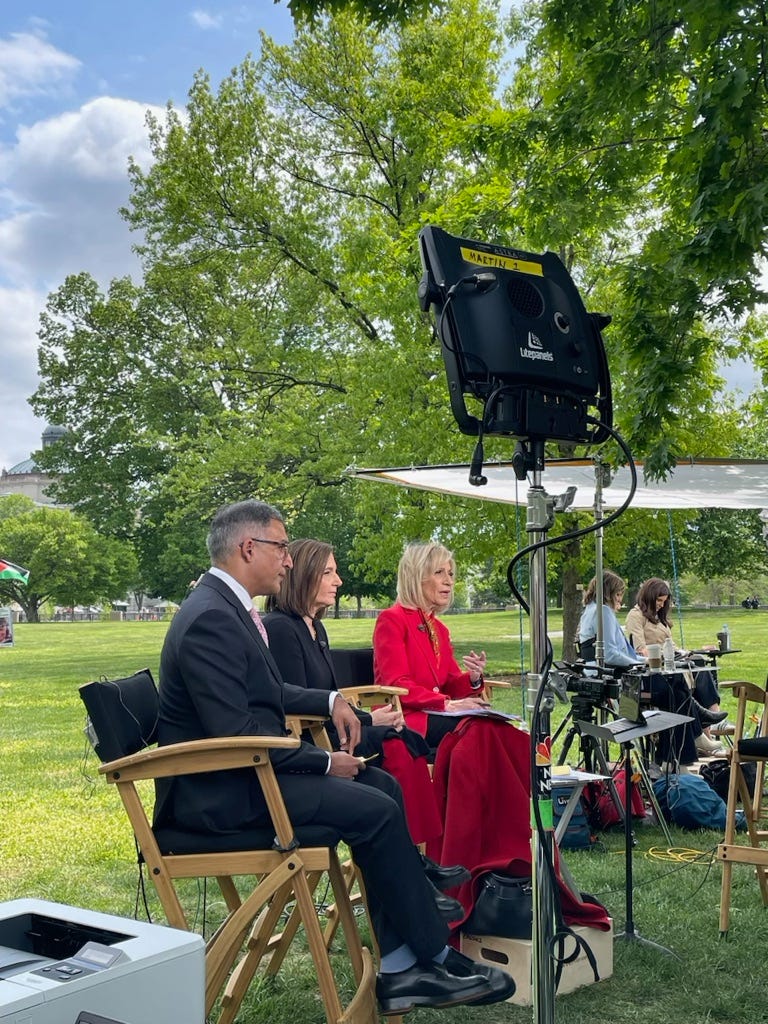
It’s hard to believe that it was just over a year ago that I sat outside, across the street from the U.S. Supreme Court building in the Senate Swamp, listening to the oral argument and preparing to comment on it in real time. (snip)

At the time, I wrote, “The case is all about Donald Trump and whether he can be prosecuted for the most serious of his crimes against the American people, trying to hold onto power after losing the 2020 election. It’s also about the legacy of the Roberts Court and whether history will view the already unpopular Justices as the Court that gave away democracy.”

Overall, there are more than 30 cases remaining on the Court’s dockets. There are also a number of procedural and other issues pending in cases that haven’t been fully briefed for a decision on the merits this term. This is the so-called shadow docket, where litigants ask the courts to make decisions in cases characterized as emergencies. Cases involving deportations and DOGE are among them. And also, the wild card, a number of cases still percolating through the lower courts where the issues aren’t yet ripe enough to be before the Supreme Court, but could become so in the next few months, at least enough to merit a trip to the shadow docket and interfere with the Supreme Courts’ summer break. The biggest question that remains for me is whether this Court will continue down the path it set itself upon last term, or will tell Trump no in a meaningful way?

Welcome to the new week. Thanks for being with me at Civil Discourse as we approach our third anniversary.

We’re in this together,

Joyce

Peace & Justice History for 9/13:

September 13, 1858
A group of the citizens of Oberlin, Ohio, stopped Kentucky slavecatchers from kidnapping John Price, a black man. Shakespeare Boynton, son of a wealthy landowner had lured Price with the promise of work. Oberlinians, black and white, from town and from the local College, pursued the kidnappers to nearby Wellington at word of his abduction.
These were twenty of the thirty-seven citizens from Oberlin and Wellington who were charged with breaking the law by helping John Price escape from slave catchers in the fall of 1858. The Oberlin-Wellington Rescue and subsequent trial caught the eye of the nation as escalating tensions over slavery raised the prospect of civil war
The group, led by Charles Langston, James M. Fitch, bookseller and superintendent of the Oberlin Sunday School, and John Watson, a grocer, wanted to proceed nonviolently, but when the Kentuckians refused to surrender Price, the response was “we will have him anyhow.”
They rushed the door guards of the Inn and theology student Richard Winsor took Price to safety, hidden for a time in the home of Oberlin College President James Fairchild, later helped across the Canadian border to freedom.

The Oberlin-Wellington Rescue
September 13, 1961
Bertrand Russell, aged 89, and 32 others were arrested during a major demonstration against nuclear weapons in Trafalgar Square, London.
September 13, 1971
President Richard Nixon, speaking to his Chief of Staff Robert Haldeman, was recorded on the White House’s taping system saying: “Now here’s the point, Bob. Please get me the names of the Jews. You know, the big Jewish contributors to the Democrats. Could we please investigate some of the cocksuckers?”

Pres. Richard Nixon (L) with Chief of Staff Bob Haldeman, advisor John Ehrlichman (R) with Sec. of State (standing) Henry Kissinger
listen to The Smoking Gun:
September 13, 1982 
The European Parliament voted to phase out promotion and advertising of war toys throughout the 25 countries of the European Union (formerly European Economic Community).
September 13, 1983
The first group from Peace Brigades International (PBI) arrived in Guatemala to provide unarmed and nonviolent witness protection for indigenous leaders. Following decades of severe repression of native ethnic groups by the unelected military government, the PBI team accompanied the Mutual Support Group (GAM in Spanish) of Families of the Disappeared, the first human rights group to emerge from the terror and survive.
PBI vision and mission 
September 13, 1993

The Prime Minister of Israel, Yitzhak Rabin, and the leader of the Palestine Liberation Organization (PLO), Yasser Arafat, shook hands before cheering crowds on the White House lawn in Washington after signing an accord establishing limited Palestinian autonomy.
Read more 

https://www.peacebuttons.info/E-News/peacehistoryseptember.htm#september13

Important news from Janet!