News For The Upcoming Week:

SCOTUS works, mass shootings, Judge Hannah Dugan’s case, and more this week, from Joyce Vance.

The Week Ahead

Joyce Vance Dec 14, 2025

Saturday was shattered by two mass shootings. The first, at Brown University in Rhode Island, happened as students prepared for exams. Two people were killed and nine injured. A “person of interest,” which is a law enforcement term that means someone law enforcement wants to speak with about a crime, but whom they are not yet prepared to charge, is in custody.

Frequently, a person of interest will evolve into a suspect. But tonight, there is news that individual has been released. Rhode Island Attorney General Peter Neronha explained that although there was “some degree of evidence” that pointed to a 24-year-old Wisconsin man who was detained Sunday morning, “that evidence needed to be corroborated and confirmed, and over the last 24 hours leading into just very, very recently, that evidence now points in a different direction.”

It’s important to give law enforcement the time it needs to do its job here, to ensure that all threats to the community are fully mitigated, and as much as possible is learned about what prompted the shooting, so victims can have closure.

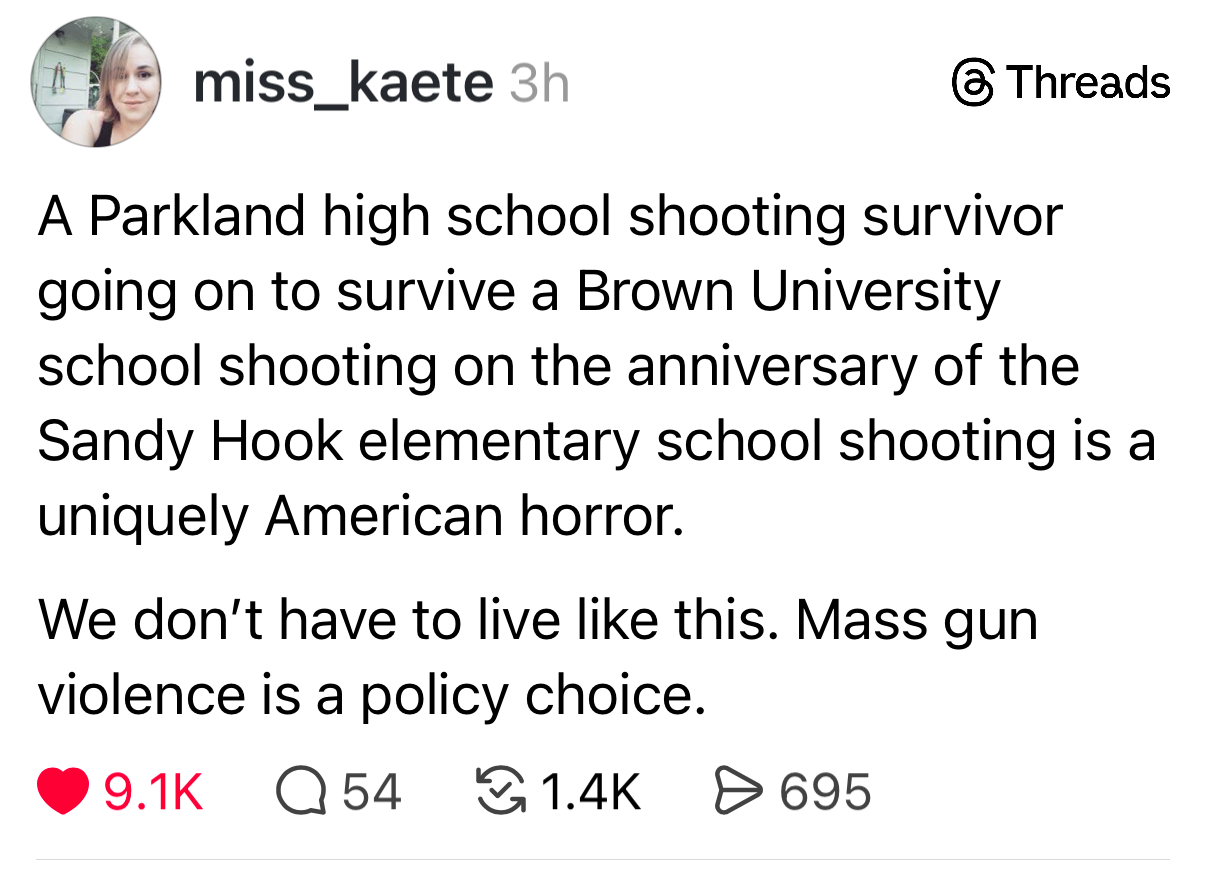
What seems unimaginable to people who graduated before the epidemic of school shootings is all too real for this generation of students. Today is the anniversary of the deadliest school shooting in our history, at Sandy Hook Elementary school, where the shooter killed 26 people, 20 six- and seven-year-old children and six adults. The shooter killed his mother before he drove to Sandy Hook and took his own life as law enforcement arrived at the school.

This post on threads got it absolutely right:
The second shooting was a terrorist attack launched by two men against Jews celebrating Hanukkah at the beach in Sydney, Australia, another incident in a tide of rising antisemitism. The death toll continues to climb. The shooters took the lives of a beloved rabbi and at least 14 others who were at the event for families. A Holocaust survivor and a 10-year-old girl were also among the victims. It seems impossible that this explanation needs to be offered, but increasingly, it is essential: killing innocent Jews does not help people in Gaza, if, indeed, that was the motivation here.

One point of light in the tragedy was the bravery of a local fruit shop owner, Ahmed El Ahmad, who ran towards the violence and snatched an enormous, long gun from the hands of one of the shooters. Ahmad was shot by the other terrorist and is recovering in hospital.

After this turbulent weekend, we head into a week that promises more chaos.

Judge Hannah Dugan’s Trial Starts Monday

After jury selection began late last week, trial gets underway for Wisconsin state Judge Hannah Dugan, who was indicted by the Justice Department last May for helping a noncitizen try to evade arrest by immigration authorities at the county courthouse where she sits, last April.

If you want to review the facts and the background, we discussed this situation when the Judge was first arrested and again when she was indicted.

Judge Dugan’s capable lawyers will put on a solid defense. She has maintained she was simply trying to keep order in her courtroom and permitted the non-citizen to use one of the doors leading out of her courtroom that was less public, but that didn’t prevent agents and officers from accosting him. The message behind the indictment is clear: If they can arrest judges, no one is safe. And in the months since Duggan’s indictment, the administration has certainly expanded on it, indicting Kilmar Abrego Garcia on stale charges in apparent retaliation for his efforts to insist he was illegally deported and bringing now-failed indictments against a former FBI Director, Jim Comey, and current New York State Attorney General, Letitia James, whom Trump views as political enemies.

The good people of Wisconsin seem to understand this threat. They have been protesting even since the Judge was first detained.

We will follow the trial’s progress this week. Tuesday night at 6:30 p.m. Central, we’ll be joined by legal reporter Adam Klasfeld of All Rise News, who will be in the courtroom this week and will join us to share what’s transpiring. Make sure you mark your calendars.

Friday, DOJ is required to release the Epstein Files

On the heels of House Democrats’ release of photographs from Jeffrey Epstein’s estate last week, the Justice Department has a deadline on Friday. This is the result of the law Congress overwhelmingly passed in mid-November to force the DOJ to release its files related to Jeffrey Epstein.

Whether DOJ will comply is an entirely different matter. Trump demanded that his attorney general open an investigation into only Democrats whose names have surfaced. Bondi may well try to use that new investigation to block demands for release. We’ve already lived through a government shutdown, which seemed to be contrived at least partially to prevent the passage of the law requiring this disclosure and the record-breaking 50-day delay in swearing in newly elected Congresswoman Adelita Grijalva of Arizona. So it’s clear the administration is determined to protect the president from further disclosures like Friday’s photo of “Trump Condoms.”

Survivors deserve justice and the public demand for it is what’s driving the process here. Keep demanding.

But ultimately, if DOJ balks, that could require intervention in the courts and delay matters. Democrats, who are in the minority in both the Senate and the House, lack the ability to issue subpoenas to obtain further information from Epstein’s estate, information that could provide the source of and context for photos that were released last week and additional information like financial records and testimony from witnesses. A process like this is essential if there is going to be accountability for Epstein’s operation and the people who participated in it, benefited from it, and helped to conceal it. So it’s worth noting that Republicans currently hold a very slender majority in the House, which will narrow further with the departure of Marjorie Taylor Greene and perhaps others, even before the midterm election.

Control of the House likely determines whether the full files ever get released.

SCOTUS

The Court is done hearing oral arguments until it picks back up with them on January 12. But that doesn’t mean we might not hear from them in the form of decisions off of the shadow docket as we head into the holidays, with National Guard cases, among other issues, developing in multiple states.

Trump Excesses

This afternoon, Trump posted “Get Your TRUMP CARD today!” on Truth Social. It’s an advertisement for the so-called Trump Card, a golden ticket for those wealthy (and presumably white) enough to buy immigration status in the U.S.

Trump even helpfully added a link to where people could go to apply—on what’s being billed as “an official website of the U.S.” at trumpcard.gov

There are two options:

  • The Gold Card “For a $15,000 DHS processing fee* and, after background approval, a contribution of $1 million, receive U.S. residency in record time with the Trump Gold Card.”
  • The Platinum Card, billed as coming soon. “Foreign nationals can sign up now and secure their places on the waiting list for the Trump Platinum Card. When launched, and upon receipt of a $15,000 DHS processing fee and $5 million contribution, they will have the ability to spend up to 270 days in the United States without being subject to U.S. taxes on non-U.S. income.”

The ick factor is high here. It reduces the presidency and this president to the position of a cheap huckster, hawking U.S. residency to the highest bidder while violently deporting hardworking people, and in some cases, getting it wrong and grabbing American citizens and military veterans.

On September 19, Trump signed Executive Order 14351, which authorized the creation of the Gold Card program, claiming that he was “prioritizing the admission of aliens who will affirmatively benefit the Nation, including successful entrepreneurs, investors, and businessmen and women.”

There are obvious questions about the legality of this pay-for-play spectacle and the decision-making process for who qualifies. Potential immigrants make their million-dollar payments, which are referred to as a “gift.” The Executive Order says that suffices as evidence of “exceptional business ability” and “national benefit,” which is sufficient for the person paying the money, regardless of where they got it from, to receive a waiver that permits entry under the statute titled “Allocation of immigrant visas.”

A group of 20 state Attorneys General filed a lawsuit last week challenging the program.
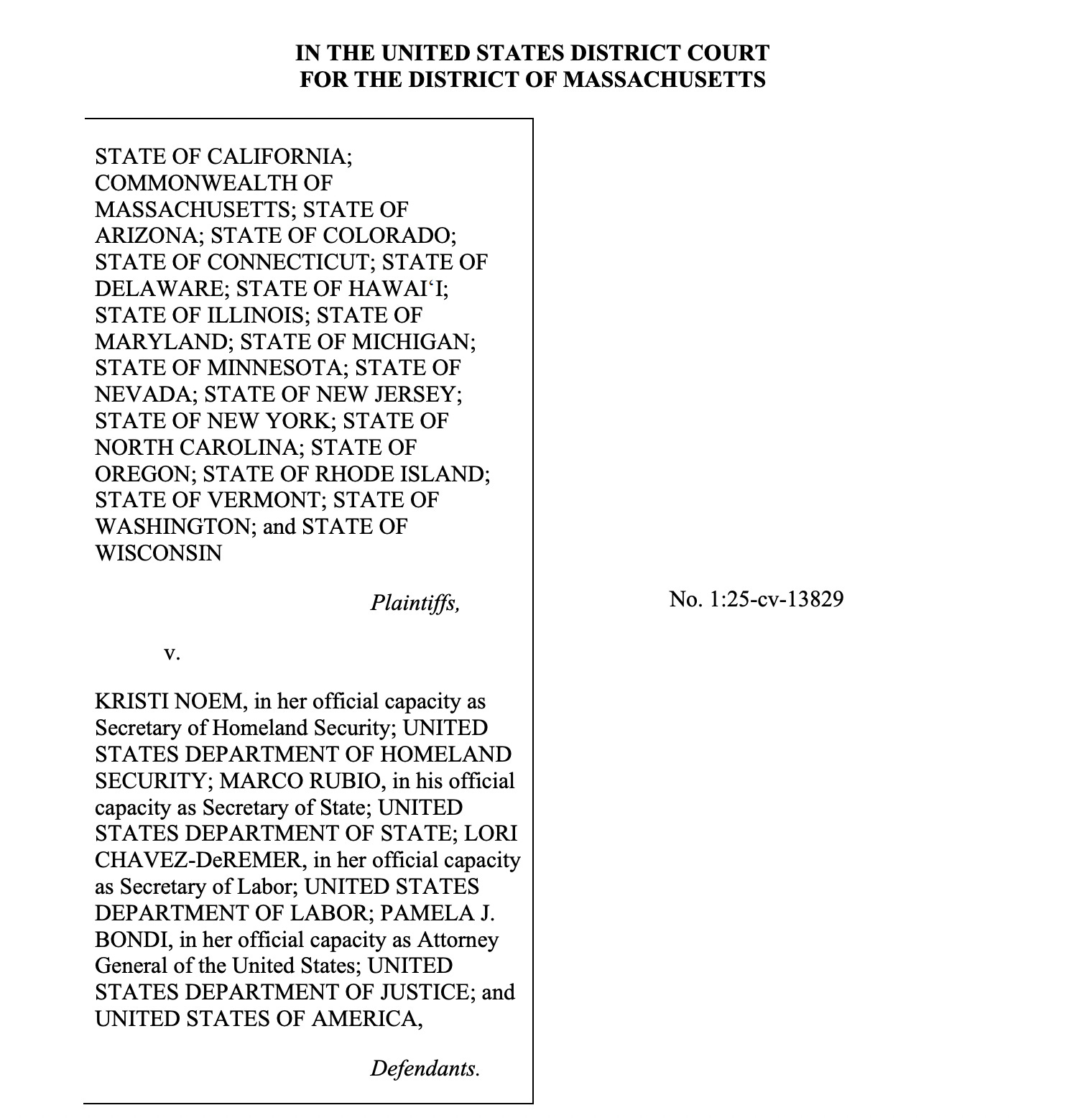
California and Massachusetts are the lead plaintiffs in the case, which alleges that the plan violates the Administrative Procedure Act and the separation of powers and asks the court to enter a ruling that the policy is unlawful and that no action can be taken under Trump’s Executive Order and the Proclamation seeking to implement it. The plaintiffs are also asking the court to enter an injunction that would prohibit the federal government from moving forward with the plan.


It’s going to be another interesting week.

Thanks for being here with me at Civil Discourse and staying informed about what’s happening to our democracy. If you value access to the information and analysis you receive here, I hope you’ll consider getting a paid subscription if you don’t already have one.

We’re in this together,

Joyce

U.S. v. Skrmetti, And More-

(And let me interject that I know that sometimes I’m a language/punctuation police officer, but I despise the term “reverse discrimination.” Either discrimination has happened, or it hasn’t, to be proven to whoever decides. There is no “reverse discrimination”. grr. Also, this is not a spoiler nor my opinion on the case, it’s simply that I guess it’s good for some people that I do not sit upon the SCOTUS, because I’d want to dismiss and tell them to use appropriate words so that the court could accurately decide based upon the evidence of discrimination, without being distracted by superfluous words. Please be at liberty to laugh at me about this. Then read all the following. -A)

The Week Ahead by Joyce Vance

June 1, 2025 Read on Substack

It’s June 1, and that means we’re starting the last month, more or less, of this Supreme Court term. The cases the Court has had briefing on and heard oral argument in will all be decided by the end of this month, although some years it spills over into the first week of July.

We never know which cases are coming next. The Court doesn’t decide them in the order they hear them argued. But usually the biggest, most impactful cases aren’t decided until the end.

This week for “The Week Ahead,” I’ve got a scorecard with some of the most important still-undecided cases for this term on it. The goal is to give you some background to refer to, so when you hear the Court has announced a decision in a certain case you’ll be prepared to understand its significance.

Here they are, in order of when they were argued, although that’s likely to have little to nothing to do with when we will see opinions.

U.S. v. Skrmetti

The issue in this case is whether states can ban gender-affirming care for trans youth in the context of a 2023 Tennessee law that bans gender-affirming care, like puberty blockers and hormone therapy, for transgender patients who are minors. The Biden administration intervened in the case and was a party along with three transgender teens and their parents. That changed with the change in administrations. The Trump Justice Department, as you would expect, is on the other side of the case.

A key issue in the case is whether denying treatment to trans youth that is available to their gender conforming peers violates the Constitution by denying them equal protection under the law. A federal district court judge held that it did. But the Court of Appeals reversed. About 25 other Republican dominated states have similar laws. The result in this case will apply beyond Tennessee.

At oral argument, the conservative Justices seemed disinclined to accept the argument that this law is a form of sex discrimination, even though cisgender kids will be able to access treatment that transgender people won’t be able to receive if these laws stand. But the votes seemed to be in place to permit Tennessee and other states to keep their restrictive laws in place.

Free Speech Coalition v. Paxton

The case involves a 2023 Texas law that is supposed to keep minors from accessing pornography online. It requires websites to verify a person’s age before they are admitted to the site. But an industry group that calls itself the Free Speech Coalition sued, claiming the law violates the rights of adults who want to access the content, an impermissible burden on free speech. The ACLU is on their side in the case.

There was at least some indication at oral argument that the Justices are aware we no longer live in a world of dial up internet connections and want to revisit the standards that are used to “protect kids.” The technical legal issue is whether the court of appeals used the wrong legal standard to decide the case. Instead of using the highest standard of review and requiring the Texas law to pass “strict scrutiny” before it could burden the adults’ right to have access to protected speech, they only required that there be a “rational basis” connecting the law to its intent to protect minors.

Ames v. Ohio Department of Youth Services

The Court’s decision in this case could potentially signal a sea change in reverse discrimination employment litigation. The case involves a straight woman who claims she faced “reverse discrimination” on the job because she wasn’t gay, leading her to be passed over for promotion opportunities. The issue is whether a plaintiff who is a member of a majority group has to show that her employer is the “unusual” one who discriminated against the majority, before bringing a case under Title VII of the Civil Rights Act of 1964. If she wins, this sort of reverse discrimination case could become easier to bring.

The plaintiff lost out on a promotion to a lesbian woman. She was subsequently demoted and the position she was removed from was given to a gay man. All of this started 13 years into her employment, after a new boss, who was a gay woman, became her supervisor.

There was speculation following oral argument that the plaintiff might win unanimously. Justice Sotomayor seemed to say she thought the plaintiff might have a valid claim, noting that based on the record before the Court, there was “something suspicious” about what happened. The consensus among the Justices seemed to be that everyone had to be treated equally.

Smith & Wesson Brands v. Estados Unidos Mexicanos

There are two technical legal issues in this case, but together, they add up to an answer to the question of whether Mexico can sue U.S. gunmakers for what it has long maintained is their responsibility for the epidemic of gun violence within its borders. Mexico argues that a number of U.S. gunmakers made it possible for traffickers to illegally purchase firearms in the U.S., only for them to be provided to Mexican drug cartels.

The Court will decide: (1) Whether the production and sale of firearms in the United States is the proximate cause of alleged injuries to the Mexican government stemming from violence committed by drug cartels in Mexico; and (2) whether the production and sale of firearms in the United States amounts to “aiding and abetting” illegal firearms trafficking because firearms companies allegedly know that some of their products are unlawfully trafficked.

If the Court decides in Mexico’s favor, its lawsuit against U.S. gun manufacturers will move forward.

Louisiana v. Callais

This is the Louisiana redistricting case. The issues revolve around whether a Louisiana congressional district created to comply with the Voting Rights Act resulted in an unconstitutional gerrymander that discriminates based on race. The Callais plaintiffs are a group of “non-African Americans” who say the redistricted map violates the Constitution because it takes race into account in violation of the 14th Amendment.

Although the Court may be inclined to do away with the Voting Rights Act at some point, this case is reminiscent of a 2023 gerrymandering case out of Alabama, where a 5-4 majority that included Chief Justice Roberts and Justice Kavanaugh upheld the Voting Rights Act and forced Alabama to comply with it, rejecting maps drawn by the state legislature that made it all but impossible for Black citizens to elect candidates of their choice to Congress.

This case might have a similar outcome. It has similarly complicated facts and an up-and-down history on appeal. It comes down to whether Louisiana, whose population is about 1/3 Black, will have a second Black opportunity district. The technical issues involve whether a three-judge district court in this case was mistaken when it ruled that race predominated in the Louisiana legislature’s decision on maps, whether it erred in finding those decisions couldn’t pass the strict scrutiny test and a set of preconditions known as the Gingles factors, and whether the case is the sort of “non-justiciable” matter that should be resolved through the political process, not decided in the courts.

Mahmoud v. Taylor

The issue here is whether religious parents’ rights are violated when a school board doesn’t give them the ability to opt out from having LGBTQ-themed books available to their children in elementary school. The issue is presented as: Whether public schools burden parents’ religious exercise when they compel elementary school children to participate in instruction on gender and sexuality against their parents’ religious convictions and without notice or opportunity to opt out.

At oral argument, the Court’s conservative majority seemed sympathetic toward the parents.

Trump v. CASA, Inc. (consolidated with Trump v. Washington and Trump v. New Jersey)

This is the birthright citizenship case that was argued only earlier this month. We discussed it here. The issue isn’t whether Trump can end birthright citizenship. Rather, it’s whether the Supreme Court should stay the district courts’ preliminary injunctions except as to the individual plaintiffs and identified members of the organizational plaintiffs or states while the litigation works its way through the courts.


It’s hard to believe that it was just over a year ago that I sat outside, across the street from the U.S. Supreme Court building in the Senate Swamp, listening to the oral argument and preparing to comment on it in real time. (snip)

At the time, I wrote, “The case is all about Donald Trump and whether he can be prosecuted for the most serious of his crimes against the American people, trying to hold onto power after losing the 2020 election. It’s also about the legacy of the Roberts Court and whether history will view the already unpopular Justices as the Court that gave away democracy.”

Overall, there are more than 30 cases remaining on the Court’s dockets. There are also a number of procedural and other issues pending in cases that haven’t been fully briefed for a decision on the merits this term. This is the so-called shadow docket, where litigants ask the courts to make decisions in cases characterized as emergencies. Cases involving deportations and DOGE are among them. And also, the wild card, a number of cases still percolating through the lower courts where the issues aren’t yet ripe enough to be before the Supreme Court, but could become so in the next few months, at least enough to merit a trip to the shadow docket and interfere with the Supreme Courts’ summer break. The biggest question that remains for me is whether this Court will continue down the path it set itself upon last term, or will tell Trump no in a meaningful way?

Welcome to the new week. Thanks for being with me at Civil Discourse as we approach our third anniversary.

We’re in this together,

Joyce