
Tag: Republican Crime
Clay Jones, Open Windows
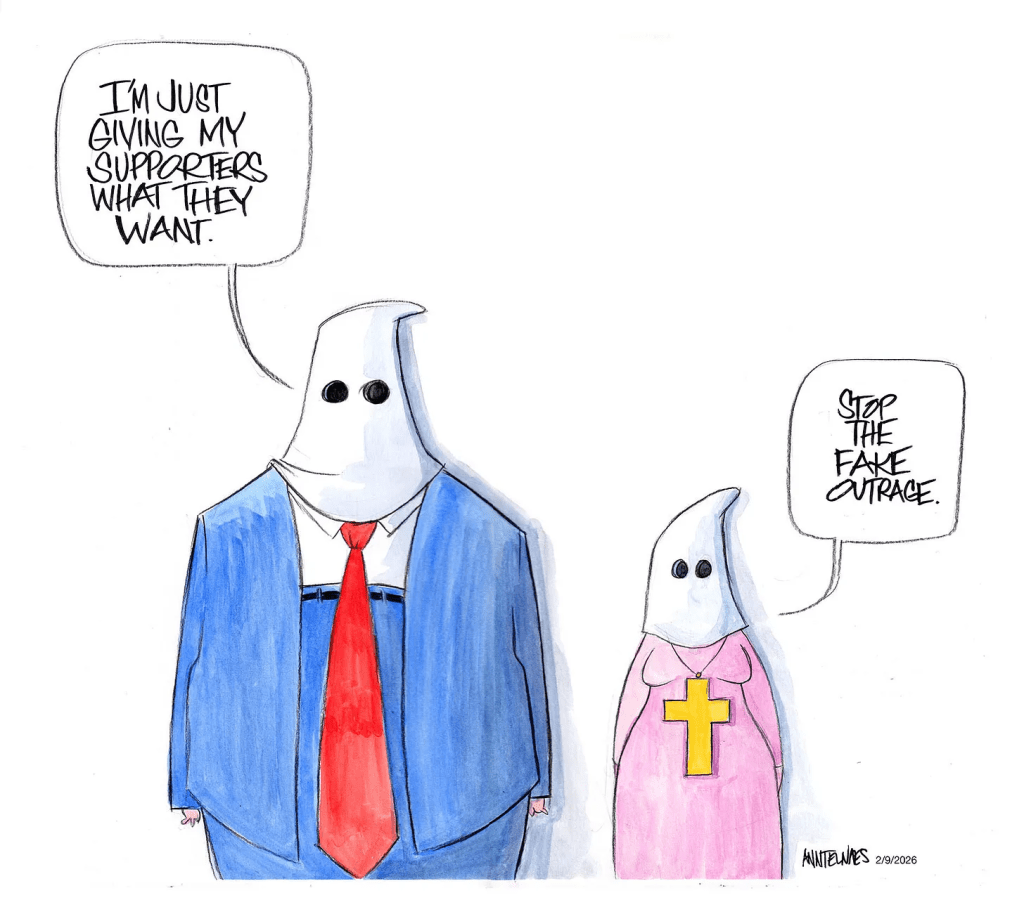
We already know Trump is a racist
That’s not new. Ann Telnaes
Trump throws red meat out regularly when trying to divert attention or he thinks his base isn’t solid. The very reason he was first elected was due to the underlying racism and sexism in this country. Trump just gave them permission to say it out loud.
==========
Trump Loves Hate
A message of love in Spanish tightens Trump’s sphincter
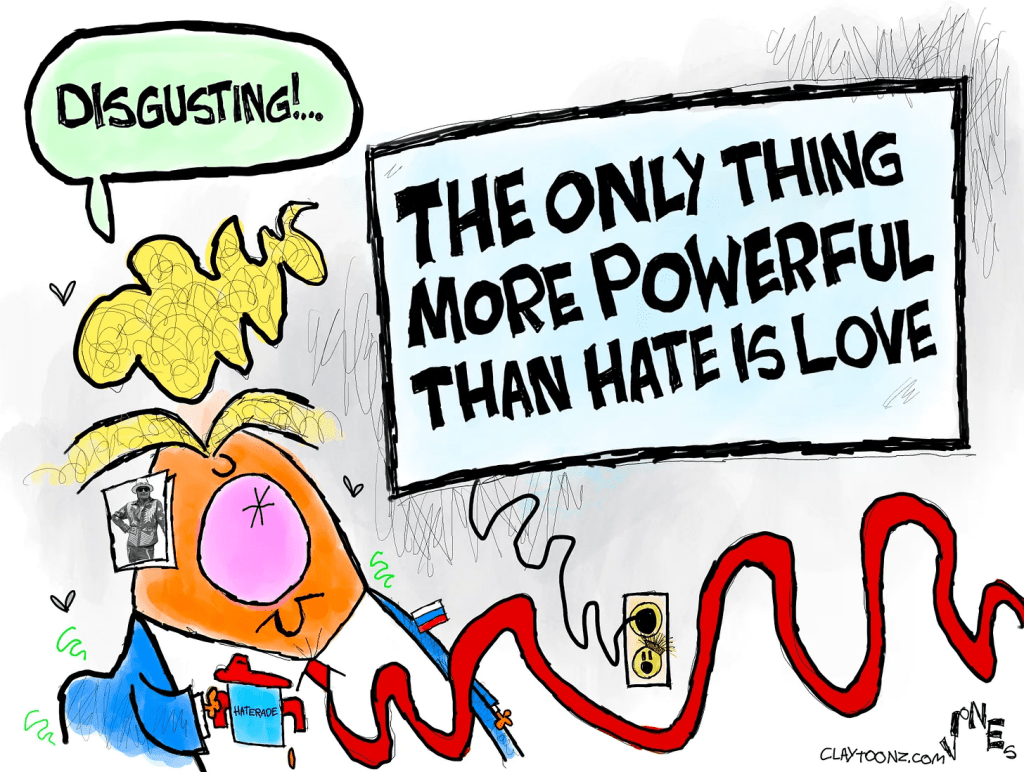
If you believe that a message of love and unity is in opposition to everything you stand for, and you have to fight it with every fiber of your being, then you are either Darth Sidious, Hitler, or Donald Trump.
Why would you take a message that says, “The Only Thing More Powerful Than Hate is Love” as something hostile and political? Because it’s in Spanish and everything you’re about is hate?
Last night after the Super Bowl, Trump posted to social media, “The Super Bowl Halftime Show is absolutely terrible, one of the worst, EVER! It makes no sense, is an affront to the Greatness of America, and doesn’t represent our standards of Success, Creativity, or Excellence. Nobody understands a word this guy is saying, and the dancing is disgusting, especially for young children that are watching from throughout the U.S.A., and all over the World.” (Snip-MORE, and it’s hot)
Interview With Georgia Fort:
Georgia Fort Makes It Plain “Journalism Is Not A Crime”
Episode 2 of “I Spent Three Days In Minneapolis!”
W. Kamau Bell Feb 08, 2026
(The above link is for the video interview at the top of this Substack page; 20 minutes and small change. -A.)
Happy Superbowling to all who celebrate.
It’s been less than 48 hours since I sent out the first episode of I Spent Three Days in Minneapolis. (Are these “episodes”? I don’t know what else to call them. They are more than interviews… Moments? Happenings? Witnessings?) The response from you all has been amazing and truly heartening. It is inspiring to think that me and a small crew turned all this around so quickly AND ALSO that it has found an audience. It really makes me proud. I can’t wait to share more, so leeeeeeeeet’s gooooooooooo!
I’m sending this today, because my subscribers don’t seem like the types of people who’d get upset having their Superbowl activities interrupted with an incredible conversation. One of the big “gets” that my producer Deshawn Plair chased down was this meet-up with three-time Emmy-winning, Twin Cities journalist Georgia Fort. Luckily, our film crew, Destiny and Kai, were already working on a project with Georgia, so they helped set this up.
And while I’m always down to talk to an independent Black journalist, this was extremely special. Georgia was only a few days removed from making international news. On January 30, Georgia Fort and my fellow ex-CNNer Don Lemon were arrested for the “crime” of reporting on a news story. Georgia and Don were covering the protest of a church where a pastor is being accused of being a member of I.C.E. (FYI, joining I.C.E. is what Jesus wouldn’t do.)
The Trumped up charges (literally TRUMPED UP) against Georgia and Don are for conspiracy(?) and for interfering with the church goers first amendment rights(??). (Yeah, suuuuuuuuure!) As much as I am mocking the anti-constitutional arrests, these are still FEDERAL charges. Two other people (both Black) were also arrested at the protest.
Let’s not forget that arrests like these are even bigger than our country’s already big need to defend the first amendment. These arrests are about punishing people who the administration simply doesn’t agree with, and more people than just the ones arrested are affected. In addition to being an award-winning independent Black journalist, Georgia is a mom, a wife, a daughter, a mentor to young Black journalists, and community member who cares. During our talk Georgia bravely admits to being terrified, but as she declares, “God did not give me a spirit of fear.”
“God did not give me a spirit of fear.” – journalist Georgia Fort
This interview was taped around 5pm on February 3, 2026. Georgia was kind enough to sit with me after she had already had a day filled with interviews. As always, shout out to Destiny and Kai for turning this around so quickly. Again, I hope you don’t mind me filling up your inbox.
Thanks again to The McKnight Foundation for partnering with me on this project.
WHO’S WITH ME?
Here’s the video I made the day I learned about the arrests.
I had no idea that I would be talking with Georgia only four days later,
W. Kamau Bell on Instagram: “I stand with @donlemonofficial, @b…
(snip-Support Minnesota info, tours info)
A Closer Look At USDOJ Court Order Defiance
plus more.
The Trump DOJ Has Utterly Collapsed and It Ain’t Pretty
INSIDE: Patrick J. Schiltz … Stephen Miller … Mark Kelly
David Kurtz Feb 04, 2026
The Destruction: DOJ Edition
One of the intended consequences of President Trump’s politicization of the Justice Department is to leave behind a weakened, overwhelmed, decimated organization that simply can’t do its job.
They’re hollowing out the DOJ by purging nonpartisan career attorneys, making life intolerable for those who remain, and replacing them with loyalists sucks the capacity out of the organization. It can’t handle as many cases, isn’t capable of tackling ambitious ones, and the quality of the lawyering suffers in all cases.
This is all coming home to roost in a very visible way in Minnesota, where the lawless Operation Metro Surge has produced hundreds of habeas cases filed by wrongfully detained immigrants. The chief federal judge in Minnesota, speaking for an overwhelmed judiciary, has already publicly castigated the Trump administration for not preparing for the flood of cases that its mass deportation operation in the state was bound to generate. (Chris Geidner explains the ins and outs of why we’re seeing so many cases.)
Meanwhile, the Minnesota U.S. Attorney’s Office has been crippled by mass resignations, including some of its most senior career attorneys. That has left the remaining DOJ attorneys in Minnesota inundated with more cases than they can keep up with. But I’m not sure that does justice to what’s been happening. It’s quite a bit worse than that.
The quality of lawyering has eroded to such a point that government lawyers have been unable to keep up with the court orders demanding that detainees be released. As a result, detainees have lingered in confinement even after courts have ordered their release.
Last week, as the Star Tribune first reported, Ana Voss, a career DOJer who was the chief of the civil division in the Minnesota U.S. Attorney’s Office, submitted an astonishing court filing in which she admitted that her office had not followed a judicial order to release a detainee because they hadn’t seen the email.
“I did not timely read these orders,” Voss reportedly said in the court filing. “I understand that is inexcusable.”
But it doesn’t appear to be a case of incompetence or willful disregard. As Voss explained in the filing: “It has become apparent to me that I am not able to effectively triage and review every order which is not an acceptable practice for me or the United States.”
Voss is reported to have subsequently resigned.
Numerous reports have suggested that mass resignations in the Minnesota U.S. Attorney’s Office are not due solely to the failure to investigate the fatal shootings of Renée Good and Alex Pretti. My suspicion is that the hell-on-wheels inundation of immigration cases is another contributing factor.
More evidence of that emerged yesterday, when Julie Le, an attorney for the government, essentially melted down in court, as FOX9’s Paul Blume reported :
“I wish you would just hold me in contempt of court so I can get 24 hours of sleep,” Le said. “The system sucks, this job sucks, I am trying with every breath I have to get you what I need.”
As Joyce Vance notes, Le is not a regular assistant U.S. attorney but a “special” AUSA. She is reported to have been working as a DHS attorney before being detailed to the Minnesota U.S. Attorney’s Office to help with the flood of immigration cases. Le had been assigned over more than 88 cases since December.
It’s easy to see this as attorneys getting what they deserve for participating in a corrupted system, but remember it’s the detainees who are languishing despite courts ordering their release. I’ve seen defiant DOJ political appointees in court telling judges to shove it. Le does not appear to be one of those kinds of attorneys:
“I am here to make sure the agency understands how important it is to comply with court orders,” said Le, who became visibly emotional during the court hearing.
Le was removed from the U.S. Attorney’s Office after her courtroom remarks, NBC News reports.
When chief Judge Patrick J. Schiltz said last week that the Trump administration had violated 96 court orders in 78 cases since Jan. 1 in Minnesota alone, I first thought this was another Trump administration gambit to defy the judicial branch. And it may be, but it’s not as direct as the confrontations in the Alien Enemies Act and Abrego Garcia cases.
As Princeton’s Deborah Pearlstein notes:
It seems increasingly clear the rampant noncompliance with court habeas orders happening in immigration cases now is not a problem of attorney ethics. It’s a symptom of structural, institutional collapse at the Department of Justice.
The Trump administration is tearing down U.S. Attorney’s offices and undermining Main Justice so that there simply aren’t the resources to even respond to the judicial branch. A burn it all down ethos. Catch me if you can.
Keep an Eye on This One …
U.S. District Judge Paul Magnuson of Minneapolis ordered the pretrial release of two immigrants accused of assaulting an ICE agent who shot one of the men in an incident last month. But the men did not make it out of the courthouse before they were re-detained, by ICE, the Star Tribune reports.
Attorneys for Alfredo Aljorna and Julio Sosa-Celis were quickly back in court, filing a habeas petition seeking their release from ICE custody. Last night, chief Judge Patrick J. Schiltz ordered the Trump administration not to remove the men from Minnesota and, if they already had, then to return them to Minnesota immediately.
Not to get overlooked: At the pretrial hearing, the mens’ attorneys introduced into evidence photos of the shooting scene that suggest the ICE agent shot through a closed door and undermine the government’s account what happened.
Quote of the Day
“In the last few weeks, our family took some consolation thinking that perhaps Nee’s death would bring about change in our country. And it has not.”—Luke Ganger, brother of Renee Good
Judge Protects Anti-ICE Protesters
U.S. District Judge Michael Simon issued a temporary restraining order barring federal agents from using tear gas and other crowd-control weapons against peaceful protesters and journalists outside an ICE facility in Portland, Oregon.
In his order, Simon was harshly critical of the Trump administration:
- “the repeated shooting and teargassing of nonviolent protesters at the Portland ICE Building will likely keep recurring … Defendants’ violence is in no way isolated.”
- “statements made by DHS officials and senior federal executives show that the culture of the agency and its employees is to celebrate violent responses over fair and diplomatic ones.”
- “Rather than reprimanding DHS violence against protesters, senior officials have publicly condoned it.”
- “There are clear instances of excessive force, including a use of force incident recorded by ICE’s own cameras and deemed “inappropriate” and “not reasonable” by a Federal Protective Service (“FPS”) Deputy Regional Director. Yet, the agents involved were not put on leave and do not appear to have been held accountable in any way.”
(snip-Stephen Miller and more)
As To DOJ’s Indictment Of Judge Boasberg:
I’m only about half-through reading this, and already know everyone else needs to see this, too. It’s important to keep up with the attacks on the judiciary. Only a decent-sized snippet here, but do go finish it. This is well written, and it informs. -A.
207. The Justice Department Beclowns Itself (Again)
The denouement of DOJ’s misconduct complaint against Chief Judge Boasberg provides useful lessons relating to both the Department’s continuing misbehavior and the emptiness of calls for impeachment.
Steve Vladeck Feb 02, 2026
There is, as ever, too much court- (and Court-)adjacent news to cover, including this morning’s New York Times double-feature on the Chief Justice’s move to have Court employees sign non-disclosure agreements and on the Times’s own expanding coverage of the Court. But I wanted to use today’s “Long Read” to come back to a post I wrote last July—shortly after the Department of Justice submitted (and then Attorney General Bondi tweeted about) an unprecedented judicial misconduct complaint against the chief judge of the D.C. federal district court, James E. Boasberg. As I wrote at the time, DOJ’s complaint was “almost laughably preposterous.” The gravamen of its charge was that Boasberg had violated the Code of Conduct for United States Judges by relaying (at a private breakfast with the Chief Justice and a group of other district judges before a meeting of the Judicial Conference of the United States) that several of his colleagues were worried about the Trump administration potentially defying their rulings.
That complaint is back in the news because late last week, we finally learned about its outcome. After a bit of procedural shuffling that I’ll explain below, it was dismissed, quite cursorily, by Sixth Circuit Chief Judge Jeffrey Sutton in a … brusque … seven-page memorandum and order. Not only did Sutton pour cold water on DOJ’s theor(ies) of Boasberg’s misconduct, but he also expressed understandable frustration with the fact that DOJ never produced the document that it claimed memorialized Boasberg’s alleged misconduct—even after it was specifically told that it needed to do so to substantiate its claims.
In other words, after filing an unprecedented complaint against a sitting federal judge, making a big public stink about it (which, by the way, was itself a violation of the law), and having its complaint invoked as one of the grounds for the proposed impeachment charges against Chief Judge Boasberg, DOJ … never followed through. It turns out, it was never about adjudicating Boasberg’s behavior; it was about making splashy headlines and fueling right-wing attacks on the judiciary without regard to whether DOJ’s specious charges would withstand meaningful scrutiny.
The obvious takeaway is that the Department of Justice has once again beclowned itself. I’d say it has shredded even more of its credibility, but when you’re publicly soliciting for new lawyers to apply via Twitter (with the primary qualification being that they “support President Trump”), there may not be any credibility left to shred. Instead, the more significant takeaway is that this really ought to be the final nail in the coffin of congressional Republicans’ breathless efforts to gin up impeachment charges against a judge whose only actual sin, as it turns out, was to decline to roll over when the government defied one of his orders, and then lied about it.
(snip-graphic of pleading filed; just click through to see it. Then there is info on other cases of which we may want to be at least aware, then back to this one; a bit more below. Use this link to skip the other cases and get back to this.)
The One First “Long Read”:
The Denouement of the Boasberg Misconduct Mess
My post from last July walked through the background and details of the Justice Department’s judicial misconduct complaint against Chief Judge Boasberg (and why it suffered from four independently fatal defects). I’d encourage folks to refer back to that post if you could use more context.
In a nutshell, DOJ’s chief accusation was that Boasberg had violated the Code of Conduct for United States Judges by publicly suggesting that he had “pre-judged” the merits of specific cases involving the Trump administration (even though, in fact, Boasberg had only privately relayed concerns that his colleagues had raised about how the Trump administration might behave in unnamed future cases). Indeed, at the time Boasberg made the relevant comments, the lawsuit in which his interactions with the Trump administration have been most visible—the J.G.G. Alien Enemies Act case—hadn’t even been filed yet. Nonetheless, DOJ decided to make hay out of Boasberg’s alleged misbehavior, and six Republican senators have since piled on by urging D.C. Circuit Chief Judge Sri Srinivasan (who, by law, was the recipient of DOJ’s misconduct complaint) to suspend Boasberg while the complaint (and a potential impeachment investigation) was pending.2
The process created by the Judicial Conduct and Disability Act of 1980 is supposed to be almost entirely confidential (which is why Attorney General Bondi’s tweet announcing the complaint was itself likely a violation of the act). But we often learn about the dispositions, at least, once the complaint has been fully resolved. That’s why we learned last week about the result of DOJ’s complaint; not only had Chief Judge Sutton dismissed it, but the 30-day period within which DOJ could have sought further review of Sutton’s decision (by filing a “petition for review” with the full Sixth Circuit Judicial Council) had expired.3
As for how DOJ’s complaint made its way to Sutton, Sutton’s memorandum explains the procedural history:
On November 26, in view of several appellate challenges to the judge’s rulings in the underlying case [J.G.G.] and of concerns that the judges on the D.C. Circuit might have to recuse themselves from any proceedings before the Judicial Council, Chief Judge Srinivasan asked Chief Justice Roberts to transfer the judicial misconduct proceeding to another circuit. On December 5, the Chief Justice transferred the matter to the Judicial Council of the United States Court of Appeals for the Sixth Circuit for resolution.
Sutton, who I have to think the Chief Justice did not pick at random (Roberts could have referred the complaint to any of the chief judges of the other circuits), made quick work of DOJ’s complaint—dismissing it just two weeks after he received it. His seven-page ruling is worth reading—not just for its thoroughness, but because, if you’re not used to reading these kinds of rulings, it is all-but-dripping with contempt for the Department of Justice’s behavior.
In short, Sutton found four different problems with DOJ’s complaint:
(snip. Yup, you know you want to know, so go read his piece and give it a like if you care to, after you finish.)
From ProPublica and MPS:
ICE’s Tracing Tool
I saw this yesterday and intended to post it for Sunday morning. It’s suppertime on Sunday, so it goes live Monday morning. It’ll keep until then. Click on through; it’s not too long. There are good graphics there, and that helped me.
Here is the User Guide for ELITE, the Tool Palantir Made for ICE
Joseph Cox ·Jan 30, 2026 at 9:49 AM
404 Media is publishing a version of the user guide for ELITE, which lets ICE bring up dossiers on individual people and provides a “confidence score” of their address.
Earlier this month we revealed Immigration and Customs Enforcement (ICE) is using a Palantir tool called ELITE to decide which neighborhoods to raid.
The tool lets ICE populate a map with potential deportation targets, bring up dossiers on each person, and view an address “confidence score” based on data sourced from the Department of Health and Human Services (HHS) and other government agencies. This is according to a user guide for ELITE 404 Media obtained.
404 Media is now publishing a version of that user guide so people can read it for themselves. (snip-MORE)
That Sealed Order in the Abrega Garcia Case-
Unsealed: Abrego Garcia
Joyce Vance Dec 30, 2025
The sealed order in the Abrego Garcia case that I wrote about in Sunday night’s “The Week Ahead” column was unsealed today. This is in the government’s hastily manufactured criminal case against him, which seemed, at the time, to be some sort of face-saving gesture after they were forced to return him to the U.S. from El Salvador, where he was incarcerated in CECOT prison.
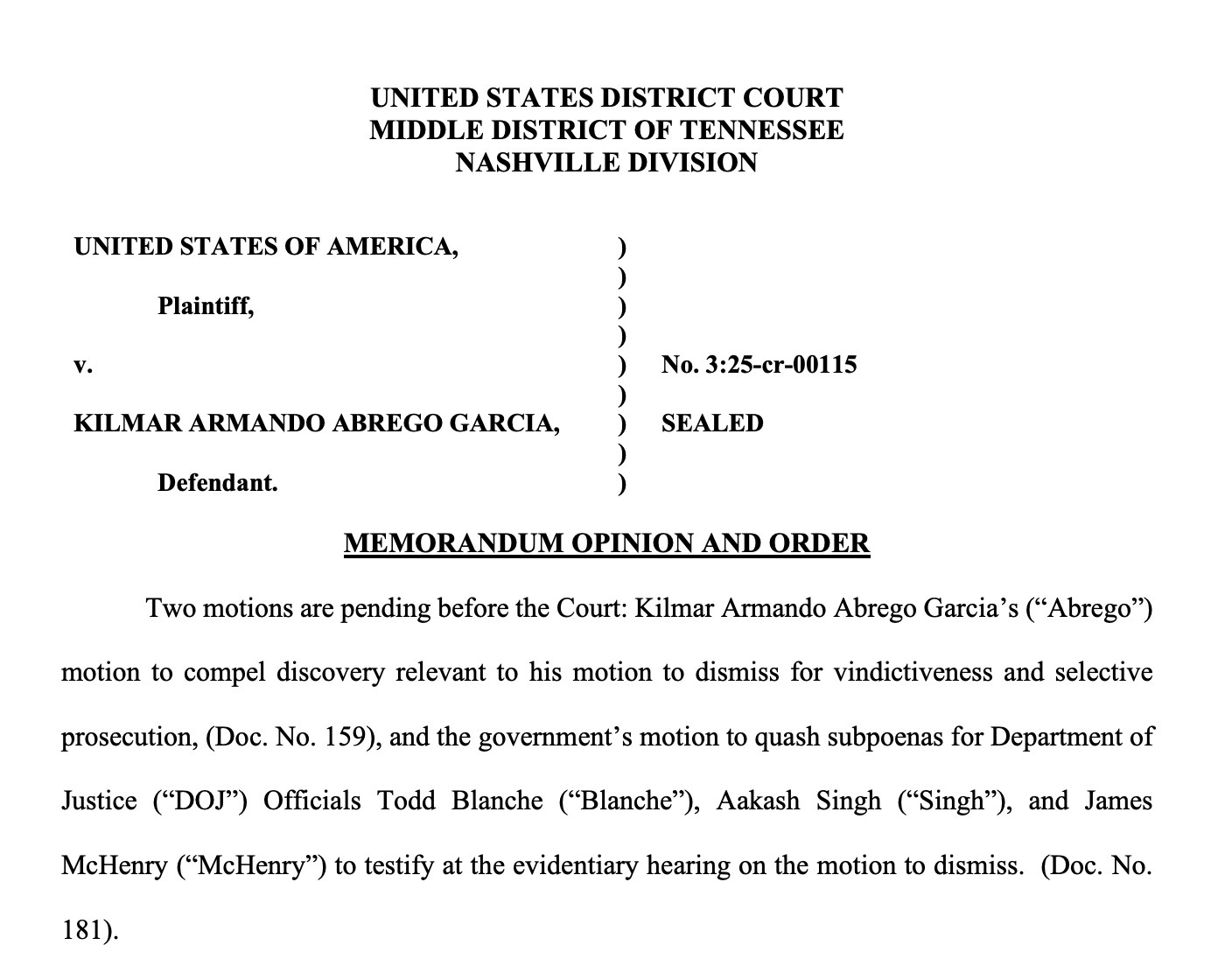
The case is before Federal District Judge Waverly D. Crenshaw, Jr. in the Middle District of Tennessee. It turned out that my conjecture that the sealed motion might have something to do with Abrego Garcia’s motions to dismiss the prosecution because it’s vindictive was on target. As we know from our discussion of this type of motion in the context of the Virginia prosecution of Jim Comey, it’s difficult for a defendant to prove, and cases are only rarely dismissed on this basis. But the timeline here has always seemed to suggest it could be a serious possibility in this one.
In the newly unsealed motion, the Judge goes straight to the heart of the government’s contention that the local U.S. Attorney made the decision to indict, so it was not influenced by any alleged vindictiveness on the part of higher-ups in Washington, writing, “The central question after Abrego established a prima facie case of vindictiveness is what information in the government’s control sheds light on its new decision to prosecute Abrego, after removing him from the United States without criminal charges. These documents show that McGuire [the local U.S. Attorney] did not act alone and to the extent McGuire had input on the decision to prosecute, he shared it with Singh [a Lawyer in Deputy Attorney General Todd Blanche’s office] and others. … Specifically, the government’s documents may contradict its prior representations that the decision to prosecute was made locally and that there were no outside influences.”
This, needless to say, is not good news for the government. To understand just how bad it is, let’s review a bit of the case’s history:
In October, Judge Crenshaw found that Abrego Garcia had come forward with evidence to suggest that a reasonable person might believe the indictment was motivated by vindictiveness on the part of the government. When that happens, the government has to offer evidence that the prosecution was undertaken for legitimate reasons, for instance, that newly discovered evidence made a case previously rejected as weak strong enough to be indicted.
Judge Crenshaw granted Abrego Garcia’s request to conduct discovery on the issue and have an evidentiary hearing. But he noted that it was entirely possible that “no fire will be discovered under all the smoke.”
The indictment stems from a 2022 traffic stop that did not result in Abrego Garcia’s arrest, or even a traffic ticket. The case file at Homeland Security Investigations remained open, but no action was ever taken on it, and the case was closed shortly after he was deported.
The timeline of the criminal prosecution gave rise to the presumption of vindictiveness in the Judge’s view:
- Abrego Garcia was deported on March 15, 2025 (despite the existence of an order that prohibited it).
- Abrego Garcia’s lawyers sued on March 24, 2025, and in less than two weeks, a district judge ordered his return to the U.S.
- Both the Fourth Circuit and the U.S. Supreme Court sided with Abrego Garcia, holding the government responsible for “facilitating” his return. The Supreme Court ruled on April 10.
- Just days after the Supreme Court’s decision, the investigation into the traffic stop was reopened by Homeland Security Investigations (HSI) under DHS Secretary Kristi Noem’s direction.
- Ten days after that, an HSI agent reached out to the acting U.S. Attorney in Nashville.
- The case was indicted on May 21, 2025, only 58 days after Abrego Garcia filed suit in Maryland seeking his return to the U.S.
As Judge Crenshaw noted back in October, “All of this stands in stark contrast to the 832 days the HSI investigation into Abrego remained pending, without referral to the U.S. Attorney’s Office in the Middle District of Tennessee for prosecution.” In other words, the case wasn’t even deemed significant enough to ask a prosecutor to take a look at it. It was only after Abrego Garcia’s lawsuit challenging the legality of his deportation—and the Supreme Court confirmation that he should be returned—that HSI seemed to take the case seriously. In the absence of any explanation from the government, the Judge correctly found these facts gave rise to a presumption of vindictiveness.
Sometimes, though, where there’s smoke, there is, in fact, fire.
The newly unsealed order relates to two motions filed by Abrego Garcia’s lawyers in the course of trying to obtain the discovery the court had ordered they were entitled to: one to compel the government to comply with some of the requests and one to obtain testimony from Deputy Attorney General Todd Blanche and some of the key people in his office. The government had submitted “over 3,000 documents” to the Judge for him to review privately, because the government maintained it wasn’t obligated to turn them over.
Judge Crenshaw has now ordered the government to “disclose to Abrego a sub-set of the over 3,000 documents that are relevant to the narrow issue of whether the government’s new decision to prosecute Abrego, after deciding not to do so, ‘was tainted by improper motivation’ arising from Abrego’s success in the Maryland civil case.” The government doesn’t have to turn over the remainder of the 3,000+ documents. The Judge asked for additional briefing on the government’s motion to prevent Blanche and his subordinates from testifying.
At the time the motion was filed, the government argued that the decision to prosecute was made by Acting U.S. Attorney Robert McGuire in Nashville, so it could not have been vindictiveness of the part of higher-ups in Washington. But as the Judge points out at length in this order, “at the time of Abrego’s arrest, Blanche linked Abrego’s criminal charges to his successful civil lawsuit in Maryland.” Blanche had “volunteered” in a television appearance that the government’s criminal investigation had started up after the judge in the civil case in Maryland accused the government of misconduct when it deported Abrego Garcia. So, Judge Crenshaw orders the government to provide the defendant with documents that “support Abrego’s argument. Specifically, some of the documents suggest not only that McGuire was not a solitary decision-maker, but he in fact reported to others in DOJ and the decision to prosecute Abrego may have been a joint decision, with others who may or may not have acted with an improper motivation.” If Abrego Garcia can use the discovery to successfully wipe out the government’s contention that the decision to indict wasn’t made in D.C., he may be on the road to getting his case dismissed.
Some of the documents the government must now turn over for the defense to use include:
- An email from one of Blanche’s subordinates to the local U.S. Attorney that “made clear that Abrego’s criminal prosecution was a ‘top priority’ for the Deputy Attorney General’s office (Blanche).”
- An email from the U.S. Attorney to his staff, advising them that “DAG (Blanche) and PDAG would like Garcia charged sooner rather than later.”
- There is also an email from the Blanche subordinate to the local U.S. Attorney advising him that they should “‘close[ly] hold’ the draft indictment until the group ‘g[o]t clearance,’ to file.” The Judge comments that “The implication is that ‘clearance’ would come from the Office of the Deputy Attorney General, not just McGuire.”
These developments are all phrased in the polite language used in courts by judges and lawyers, but they are jaw dropping. The government represented to the court that the decision to prosecute Abrego Garcia was made locally, disconnected from his effort to enforce his constitutional rights and challenge his deportation. Their own emails appear to contradict that assertion. The government will still have the opportunity to come forward and explain away the presumption of vindictiveness. I’ve seen a number of cases during my 25 years at DOJ where a defendant argued vindictiveness. In every case, the government explained why the prosecution was legitimate, and in every case, it prevailed. I’ve never seen a case where the government made representations to a judge that were refuted by its own internal communications. It’s exceptionally unusual for prosecutors to have to take the witness stand to defend their own conduct. But Abrego Garcia’s case, which has been highly irregular from the start, may well be the one where that happens.
This is all about due process. Back in April, as Abrego Garcia’s situation was coming to light, Press Secretary Karoline Leavitt claimed that there was “a lot of evidence” Abrego Garcia was a convicted member of the gang MS-13, saying that “I saw it this morning.” We were supposed to take her word for it and leave Abrego Garcia to his fate of torture in a Salvadoran prison. That’s why the rule of law and due process matter. If it’s up to Trump, anyone can be swept up and swept away and have no recourse. Our ability to go to court to protect ourselves when the government gets it wrong is more and more important.
During his monumental filibuster earlier this year, New Jersey Senator Cory Booker said that this was our moral moment and that inaction was not enough. He asked: “Where does the Constitution live? On paper, or in our hearts?” Here at Civil Discourse, it lives in our hearts and stays on our minds.
Thank you for being here with me. I know you have lots of choices about where to get your news and analysis. I appreciate that you’re spending some of it with me. Your paid subscriptions make it possible for me to devote the time and resources it takes to write the newsletter. I’m proud that we’ve built a community together that’s dedicated to keeping the Republic.
We’re in this together,
Joyce
Just One
I do want to add a content alert; there is little to nothing horrible in Annie’s post, but there is a link to testimony that could be at the least disturbing. This is such an important story, and it really is on us to make sure this stuff stays out front all the time until there is justice.
From Gene Weingarten On Corruption & Crime
The Teapot Noem® Affair by gene weingarten
Read on Substack
Welcome to the Weekend Gene Pool. You know the drill. We give you a topic, you spill your guts, we betray you by publishing it next week with snarky comments.
We’ll get to that in a minute. But first, a brief nod to what seems to be a burgeoning scandal in the Trump regime, one that was almost totally ignored yesterday, drowned out by more salacious semi-details in The Epstein Chronicles. I’d considered waiting a bit to address this new scandal-in-progress but I came up with the perfect name for it, and I wanted to stake that claim, which I have done with the headline above.
Here is the story.
Until Watergate, the existing American scandal standard was “The Teapot Dome Affair,” though “-dome” never entered the lexicon as “-gate” did for required scandal suffixery. (Tragically, the 1959 steel scandal never became “Chromedome.”)
Teapot Dome was a rather simple affair. Warren Harding’s Secretary of the Interior, Albert Fall, a man who looked like an angry and constipated Mark Twain,
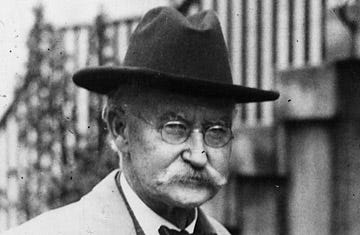
… took bribes from oilmen amounting to hundreds of thousand of dollars’ worth of cash and cows — he was also a rancher — in return for leasing them government oil reserves in the West that included the Teapot Dome field in Wyoming, which was no beaut of a butte; it was said to look something like a teapot, with its spout, but only as designed by those architects of Herman Goering’s priapic tables.

Eventually, Fall, the fall guy, fell. He did a year of hard labor in the teapot can.
—
Kristi Noem — former governor of South Dakota — is also a Westerner, and also a rancher, and also a member of the president’s Cabinet and as such also controls huge domestic budgets, and also is connected by photographs to large mountains.
The beginnings of the Teapot Noem® Affair were revealed yesterday by ProPublica. Here are the headlines:
Firm Tied to Kristi Noem Secretly Got Money From $220 Million DHS Ad Contracts
The company is run by the husband of Noem’s chief DHS spokesperson and has personal and business ties to Noem and her aides. DHS invoked the “emergency” at the border to skirt competitive bidding rules for the taxpayer-funded campaign.
…
The majority of the money — $143 million — has gone to a mysterious LLC in Delaware. The company was created just days before it was awarded the deal.
—
Honestly, you don’t need to know more than that. Or maybe you do. I myself didn’t read any further because the Epstein news of the day seemed to imply the possibility that Donald Trump once gave Bill Clinton a blow job. That story seems pretty, um, inflated, but you know. Eyeballs.
More on Kristi “Twisti” Noem later in the week, I am guessing.
—
Today’s Gene Pool challenge is based on something that happened to me last evening. I was in my car, traveling west on Massachusetts Avenue, a bustling two way thoroughfare in D.C. I turned right onto 15th Street SE, a one-lane, one-way street going my way. This street had a bike lane, which was, of course, also one-way in the same direction as the street. I checked to my left for bikers. There were none. So I turned right. This turn was legal and prudent. And that is when I almost killed a young woman and a girl I presumed to be her daughter, who looked to be about seven. They were on an electric scooter. The girl was standing in front of her mom, between mom and the handlebars.
The scooter was going the wrong way in the bike lane at twilight. It was rolling to a stop for the light, but moving faster than I was.
I had to jam on my brakes and veer to the left to avoid them. Then I did something I almost never do. I butted in to something that was Clearly Not My Business. I pulled to the curb and got out of my car. They were still at the light.
I said, “Ma’am, this is not my business, but I think you’re risking both of your lives by driving the wrong way in a bike lane on a one-way street at night. I almost hit you. I don’t think you should do this.”
She stared at me, blandly. She did not seem offended.
“Okay,” she said.
The light changed.
She roared off, at maybe 20 miles an hour, down the bike lane, the wrong way on a one-way street, into the darkening, menacing night.
—
So, that is your challenge for the day. What is some advice — buttinsky or otherwise — that you once gave with the best of intentions that either backfired or was ignored to someone’s detriment, or yours?
Send ’em as always, here. (snip-a bit MORE and a little poll on the page)
 Scottie's Playtime