A Couple Of Pertinent, Light-Hearted Stories For The Morning-

Science confirms whose farts are smellier—women’s or men’s—and what that means for Alzheimer’s.

Finally, the science news we really need.

Heather Wake

Everybody farts. Upwards of 23 times a day, in fact. It’s one of the most universal human experiences, cutting (the cheese) across age, culture, and personality. Yet for something so common, it somehow feels very different coming from a woman than it does from a man.
But according to research highlighted in a now-legendary study, there indeed is a difference between man farts and lady (sic) farts. This unexpected fact about the battle of the sexes carries an even more unexpected health benefit.

Yes, this is a story about farts. But stay with us.

Back in 1998, Dr. Michael Levitt, a gastroenterologist known among colleagues as the “King of Farts,” set out to understand where that unmistakable scent of human flatulence comes from. To answer the question, he recruited 16 healthy adults with no gastrointestinal issues. Each participant wore a “flatus collection system,” described as a rectal tube connected to a bag.

After eating pinto beans and taking a laxative, the volunteers provided samples that were then analyzed using gas chromatographic mass spectroscopic techniques. Levitt and his team broke down the chemical components inside each bag and invited two judges to help evaluate the results. The judges did not know they were sniffing human gas (which in retrospect sounds diabolical). They rated each sample on an odor scale from zero to eight, with eight meaning “very offensive.”

Their assessments pointed clearly to one culprit. Sulfur-containing compounds were responsible for the strongest and most memorable odors, especially hydrogen sulfide, which produces that classic “rotten egg” smell.

So where does the gender difference come in?

Here is the twist researchers did not expect: although men tended to produce larger volumes of gas, women’s flatulence contained a “significantly higher concentration” of egg smelling hydrogen sulfide. When the judges rated the odor of each sample, they consistently marked women’s gas as having a “greater odor intensity” than men’s. (snip-MORE, but not much.)

==========

When the mail carrier can’t read your handwriting the USPS calls in these experts to save the day

“Master keyers” can decipher a new address roughly every four seconds

Evan Porter

Our handwriting is getting worse. More and more of our writing and communications are being done digitally, and young people, in particular, are getting a lot less practice when it comes to their calligraphy. Most schools have stopped teaching cursive, for example, while spending far more time on typing skills.

And yet, we still occasionally have to hand-address our physical mail, whether it’s a holiday card, a postcard, or a package.

We don’t always make it easy on the postal service when they’re trying to decipher where our mail should go. Luckily, they have a pretty fascinating way of dealing with the problem.

The U.S. Postal Service sees an unimaginable amount of illegible addresses on mail every single day. To be fair, not all of it comes down to sloppy handwriting. Labels and packaging can get wet, smudged, ripped, torn, or otherwise damaged, and that makes it extremely difficult for mail carriers to decipher the delivery address.

You’d probably imagine that if the post office couldn’t read the delivery address, they’d just return the package to the sender. If so, you’d be wrong. Instead, they send the mail (well, at least a photo of it) to a mysterious and remote facility in Salt Lake City, Utah called the U.S Postal Service Remote Encoding Center.

According to Atlas Obscura, the facility is open 24 hours per day. Expert workers take shifts deciphering, or encoding, scanned images of illegible addresses. The best of them work through hundreds per hour, usually taking less than 10 seconds per item. The facility works through over five million pieces of mail every day.

Every. Single. Day. (snip-MORE, but again, not too much more)
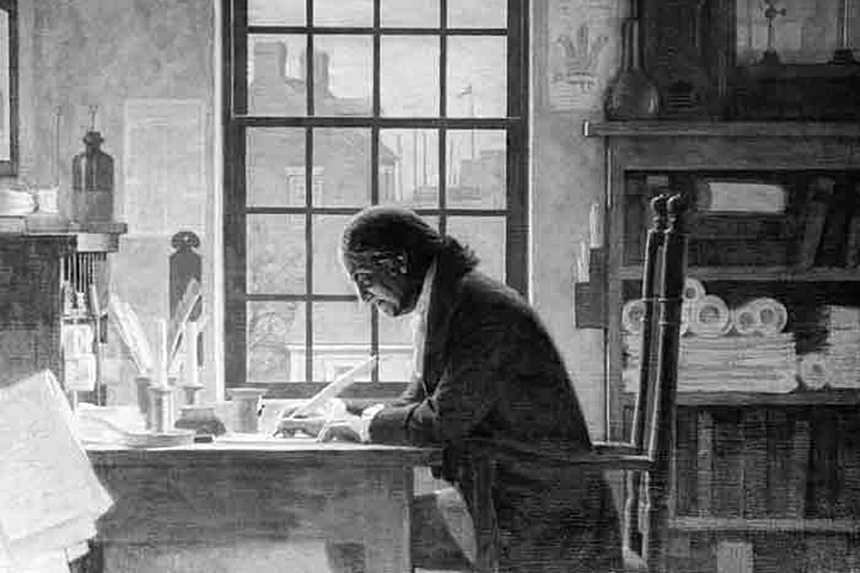
What Would Benjamin Franklin Do?

This is interesting, as to what he did.

Considering History: Ben Franklin, the U.S. Postal System, and Founding American Ideals

Ben Franklin and his role as the postmaster general of the U.S. Postal Service embodied a combination of individual and communal ideals that was at the heart of America’s founding.

Ben Railton

Benjamin Franklin by Charles E. Mills (Library of Congress)

This series by American studies professor Ben Railton explores the connections between America’s past and present.

By late July 1775, the military conflict between American colonials and English troops that would come to be known as the American Revolution was fully underway. The April battles at Lexington and Concord had blossomed into a war on many fronts, including the even more substantial Massachusetts Battle of Bunker Hill, Ethan Allen and his Green Mountain Boys seizing New York’s Fort Ticonderoga, and George Washington being appointed Commander in Chief by the newly convened Second Continental Congress.

Amid the growing war, on July 26th, that same body voted to establish a national mail service, the U.S. postal system, with Ben Franklin as the first postmaster general.

Portrait of Ben Franklin by Joseph-Siffred Duplessis, ca. 1785 (Wikimedia Commons)

That might seem like a profoundly mundane action to take during the fraught military battles and campaigns of an unfolding Revolution. But it represented an important way for the Continental Congress to amplify the emerging identity of a newly unified United States: It embodied a combination of individual and communal ideals that was at the heart of the American founding and that the USPS continues to exemplify today.

As we see in the official transcript of the Second Continental Congress, the creation of a national postal system was part of an important overarching conversation throughout the week of July 24-28, 1775; on Monday July 24th, “the Congress then resolved themselves into a committee of the whole to take into consideration the state of America.” Those considerations included establishing a medical department and new hospitals (which were connected to the war effort of course, but also comprised a communal good far beyond that immediate cause), printing currency out of a new continental treasury, and, as decided on Wednesday July 26th, responding to “the report of the Committee on the post office” by creating “a line of posts … from Falmouth in New England to Savannah in Georgia,” appointing a postmaster General for the United Colonies, and unanimously electing Benjamin Franklin, Esq. to serve in that role.

Congress Voting Independence (Wikimedia Commons)

By 1775, Ben Franklin had been involved in the creation of mail services for nearly four decades, and as was so consistently the case with Franklin, those efforts reflected both his pursuit of individual self-interests and his dedication to the communal good. In 1737, when Franklin was only 30 years old, he was appointed postmaster of his adopted home city of Philadelphia. In his autobiography he freely admitted that he took the job largely to support his own newspaper, the Gazette, writing, “tho’ the salary was small, it facilitated the correspondence that improv’d my newspaper, increased the number demanded, as well as the advertisements to be inserted, so that it came to afford me a considerable income.” But even if Franklin was mercenary about this new role, he was too much of an inventor not to innovate in it as well, and his most lasting and collectively meaningful such innovation was printing in the newspaper lists of people who had letters waiting for them at the post office, a practice that many other papers would take up for decades to come.

A painting by Charles Mills of young Ben Franklin working his printing press in Philadelphia (Library of Congress)

After a decade and a half in that important local role, the ever-ambitious Franklin was ready to move up. When Postmaster General for the Crown Elliott Benger became ill in 1753, Franklin lobbied for his overarching role. Eventually both he and a friend and fellow journalist, Virginia public printer William Hunter, were chosen as Joint Postmasters for the Crown, a role that Franklin would hold for the next two decades. He would bring a number of his Philadelphian innovations to that national role, including the aforementioned printed newspaper lists (which he instructed postmasters around the country to do). But he would also add successful new ideas, such as implementing nighttime service that led to far faster mail delivery. Ever the successful businessman, Franklin had the British Crown Post registering its first profit by 1760.

In 1774, after more than 20 years in that role, Franklin was dismissed by the British government for being too sympathetic to the colonies. But as he seemingly always did, Franklin parlayed this temporary setback into even more substantial long-term success, securing the July 1775 election to Postmaster General for the United Colonies with (again quoting the Continental Congress transcript) its accompanying “salary of 1000 dollars per an. for himself.” In case Franklin wasn’t able to make this new national postal system as profitable as the Crown’s had become under his leadership, Congress protected both the system and Franklin financially, adding that “if the necessary expense of this establishment should exceed the produce of it, the deficiency shall be made good by the United Colonies, and paid to the postmaster general by the continental Treasury.”

At least since the posthumous 1791 publication of his mythmaking autobiography, Ben Franklin had somehow embodied both self-made individual success and selfless philanthropy for the communal good. But contradictory as that duality may seem, it is also at the heart of America’s founding, as reflected in the opening passages of our two most famous framing documents. The Declaration of Independence begins with the “self-evident truths” that among each individual’s “unalienable Rights” are “Life, Liberty, and the pursuit of Happiness.” While the Constitution’s Preamble focuses on collective goals for “We the People” that include “forming a more perfect Union” and “promoting the general Welfare.”

In order for a society to endure, I would argue that it has to genuinely ensure both of these founding American ideals: that each individual in that nation has the opportunity to pursue their own dreams; and at the same time that the communal good remains an overarching collective goal. Since its July 1775 establishment, the United States Postal Service has impressively embodied both layers: offering mail service to every individual, in every corner of this giant nation; and doing so not as a corporation, but as a non-profit public good. Here on its 250th anniversary, let’s celebrate this continued reflection of our founding ideals.