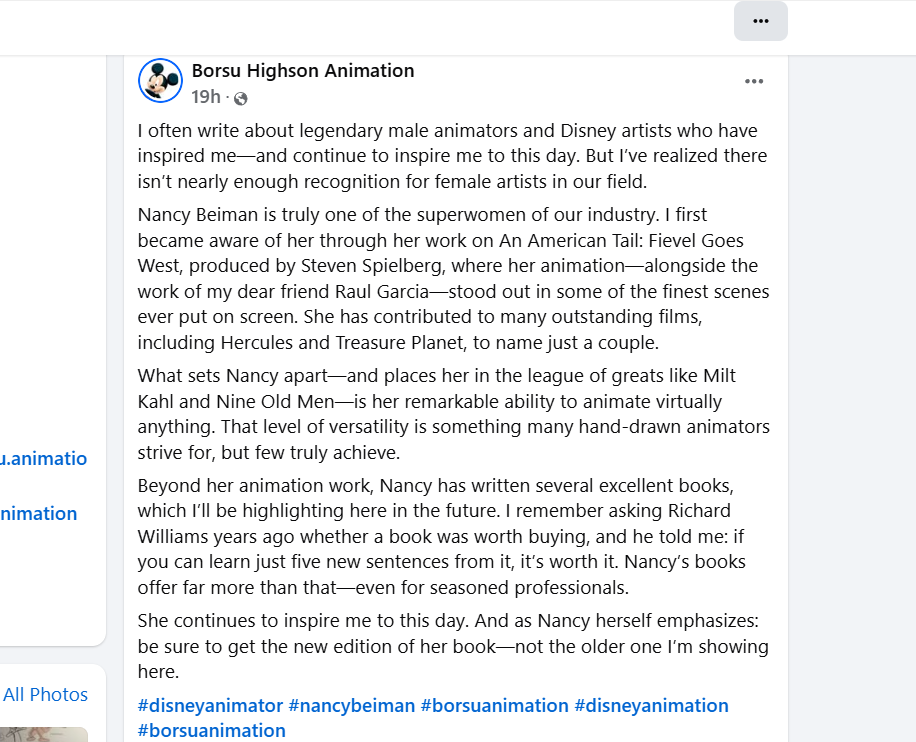
This review appeared on Facebook yesterday. I do not know Mr. Highson, but I read his columns.
My blushes, Watson.
Mr. Highson posts the cover of the first edition of Animated Performance on the Facebook post. The second edition, an essentially ‘new’ book, is available from Bloomsbury Press.
It’s nice of him to speak of me during Women’s History Month. Now let’s hear about the other female animators. One of my students, Ami Thompson, appears on the first page of this site. There are many others.
Animation really does let you ‘play’ any character; your sex, age, ethnic group do not matter. It allows you to act without anyone staring at you; there are many introverts in this profession!
Clockwise from top left: Katherine Fite, Belle Mayer Zeck, Harriet Zetterberg, and Cecelia Goetz
When Katherine Fite arrived in London in the summer of 1945, her role in the post-World War II justice process was so novel that the New York Times took notice. “Woman joins staff of war crimes group,” the paper proclaimed. Fite told the Times that “she would not know the scope of her assignment until she had arrived overseas, but that she had been conversant with most phases of the work of the State Department on war crimes.” As the quest for postwar justice continued, Fite became one of just a few women lawyers participating in what became known as the Nuremberg Trials.
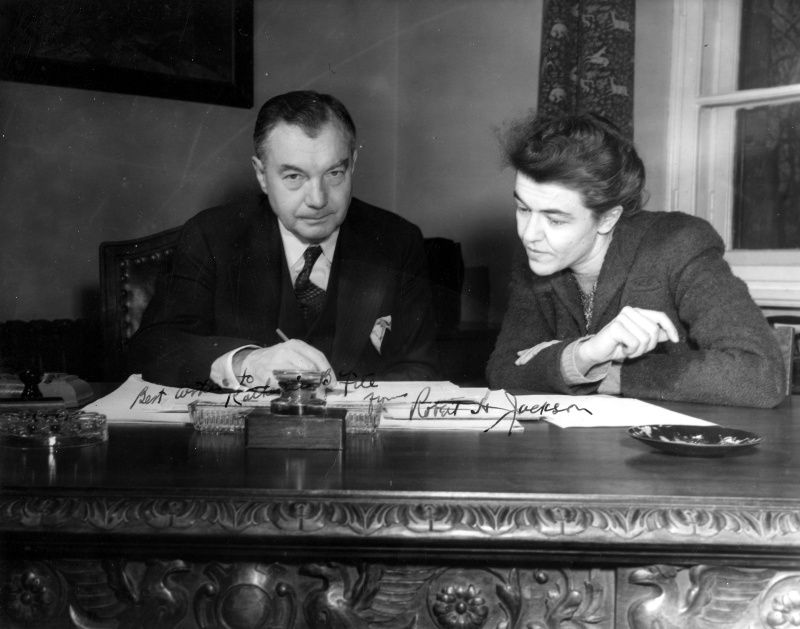
On May 2, 1945 — just six days before Victory in Europe, or V-E Day — Supreme Court Associate Justice Robert H. Jackson agreed to serve as chief prosecutor. That summer, as Europe emerged from the war, Jackson worked with his team and the Allies to prepare for the first ever international war crimes trials. Fite joined both the negotiations and legal research that led to the August 8 signing of the London Charter, creating the International Military Tribunal.
Katherine Fite (right) with Justice Jackson, ca. 1945 (National Archives)
Fite was the only woman lawyer present in the preparation phase. In September 1945, a month before the trials began, Fite toured Dachau Concentration Camp outside of Munich. She wrote home about the experience: “The gardens might well look fertile — human ashes were readily available for fertilizer.” A Polish-Jewish man who had survived Dachau showed her the gas chambers, disguised as shower rooms.
After the first trial, which lasted until October 1946, the United States launched 12 more trials that continued through 1949. Men dominated the courtroom — both as lawyers and as defendants — so women’s contributions were often overlooked. From the beginning, however, the American legal team relied on women’s work in key ways, from Fite’s work in the planning through the execution of the final trials, to Belle Zeck’s foundational work investigating German manufacturer I.G. Farben, to Cecelia Goetz’s key role prosecuting Krupp Industries.
Fite was not the only woman present at the Nuremberg Trials, but she was the highest-level female attorney in the early phases. Harriet Zetterberg was another early participant, the only woman lawyer assigned to the main prosecution team for the first Nuremberg trial, beginning in mid-August and lasting until June of 1946. Zetterberg arrived in Nuremberg in mid-September and prepared trial briefs, including one on slave labor and how it was used as a method to kill. Zetterberg felt the weight of the work, calling the six interrogations she witnessed “extremely interesting — one gets a sense of listening to history in the making.” (snip-MORE. This is really good.)
During the same week as the president’s address to Congress, RepresentWomen held our annual Democracy Solutions Summit (DSS). This solutions-oriented event allowed us to imagine what our democracy could look like with better policies and better representation.
Here, women leaders, elected officials, advocates and experts discussed the problems facing our democracy and uplifted actionable solutions to improve women’s representation and strengthen our democracy overall. This year’s summit addressed the critical need for more women in local, state and federal leadership roles.
The Democracy Solutions Summit clearly contrasts with the uncertainty of Trump’s address to Congress. The DSS is the only democracy summit featuring only women speakers and panelists committed to actionable, data-driven solutions and building coalitions that bolster American democracy at this critical time. Furthermore, our research has found that when multiple structural solutions are combined, we can bolster women’s representation in every level of government.
Complete recordings of the summit are available online, but here is a quick recap of all three days. (snip-More)


 Scottie's Playtime