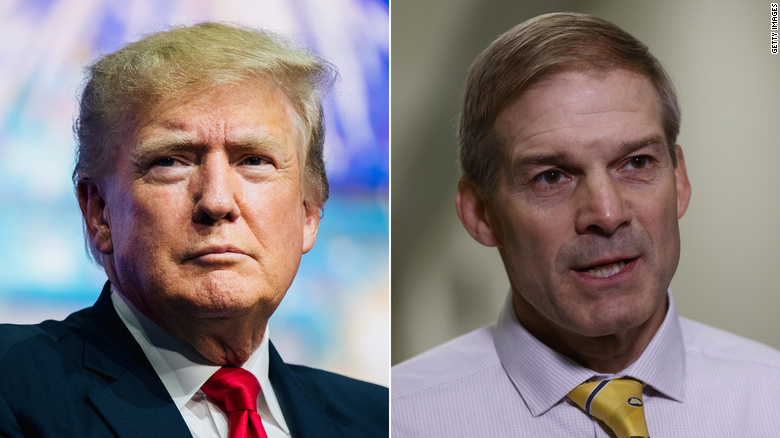
The House select committee investigating the Capitol insurrection is now in possession of White House records that provide new details about a phone call Donald Trump made to Republican Rep. Jim Jordan on January 6, 2021 — as the investigation drills down on the former President’s communications that day and questions have long swirled around calls between him and lawmakers.
Two sources who have reviewed the call records tell CNN that Trump spoke on the phone at the White House residence with Jordan for 10 minutes on the morning of January 6. That afternoon, Jordan took to the House floor to object to the certification of President Joe Biden’s Electoral College win, and pro-Trump supporters attacked the US Capitol.
A key focus of the committee’s investigation has been on the runup to the insurrection and the myriad ways Trump and his allies, including those in Congress, tried to overturn the election results. The new details about the morning phone call come as the committee is debating whether to move forward with a subpoena for Jordan after he refused to voluntarily appear for an interview.
Since Jordan acknowledged last summer that he spoke to Trump on the phone that day, the Ohio Republican and Trump loyalist has waived off questions about it or been inconsistent in his answers.
When asked on Friday about the White House records, Jordan told CNN that he had multiple calls with Trump on January 6 but could only confirm that he spoke with Trump after he left the House floor and did not remember whether they spoke that morning.
“I talked to the President a number of times that day, but I don’t remember the times,” Jordan said.
A spokeswoman for Trump did not immediately respond to a request for comment.
One entry in the White House records shows a request from Trump to get Jordan on the phone from the White House residence on the morning of January 6. A second entry shows that the length of the call was 10 minutes.
These call logs are among the documents the National Archives turned over to the House select committee investigating the riot after Trump last month lost his bid at the Supreme Court to keep them secret. The records have been crucial for congressional investigators as they try to build a complete narrative of what happened that day, and the call logs help to deepen that understanding.
Records show Trump did not leave the White House until 11:40 a.m. ET on January 6, 2021, to give a speech to thousands of his supporters gathered at the Ellipse. According to footage of House proceedings that day, Jordan spoke on the floor for five minutes starting at 1:32 p.m. ET during the debate over whether to reject Biden’s electors from Arizona.
Jordan later spoke to request a roll call vote on the Arizona challenge at 10:27 p.m. when lawmakers returned to the chamber after being evacuated as rioters interrupted the congressional proceedings.
On Friday, Jordan said, “I don’t recall,” when asked specifically if he spoke with Trump in the morning before the violence started. “I know I talked to him after we left off the floor,” adding that he did not remember how long his calls with the former President lasted that day.
Jordan’s previous recollections of his conversations with Trump on January 6 have been inconsistent.
At a House Rules Committee hearing in October, Chairman Jim McGovern, a Democrat from Massachusetts, specifically asked Jordan when he spoke with Trump that day.
“I talked to the President after the attack,” Jordan said at the time.
When McGovern pressed Jordan again and asked him to confirm that the call did not occur before or during the attack, Jordan replied: “Right. And I’ve been clear about that.”
Months earlier, in July, he told a local reporter he could not recall when he spoke to Trump or how many times they talked.
“Uh, I’d have to go — I spoke with him that day after. I think after?” he told the Spectrum News TV channel in Ohio. “I don’t know if I spoke with him in the morning or not. I just don’t know. I’d have to go back. I mean I don’t know when those conversations happened. But what I know is that I spoke with him all the time.”
In the committee’s letter to Jordan seeking a voluntary interview, Democratic Rep. Bennie Thompson, who chairs the panel, said investigators specifically wanted to ask Jordan about his communications with the former President.
“We understand that you had at least one and possibly multiple communications with President Trump on January 6th,” Thompson wrote in December. “We would like to discuss each such communication with you in detail.”
The committee also wants to speak with Jordan about meetings he had with White House officials and Trump in the months between the 2020 presidential election in November and the January 6 attack about “strategies for overturning the results of the 2020 election.”
The message, which Jordan forwarded to Meadows on January 5, outlined a legal theory that then-Vice President Mike Pence had the authority to stand in the way of the certification of the 2020 election. The text message is just one example of how Jordan provided a megaphone to the narrative that the election had been stolen from Trump.
The panel’s letter to Jordan also sought to learn more about any communications he had with Trump’s allies, legal team and staffers about potential organizing, planning or strategizing around January 6.
When Jordan indicated earlier this month that he doesn’t plan to cooperate and dismissed the committee’s investigation as illegitimate, a spokesperson for the panel said that Jordan is a “material witness” because he has admitted to speaking directly with Trump on January 6.
The spokesperson also suggested, without evidence, that Trump and his team are the reason Jordan is not cooperating.
“Mr. Jordan has previously said that he would cooperate with the committee’s investigation, but it now appears that the Trump team has persuaded him to try to hide the facts and circumstances of January 6th,” the spokesperson said.
Jordan was originally selected by House Minority Leader Kevin McCarthy to be one of five GOP members serving on the committee back in July. But House Speaker Nancy Pelosi rejected McCarthy’s selection of Jordan, along with GOP Rep. Jim Banks of Indiana, because she said their appointments could impact the “integrity of the investigation.”
The committee has long viewed Jordan as a top target for its investigation. In August, Jordan was among a group of Republican lawmakers whose phone records the committee asked various companies to preserve. At the time, Jordan warned about the precedent the panel would be setting if it went after sitting members of Congress.
The committee is still weighing whether it will take the next step and issue Jordan a subpoena, a move it is also considering with McCarthy and GOP Rep. Scott Perry of Pennsylvania.
The panel met on Thursday to discuss their options but did not settle on next steps when it comes to efforts to get their fellow lawmakers to cooperate. Chairman Thompson acknowledged on Thursday that it’s a complicated issue.
“You know, you have to respect this institution,” he told CNN. “You know, we have to see whether or not it’s ever been done before. If it had, on what authorities. So, we just want to be right. And if we are not in good standing with it, then I mean, we probably won’t do it.”
PEARSON SHARP: More and more Americans are standing up and fighting back against the tyranny of the COVID conspiracy theory. Convoys of outraged truck drivers are sending a message loud and clear to cowardly leaders all over the world, from Canada to Australia and even here in the U.S., and that message is simple: Back off, or else. We, the people, will not tolerate this oppression any longer.
Young athletes are a prime group to be targeted by this deadly vaccine with 500% more soccer players in the E.U. dropping dead from heart attacks than one year ago — 500%. Who is actually braindead enough to think that this is just a coincidence, when Pfizer and Moderna’s vaccine are known by the FDA to cause heart attacks. This is a pandemic of the ignorant, and it’s killing our country.
So, for all of you progressives and Democrats and radical leftists out there. Do us all a favor, please, and go get vaccinated. In fact, don’t stop there. Get double vaccinated, and be sure to get all your boosters. All three or four of them. Why stop there? If more is better— get five, six, get 10 boosters. All the rest of us sane, freedom-loving Americans are counting on you to get your injections. The survival of our country depends on it.
Sharp first appeared on JMG in December 2020 when he boasted about denying that Biden was the then president-elect.
He next appeared here when he called for executing “traitors” who deny that Trump really won the election.
Sharp’s videos were regularly posted to Trump’s official YouTube channel, back when he had one.
House Speaker Rusty Bowers, left, and Rep. John Fillmore talked Wednesday on the House floor about the speaker’s decision to quash Fillmore’s legislation that would have allowed lawmakers to reject election results.
Howard Fischer, Capitol Media Services
The top House Republican is unilaterally quashing legislation that would have given lawmakers the power to reject election results.
Strictly speaking, Speaker Rusty Bowers is not killing House Bill 2596, he told Capitol Media Services on Wednesday. That’s something he could do by simply refusing to assign it to any committee to be considered.
Instead, Bowers has taken the unprecedented step of assigning the proposal to each and every one of the 12 House committees, saying he knows full well there is no way it can secure approval of each. Most bills go to no more than two committees.
The maneuver drew an angry reaction from the bill’s sponsor, Rep. John Fillmore, R-Apache Junction. He complained to Capitol Media Services that “his highness’’ was abusing his powers in deep-sixing a measure that 14 other Republicans, out of 47 in the Legislature, support fully enough to sign on as co-sponsors.
“He does things like he’s God,’’ Fillmore said of the speaker. But Fillmore acknowledged he doesn’t have the votes — at least among those in his caucus willing to stand up — to oust Bowers as speaker and install someone who would allow the plan a chance of getting to the House floor for a vote.
“Sometimes there are a great many of the legislators (who) don’t have the intestinal fortitude to do what is right,’’ Fillmore said.
His proposed legislation is a grab bag of changes to election laws. It would:
Repeal laws allowing anyone to get an early ballot, saying only those with an excuse, like being hospitalized, would get that right.
Bar all other forms of early voting, requiring that ballots be cast only on Election Day.
Prohibit the use of Election Day voting centers available to anyone within a county, restricting people to casting ballots only in their home precinct.
“We need to get back to 1958-style voting,’’ Fillmore said.
But the provision that alarmed Bowers and some others would have required the Legislature to call itself into special session after every election to review the ballot tabulating process for both the primary and general elections.
More to the point, it would permit lawmakers to “accept or reject the election returns,’’ with the latter option paving the way for anyone to file suit to seek a new election.
That is unacceptable, Bowers told Capitol Media Services.
“We gave the authority to the people,’’ the Mesa Republican said.
“For somebody to say we have plenary authority to overthrow a vote of the people for something we think may have happened, where is it (the evidence)?’’ Bowers said of the unproven and unverified claims made by those seeking a new 2020 vote.
He said the audit of Maricopa County’s 2020 election returns ordered by Senate President Karen Fann has not produced any evidence that, as some have contended, the election was stolen from Donald Trump.
“The point is, when we gave a fundamental right to the people, I don’t care if I win or lose, that right was theirs,’’ Bowers said. “And I’m not going to go back and kick them in the teeth.’’
The speaker also said he could not go along with another provision that would have scrapped the current system of having ballots tabulated by machine, replacing that with a hand count of the all the votes cast, a figure that exceeded 3.4 million in 2020.
Proponents have argued that machine counts cannot be trusted, with allegations — all never proven — that the tabulators were either hacked or programmed to produce winning numbers for Joe Biden. Bowers said the solution of hand counts is worse than any potential problem.
“There’s individual elements (of the bill) that harm accuracy, speed and dependability of a vote,’’ Bowers said. “And if I can stop it, I’m not going to let that happen.’’
Bowers acknowledged there are those within his own party who continue to insist the last presidential election was rigged. And he said he is willing to consider changes in law designed to protect the right to vote and protect against cheating.
For example, he has allowed bills to go forward that would alter the early voting process or increase identification requirements.
But Bowers said he’s not willing to go along with “capricious’’ alterations to the law sought by “people of that ilk, the screaming, demanding, arrogant, self-righteous bunch.’’ And the speaker said it is his job to stand up and say “no,” even when others cannot — or will not.
“I would say that most Republicans don’t like it that way,’’ he said of the election-results deniers. “They’re just intimidated by these people.’’
Killing Fillmore’s bill “is just a message,” Bowers said.
Fillmore said Bowers has it wrong in saying the Legislature should have no role in reviewing — and potentially voiding — election returns.
“The Supreme Court has said that voting is our responsibility,’’ he said Wednesday after being informed of the speaker’s decision. “Who else, if not the state Legislature, would deal with this?’’
Fillmore, in introducing the legislation, said he isn’t buying arguments by election officials who say that machine counts are more accurate.
Nor was he swayed by the fact that current law already requires there be a hand count of ballots from selected precincts to compare that tally with what the machines registered. If those results are within a specified percentage, then the results statewide are presumed accurate. That is what happened after the 2020 election.
A judge separately ordered inspection of more than 1,600 ballots cast in the general election after allegations the machines had not properly tabulated the presidential race. In that case, the hand count found just nine with errors in the presidential race, not enough to declare Trump the winner here, even if that error rate ran through all similar ballots.
Bowers said that, in assigning HB 2596 to all 12 committees, he actually is giving Fillmore what he wants: the chance for one or more hearings. That could not have occurred if he refused to refer it to any committee at all, he said.
But Bowers made it clear that there is no way this bill would ever become law.
He gets that power not just by virtue of being the speaker and deciding what bills are put up for votes of the full House.
There’s also the fact that there are only 31 Republicans in the 60-member chamber. And with no Democrats in support, that means a single GOP vote against it — including his — would kill it if if even got that far.
Notice the guy who authored the bill wanted to get back to 1950 style voting.
After watching House Speaker Rusty Bowers torpedo his controversial election bill, Rep. John Fillmore on Wednesday compared it to a "lynching." Yep – he said that…https://t.co/Z0nptE1xc7 via @azfamily
The Supreme Court nomination battle to replace retiring Justice Stephen Breyer provides us with a historic opportunity to demand that the US Senate only confirm a nominee with a proven commitment to the rule of law who will judge cases based on the clear text and meaning of the US Constitution as written, and not legislate from the bench to impose a political ideology.
We can’t allow Biden to give a lifetime appointment to a radical judge simply because she checks the right identity boxes demanded by the left. But, we are going to need your financial help to make a difference in this upcoming Supreme Court confirmation battle.
Please give generously so we can fight this upcoming nomination. We already have a great deal of experience in these types of battles. Our work contributed in a major way to the confirmation of President Trump’s nominations of Neil Gorsuch, Brett Kavanaugh and Amy Coney Barrett.
Please step forward today with a financial investment in this battle. Your donation of $25, $50, $100, $500 or even $1,000 will make a huge difference in our ability to preserve a strong conservative majority on the Supreme Court and ensure that Joe Biden is not able to radicalize the Court by confirming extreme nominees committed to leftist ideology, not the rule of law.
Exporting murder. Behind a reign of terror against LGBTQ+ people in Ghana, a familiar name: Brian Brown, a rabid American bigot who fought marriage equality in the US and has mysterious Russian ties. https://t.co/AeuLnaL89p
Propelled in part by the wildly contagious omicron variant, the U.S. death toll from COVID-19 hit 900,000 on Friday, less than two months after eclipsing 800,000.
The two-year total, as compiled by Johns Hopkins University, is greater than the population of Indianapolis, San Francisco, or Charlotte, North Carolina.
The milestone comes more than 13 months into a vaccination drive that has been beset by misinformation and political and legal strife, though the shots have proved safe and highly effective at preventing serious illness and death.
“It is an astronomically high number. If you had told most Americans two years ago as this pandemic was getting going that 900,000 Americans would die over the next few years, I think most people would not have believed it,” said Dr. Ashish K. Jha, dean of the Brown University School of Public Health.
He lamented that most of the deaths happened after the vaccine gained authorization.
“We got the medical science right. We failed on the social science. We failed on how to help people get vaccinated, to combat disinformation, to not politicize this,” Jha said. “Those are the places where we have failed as America.”
Just 64% of the population is fully vaccinated, or about 212 million Americans, according to the Centers for Disease Control and Prevention.
Nor is COVID-19 finished with the United States: Jha said the U.S. could reach 1 million deaths by April.
Among the dead is Susan Glister-Berg, 53, of Sterling Heights, Michigan, whose children had to take her off a ventilator just before Thanksgiving after COVID-19 ravaged her lungs and kidneys.
“She’s always cared more about people than she did herself. She always took care of everyone,” said a daughter, Hali Fortuna. “That’s how we all describe her: She cared for everyone. Very selfless.”
Glister-Berg, a smoker, was in poor health, and was apparently unvaccinated, according to her daughter. Fortuna just got the booster herself.
“We all want it to go away. I personally don’t see it going away anytime soon,” she said. “I guess it’s about learning to live with it and hoping we all learn to take care of each other better.”
The latest bleak milestone came as omicron is loosening its grip on the country.
New cases per day have plunged by almost a half-million since mid-January, when they hit a record-shattering peak of more than 800,000. Cases have been declining in 49 states in the last two weeks, by Johns Hopkins’ count, and the 50th, Maine, reported that confirmed infections are falling there, too, dropping sharply over the past week.
Also, the number of Americans in the hospital with COVID-19 has declined 15% since mid-January to about 124,000.
Deaths are still running high at more than 2,400 per day on average, the most since last winter. And they are on the rise in at least 35 states, reflecting the lag between when victims become infected and when they succumb.
Still, public health officials have expressed hope that the worst of omicron is coming to an end. While they caution that things could still go bad again and dangerous new variants could emerge, some places are already talking about easing precautions.
Los Angeles County may end outdoor mask requirements in a few weeks, Public Health Director Dr. Barbara Ferrer said Thursday.
“Post-surge does not imply that the pandemic is over or that transmission is low, or that there will not be unpredictable waves of surges in the future,” she warned.
Despite its wealth and its world-class medical institutions, the U.S. has the highest reported toll of any country, and even then, the real number of lives lost directly or indirectly to the coronavirus is thought to be significantly higher.
Experts believe some COVID-19 deaths have been misattributed to other conditions. And some Americans are thought to have died of chronic illnesses such as heart disease and diabetes because they were unable or unwilling to obtain treatment during the crisis.
The Rev. Gina Anderson-Cloud, senior pastor of Fredericksburg United Methodist Church in Virginia, lost her dementia-stricken father after he was hospitalized for cancer surgery and then isolated in a COVID-19 ward. He went into cardiac arrest, was revived, but died about a week later.
She had planned to be by his bedside, but the rules barred her from going to the hospital.
“I think it’s important for us not to be numbed. Each one of those numbers is someone,” she said of the death toll. “Those are mothers, fathers, children, our elders.”
When the vaccine was rolled out in mid-December 2020, the death toll stood at about 300,000. It hit 600,000 in mid-June 2021 and 700,000 on Oct. 1. On Dec. 14, it reached 800,000.
It took just 51 more days to get to 900,000, the fastest 100,000 jump since last winter.
“We have underestimated our enemy here, and we have under-prepared to protect ourselves,” said Dr. Joshua M. Sharfstein, a public health professor at Johns Hopkins Bloomberg School of Public Health. “We’ve learned a tremendous amount of humility in the face of a lethal and contagious respiratory virus.”
The latest 100,000 deaths encompass those caused by both the delta variant and omicron, which began spreading rapidly in December and became the predominant version in the U.S. before the month was out.
While omicron has proved less likely to cause severe illness than delta, the sheer number of people who became infected with it contributed to the high number of deaths.
Ja said he and other medical professionals are frustrated that policymakers are seemingly running out of ideas for getting people to roll up their sleeves.
“There aren’t a whole lot of tools left. We need to double down and come up with new ones,” he said.
COVID-19 has become one of the top three causes of death in America, behind the big two — heart disease and cancer.
“We have been fighting among ourselves about tools that actually do save lives. Just the sheer amount of politics and misinformation around vaccines, which are remarkably effective and safe, is staggering,” Sharfstein said.
Protesters in Charlotte joined demonstrations nationwide Saturday rallying against restrictive anti-abortion laws in Texas and advocating for reproductive rights. The group gathered in First Ward Park for the uptown Charlotte rally and march. HANNAH LANGHLANG@CHARLOTTEOBSERVER.COM
North Carolina isn’t exactly considered a champion of reproductive rights.
So it may come as a surprise that North Carolinians can now get hormonal birth control without a doctor’s prescription, thanks to a law initially passed last year by the state’s Republican-controlled legislature and signed by Democratic Gov. Roy Cooper.
The law, which went into effect Tuesday, allows pharmacists to dispense birth control pills and patches without the signature of a patient’s physician, removing a significant, unnecessary barrier that prevents many people from obtaining hormonal contraception.
It almost sounds too good to be true — and it very well may be.
The law is clear that people will now be able to obtain birth control without a prescription, but it’s less clear whether their insurance will still have to pay for it.
Under the Affordable Care Act, most insurance plans are required to cover FDA-approved contraceptives with no out-of-pocket costs when prescribed by a health care provider. That provision significantly reduced the cost of birth control for many, but faced strong objections from conservatives. The Trump administration later undermined that mandate by allowing for broad religious and moral exemptions, which the U.S. Supreme Court eventually upheld in a 2020 ruling.
But the requirement doesn’t seem to apply to contraceptives dispensed without a prescription — meaning that those who would benefit from getting birth control without the added trouble of a doctor’s visit might still be shackled with the burden of paying for it. Without insurance, the birth control pill can cost as much as $600 a year, an expense that is unmanageable for many people.
Since the law only went into effect this week, the state health director hasn’t yet provided specific guidance — otherwise known as “standing orders” — that instructs pharmacists how to carry it out. That guidance should come quickly in order to clarify whether or not birth control dispensed without a prescription will result in co-pays or other out-of-pocket costs.
In other states where birth control is available without a prescription, such as California, the law was written to specifically mandate coverage for both prescribed and non-prescribed contraceptives. But North Carolina’s law doesn’t include such a provision.
It’s not for lack of trying. Rep. Julie von Haefen, a Wake County Democrat, introduced a bill that would have specifically addressed the affordability aspect. In addition to empowering pharmacists to dispense birth control without a prescription, House Bill 817 would have required insurers to cover both prescription and nonprescription contraceptives. Unfortunately, the bill did not gain any traction in the Republican-controlled legislature.
“I’m not sure if the bill drafters of the other bill that ended up passing really thought through whether that would affect the health care coverages, because it’s not technically a written prescription from a doctor,” von Haefen said. “The reason I did my bill was mostly to eliminate the co-pays for any kind of hormonal contraceptives.”
But Jillian Riley, the North Carolina director of public affairs for Planned Parenthood South Atlantic, said that birth control dispensed by a pharmacist could still be covered by insurance due to a different state statute that requires reimbursement when services normally covered by a person’s insurance policy are performed by a different licensed health care provider.
Surprisingly enough, making hormonal birth control more accessible is something that has enjoyed a fair amount of Republican support over the years, particularly at the national level.
It was a big talking point for U.S. Sen. Thom Tillis when he first ran for office in 2014, as well as for a handful of other Republicans running in battleground states. It’s even an issue that U.S. Rep. Alexandria Ocasio-Cortez and U.S. Sen. Ted Cruz famously — and strangely — agreed on back in 2019.
What Democrats and Republicans don’t agree upon, however, is who should pay for it. While the GOP appears to support measures that make birth control more available, the party has been less enthusiastic about making sure everyone can afford it.
That’s a problem, because affordability and accessibility go hand in hand. If the state health director decides that the law, as written, does not require insurance companies to cover the cost of birth control without a prescription, lawmakers should quickly craft stronger legislation that ensures contraception is both affordable and accessible for all North Carolinians.
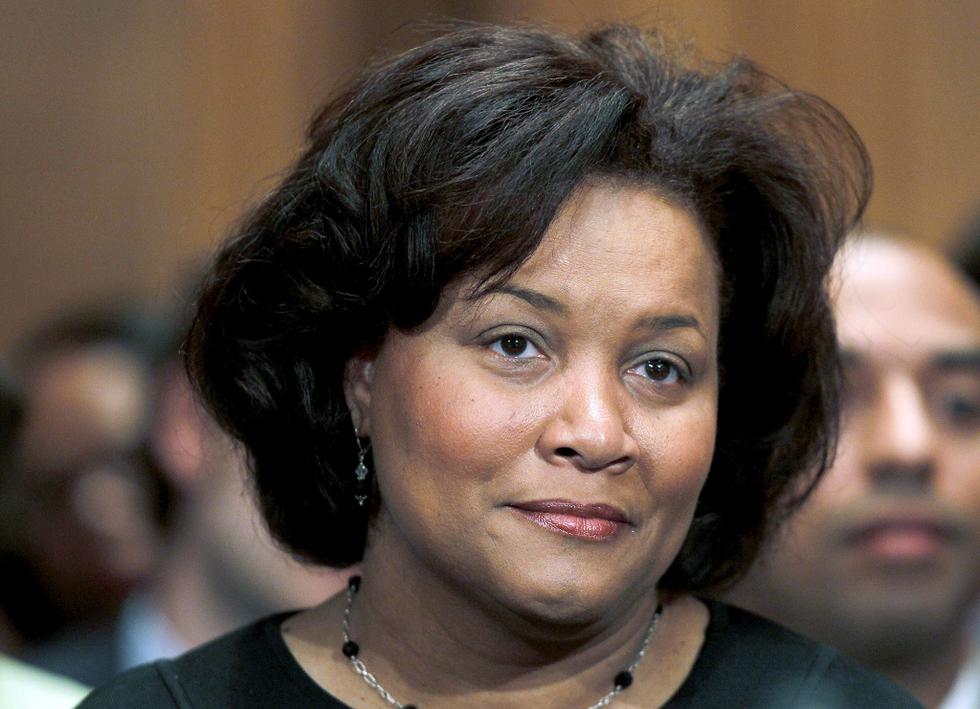
Judge J. Michelle Childs, who was nominated by President Barack Obama to the U.S. District Court, listens during her nomination hearing before the Senate Judiciary Committee, April 16, 2010.
At the moment, South Carolina District Court Judge J. Michelle Childs is the only person confirmed by the Biden administration to be under consideration for the soon-to-be-vacant Supreme Court seat. A favored pick of fellow South Carolinians Rep. James Clyburn (D-SC), the highest-ranking Black leader in Congress, and Sen. Lindsey Graham (R-SC), Childs’s work during her time as an attorney has recently come under scrutiny, as she defended employers against racial and gender discrimination allegations while working as a partner at the anti-union South Carolina law firm Nexsen Pruet.
Childs’s track record as a district court judge, a post she has held since 2010, has received less inspection. On numerous occasions, Childs issued such punitive decisions on criminal justice issues that those rulings were eventually overturned on appeal by higher courts. Throughout the 2010s, a period where criminal justice reform was increasingly prioritized for activists and Democratic politicians alike, Childs ruled against both plaintiffs and defendants who alleged everything from excessive force by prison guards to ineffective legal counsel to sentencing errors.
In March 2016, an inmate named Lewis Duckett sued the South Carolina Department of Corrections’ dietitian, alleging that the food he was forced to eat while in prison was so lacking in nutrients and vitamins that the state’s corrections facility where he was incarcerated was violating his Eighth Amendment right to avoid cruel and unusual punishment. Childs dismissed the case. Just one month later, the Fourth Circuit Court of Appeals overruled Childs’s decision, allowing for further proceedings.
In 2017, inmate Benjamin Heyward brought a civil rights action against prison guard Audrey Price, alleging use of excessive force after Price pepper-sprayed him in the face in the course of an argument that arose over a request Heyward made for some cleaning solvent to tidy his cell. As a result of the macing, Heyward reported that his eyes were swollen for three days. He suffered chest pain for five days, and had persistent headache symptoms for a week.
Judge Childs ruled against Heyward, claiming he was unable to prove use of excessive force. But eight months later, the Fourth Circuit ruled that Judge Childs had wrongly rejected Heyward’s excessive-force claim based on an “arbitrary quantity of injury,” and reversed her decision to grant the officer a summary judgment.
Childs’s rulings weren’t confined to inmates alleging abuse and mistreatment in South Carolina’s prisons. She also, on multiple occasions, ruled against incarcerated people who alleged that they were wrongly or excessively sentenced, only to have those decisions reversed later or overturned by the circuit courts.
In 2017, Judge Childs dismissed a motion brought by Gerald Decosta Whaley, who had been sentenced in 2014 to 262 months in prison, followed by five years of supervised release, for selling marijuana, cocaine, and ecstasy with his brother. In 2015, Whaley argued that his lawyer had failed to provide him adequate legal counsel by not filing a direct appeal, and filed a motion to vacate or correct his sentence.
Childs dismissed Whaley’s petition without even granting him an evidentiary hearing, a decision that the Fourth Circuit found particularly objectionable. Less than a year later, that court reversed Judge Childs’s decision, finding in fact that Whaley “informed his counsel at sentencing that Whaley wished to file a direct appeal, but that counsel failed to file one.” In dismissing this motion without so much as a hearing, Judge Childs had “abused [her] discretion,” the court found.
Again in 2017, Judge Childs ruled against an inmate claiming to have been wrongly sentenced. In 2014, Jesse James Quarles pled guilty to being a felon in possession of a firearm. Three years later, he was given an elevated sentence of 180 months on the grounds that he was a “career criminal,” thanks to three prior burglary convictions.
Before that sentence was handed down, Quarles filed a motion claiming that he had been improperly charged as a career criminal, citing changes in U.S. law that had since reclassified burglary as nonviolent felony, a change that would have reduced his sentence substantially. In November 2017, Judge Childs dismissed Quarles’s motion, and upheld his 180 months.
Just a month later, before a higher court could act, Judge Childs reversed her own ruling, admitting that Quarles did not have the requisite three felonies needed to be classified as a career criminal.
Judge Childs’s repeated opposition to leniency in sentencing and alleged abuse cases brought by prisoners is notable in its own right; that she made those decisions on such dubious grounds that they were routinely overturned by higher courts indicates a commitment to tough-on-crime rulings beyond the letter of procedure.
Given the salience of criminal justice reform to Democratic politicians nationwide, it’s hard to reconcile a judge with such a record on criminal justice issues serving as the Supreme Court nominee of the Biden administration. Despite thus far refusing to legalize marijuana, the White House has restarted pattern-or-practice investigations into police departments, and has continued to talk up the importance of criminal justice reform.
Rep. Clyburn has been Childs’s loudest supporter among Democrats. In response to a question about Childs’s rulings, a Clyburn spokesperson said, “The insinuation that Jim Clyburn would support a nominee to the Supreme Court with the intent to undermine criminal justice reform is so preposterous that it discredits the integrity of this entire report.”
Throughout 2020’s campaign cycle, the Biden-Harris pairing went to great lengths to assure voters that criminal justice issues were a top concern for them, and that both of them had disavowed their own tough-on-crime pasts and the Democratic Party’s notorious Crime Bill of the 1990s.
It’s difficult to imagine someone with a record like Judge Childs’s winning votes from criminal justice advocates like Sen. Cory Booker, or even Dick Durbin, both of whom sit on the Senate Judiciary Committee and have claimed that these issues are particularly important for them. Childs’s record, meanwhile, is not shared by other front-runners: Ketanji Brown Jackson, for instance, was a former public defender and sentencing commission vice chair.
Pamela Moses was sentenced to six years in prison for trying to register despite a felony conviction but officials admitted making a series of mistakes
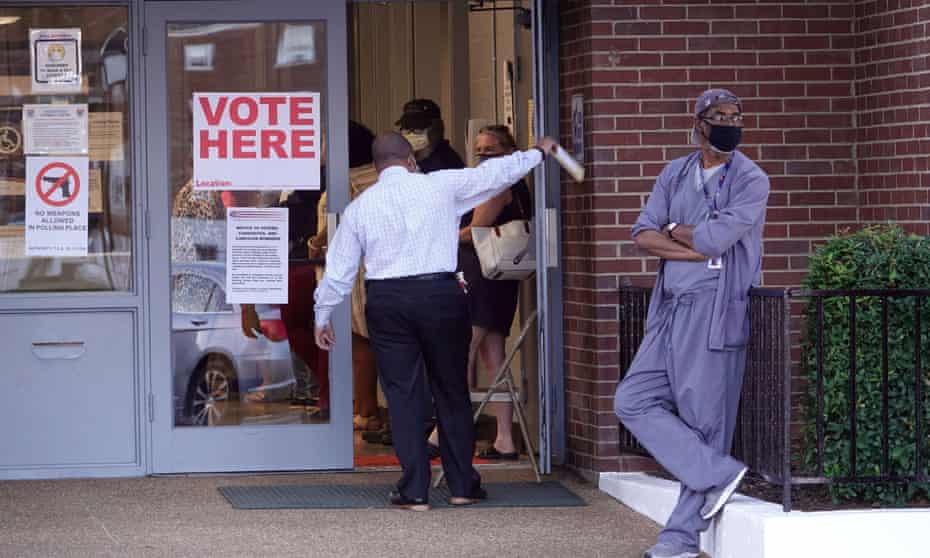
People arrive to vote early in the general election in Memphis, Tennessee. Photograph: Karen Focht/Zuma Wire/Rex/Shutterstock
Hello Fight to Vote readers,
For the last few months, I’ve been following the case of Pamela Moses, a 44-year-old activist in Memphis who was convicted in November for trying to register to vote while she was ineligible. On Monday, Moses, who is Black, was sentenced to six years and one day in prison.
To my eye, the case is far more complex than it seems.
Amy Weirich, the local prosecutor, has trumpeted both the conviction and the sentence in press releases. She has highlighted that Moses has an extensive criminal record, and she told a straightforward story about Moses’ voting crime. In 2015, Moses pleaded guilty to perjury and tampering with evidence in connection to allegations that she stalked and harassed a local judge. Tampering with evidence is one of a handful of felonies that causes someone to permanently lose their voting rights in Tennessee. Nonetheless, Moses, still on probation, knowingly tried to register to vote in 2019.
The case caught my attention for a few reasons. First, it is rare to see a prosecutor bring criminal charges against someone for election crimes, and I was curious whether this was a bona fide case of fraud or of someone who had made a mistake. Second, there has been growing awareness of racial disparities in punishments for election-related crimes. Black people such as Crystal Mason and Hervis Rogers have faced years in prison for making mistakes about their voting eligibility. White voters have received much lighter sentences for election-related crimes.
Weirich’s office did not respond to interview requests, but the more I looked into Moses’ case, the more I realized the case wasn’t straightforward at all. Behind the scenes, Tennessee officials conceded that they had made a series of mistakes concerning Moses’ voting eligibility.
The US state that fought back after Republicans tried to rig its elections
Read more
In 2015, when Moses pleaded guilty to her felony, she says no one told her she couldn’t vote. “They never mentioned anything about voting. They never mentioned anything about not voting, being able to vote … none of that,” Moses told me last year. (She added she hadn’t discussed the case with her two sons, 24 and 13, but described it as “traumatic”.)
At the time, election officials should have removed her from the rolls, but the court never sent election officials in Memphis the documents they needed to do so, according to a letter from an election official I obtained.
Moses didn’t know anything was amiss until 2019, when she launched a long-shot mayoral campaign. Election officials said she couldn’t appear on the ballot because of her felony. When they began to look into her eligibility, they also realized she had never been taken off the voter rolls. Moses went to court and asked a judge to clarify whether she was still on probation, and the court confirmed that she was. What happened next is at the crux of the case against her.
Moses did not believe the judge had correctly calculated her sentence. So she went to the local probation office and asked an officer to figure it out. An officer filled out and signed a certificate confirming her probation had ended. In Tennessee, people with felony convictions who want to vote need that document from a correction official. Moses submitted it to local election officials along with a voter registration form.
But the day afterwards, an official at the corrections department wrote an email to election officials saying a probation officer had made an “error” on Moses’ certificate. Moses was still serving an active felony sentence, they wrote, and was not eligible to vote. The department offered no explanation for the mistake.
Such errors are actually fairly common in Tennessee, where the voting rules are extremely confusing for people with felonies, Blair Bowie, an attorney at the Campaign Legal Center, told me. A 2017 study found that about 8% of the certificates submitted were rejected because the voters remained ineligible. Bowie said she was unaware of any voter in the state ever facing criminal charges for submitting a certificate but later turning out to be ineligible to vote.
During Moses’ trial, prosecutors argued that she knew she was ineligible to vote when she submitted the certificate. They pointed to the fact that she submitted it even though a judge had recently told her she was ineligible.
“Even knowing that order denied her expiration of sentence, Pamela Moses submitted that form with her application for voter registration and signed an oath as to the accuracy of the information submitted,” prosecutors wrote in their request for an indictment. “Pamela Moses knowingly made or consented to a false entry on her permanent registration.”
“You tricked the probation department into giving you documents saying you were off probation,” the judge sentencing her said last week.
“That seems absurd to me on its face,” said Bowie, who is involved in a challenge to Tennessee’s process for restoring voting rights. “The instructions on the certificate of restoration form are very clear to the probation officer or the clerk. They say you will check these records and you will sign off on this based on what the records say.
“They’re saying that she tricked the probation officer into filling out this form for her. That creates a really scary prospect for people who think they’re being wrongly told they’re not eligible.”
Moses is currently in custody and an appeal is expected. But the case highlights the byzantine maze that people with felony convictions have to go through to figure out if they can vote. And it shows the harsh consequences prosecutors can bring if people with felony convictions make a mistake.


 Scottie's Playtime