Michael Moore: Biden ‘has been played like a sucker’ by Netanyahu
Director and activist Michael Moore argued Wednesday that President Biden “has been played like a sucker” by Israeli Prime Minister Benjamin Netanyahu.
JD Vance chose a disturbing location for his Arizona campaign stop
Generation Church in Mesa, Arizona, is led by a pastor who claims Christians can’t vote for Democrats and women who seek divorce after abuse are defying God’s word.
Let’s hope 2024 will be the year that “both sides” fact-checking as a journalistic genre grows up.
The comically bad “fact-checking” that came out of the Democratic National Convention should be a wake-up call for anyone who cares about the truth.
Example: Kamala Harris received a “Mostly False” when she said that, through Project 2025, Donald Trump “plans to create a national anti-abortion coordinator and force states to report on women’s miscarriages and abortions.” Politifact explained that “Project 2025 doesn’t mention a ‘national anti-abortion coordinator.’ The document calls for a ‘pro-life politically appointed Senior Coordinator of the Office of Women, Children, and Families.’”
That’s like saying it’s untrue to suggest a diner serves ketchup when it merely offers catsup.
Trump’s Firehose of Falsehoods
These attempts to parse “tomato” from “tomah-to” might make some sense in a reality that didn’t include Donald Trump, whose complete rejection of the truth thrives when the press falls into the trap of suggesting “both sides” as equally flawed. The perennial GOP nominee lies about everything from hurricane warnings to his historically bad jobs record.
Even the idea that Trump can be fact-checked helps Trump. It falsely suggests there are times when he might be constrained by the truth when he, like all authoritarians, is “cognitively irresponsible,” says rhetoric scholar Jennifer Mercieca. He uses his words almost solely to reject the idea that he’s accountable to anyone or democracy itself.
The combination of Trump’s firehose of falsehoods and the media’s agenda to appear even-handed has always yielded toxic slop. But “fact checkers’” do accidentally reveal two truths:
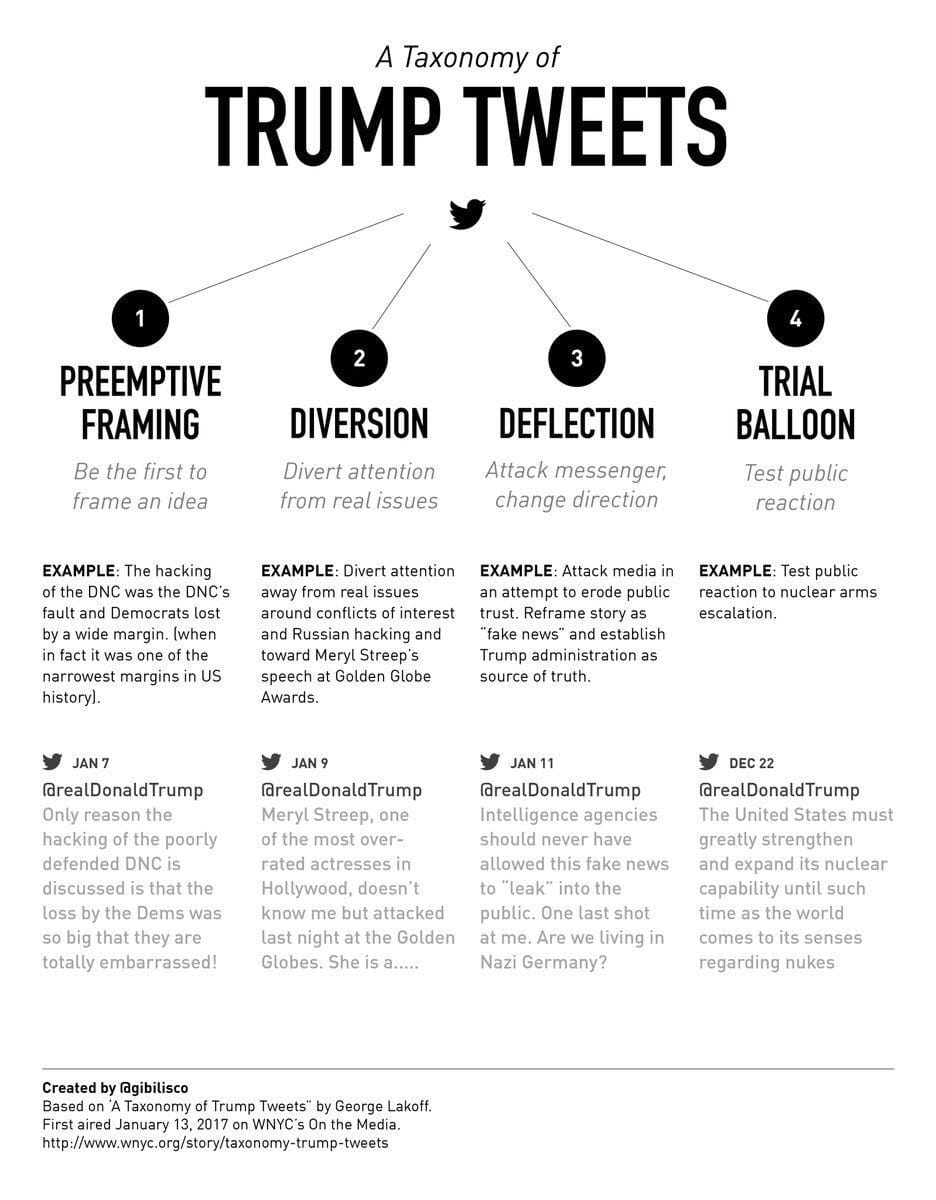
As Dr. George Lakoff has explained for years, accepting someone else’s framing spreads that framing, even if you’re debunking it.
The whole fact-check genre could be called “Don’t Think of this Thing I Think is Wrong.” Whether it’s Richard Nixon saying, “I am not a crook,” or the AP telling us that JD Vance didn’t technically mate with furniture, the idea you’re trying to dispel is spread far more than it can ever be debunked. A fact check tends to be the opposite of a truth sandwich, which Dr. Lakoff proposed to minimize the spread of blatant lies.
The press still has no idea how to treat Trump, one of the worst liars in American history.
Many of the worst fact checks – like the suggestion Trump doesn’t want to repeal Obamacare – rely on Trump’s constant contradictions of himself, often in the same sentence. This loads in the presumption that Trump uses language the way typical politicians do instead of as a super salesman/demagogue.
Lakoff categorized Trump’s tweets to make it easier to analyze Trump’s linguistic vandalism:
Trump is also an expert in paralipsis, which Mercieca describes as his way of asserting something without taking responsibility for saying it himself. It’s his game of “I’m not saying/I’m just saying.” He does this by retweeting particular noxious notions or images he’s trying to spread or framing his assertions with “many people are saying.” It’s a repulsive hack that renders fact-checks useless.
Fact checks in the Trump era have begun to operate a bit like the “Community Notes” scam on Elon Musk’s version of Twitter. Sure, you occasionally get a gem that exposes an obvious scam – like a faked Trump rally photo or a Republican bragging about an infrastructure program he opposed. But think about where those notes don’t appear. They’re never on Elon’s tweets, which are saturated with right-wing propaganda, AI-generated disinformation, and neo-Nazi conspiracy theorizing. So, in essence, they’re vouching for every lie he spreads.
Can Fact Checks be fixed?
Donald Trump depends on journalism’s failed conventions to continue to normalize his unprecedented attack on American freedoms. That’s why editors must pursue multiple strategies to ensure they don’t mislead anyone into thinking Trump’s dishonesty is comparable to his opponent’s or any relevant American political figure.
We need information to debunk lies, yet there should be a greater sense of responsibility when dealing with blatant untruths. That starts with recognizing that lies change brains, even when debunked. They are like toxic spilloff or nuclear waste that must be tracked, contained and cleaned up as much as possible. The best way to do that is to lead with the truth whenever possible, the exact thing Trump is trying to bury with his lies.
Readers also need a sense of Trump’s lies’ unprecedented scope, recurrence and purpose. One strategy is to annotate a typical rally speech with facts and reality checks. Then, compare it to a typical Harris speech. Another is to track his most-repeated lies. And, as Dr. Lakoff has suggested for decades, journalists should also analyze the rhetoric’s frames to give voters a sense of the information war being waged for their brains.
The problem with all of these strategies is that the press would be required to do something that they seem to do their best to avoid: Call out Trump’s lies directly. The best we can hope for is a “falsely claims” in a headline or two, which is better than nothing.
Fact checkers should stop pretending they are the be-all and end-all of determining a fact’s value. Since their jobs do not seem to depend on their reputations or track records, they should bring in experts whose careers depend on accuracy to take on Trump’s most repeated lies.
Publications that care about the truth need to show they understand the seriousness of this moment. Democracy and journalism face an unprecedented attack from Trump and MAGA that threatens the future of these two pillars of a free society.
Cowering to Trump will, at best, buy you more opportunities to cower to Trump, who will never be satisfied – not until he can imprison anyone who displeases him by suggesting he alone isn’t in charge of deciding what is true.
Benjamin Netanyahu is as obtuse as Donald Trump Read on Substack
Israeli newspaper Yedioth Ahronoth has revealed that Israeli Prime Minister Benjamin Netanyahu killed a ceasefire and hostage release agreement last July. The report is based on a document the newspaper obtained. Bibi killed the deal by proposing a raft of new demands at the 11th hour.
Among those demands was that Israel retain control of the Egypt-Gaza border area – a condition Netanyahu has since portrayed as non-negotiable, including at a press conference on Wednesday.
Last week, the Israeli Defense Force found six dead Israeli hostages. Yedioth Ahronoth also reported that at least three of the six hostages, Carmel Gat, Aden Yerushalmi, and Hersh Goldberg-Polin were due for release as part of the May draft agreement.
The other three hostages murdered are Ori Danino, Almog Sarusi, and Alex Lobanov.
An Israeli source familiar with the talks said Netanyahu’s demands were to blame for the deaths of the hostages over the weekend. Netanyahu, who’s already a war criminal wanted by the International Criminal Court, is responsible for the deaths of at least 40,000 Palestinians. I have to look the number up every time I write about this because it keeps rising.
Much like Vladimir Putin, Netanyahu bombs civilian targets.
The inside source told CNN that when Netanyahu put the obstacles up and said no to the deal, “The hostages died because he insisted.”
The Hostages Families Forum said the deaths are a “direct result of Netanyahu’s thwarting of the deals.”
Donald Trump does not care about people who died for our nation. When he visited Arlinton National Cemetary, he stood next to graves for a political photo-op of him giving his patented thumbs-up. Trump saw dead soldiers as a tool for his campaign.
Netanyahu, who’s as fascist, corrupt, heartless, and as selfish as Trump, sees dead hostages as a tool for his campaign…his campaign of war. Bibi refuses to end this war. In the current round of ceasefire negotiations, one of Bibi’s demands is that he can resume indiscriminately bombing Gaza anytime he wants. It’s a ceasefire for only one side to cease firing.
Hamas is a terrorist organization. We can’t forget that they’re murderers and kidnappers. There wouldn’t be any hostages to negotiate for if Hamas hadn’t kidnapped them. But we also can’t forget that Hamas is NOT Palestine. Palestinian civilians shouldn’t be cannon fodder for Netanyahu.
When Hamas attacked Israel on October 7 last year, it was a gift for Netanyahu.
Drawn in 30 seconds: (go watch it on his page, linked here and up above.)
Telling tourists on the Great Barrier Reef about climate change doesn’t negatively affect their trip, according to a new study.
Instead, finds the research, it could be a good avenue to promote climate action for people who wouldn’t otherwise be engaged.
The study, done by a team of Queensland researchers, is published in People and Nature.
“Tourism operators are getting more engaged in learning how they can spread more awareness, given the state of the Reef and how urgent it’s getting,” says lead author Dr Yolanda Waters, an environmental social scientist at the University of Queensland.
“But they still have these concerns – what if it ruins people’s day? People pay a lot of money to go to the Reef.”
The team tested this concern by surveying 656 visitors on a variety of Reef tours that either did or didn’t mention climate change.
Waters tells Cosmos that her background working in Great Barrier Reef tourism provided the stimulus for the research.
“I used to work on the boats out of Cairns, and I went through these experiences of tourists asking questions and not really feeling equipped to answer them,” she says.
“There is this real feeling: how do we talk about this in a way that doesn’t negatively affect the industry?”
Dr Yolanda Waters (right) on the Great Barrier Reef. Credit: Yolanda Waters
The researchers joined forces with 5 Reef tour operators in north Queensland to set up the experiment.
“We tried to get a range of different operators out of Cairns and Townsville, because we were also testing if it depends on the type of experience, the type of boat, if it’s 300 people or a smaller trip,” says Waters.
The researchers and tour staff developed control and experimental climate trips for each tour.
“It really depended on the boat and the type of trip,” says Waters.
“The operators let us work with their staff and design one trip that had no information about climate change specifically – they still had their regular information about marine life and regular day-to-day operations.
“And on other trips, they let us work with the staff to make sure climate change was very clearly incorporated throughout the day.”
This might include marine biologists’ presentations addressing climate change, videos, and posters.
“On the trip back, I went around and surveyed as many tourists as I could,” says Waters.
Visitors were asked to complete a 5-minute paper survey asking about their experience of the trip, and their engagement with climate change.
The researchers found that trips mentioning climate didn’t have a significant effect on visitors’ experiences.
“There was no overall effect on satisfaction,” says Waters.
Credit: Yolanda Waters
People on both trips were interested in learning more about climate change.
“A lot of them wanted to have a chat about it, especially on days where there was no climate information on the boat – people noticed,” says Waters.
But people on trips with climate information weren’t any more likely to be spurred to action on climate change.
“We found that the climate information did increase people’s awareness about the threat, that information did get across to people, but we found that didn’t really translate to people’s willingness to do something when they went home,” says Waters.
This means that the information about climate change could be tweaked to be more solutions-focussed, according to the researchers.
“Our conclusion out of this, which aligns with some of the other research we’ve been doing, is that if tourism is to be this beacon of engaging people with climate change, it can’t just be talking about threats – people really want to know about solutions,” says Waters.
“Most people have no idea how they can help stop the ocean boiling. So that was the opportunity we identified.”
Credit: Yolanda Waters
The research comes shortly after the release of the 2024 Great Barrier Reef Outlook report by the Great Barrier Reef Marine Park Authority, which is compiled every 5 years.
The report found that, while parts of the Reef had declined and parts had improved, the overall state of the Reef remained “poor” and climate change was rapidly closing the window to preserve its health.
The researchers say in their paper that the tourism industry has an opportunity to promote action on climate change, provided it uses the right strategies.
“Two million people visit the Reef every year,” points out Waters. She adds that tourists often place a high amount of trust in the information given to them by guides.
“This is the right place and time to do it, but if tourism wants to really embrace the role, they need to start tailoring those talks and those education materials around solutions and actions that people can take home with them.”
Waters says the tourism operators the team worked with were “very receptive” to the study.
“I think tourism really does want to be on board,” she says.
“Tourism has to change, no matter what happens. And I think they’re starting to really recognise that.”
Marmosets do something that only humans, dolphins and elephants have been known to do: give each other names.
Mother and daughter marmoset monkeys named Bhumi and Belle. Credit: David Omer’s Lab.
“Phee-calls” – a specific vocal call – used to identify and communicate between individual marmosets are described in new research published in the journal Science. Listen:
There are 22 species of marmoset native to South America and occasionally spotted in Central America. The generally live in small family groups of 2 to 8 individuals.
The common marmoset weighs just a few hundred grams and is about 19cm tall. They are easily recognised by their large, white ear tuffs.
Naming other individuals is a highly advanced cognitive skill in social animals. Interestingly, our closest evolutionary relatives, non-human primates, have until now appeared to lack this ability.
Researchers uncovered the phee-calls in marmosets by recording their conversations.
They found that, not only do the little monkeys use phee-calls to address specific individuals, they are also able to tell when a call was directed at them and responded more accurately when it was.
“This discovery highlights the complexity of social communication among marmosets,” explains study lead and senior author David Omer from the Hebrew University of Jerusalem. “These calls are not just used for self-localisation, as previously thought – marmosets use these specific calls to label and address specific individuals.”
The researchers also noticed marmosets within a family group used similar vocal labels to address different individuals. Adult marmosets were even able to learn the names of individuals they weren’t related to by blood.
Such vocalisations may help marmosets in dense rainforest habitats where visibility is limited.
Baby marmoset monkey named Bareket. Credit: David Omer’s Lab.
“Marmosets live in small monogamous family groups and take care of their young together, much like humans do,” says Omer. “These similarities suggest that they faced comparable evolutionary social challenges to our early pre-linguistic ancestors, which might have led them to develop similar communicating methods.”
Understanding how social communication developed in marmosets could help explain human language evolution.
In the Spring edition of Cosmos Magazine, Drew Rooke looks at the prospects of talking to whales, and Amalyah Hart looks at insect consciousness. Out September 26.




 Scottie's Playtime