

February 1, 1960 Greensboro first day: Ezell A. Blair, Jr. (now Jibreel Khazan), Franklin E. McCain, Joseph A. McNeil, and David L. Richmond leave the Woolworth store after the first sit-in on February 1, 1960. Four black college students sat down at the Woolworth’s lunch counter in Greensboro, North Carolina, and were refused service because of their race. To protest the segregation of the eating facilities, they remained and sat-in at the lunch counter until the store closed. Four students returned the next day, and the same thing happened. Similar protests subsequently took place all over the South and in some northern communities. By September 1961, more than 70,000 students, both white and black, had participated, with many arrested, during sit-ins.  On the second day of the Greensboro sit-in, Joseph A. McNeil and Franklin E. McCain are joined by William Smith and Clarence Henderson at the Woolworth lunch counter in Greensboro, North Carolina. “Segregation makes me feel that I’m unwanted,” Joseph McNeil, one of the four, said later in an interview, “I don’t want my children exposed to it.” Listen to Franklin McCain’s account of what happened |
| February 1, 1961 On the first anniversary of the Greensboro sit-in, there were demonstrations all across the south, including a Nashville movie theater desegregation campaign (which sparked similar tactics in 10 other cities). Nine students were arrested at a lunch counter in Rock Hill, South Carolina, and chose to take 30 days hard labor on a road gang. The next week, four other students repeated the sit-in, also chose jail. |
February 1, 1968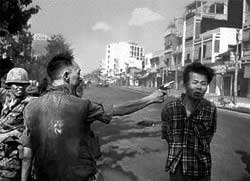 General Nguyen Ngoc Loan executes Nguyen Van Lem a NLF officer. Saigon police chief Nguyen Ngoc Loan summarily executed Nguyen Van Lem, suspected leader of a National Liberation Front (NLF aka Viet Cong) assassination platoon, with a pistol shot to the head on the street. AP photojournalist Eddie Adams’s Pulitzer Prize-winning photograph of the incident became one of the most famous, ubiquitous and lasting images of the war in Vietnam, affecting international and American public opinion regarding the war. |
https://www.peacebuttons.info/E-News/peacehistoryfebruary.htm#february1

 Scottie's Playtime
One thought on “Peace & Justice History for 2/1”