
Hamburger Mary’s Goes to the 11th Circuit by Joyce Vance
A case you need to know about! Read on Substack
This post is about a case that could be easily overlooked with so much Trump news spewing through the fire hose these days. But Florida’s continued aggression in the culture wars has the potential to affect all of us. So, as here, when a brave plaintiff takes its case to court and wins, it’s news we all need to know about.
On Tuesday, the Eleventh Circuit Court of Appeals decided HM Florida-ORL, LLC v. Sec. of Florida DBPR, a case involving Hamburger Mary’s, a restaurant and bar in Orlando that regularly hosted drag performances, including family-friendly shows. When the Florida legislature passed SB 1438 in 2023, Hamburger Mary’s canceled its family-friendly drag shows and prohibited minors from attending any of its other shows out of fear of losing its business and/or liquor license. As a result, Hamburger Mary’s lost 20% of its bookings.
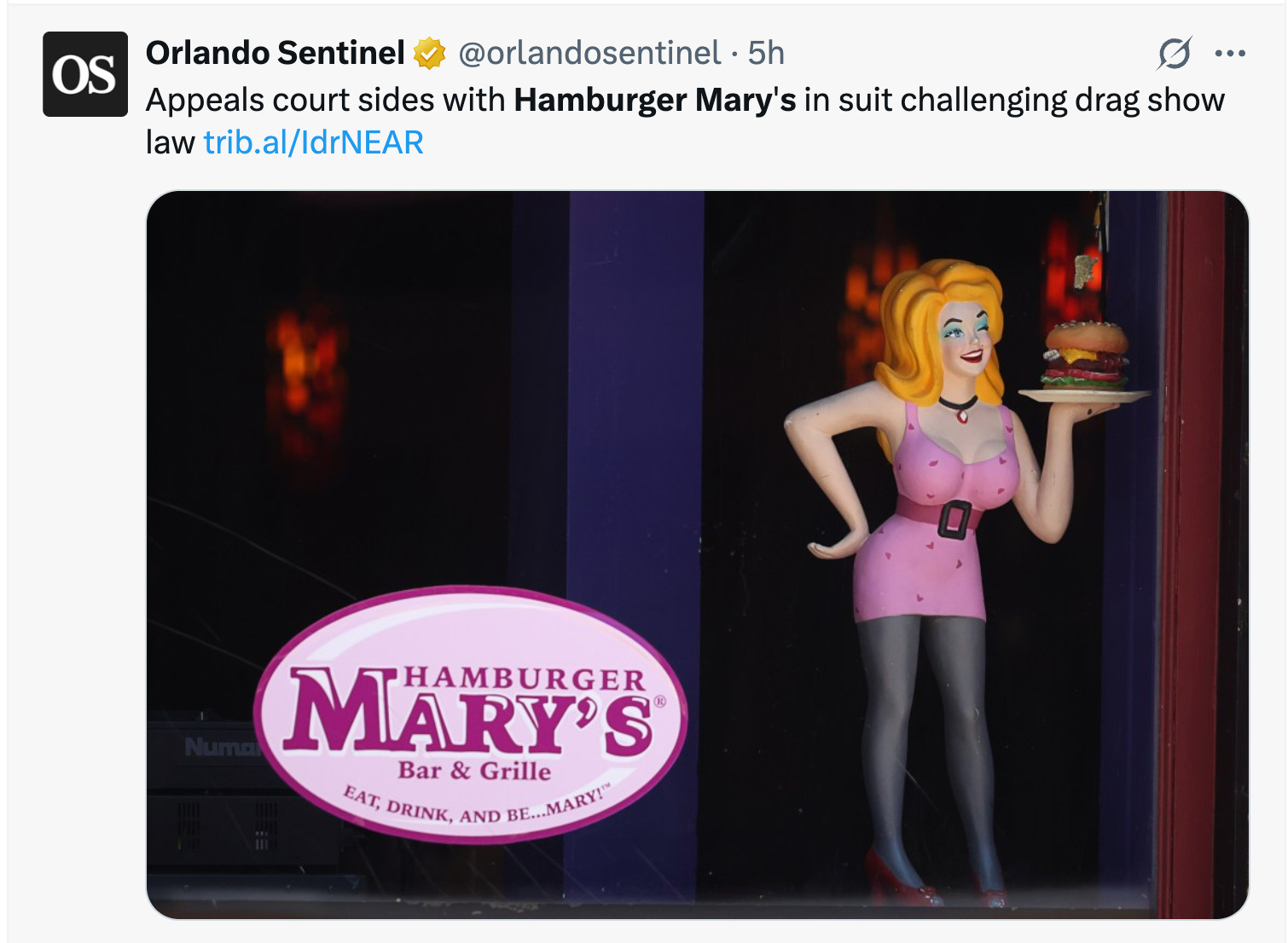
The new law gave state agencies the power to target LGBTQ+ friendly businesses in two major ways:
- It gave the Department of Business and Professional Regulation discretionary authority to fine, revoke liquor licenses, and even shut down establishments.
- It made it a crime to admit young people to any performance, exhibit, play, or show that the state deems inappropriate, even if the child’s parents think it is appropriate for their family.
The bill was an effort by conservative politicians, led by Florida Governor Ron DeSantis, to impose their beliefs on the entire state. It was a major salvo in the culture wars. Their too-clever-by-half mechanism was to punish private businesses that included or supported the LGBTQ+ community in order to exclude that community from being a public presence in Florida. The law’s language was so vague that businesses had no realistic way of knowing what it prohibited, meaning they had to take the extreme steps Hamburger Mary’s took to pull back their offerings in order to avoid the risk they’d be put out of business.
So, Hamburger Mary’s filed a lawsuit against Florida, its governor, and Secretary of the Florida Department of Business and Professional Regulation (FDBPR) Melanie Griffin, seeking a preliminary injunction that would keep the state from enforcing its law while the litigation proceeded. The district court granted the preliminary injunction and the Secretary appealed to the Eleventh Circuit.
The issue in the case involves the First Amendment, as you’ve probably figured out by now. Although the technical legal issue was whether the district court had been correct to grant the injunction, the substantive issue is whether Florida’s Senate Bill 1438 (“The Protection of Children Act”), which prohibits children from attending “adult live performances,” is unconstitutional under the First Amendment, because it is both vaguene and overly broad.
The Eleventh Circuit ruled in Hamburger Mary’s favor, keeping the injunction against enforcement of SB 1438 in place, because the panel believed the law was likely unconstitutional—both too vague for people to understand what they could and couldn’t do to remain in compliance with it and overbroad in its supposed efforts to protect children without regard to their parents’ views.
It’s significant that this decision comes out of the conservative Eleventh Circuit, although admittedly, the composition of this panel, which included both an Obama and a Biden appointee, is unusual. Florida could seek en banc review from the full court, in hopes of getting a more favorable hearing. The decision was 2-1. The third judge on the panel, Senior Judge Gerald Bard Tjoflat, was appointed by President Gerald Ford. His objection to the majority’s decision primarily involved a belief that the injunction came too early, and the courts should have demurred until they saw how the state enforced the law in practice.
Among the most interesting points made in the opinion:
- The Court found the penalties for violations under SB 1438 “grievous.” The penalties for violations include a $5,000 fine for a first offense or a misdemeanor prison sentence of up to a year.
- On protecting First Amendment rights, they noted that “The government cannot shroud rules in foggy language and then blame would-be speakers for their fears of what may lurk in the fog.” Laws like this use vagueness as a means to get private individuals and businesses to obey in advance, staying as far back as possible from the line of conduct the law prohibits in order to avoid the consequences of violating it. In this way, the state restricts far more First Amendment-protected conduct than they are legally entitled to. The panel wasn’t having any of it. It noted the importance of securing “breathing room for free expression” in a case like this.
- We’ve seen injunction cases before, so we know that Hamburger Mary’s had to demonstrate it was likely to succeed on the merits of its claim in order to get the injunction. The court underscored the point above when it found that they met this burden, discussing the “chilling effect” laws like this have, and the way they discourage people from speaking their minds, even if their speech doesn’t fall squarely within what the law prohibits. They noted that “[T]he Act’s vagueness…means it is likely to stifle a substantial amount of protected speech,” explaing that at oral argument, the state had been unable to explain, for instance, how to decide what kind of performances would be acceptable for kids of different ages, which the law requires venues to do to avoid penalties. They concluded, “If the Secretary’s attorney can’t articulate the difference, it’s hard to imagine how we could expect performance proprietors to know what the Act means.”
At least for now, the First Amendment is still alive and kicking in Florida. The majority in this case held that the state was trying to “empower those who would limit speech” but that “the First Amendment empowers speakers instead.” “Requiring clarity in speech regulations,” the court wrote, “shields us from the whims of government censors.” This case is important for Floridians and for the LGBTQ+ community. Beyond that, in a time when our rights are under attack, it’s important for all of us.
We’re in this together,
Joyce

 Scottie's Playtime
Hi. As the Judges wrote: Laws like this use vagueness as a means to get private individuals and businesses to obey in advance, staying as far back as possible from the line of conduct the law prohibits in order to avoid the consequences of violating it. In this way, the state restricts far more First Amendment-protected conduct than they are legally entitled to. The attempt is to deny LGBTQ+ people equal presence in society by making events featuring them or their ideas possibly too costly to places that might hold the events. They want to eliminate the LGBTQ+ presence in society that legally they can’t do so they use the idea of threats and intimidation. This is all about wiping out the LGBTQ+ and installing Christian church doctrine in society enforced by the laws of the state. They have the idea that they can force the country into being a theocracy state by state with Oklahoma already trying hard to make their state a theocracy. The governor has proclaimed the entire state for Jesus, a Christian state despite all the people with other religions. The state education secretary has done everything possible to make the public schools teach fundamentalist Christian doctrine along with white supremacy. Hugs
LikeLiked by 1 person