
because when the US does these things, they take place in all of our names whether we want it, or not. It’s part of why the power for these things lies in our legislature. The power does not rest with the executive unless the legislature votes to give it.
Stephen Walker Sun 22 Jun 2025 07.00 EDT
This summer will mark 80 years since the attacks stunned the world. Today, every one of the crew members who carried out the bombings is dead. Here, one of the last writers to interview them reopens his files
Sun 22 Jun 2025 07.00 EDTShare
‘It was a beautiful morning. The sun was shining on the buildings. Everything down there was bright – very, very bright. You could see the city from 50 miles away, the rivers bisecting it, the aiming point. It was clear as a bell. It was perfect. The perfect mission.”
I’m sitting in a Chinese restaurant in San Francisco opposite the navigator of the Enola Gay, the B-29 bomber that dropped the atomic bomb on Hiroshima on 6 August 1945. The year is 2004, and Theodore “Dutch” Van Kirk, aged 83, has agreed to be interviewed for a book I’m writing for the 60th anniversary of that fateful mission. Van Kirk informs me, with the trace of a smile, that this will probably be the last interview in his life.
We have spent the afternoon looking through wartime logbooks from his 58 overseas combat missions. Now, between servings of dim sum, he is telling me about the 59th, the one that wiped out a city, along with well over 100,000 people.
“The instant the bomb left the bomb bay, we screamed into a steep diving turn to escape the shockwave. There were two – the first, like a very, very, very close burst of flak. Then we turned back to see Hiroshima. But you couldn’t see it. It was covered in smoke, dust, debris. And coming out of it was that mushroom cloud.”
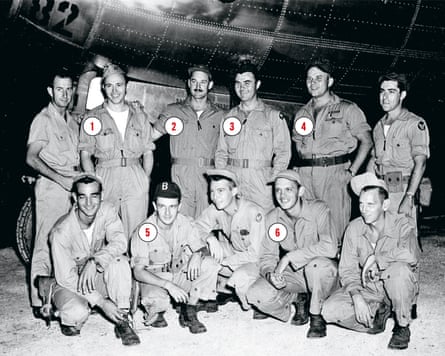
The crew of the B-29 bomber Enola Gay. Stephen Walker interviewed Theodore ‘Dutch’ Van Kirk, navigator (1); Tom Ferebee, bombardier (2); Paul Tibbets, pilot (3); Bob Lewis, co-pilot (4); George ‘Bob’ Caron, tail gunner (5); and Robert Shumard, assistant engineer (6). Photograph: Photogquest/Getty Images
He stops a moment, awe visibly registering on his face. “The city was gone. It was only three minutes since we’d dropped the bomb.”
Van Kirk died in 2014. In the years since we met, all the other crew members who flew on the missions to Hiroshima, and to Nagasaki three days later on 9 August, have also died. Meanwhile, the numbers of hibakusha, those who survived the attacks, are rapidly dwindling. We are passing into a twilight of history. As we approach the 80th anniversary of the atomic bombings, this biological fact seems disturbingly relevant. Twenty years ago, the world was a dangerous place. Today, it’s more so. More nations are developing nuclear weapons with few, if any, effective international controls. Tactical nuclear strikes have been explicitly threatened by Vladimir Putin and Kim Jong-un. And, just in the last week, war has broken out in the Middle East over fears that Iran may be very close to having a bomb. In such times, perspective matters. The shocked testimony of those like Van Kirk needs to be heard. History has lessons to teach us.
It was this thought that prompted me to reopen my files, to reread the transcripts of interviews with some of the crew members of both attacks. Much of this material was untouched for two decades; nothing relating to the Nagasaki mission was published. Here were some of the last testimonies of those who did the unthinkable. They were in their 80s or 90s, nearing the end of their lives. How did they remember it?
On 4 August 1945, Charles “Don” Albury, a 24-year-old B-29 pilot, was summoned to a secret briefing on Tinian, a Pacific island 1,500 miles south of Japan. Then the biggest bomber base in the world, Tinian was a jump-off point for a conveyor belt of the almost daily destruction of Japan. About 300,000 people had already died and 9 million were now homeless.
But Albury’s outfit had yet to take part in the attacks. Known as the 509th Composite Group, they occupied a secret compound on a far corner of the base. “Security was very, very tight,” Albury told me when I met him at his home in Orlando, Florida. Then aged 83, he grinned mischievously. “I remember one time the base commander got too near one of our planes. A guard nearly shot him.”
Even the 509th’s crews knew nothing about their ultimate missions. And they had been training for almost a year. First in Utah, later on Tinian: “We kept dropping practice bombs and flying these crazy steep turns. We did it day after day. For months.” But nobody told them why, and few dared ask. Those who did could find themselves swiftly dispatched by their leader, Paul Tibbets, a battle-hardened bomber pilot, to hardship posts above the Arctic Circle. “You learned to keep your mouth shut,” said Albury.
But in that 4 August briefing a part of the secret was about to be revealed.
Nine days earlier, on 26 July, President Truman had delivered his ultimatum to Japan in the Potsdam declaration: either surrender unconditionally, or face “prompt and utter destruction”. The means of that destruction was not specified. And Japan had not surrendered.
If I live for 100 years I will never get these few minutes out of my mind
(snip-MORE)

 Scottie's Playtime
Fascinating and gritty commentary and reflections on such a stunning display of power after years of war, killing, and destruction on an almost global scale. I keep hoping that we’ve put it all behind us, but war keeps making comebacks. Cheers
LikeLiked by 1 person
Agreed. Cheers to you, too.
LikeLiked by 1 person
A timely reminder of that fateful decision, ali. Thank you.
LikeLiked by 1 person
It’s always so good to see you here, Annieasksyou, and thank you, too!
LikeLiked by 1 person