
Ypsilanti, named for a Greek Freedom Fighter against Tyranny, Rallies against Trump on “No Kings” Day
Juan Cole 10/19/2025
Ann Arbor (Informed Comment) – In the 1820s Greece waged a successful war of independence against an authoritarian king, the Ottoman Emperor Mahmoud II. The American public, enthralled with this saga of a quest for liberty, idolized the revolutionaries, who were led for a few years by Demetrios Ypsilantis. They took his name for the name of their town, Ypsilanti. The people here therefore have a very long history of despising tyrants, and they demonstrated it again on Saturday.
Some 3,500 demonstrators came out for a march against Trump policies on No Kings Day, October 18 in Ypsilanti, Michigan, according to Lilly Kujawski. People chanted “What does democracy look like? This is what democracy looks like!” and “Hey, hey, ho, ho, Donald Trump has got to go.”
Ypsilanti is a majority white, predominantly Democratic town of about 20,000 residents in the southeast corner of the state, with several factories (including the Rawsonville Ford plant) and Eastern Michigan University, with its WEMU NPR jazz station.

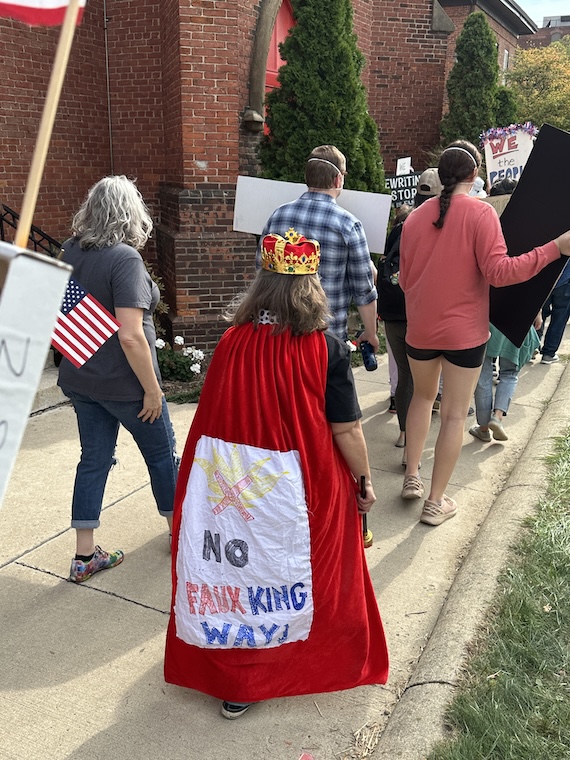
As a blue collar town, it shows that the slight swing to Trump among working class families nationally did not happen everywhere. Trump’s workers often don’t have a high school degree or are evangelicals. In 2024, he “lost majorities of blue-collar blacks, Latinos, and non-evangelical whites,” according to Brookings. The roughly one quarter of the residents in the town who are of African-American heritage suffer from the openly racist discrimination of Trump’s minions.
Trump policies favoring the rich fat cats and harming blue collar workers hurt Ypsilanti residents. His tariffs will raise the cost of the things they buy. His attack on their health care will put up their doctor and hospital costs. For those between jobs, the cuts to SNAP, medicaid and other benefits hurt.
When Demetrios Ypsilantis mounted his rebellion against the Ottoman Empire, among his goals were a rule of law and a constitutional order. The Ottoman Empire was an absolute monarchy that in the 1820s had no constitution, no legislature, and the judges in which were Muslim clerics appointed by and paid by the state, so that they had no independence of the sultan.


The French political philosopher Montesquieu (d. 1755) had laid out the problem in his Spirit of the Laws, which deeply influenced the American Founding Fathers. He wrote,
“There would be an end of everything, were the same man or the same body, whether of the nobles or of the people, to exercise those three powers, that of enacting laws, that of executing the public resolutions, and of trying the causes of individuals.
Most kingdoms in Europe enjoy a moderate government because the prince who is invested with the two first powers leaves the third to his subjects. In Turkey, where these three powers are united in the Sultan’s person, the subjects groan under the most dreadful oppression.”

 Scottie's Playtime