
October 21, 1837 Osceola painted by George Catlin, 1838 The U.S. Army, enforcing President Andrew Jackson’s 1830 Indian Removal Act, captured Seminole Indian leader Osceola (meaning “Black Drink”) by inviting him to a peace conference and then seizing him and nineteen others, though they had come under a flag of truce. Under the law, they and the others of the “Five Tribes” (Choctaws, Chickasaws, Creeks and Cherokees) were to be moved, by force if necessary, west of the Mississippi to Indian Territory (Arkansas and Oklahoma). The Seminole had moved to Florida (then under the control of Spain) from South Carolina and Georgia as they were forced from their ancestral lands, then forced further south into the Everglades where they settled. Read more about Osceola |
| October 21, 1967 In Washington, D.C., more than 100,000 demonstrators from all over the country surrounded the reflecting pool between the Washington and Lincoln monuments in a largely peaceful protest to end the Vietnam War.It was organized by “the Mobe,” the National Mobilization Committee to End the War in Vietnam. Some then marched on, encircled and attempted to storm the Pentagon in what some considered to be civil disobedience; 682 were arrested and dozens injured. This protest was paralleled by demonstrations in Japan and Western Europe, the most violent of which occurred outside the U.S. Embassy in London where 3,000 demonstrators attempted to storm the building. 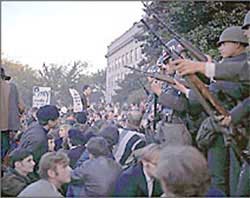 at the Pentagon Read two different accounts of the day with photographs: |
| October 21, 1983 In the first public action of the new Seattle Nonviolent Action Group (SNAG), 12 people blockaded the Boeing Cruise Missile plant in Kent, Washington; none were arrested. |
| October 21, 1994 In an “Agreed Framework” to “freeze” North Korea’s nuclear program, the United States and North Korea (Democratic Peoples’ Republic of Korea or DPRK) agreed over the next 10 years to construct two new proliferation-resistant light water-moderated nuclear power reactors (LWRs) in exchange for the shutdown of all their existing nuclear facilities. The DPRK also agreed to allow 8,000 spent nuclear reactor fuel elements to be removed to a third country; to remain a party to the Nuclear Non-Proliferation Treaty (NPT); and to allow inspections by the International Atomic Energy Agency. In the deal negotiated by Ambassador at Large Robert Gallucci, the U.S. agreed to normalize economic and diplomatic relations with Pyongyang and to provide formal assurances against the threat or use of nuclear weapons by the United States. The details of the agreement and what has followed Interview with Robert Gallucci, Dean, Walsh School of Foreign Service, Georgetown U. |
https://www.peacebuttons.info/E-News/peacehistoryoctober.htm#october21

 Scottie's Playtime