
The Week Ahead by Joyce Vance
November 2, 2025 Read on Substack
This Wednesday, the Supreme Court will hear the Trump tariffs case, arguably one of the most important cases it will hear all term.
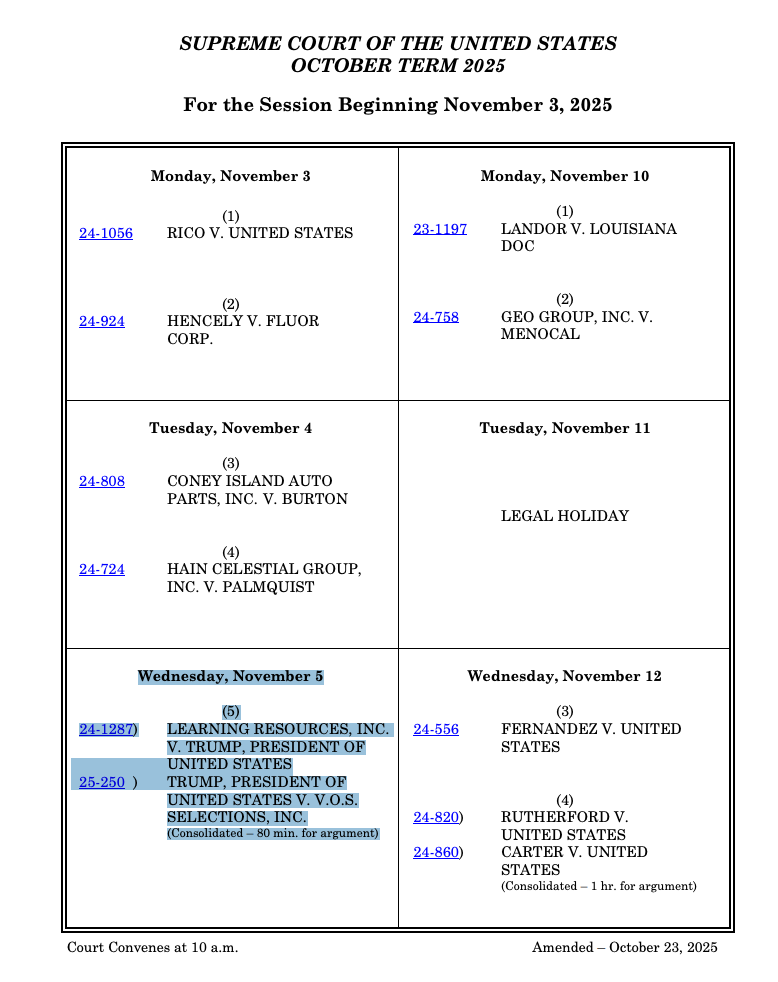
But, it’s important to understand that this is not a case about tariffs in general or about whether they are good policy. It’s a case about specific tariffs that President Trump imposed in February and whether he had the statutory authority to impose them. In other words, this is yet another example of Trump attempting to seize power that neither the Constitution nor our laws grant him and going to the Supreme Court in hopes they will validate it nonetheless. After argument, the Supreme Court will decide whether Trump had the legal authority to impose these tariffs in two cases.
We’ve been tracking this issue since Trump first threatened to impose tariffs, waffling back and forth seemingly from minute to minute. We studied the U.S. Court of Appeals for the Federal Circuit’s decision that rejected Trump’s effort to impose tariffs using IEEPA (I-E-Pa), the 1977 International Emergency Economic Powers Act, for the very simple reason that the Act, unlike other statutes that do give a president the right to impose tariffs, doesn’t mention tariffs at all. It does not give the president any authority to impose them under the statute that he has expressly said he used to do so. This is the kind of textualist argument conservative justices have backed in other cases, and to abandon that approach here would be a sharp and hypocritical departure for them. Last term, Justice Gorsuch wrote that the justices’ primary focus should be on the text of the statute.
The Constitution gives the power to impose taxes, which includes tariffs, to Congress. Because IEEPA doesn’t extend that power to the president, his use of it here is just a power grab, the kind of practice the Supreme Court should push back against if it intends to remain relevant to the American experiment. The Federal Circuit’s decision pointed out that while other laws expressly give the president the power to impose tariffs, IEEPA does not. Congress knows how to give the president the power to impose tariffs when it wants to and because it did not do so here, that should be the end of the inquiry. The administration should lose here. So what we hear in oral argument, even though it won’t necessarily signal where individual judges will end up, is worth following closely to see what tea leaves can be read for this case. It may also give us some sense of whether the Court intends to act as a check in other cases involving Trump’s power grabs.
The “major questions” will also be in play on Wednesday. You may recall it from recent terms of Court, where a conservative majority has recently used it to say there must be clear guidance from Congress before a federal agency can act on a major question of economic or political significance. Here’s the wrinkle: The Court has only used the doctrine to hamstring the Biden administration, and not to hinder Trump.
- In 2022, the Court decided National Federation of Independent Business v. Department of Labor, Occupational Safety and Health Administration, invalidating the Biden administration’s Covid testing/vaccination mandate for employers of more than 100 people. Without explicitly referencing the major questions doctrine, the Court wrote Congress had not given the president the authority to impose a vaccine mandate.
- In 2022, the Court decided West Virginia v. Environmental Protection Agency, rejecting the EPA’s authority to regulate greenhouse gas emissions from coal-fired power plants because Congress had not specifically authorized a regulation with such major political and economic consequences.
- In 2023, the Court rejected Biden’s student loan relief package in Biden v. Nebraska, holding that even though a federal statute allowed the Secretary of Education to “waive or modify” student loan debt, that authorization was insufficient for the Biden policy because this was a major question.
The Federal Circuit used these cases as precedent against the Trump administration. “Tariffs of unlimited duration on imports of nearly all goods from nearly every country with which the United States conducts trade” is “both ‘unheralded’ and ‘transformative,’” the court wrote, concluding that as a result, the administration needed to be able to “point to clear congressional authorization” for its tariffs. The absence of any language in the statute authorizing them was fatal to Trump’s case in the lower court. But the sardonic joke among appellate lawyers has been that the major questions doctrine only applies to Democratic administrations. On Wednesday, we will see whether that holds up and if the Court’s conservative majority is willing to twist itself into pretzel logic to support this administration’s political objectives.
There are other issues to look at this week:
As the Trump administration continues its extraterritorial strikes on supposed drug traffickers, there is increasing concern about the legality of that conduct. Georgetown law professor Steve Vladeck and I will take up that issue on Monday evening at 9 p.m. ET/8 CT in a Substack Live (if you subscribe to Civil Discourse, you’ll receive an email inviting you to join us when we go live, so mark your calendars and be ready).
As we head into the week, there are billboards up on the expressway heading toward U.S. Southern Command, in Doral, Florida, that tell troops “Don’t let them make you break the law” in response to those attacks.
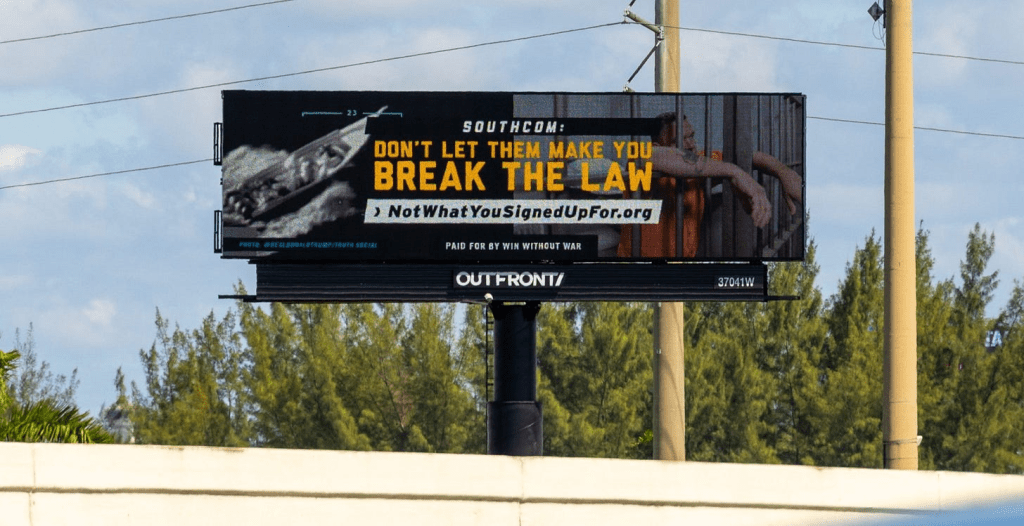
New billboards are going up near Miami, Chicago, and Memphis, Tennessee, as well, a warning to troops being deployed in American cities. The billboards are part of a campaign by veterans to support and encourage the troops to uphold military order.
If you’ve forgotten about DOGE, unfortunately, it’s time to remember. There are reports that the Pentagon’s DOGE unit “is leading efforts to overhaul the U.S. military drone program, including streamlining procurement, expand homegrown production, and acquire tens of thousands of cheap drones in the coming months.” And the Bulwark reported that Rear Admiral Kurt Rothenhaus was recently removed from his post as chief of naval research, the top post at the Office of Naval Research (ONR), and replaced by Rachel Riley, who has been working in DOGE-related roles in the Trump administration. Although she was a Rhodes Scholar, Riley, 33, has “no apparent naval experience.”
There are also reports of DOGE interfering with the Department of Agriculture. Senator Dick Durbin tweeted that “President Trump and the DOGE cowboys want to close and diminish critical agricultural research at the University of Illinois. The only other soybean lab like that in the world is in…China. Our President is ceding our agriculture research leadership to China.”
Remember back in February, when Trump floated the idea that everyone could get a $5,000 check from all of DOGE’s “savings”? That didn’t work out so well, did it? You may want to remember this for Thanksgiving dinner.
Tuesday is election day. There is the Virginia governor’s race and the New York City mayoral race. Also, the governorship is at issue in New Jersey. A California ballot initiative will determine whether that state will engage in defensive redistricting designed to offset the aggressive way the Trump administration has demanded Republican states use it to spike the balance between the two parties in the House in their favor, effectively letting politicians choose their voters, instead of the other way around. There is also a race in Pennsylvania, where three Democratic members of the state Supreme Court face retention votes that could be highly significant in the potential 2028 battleground state.
Vote.org, a nonpartisan voter registration and engagement platform, announced a “huge spike” in voter registration ahead of the elections, with their online registration platform being used more than twice as many times as they were during the comparable 2021 election cycle.
They reported that:
- More than 80% of those users are under the age of 35
- Nearly half (46%) are just 18 years old
- Compared to 2021, there are more young voters, more women, and more voters of color using the platform
It’s good news for pro-democracy Americans.
The house will remain out of session, yet again this week.
Epstein. Epstein. Epstein.
But as we all know, that means SNAP is still in danger, which means many of our fellow citizens could begin to go hungry this week if the administration tries to skirt compliance with or obtains an injunction staying decisions by a court in Massachusetts, and a more specific one in Rhode Island, which require the administration to use emergency dollars to fund SNAP. There, Chief Judge John J. McConnell Jr. ordered the USDA to distribute contingency funds and to report to the Court on its progress by 12:00 p.m. on Monday, November 3. Expect more litigation this week.
ICE agents are still engaging in “enforcement actions” in American communities and residential neighborhoods. Stories of abuses are circulating; it’s a critical moment for using our skills to ferret out misinformation and focus on the truth. This photo is from a Day of the Dead celebration in New Orleans.

It is clear that this is a week that will require us to summon our courage and continue to pay close attention. The times are far too important for us to look away. Remind yourself that dictators use overwhelm as a tactic for getting people to give up and submit to their rule. Let’s not do that to us.
We’re in this together,
Joyce

 Scottie's Playtime