
| November 6, 1913 Mohandas K. Gandhi led 2500 ethnic Indian miners, women and others from South Africa’s Natal province across its border with Transvaal in the Great March. This was a violation of the pass laws restricting the movement of all non-whites in the country. Originally granted the rights of British subjects, Indians’ rights were steadily eroded beginning in the 1890s with the denial of the right to own property. Shortly before the March, a court in Capetown had invalidated all Muslim and Hindu marriages. Gandhi and many others were arrested and jailed after refusing to pay a fine.  The Great March to Transvaal  Mohandas Gandhi, 1915 Read about the early resistance in South Africa |
| November 6, 1962 The 17th session of the U.N. General Assembly passed Resolution 1761 condemning apartheid in South Africa and called on all member states to terminate diplomatic, economic and military relations with the country. The policies of the country embodied in apartheid, the strict racially separatist regime, were declared a threat to international peace and security.  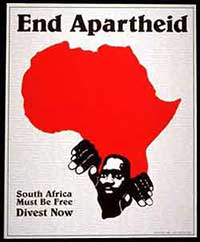 Apartheid was the racially separatist regime under which black and, to a somewhat lesser extent, so-called colored South Africans, were without political, civil or economic rights. All political power and wealth were held by the white population, approximately 15% of the country. “Apartheid” is the Afrikaans word for “apartness.” (Afrikaans is the language of the Boers, or [white] Afrikaners.) U.N pressure over the years on South Africa |
| November 6, 1965 2,500 people gathered in New York City’s Union Square to witness the burning of draft cards, a violation of recently passed federal law, as an expression of resistance to the Vietnam War. Dorothy Day, founder of the Catholic Worker movement, and pacifist leader A.J. Muste spoke, identifying with the “crime” about to be committed.  Gordon Christianson, chairman of the Committee for Nonviolent Action and a World War II combat veteran, used his lighter to burn the cards. A counter-demonstrator shot a fire extinguisher at those ready to burn their cards, but they still ignited. And the counter-demonstrators shouted, “Burn yourselves, not your draft cards!” At trial, those who were arrested conceded the prosecution’s case, submitting footage of the action shot by a supporter. They made a defense under the First Amendment to the Constitution, arguing that the burning of draft cards in such a context was an act of symbolic speech. The trial judge found them guilty and sentenced them to six months in federal prison. |
| November 6, 1986 Although an American plane with supplies for the Nicaraguan contra insurgents had been shot down the previous month, and a Lebanese newspaper reported that the U.S. government had arranged for the sale of weapons to Iran, President Ronald Ronald Reagan denied involvement (“. . . a story that came out of the Middle East, and that to us has no foundation . . . .”) in what came to be known as the Iran-Contra scandal. Both the ongoing aid to the contras and the weapons sales to Iran were violations of U.S. law.  |
https://www.peacebuttons.info/E-News/peacehistorynovember.htm#november6

 Scottie's Playtime