
The SAVE Act Is Dead, Fulton County Is Fighting Back; So, Of Course, Trump Wants To Seize Control Of The Election
Here’s everything you need to know after a day of fast moving developments
Joyce Vance Feb 26, 2026
The SAVE Act appears to be dead, at least for now.
Trump wanted his party to enact the SAVE Act because it was supposed to make it more difficult for citizens he thinks are Democrats to vote: Its strict ID requirements would have impacted poor people, elderly people, students, married women, and others.
Although Trump pushed hard for its passage, most recently during the State of the Union address, enough Senate Republicans defected to make passage a possibility too remote to pursue. Republicans attempted a “talking filibuster” to get the bill across the finish line, but the procedural unity that would have required failed to materialize. Per Punchbowl News, North Carolina’s Thom Tillis, Utah’s John Curtis, Kentucky’s Mitch McConnell, Alaska Senator Lisa Murkowski, and possibly others who weren’t named broke ranks.
It’s a major loss for the president.
There is also good news out of Fulton County, Georgia.
Instead of the hearing we were expecting on the County officials’ request to have their 600 boxes of election records restored to them this Friday, we got an order from Judge J.P. Boulee.
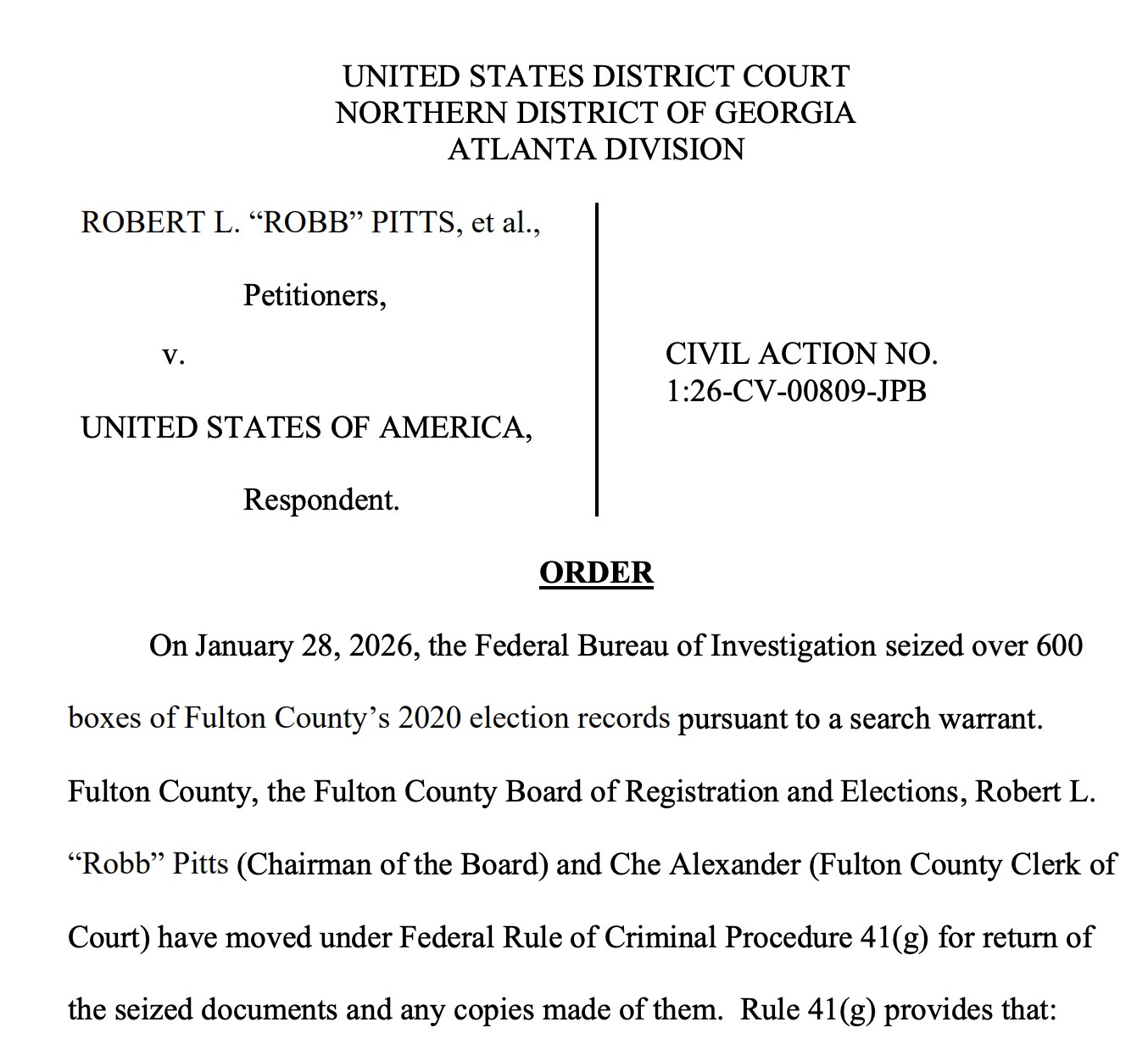
The County officials asked the Judge to use Federal Rule of Criminal Procedure 41 to restore their property to them. That rule permits: “A person aggrieved by an unlawful search and seizure of property or by the deprivation of property may move for the property’s return.” Judge Boulee set forth the four requirements for establishing that the moving party is entitled to have their items returned:
(1) the government displayed a “callous disregard” for the plaintiff’s constitutional rights;
(2) the plaintiff has an individual interest in and need for the material whose return he seeks;
(3) the plaintiff would be irreparably injured by denial of the return of the property; and
(4) the plaintiff does not have an adequate remedy at law absent the Rule 41 proceeding.
The Judge pointed out that a successful Rule 41 proceeding would not deprive the government of the use of evidence for lawful purposes. If returned, the County would be required to preserve the documents for the government’s later use—a requirement that it is already subject to, because these are election records that must be maintained.
The Judge noted his obligation to hear testimony and take evidence if he was ultimately called upon to decide the dispute. That’s something that DOJ might be eager to avoid, given the apparent irregularities in their process, which saw the head of the Atlanta FBI office step aside and a U.S. Attorney from Missouri, instead of the one in Atlanta, handle the matter. He then gave the government an out: “the Court believes it is best for the parties to work toward a mutually agreeable resolution before receiving additional evidence.” He gave them until March 4 to agree on a mediator and until the 18th to report back on whether the mediation succeeds.
It’s a strong move from the Judge. He declines to rule on whether the County officials can meet the high standard for proof under Rule 41. But the fact that he hasn’t denied their request out of hand and is treating it this seriously strongly suggests to the government where this is headed if they don’t reach a deal to return the records to the County. Rule 41 proceedings don’t usually make it this far, and the government has to be concerned that’s a very bad sign for them. The risk that they will still have to return the items they seized pursuant to a court order, and that all of their maneuvering will be publicly exposed in the process, is substantial.
There’s a subtle additional benefit here. The subtext has always been that this process, designed to cast doubt on election officials in the County (even though recounts and court cases confirmed the outcome), was designed to permit Republicans who control the state legislature to take over elections. It will be much more difficult for them to proceed while this process lingers, so a delay of even a couple of weeks, with the elections drawing ever closer, isn’t a bad thing.
And finally, a caution.
The Washington Post reported this morning that “Pro-Trump activists who say they are in coordination with the White House are circulating a 17-page draft executive order that claims China interfered in the 2020 election as a basis to declare a national emergency that would unlock extraordinary presidential power over voting.”
Of course, at the time, and with Trump officials in place running cybersecurity, there was a different message. In a Joint Statement, the National Coordinator for Critical Infrastructure Security and Resilience CISA, the Election Infrastructure Government Coordinating Council (GCC), and the Election Infrastructure Sector Coordinating Council (SCC), reported that “The November 3rd election was the most secure in American history . … There is no evidence that any voting system deleted or lost votes, changed votes, or was in any way compromised … While we know there are many unfounded claims and opportunities for misinformation about the process of our elections … we have the utmost confidence in the security and integrity of our elections, and you should too.” Chris Krebs, Trump’s Director at CISA, told 60 Minutes that “[Election] Day was quiet. There was no indication or evidence that there was any evidence of hacking or compromise of election systems on, before, or after November 3 … We did a good job. I would do it one thousand times over.”
Beyond that, a 2021 intelligence review concluded that China did not engage in efforts to influence the 2020 election. There were multiple audits and recounts, court rulings, and investigations without any finding of widespread fraud. There was no evidence of coordinated foreign interference.
So we all get it. It’s another ginned-up emergency. There wasn’t an outbreak of irrepressible crime on American streets that necessitated the federalization and deployment of the National Guard. Trump made that up. A Venezuelan gang, Tren de Aragua, wasn’t invading the United States. Trump made that up. There wasn’t a balance of payments problem that warranted the imposition of exceptional tariffs. Trump made that up. And there’s not an emergency involving our elections that means Trump should take control of them. He’s making that up too—to the extent that there’s an emergency, he’s the cause of it.
The order Trump’s election denier buddies are pushing would use the supposed China emergency as the reason to declare yet another national emergency. The Post’s reporting suggests they will claim that permits them to “mandate voter ID, ban mail ballots, and change voting machines in November’s midterm elections.” How convenient—all the stuff they want to do, but can’t, because the law doesn’t permit it or Congress won’t pass laws authorizing it, tied up with a nice, neat bow into another one of those “uh oh—emergency, so I can claim extraordinary powers” executive orders Trump has become so fond of using.
The reality is that the president lacks constitutional authority to control elections. The Constitution gives that authority to the states. Even if Trump declared another national emergency, there is no basis for the assertion it would permit him to seize control of the elections. All this plot shows is that Trump lacks confidence in his party’s ability to win the midterm elections.
The election deniers are back in the White House and hard at work, as they were in 2020, to try and prevent American voters from determining the outcome of this year’s elections. Just like it did in 2020, the rule of law will prevail here.
Pro-voter lawyers will go to court if Trump tries to implement this kind of desperate attempt to rig the election. And they will win. Even the Supreme Court has ruled against Trump, now in both the National Guard and in the tariffs cases, when he attempted to drum up fake emergencies to justify his assumption of exceptional powers. Nothing is certain with this Court, but district court judges who are increasingly taking this administration to task and holding it to account are likely to pave a smooth path. And working against the administration is the clear fact that the greatest threat to free and fair elections isn’t China, non-citizens, or Democrats—it’s this president and his cronies.
For years, I’ve been working to educate the public on the fact that voter fraud isn’t the problem—all of the evidence is to the contrary. The real issue is Republicans who use false or dramatically overblown claims of fraud to suppress the vote, and keep eligible citizens from voting. Let’s stay informed and make sure they don’t get away with that this year.
(snip)
We’re in this together,
Joyce

 Scottie's Playtime
This is good news for this morning!🌞
LikeLike