
Also Known As: Tucanete Esmeralda (Spanish), Tucancillo Verde (Spanish)
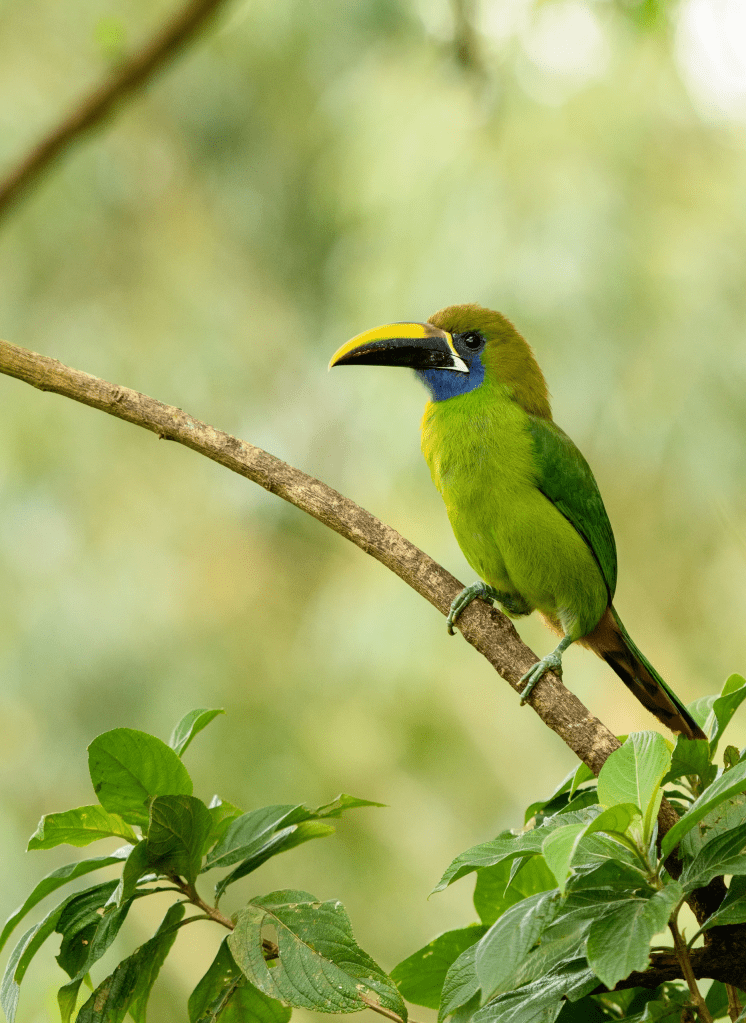
Aptly named for its striking green plumage, the Northern Emerald-Toucanet is actually quite camouflaged in the leafy forests where it makes its home. With its tropical take on countershading — darker green on the back and wings, lighter yellow-green below — this bird beautifully matches the color palette of forest leaves, whether seen from above or from below. With its accents of chestnut, blue, and white, and a large black and yellow bill, this pigeon-sized bird is a true beauty.
Similar to other toucans, Northern Emerald-Toucanets eat mostly fruit, capitalizing on the wide diversity of fruit-bearing trees in the humid forests of their home in Central America. These birds mostly swallow their food whole, including some larger-seeded fruits, which they repeatedly regurgitate and swallow until the flesh is consumed. Whether by regurgitation or defecation, these birds spread the seeds of their food trees throughout the forest. Many tropical trees have evolved to bear fruit specifically for this purpose, taking advantage of birds’ wings to spread their seeds far and wide. In fact, the process of moving through the digestive tract of an animal actually helps the seeds of many of these trees to germinate. In effect, these toucanets, along with a cohort of other fruit-eating birds and mammals, are gardeners of their own food forests. (snip)
Bird Gallery
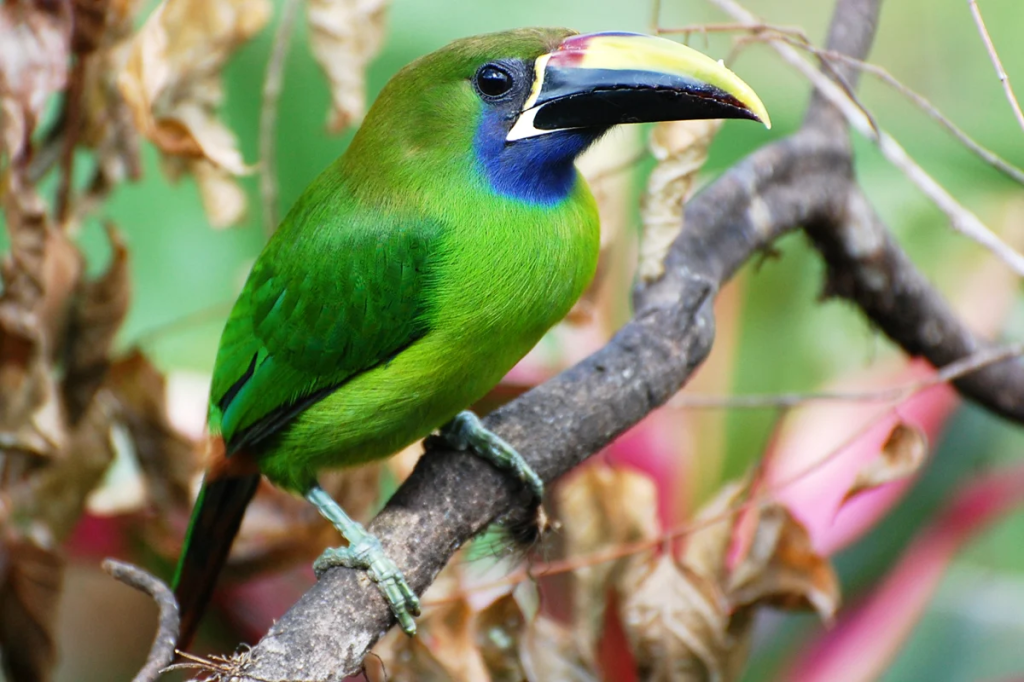
The Northern Emerald-Toucanet is indeed a beautiful, vibrant green, top and bottom, with the back a deeper, darker hue and the underparts lighter and slightly yellowish. The long tail is iridescent blue and green, with a rusty or chestnut tip matched by the vent feathers beneath the tail. The eight subspecies across its geographic range vary in the coloration of the throat, either blue or white, and the bill. In all subspecies, the lower mandible is black. The upper mandible has some black as well, but may be almost entirely yellow. Some subspecies also have a reddish to brown patch near the nostrils.

 Scottie's Playtime
oh that is stunning. Sort of puts our robins to shame, doesn’t it
LikeLiked by 1 person
Well, I’m a bit nutty about birds even though I can’t ID very many, nor tell their songs apart. But yes, that toucanet is gorgeous! But I dearly love robins, and find them beautiful, too. I’m always happy to see a robin in the yard! (You can tell I’m nutty about birds when I’m raising a brown robin up to a toucanet! It’s not you, it’s me…)
LikeLike
I fell into birdwatching when I got my first ‘real’ camera, and then when we moved up here it was bird heaven. I kept track of every species I saw, from robins to sawwhet owls to cuckoos. Then the water began drying up, and our beloved neighbors down below began aiming for perfect green lawns and the ChemLawn people trundled by every week or so, and even where we are, the birds began to thin out.
My favorite bird event (and oh for a camera) was one morning when I saw a robin hunting down its family’s breakfast. She stopped, peered at the ground, and yanked up a snake that must have been four or five feet long. She grabbed it by the middle and began whapping it up and down on the grass until it finally broke in half (yewwww), then instead of leaving half behind, she swallowed one half, scooped up the other half and flew off, very very slowly, toward her nest. I suspect they dined on snake for a very long time. “Oh, MA, snake again? REALLY?”
LikeLiked by 1 person
“Think of the little robins in places where there isn’t anything to eat! Finish up!”
LikeLike
Howdy Ali!
La Petite Fille loves birding and has since she was in elementary school. We go every week with a campus birding group in the more clement weather. On our walk to school we pass through a park that has a nesting pair of pileated woodpeckers. I feel privileged every time I see one since there are only 3,000 left in Canada.
These are some pretty wonderful pictures. Birds are amazing creatures. I never tire of seeing them around the house no matter how common.
Huzzah!
Jack
LikeLiked by 1 person
🦜🌞
LikeLiked by 1 person