
The Week Ahead
March 15, 2026
Joyce Vance Mar 15, 2026
It’s another week full of legal proceedings. And a little politics, too.
Tuesday: Maduro and Flores hearing
The U.S.-ousted Venezuelan leader Nicolás Maduro and his wife, Cilia Flores, were captured by U.S. forces on January 3 at their Caracas home. They were arrested pursuant to an indictment federal prosecutors had obtained and taken to the U.S. to face those charges. Both pled guilty and are currently detained pending trial. The superseding indictment can be found here. We discussed it at length here.
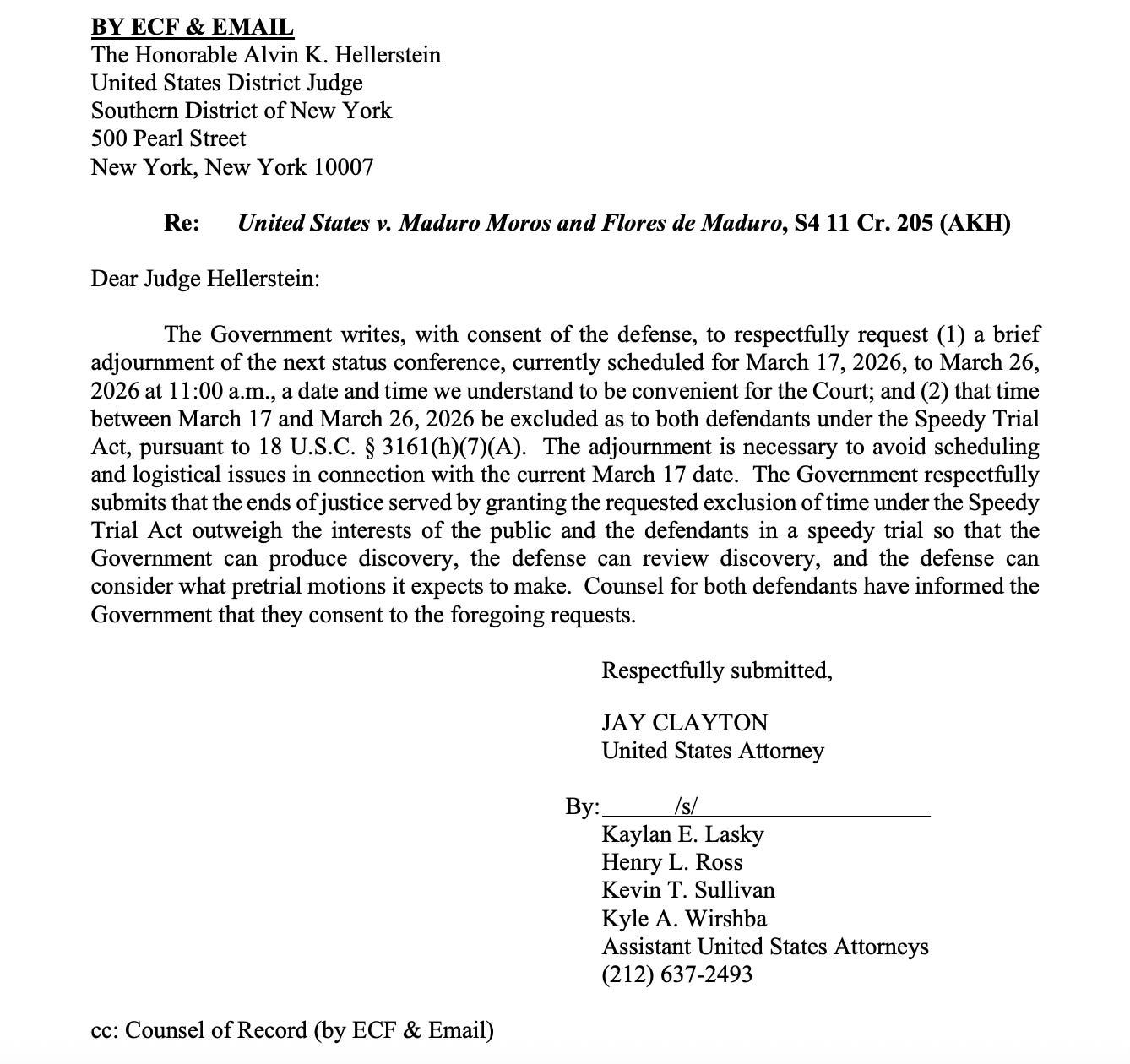
There was supposed to be a status conference on the case this Tuesday. But the government wrote the Judge, Alvin Hellerstein in the Southern District of New York, requesting a “brief continuance.” The stated reason was to permit discovery to proceed before the parties returned to court, a reasonable request given the likely amount of evidence the government will be turning over to the defense and the time it takes to review it with defendants who remain in custody.
But the government has been busy on the case already, opposing the defendants’ efforts to use Venezuelan government monies to fund their defense. Prosecutors say Maduro is not the legitimate leader of Venezuela and hasn’t been considered by the U.S. to be so for several years. Madura and Flores’ lawyers argue the laws and traditions of the country permit it to fund their defense. A Venezuelan official has said they are prepared to do so.
The defendants argue that their inability to access certain third-party funds to pay for their legal fees violates their Fifth and Sixth Amendment rights to due process and effective assistance of counsel. The parties have filed their briefs, and Judge Hellerstein is expected to consider the legal fees dispute during the March 26 hearing.
Tuesday: Illinois Primary
Illinois voters head to the polls Tuesday to choose their Democratic and Republican nominees for the open Senate seat being vacated by Dick Durbin, who is retiring after almost three decades. Two members of the House, Raja Krishnamoorthi and Robin Kelly, have thrown their hats into the ring, leaving their seats up for grabs. Three additional Illinois representatives are retiring: Danny Davis, Jan Schakowsky, and Jesus “Chuy” Garcia.
That means the Illinois delegation will look different, possibly younger, heading into 2027, and we will have new names to learn. Kamala Harris won the state with 54.8% of the vote in 2024, and it’s unlikely Democrats will lose any seats. In Kelly’s district, former representative Jesse Jackson Jr, who pled guilty to misusing campaign funds in 2013 and was sentenced to 30 months in prison (he served a little under two years), is trying to make a comeback, but he is one of 10 Democrats running for the seat. Jackson, who represented the district for over 20 years before going to prison, is up by double digits in two polls.
Everyone expects Governor JB Pritzker to handily win reelection. But as a potential 2028 presidential contender, there will be heavy scrutiny of how he handles himself during the campaign and how well he performs and leads the Democratic ticket. So there’s a lot to see here.
Under Illinois law, only poll workers and poll watchers can be at the polls on election day, and other people may not mill around outside as voters go about their business. Nonetheless, there have been concerns that ICE might show up to intimidate people. But DHS’s Assistant Secretary for Election Integrity, Heather Honey, issued a statement in late February, saying “Any suggestion that ICE is going to be present at polling places is simply disinformation.” She committed that there would “be no ICE presence at polling locations” during a call with voting officials from across the country.
That makes sense and I’m inclined to believe it. But only because doing it now would trigger legal challenges that would likely be decided against the administration. If they’re going to do this, we’ll likely see it for the first time when voters go to the polls in November.
Wednesday: Fulton County.
As you may recall from our earlier discussion, Judge J.P. Boulee sent the Justice Department and Fulton County to mediation in the case filed by the latter over the government’s seizure of voting records. Wednesday is the date by which the parties must let the Judge know whether they’ve been able to resolve the matter voluntarily. If mediation failed, it will be up to the Judge to decide whether the records are due to be returned, which they almost certainly are (the government gets to keep copies), but the administration could face some messy, revelatory testimony in court if the County goes into the unusual decision to have a U.S. Attorney from Missouri take over the matter, rather than the local U.S. Attorney.
The Rest of the Mess
Pam Bondi wants to deprive state bar associations of their ability to consider ethics challenges to federal prosecutors’ behavior.
DOJ has posted a proposed new regulation in the Federal Register that would prohibit state bars from proceeding while DOJ is conducting an internal review. Nothing in the rule would preclude DOJ from engaging in endless delay and short-circuiting state investigations.
In practice, state bar associations have routinely deferred to DOJ to conduct internal ethics proceedings before they act against a Justice Department lawyer. But that was under the old rules, where DOJ took ethics seriously. And as a practical matter, state bars, not Pam Bondi or Donald Trump, decide whether to give a specific lawyer a license to practice law in their state, so it’s difficult to see how the government has a legal leg to stand on here. It would be like Donald Trump deciding who can be a barber in Oklahoma or a cosmetologist in Arizona.
There is a 30-day comment period for the proposed regulations that will close on April 6. Comments will be public. Expect a wide variety of members of the legal profession to weigh in against the administration’s transparent effort to prevent state bar action against DOJ officials who are in ethical trouble. Congress made it clear in a law called the McDade Amendment that government attorneys “shall be subject to State laws and rules … governing attorneys in each State where such attorney engages in that attorney’s duties, to the same extent and in the same manner as other attorneys in that State.” The measure was passed in 1998 amid concerns about overzealous prosecutors. Pennsylvania Republican Representative Joseph McDade (R-PA) championed the measure after he was acquitted on bribery and racketeering charges.
The SAVE Act heads to the Senate for a vote this week.
We’ve been talking about it for months. This appears to be the week the Senate will vote on the SAVE Act. It has already passed in the House. In our conversation at Big Tent last week, Marc Elias opined it would not pass. The Senate would have to abandon the filibuster rule to get it across the finish line. That would be a last-ditch measure that Republican Senators have long argued against, but some seemed to waffle on the issue last week.
Trump tried to get Republican Senators to abandon the filibuster last November. He made that pitch with visiting Hungarian Prime Minister Viktor Orbán at his side. Orban heads what he has called an “illiberal democracy” in that country. It was quite an image.
The issue last year was the pending government shutdown. Trump called on Senate Republicans to scrap the filibuster rule and allow simple majority votes to prevail on that issue and for most other legislation. They declined, even though, or perhaps because, Trump promised his party that if they did, the GOP would “never lose the midterms and we will never lose a general election” for the foreseeable future. It will be interesting to see if that pitch reemerges this week as Trump tries to pass a measure designed to suppress Democratic votes in the upcoming election.
Senators on both sides of the aisle have long understood the power that honoring the filibuster gives both sides; it’s a form of mutually assured retention of power. But Texas Senator John Cornyn, long a proponent of the filibuster, put out an op ed in the New York Post arguing that the SAVE America Act is more important than it is.
“For many years, I believed that if the US Senate scrapped the filibuster, Texas and our nation would stand to lose more than we would gain … My fellow conservatives and I have proudly used the 60-vote threshold to protect the country from all sorts of bad ideas and dangerous policies. But when the reality on the ground changes, leaders must take stock and adapt…Today, Democrats are weaponizing the Senate’s rules to block the SAVE America Act, defund the Department of Homeland Security and hurt the American people — all to spite President Donald Trump.”
It was quite a reversal of long-held principles in service of Trump from the Texas Republican, who is facing an uphill battle to hold onto his Senate seat. He faced a primary challenge from Texas Attorney General Ken Paxton. Neither candidate reached the 50% threshold necessary for an outright win, so there will be a runoff, which is scheduled for May 26, although there have been whispers of a voluntary resolution. How we are about to find out if other Republican senators want to hold onto any of their institutional power or are willing to throw it away on Trump and a law that has strong arguments against its constitutionality.
Finally, Julie Le, the former government lawyer in Minneapolis who we met in this piece, when she begged a judge to hold her in contempt so she could get a good night’s sleep, has launched a Congressional campaign website. “This job sucks,” she told the judge. Now, it appears she might be looking for a new one, since she was ultimately removed after her outburst in court.
We’re in this together,
Joyce

 Scottie's Playtime