
From Cornell Lab Bird Cams:
From American Bird Conservancy:
Three-wattled Bellbird
Procnias tricarunculatus
Also Known As
- Campanero Tricarunculado (Spanish)
- Pájaro Campana Centroamericano (Spanish)
About
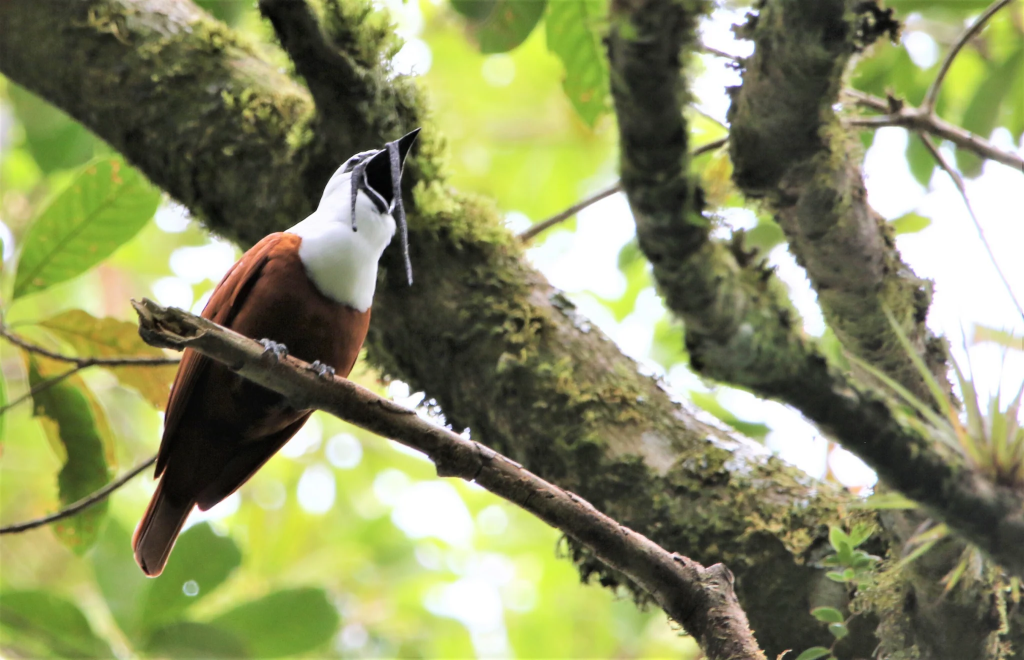
The Three-wattled Bellbird, like other Central and South American bellbirds in the Cotinga family, is a natural history paradox. Breeding males perch on exposed branches and sing one of the loudest songs of any bird, impossible to ignore and audible from more than half a mile away. However, despite this extremely conspicuous breeding season behavior, females and nonbreeding males are notoriously difficult to observe, foraging in the higher levels of the canopy and remaining remarkably silent. As a result, this species has been subject to fascinating and in-depth studies of its song and courtship behavior, but some of the most basic aspects of its natural history are unknown. For instance, only two nests have been recorded, one in 1975 and one in 2012, and no eggs or young have been documented.
But biologists have learned a great deal from studying the Three-wattled Bellbird’s song. The bellbirds belong to a group of perching birds known as the suboscines, which also includes tyrant flycatchers like the Western Kingbird and antbirds, such as the Marsh Antwren. While the “true” songbirds (or oscines) are famous for their song-learning abilities, suboscine songs are classically considered to be completely innate, with no learning taking place. However, the Three-wattled Bellbird shares an important feature with birds that learn their songs: dialects. Birds from Nicaragua sound noticeably different from Costa Rican birds in the Cordillera de Talamanca and the Cordillera de Tilarán, which each host populations with distinct songs. (snip-MORE)


One thought on “Your Saturday Morning Birds Post”