
The Week Ahead
April 26, 2026
Stay with me tonight. This one runs a little long, but it’s all information you’ll need.
It’s likely that much of this week will be overshadowed by investigation into what happened Saturday night at the White House Correspondents’ Dinner, where Cole Thomas Allen, a 31-year-old California man with a master’s degree from Cal Tech, approached the ballroom at the Washington Hilton armed with a shotgun, a handgun and knives, and attempted to sprint through the magnetometer security checkpoint. He was stopped there. A Secret Service agent was shot, but was fortunately protected by a bulletproof vest. It’s not clear who shot him.
The White House Press Corps, still dressed in tuxedos and ball gowns, trooped into the press briefing room at the White House to hear from the President, who appeared, flanked by acting Attorney General Todd Blanche, FBI Director Kash Patel, and others. They, too, were still in tuxedos from the event.
It’s not clear who the “designated survivor” for the event was. CBS’ Margaret Brennan pointed out Sunday morning that “Five of the top six officials in the presidential line of succession were in attendance: Vice President JD Vance, House Speaker Mike Johnson, Secretary of State Marco Rubio, Treasury Secretary Scott Bessent, and Defense Secretary Pete Hegseth.”
Trump was in good spirits as he spoke, complimenting the press and laughing about the speech he had hoped to give after dinner. It was a much more affable Trump than we’ve seen in the course of the last year as he interacted with members of the media he has often been sharply critical, or dismissive of, during his first year in office. Trump went on the attack against the press even before his January 2025 inauguration, as we discussed at the time.
This was a different Trump who spoke in a very measured fashion, far more measured than usual, almost as if he saw this incident as providing the opportunity for a reset. He respectfully took questions from reporters like CNN’s Kaitlin Collins and NBC’s Garrett Haake. He was kindly toward the press; that’s the only way to characterize it. Whether that was a momentary blip or it suggests he will try to convince the media to rebuild its relationship with him remains to be seen. He did say that the Correspondents’ Dinner would be rescheduled within a month, without seeming to understand that the Correspondents’ Association puts on the dinner and controls the event.
At the press conference, Trump was asked why this keeps happening to him—this was the third attempt on his life since he announced his run for the presidency ahead of the 2024 election. He responded that he “has studied assassinations” and that it’s the “people who do the most” that assailants go after, using Abraham Lincoln as an example. Trump said that it “only happens to impactful people” and that he didn’t want to say he “was honored” by the repeated attempts on his life, but he let the implication hang in the room.
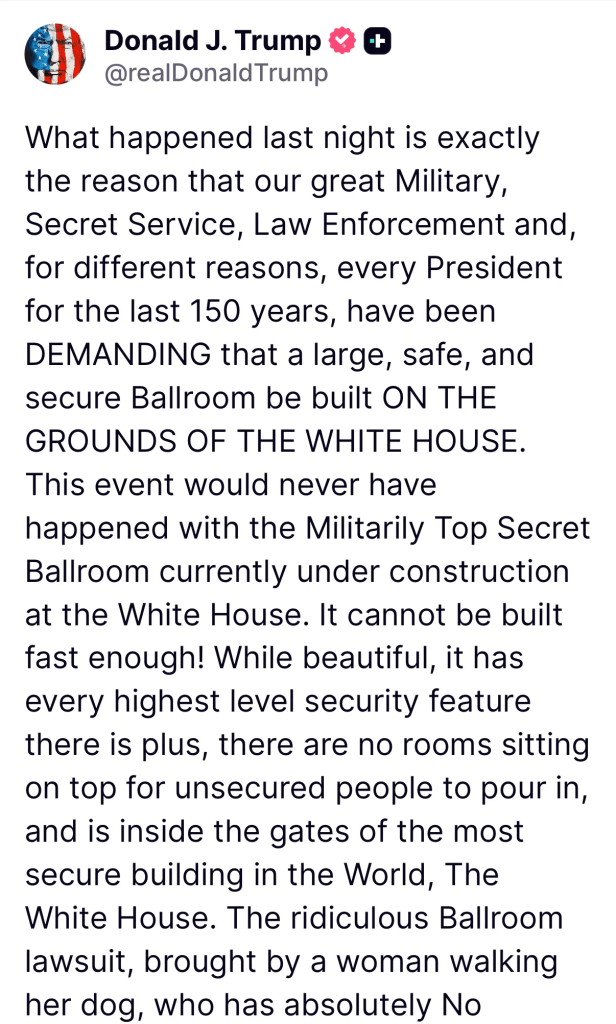
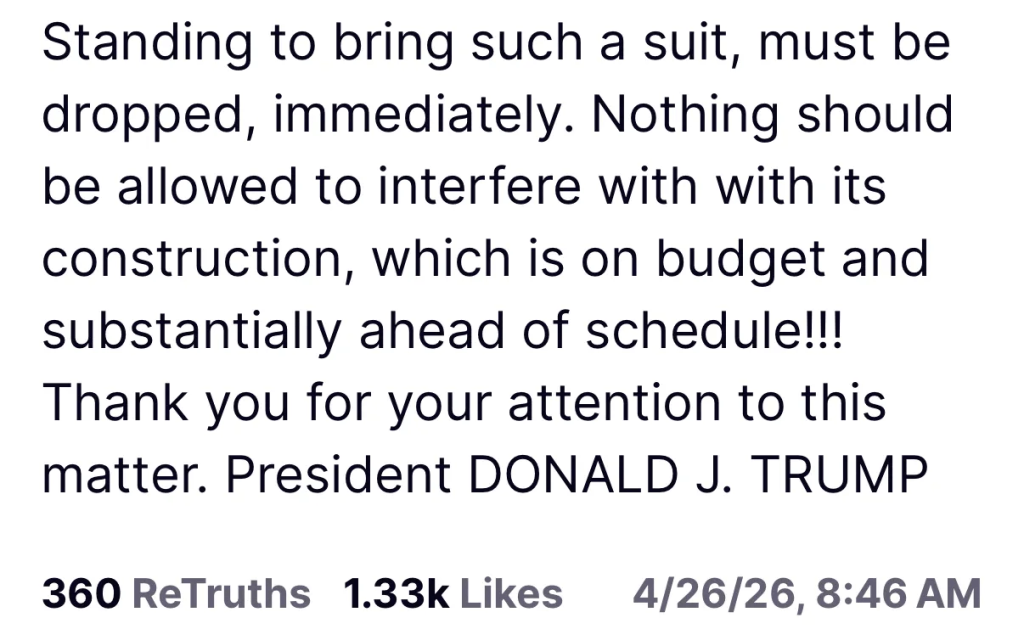
But he did not abandon politics. As he began his comments, Trump said the incident demonstrated why the ballroom he is building at the White House is needed.
Trump reiterated his comments in a Sunday morning post on Truth Social, claiming presidents have been demanding a ballroom like the one he’s building for 150 years.
His amen corner all took up the chant on Twitter, on cue.
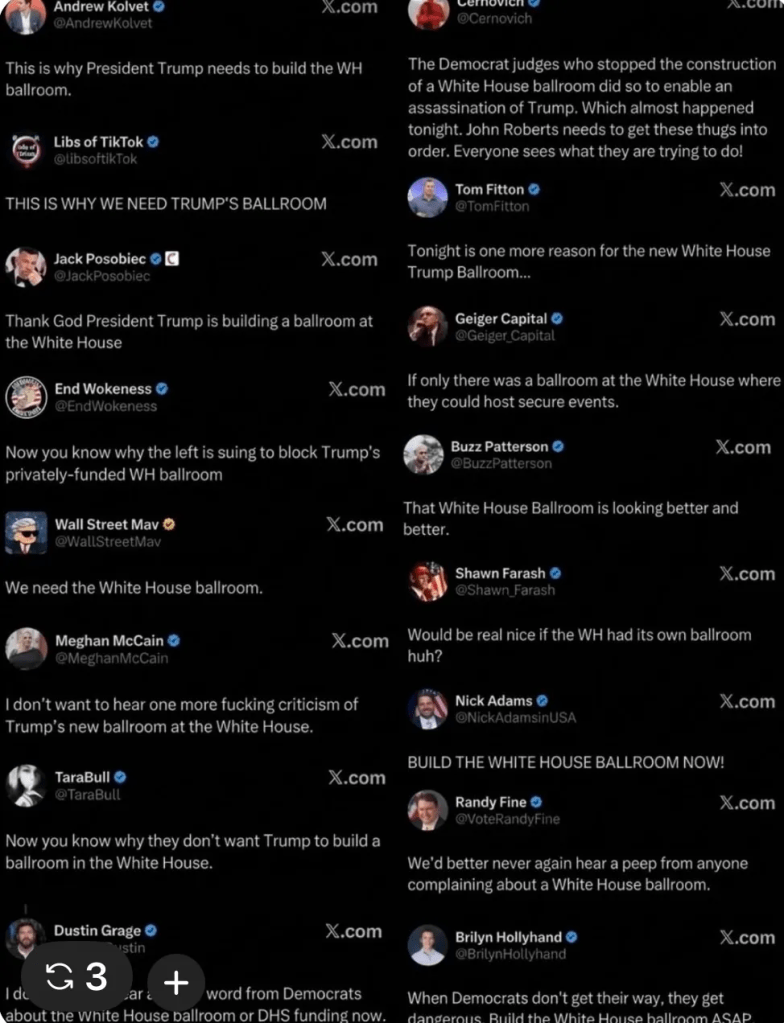
But, as we noted above, the dinner is run by the Correspondents’ Association, not the White House. There is no reason to believe they would use a White House ballroom for a dinner designed to celebrate freedom of the press and its independence from government. Trump can make the argument he needs a safe space to entertain, but it’s a disconnect from the event last night.
Miles Taylor commented on Threads that “The WHCD shooter will be used to justify things that have nothing to do with the WHCD shooter. Mark this moment.” That seems likely.
The immediate investigation will focus on whether the shooter was a lone wolf, as it appears, or whether there is an ongoing threat. There is reporting today that Allen was a member of a group called The Wide Awakes, who appear, based on their web presence, to be committed to “radically” reimagining the future, but look to be a group of creative, peaceful people. Law enforcement will want to determine whether someone or something radicalized Allen and directed him toward violence.
There are sure to be, and there should be, questions about the Secret Service and how this happened. Asked about that during the press conference, Trump responded that he was “very impressed by the Secret Service.” But this is the third time a would-be assassin has gotten close to Trump, and one would have expected them to tighten ranks after the first attempt. Trump, however, does not seem to have viewed any of it as a failure by the Service and he was complimentary of the D.C. police, as well, in a phoner on Fox News.
It’s important to note that the Secret Service stopped Allen at the perimeter they had established. They succeeded in that sense. The real question will be whether the perimeter should have been set further back. I’ve attended the dinner multiple times and one observes layers of security that require guests to walk up the hill to the circular drive in front of the Washington Hilton before entering the hotel, but there are parties and receptions occurring in advance of the perimeter before entering the ballroom area, and, as we now know, Allen avoided scrutiny as a guest who checked into the hotel the day before the dinner. There are real questions that will have to be confronted here to ensure protection for future dinners, to say nothing of the scads of parties that happen in connection with this dinner, and other national events that are held at the Hilton.
Late Saturday evening, D.C. U.S. Attorney Jeanine Pirro announced that Allen would be arraigned on Monday. She said he will be charged with one count of assault on a federal officer using a dangerous weapon and two counts of using a firearm during a crime of violence. That could be fluid as officials learn new information. But the charges she identifies are found at 18 USC 111, which carries a 20-year maximum penalty, and 18 USC 924(c), which carries a 7-year penalty if a firearm is brandished and a 10-year penalty if it’s fired.
The motive seemed to be coming into focus throughout the day as some of Allen’s anti-administration writings were released. On Meet the Press, acting Attorney General Todd Blanche said authorities believed the suspect may have been targeting Trump administration officials, including Trump himself. The basis for that belief appears to have been examination of electronic devices and some writings. But Blanche told CNN’s Dana Bash they were still looking at the motive.
As I heard seasoned journalists, many of them friends, discuss how frightening the shooting was on air Saturday night and Sunday morning, I couldn’t help but reflect on how much worse it is for America’s children. How many of them still suffer a lingering sense of trauma from the moment a shooter crashed into their classroom or their place of worship? If there’s ever been a time to pass sensible gun control laws, it’s now. If we’re going to play politics, as Trump did with immediately pivoting to justifying his ballroom, let’s play that kind and make some good trouble.
There will be in court developments in other matters to track, as well, this week:
This Wednesday will be the last regularly scheduled day for the Supreme Court to hear oral argument this term. The Court will take up two consolidated cases, Mullin v. Doe and Trump v. Miot, and consider whether the Trump administration acted properly when it revoked protected status for Syrians and Haitians living in this country. The cases involve decisions from New York and Washington, D.C., barring the administration from stripping more than 350,000 Haitians and 6,000 Syrians of protected legal status that protects them from deportation.
The cases hit the court just last month, on March 16. The Court allowed the lower courts’ decisions to remain in place, preventing deportations, determining that it would hear the case promptly, allotting an hour for oral argument. This has all happened very quickly, with the final brief being filed just last week on Monday.
There is also news on the voting front. Friday evening, Mississippi Governor Tate Reeves announced that he was calling a special session of the legislature so that new maps could be drawn.
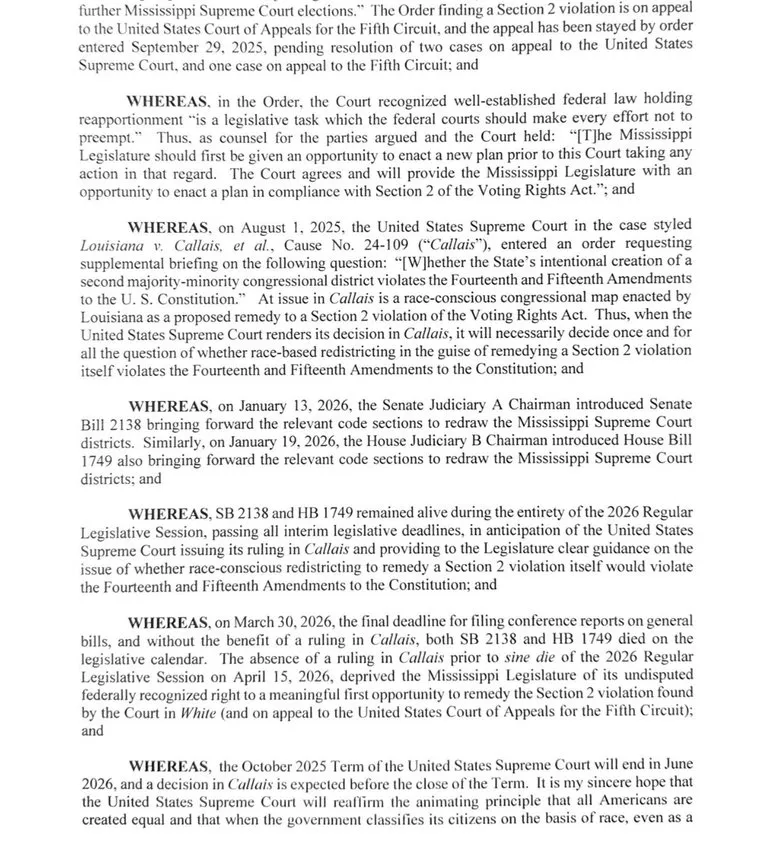
This redraw would be limited to state Supreme Court districts. A federal court found Mississippi’s state Supreme Court districts violated Section 2 of the Voting Rights Act and required the legislature to pass a remedial map. But it failed to do so during the regular session. A court hearing was scheduled for this week, and the court would have likely adopted its own map. So the Governor is calling this special session in hopes the court will hold off until the legislature has time to act.
In the election last November, voters ended the Republican supermajority in the legislature, but Republicans still hold a majority of the seats in both chambers and should be able to pass a map of their own devising. So the governor likely believes a map that comes out of the legislature will be superior to one created by the court.
And finally, the SAVE Act isn’t quite dead yet. We need to stay alert to any resurgence and be prepared to call our members of Congress to demand they resist its resuscitation. Trump is again demanding that his party end the filibuster and pass the Act, saying that not doing so will “lead to the worst results for a political party in the HISTORY of the United States Senate.” It reads as an acknowledgment that only voter suppression can save the Republican Party in the midterm elections.
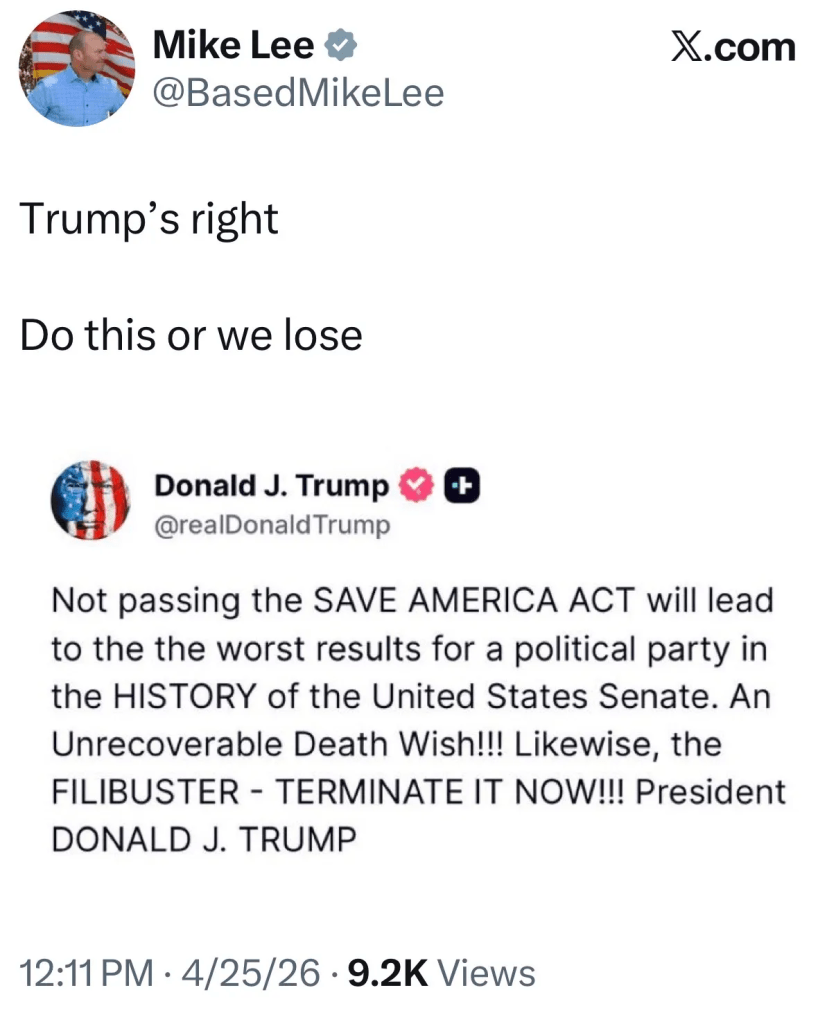
Utah Senator Mike Lee followed up on Trump’s command with this tweet. Lee is not up for reelection until 2028. But he, too, seems to sense that this will be a dangerous election for Republicans. The SAVE Act is one of the last-ditch efforts Republicans have to suppress the vote and hold onto power this year and again in 2028. There is no mention of crafting policies designed to win the hearts and minds of American voters. It’s just about keeping eligible American citizens from voting. We must do everything we can to resist that.
If you’ve found this useful, it’s exactly the work I do every week—reading the filings, tracking the arguments, and explaining what it means before it becomes obvious. The headlines will keep coming, but understanding them takes more than a glance. That’s what this space is for. My goal is to give you clear, careful analysis you can rely on. If that’s the kind of work you value, I hope you’ll choose to subscribe.
We’re in this together,
Joyce

 Scottie's Playtime
Without digging into the politics and such of this, it would appear that sooner or later Trump is going to ‘take one for the team”. It’s obviously obvious that he has enraged and appalled a LOT of nutters and just as many sane people and eventually he will either be fit with a bullet proof vest or a strait (straight?) jacket. Or both.
LikeLike